WengYang Industrial Zone Yueqing Wenzhou 325000
Horas de trabalho
De segunda a sexta-feira: das 7h às 19h
Fim de semana: 10:00 - 17:00
WengYang Industrial Zone Yueqing Wenzhou 325000
Horas de trabalho
De segunda a sexta-feira: das 7h às 19h
Fim de semana: 10:00 - 17:00

Compare 1P+N e 2P RCBOs: comutação do neutro, polos protegidos, classificações e uma lista de verificação prática para compradores. Saiba por que a folha de dados exata é importante.
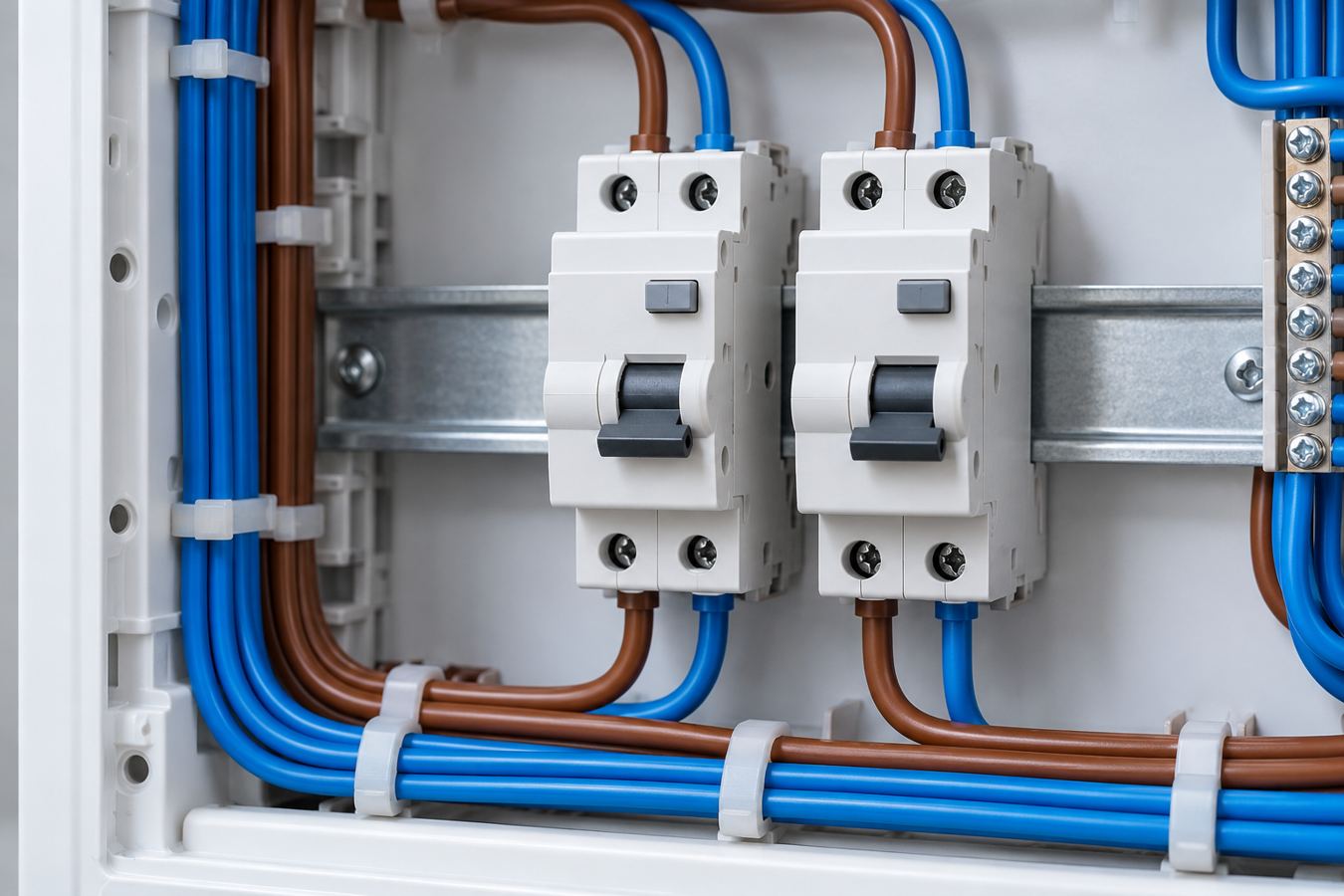
1P+N vs 2P RCBO: ambos os rótulos aparecem em disjuntores de corrente residual com proteção contra sobrecorrente, mas eles não dizem, por si só, se o neutro é comutado ou se ambos os polos têm proteção contra sobrecorrente. O diagrama de circuito exato e a folha de dados decidem esses detalhes. Este guia explica o que verificar antes de especificar um RCBO para um quadro de distribuição monofásico.
Um RCBO 1P+N tem um polo de fase e um caminho de neutro. Seu condutor de fase recebe proteção contra sobrecorrente; o neutro pode ser comutado ou não comutado, dependendo do modelo. A ABB, por exemplo, lista variantes com neutro comutado e sem neutro comutado dentro de sua família 1P+N DSE201. Um RCBO 2P tem dois polos, mas suas funções de proteção e comutação ainda precisam ser confirmadas pelo esquema do fabricante específico. A Schneider Electric lista uma variante 2P iC60H2 com dois polos protegidos. Esses exemplos de produtos demonstram por que um rótulo de contagem de polos sozinho é insuficiente para aquisição.
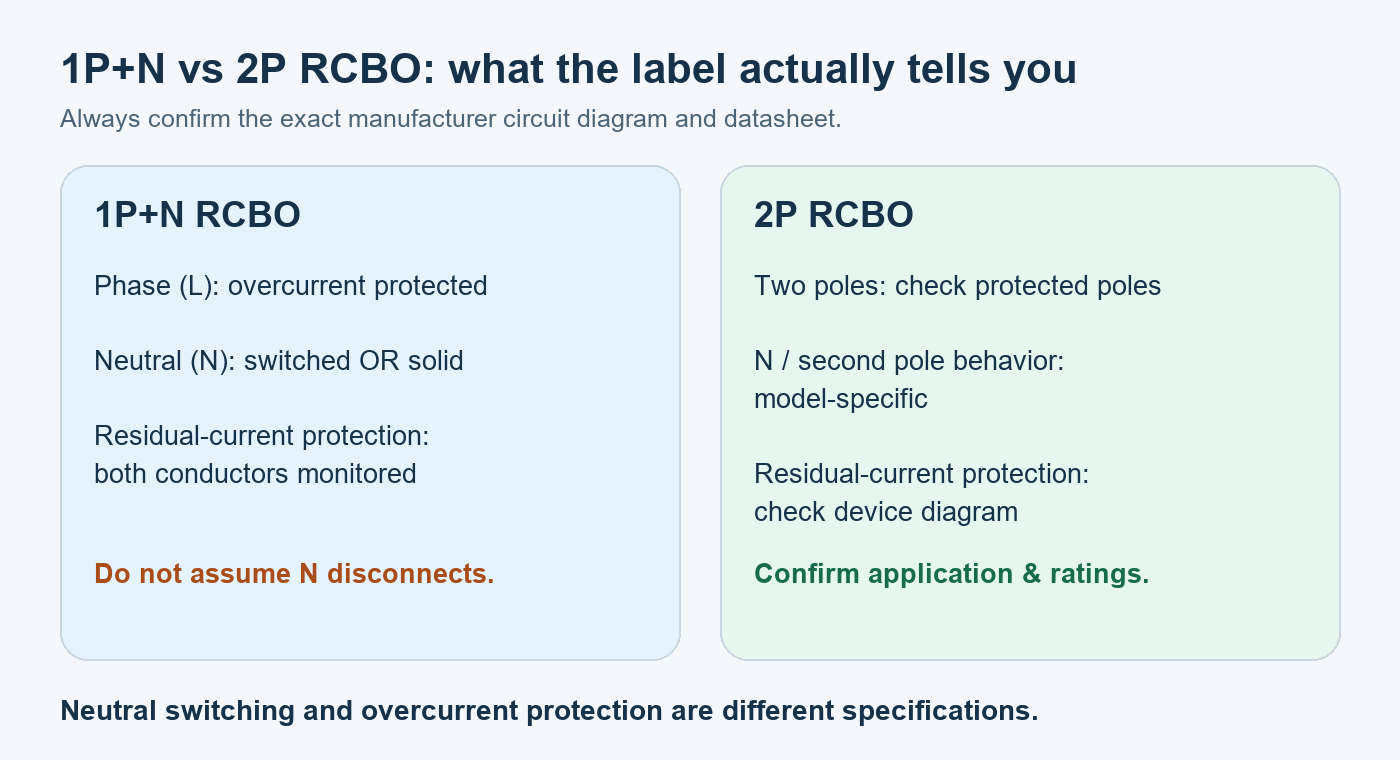
“Neutral switched” means that the device opens the neutral path as part of its switching action. It does não mean the neutral has its own overcurrent trip element. This distinction affects isolation requirements, panel schedules, test procedures and the suitability of a device for a particular earthing arrangement. Some 1P+N units switch the neutral; others leave it solid. Therefore, never infer isolation performance from “1P+N” printed on a sales page.
The RCBO’s residual-current function compares current in the conductors passing through its sensing arrangement. A mismatch can cause a trip. Overcurrent protection is a separate function, with its own rated current and breaking-capacity specifications. For the wider context, see our RCBO wiring diagram guide.
| Pergunta | 1P+N RCBO | 2P RCBO |
|---|---|---|
| How many poles/paths? | One phase pole plus neutral path | Dois polos |
| Quais polos possuem proteção contra sobrecorrente? | Polo de fase; verificar o dispositivo exato | Verificar folha de dados; alguns modelos protegem ambos os polos |
| O neutro desliga? | Pode ser comutado ou não comutado | Verificar diagrama de fiação e designação do polo |
| O rótulo sozinho pode confirmar o isolamento? | Não | Não |
| Other ratings to verify | Voltage, current, residual-current sensitivity/type, short-circuit capacity, certification and dimensions | |
Published model specifications show why the pole label is only a starting point. The VKL003/VKL003N product page lists 1P+N versions rated 5–40 A, with VKL003 at AC 240 V and VKL003N at AC 120 V. The VRL22 product page lists a 2P version rated 6–63 A at AC 240 V. Residual-current type and sensitivity options depend on the selected variant.
These family-level specifications do not establish whether neutral is switched or whether both poles have overcurrent protection. Before specifying a unit, request the exact variant’s terminal diagram, datasheet and applicable approval documents, then match them to the circuit and local requirements.
Não. As designações dos seus polos são diferentes e as funções internas de comutação e sobrecorrente variam consoante o modelo. Compare as folhas de dados em vez de tratar os rótulos como intercambiáveis.
No. ABB’s DSE201 1P+N range includes both switched-neutral and solid-neutral variants. Check the exact model code and wiring diagram.
The required residual-current sensitivity depends on circuit use, applicable code and design. Specify it with a qualified engineer or electrician; do not assume one value fits every application.
Tell us your supply voltage, rated current, required residual-current type/sensitivity, breaking capacity, certification market and whether switched neutral is required. Contact KUANGYA for a matching RCBO specification and datasheet. If you are diagnosing an existing device, see our RCBO troubleshooting guide.
Technical references: IEC 61009-1:2024; ABB DSE201 eRCBO range; Schneider Electric iC60H2 2P RCBO.

