WengYang Industrial Zone Yueqing Wenzhou 325000
Horas de trabalho
De segunda a sexta-feira: das 7h às 19h
Fim de semana: 10:00 - 17:00
WengYang Industrial Zone Yueqing Wenzhou 325000
Horas de trabalho
De segunda a sexta-feira: das 7h às 19h
Fim de semana: 10:00 - 17:00

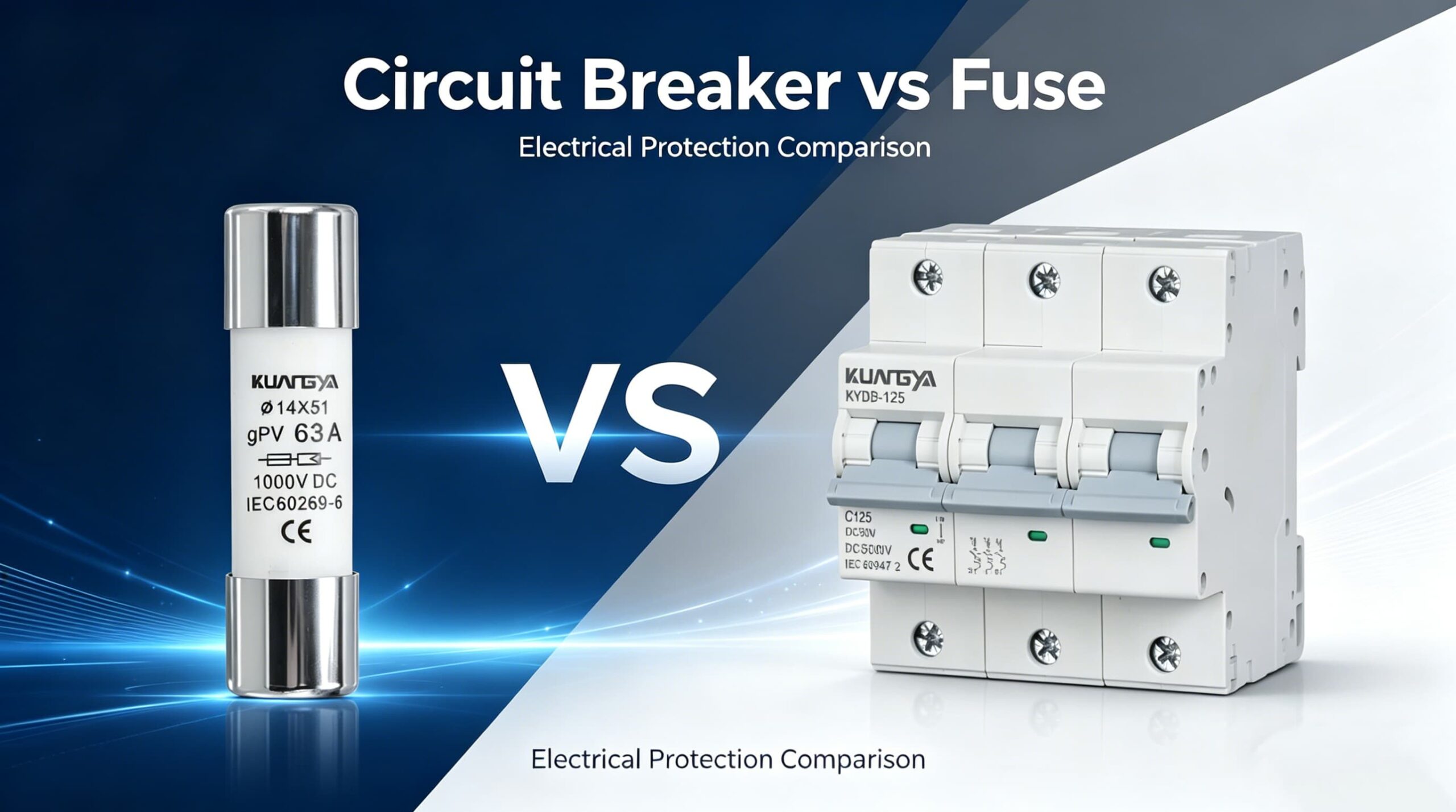
Understanding circuit breaker vs fuse is important when designing safe electrical systems.
A fuse protects electrical circuits by melting under excessive current, while a circuit breaker trips mechanically and can be reset. Fuses are faster and cheaper, while circuit breakers are reusable and more convenient for modern electrical systems.
When designing an electrical system, choosing the right protection device is critical for safety and reliability.
Two of the most common options are circuit breakers and fuses.
But what are the real differences between them, and which one is better for your application?
In this guide, we compare circuit breakers vs fuses in terms of:
to help you select the right protection solution.
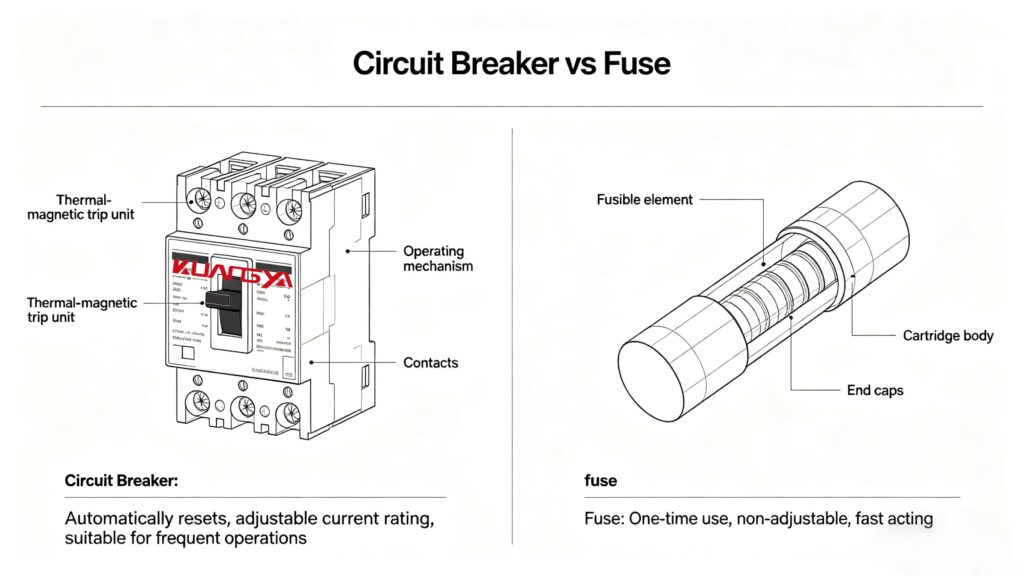
A fuse is a sacrificial overcurrent protection device designed to protect electrical circuits from excessive current.
It contains a metal element or wire that melts when the current exceeds a specific limit. Once the fuse element melts, the circuit opens and stops current flow.
PV fuses are widely used in solar power systems to provide fast and reliable overcurrent protection.
Learn more about our DC fuse solutions at Site oficial do Kuangya
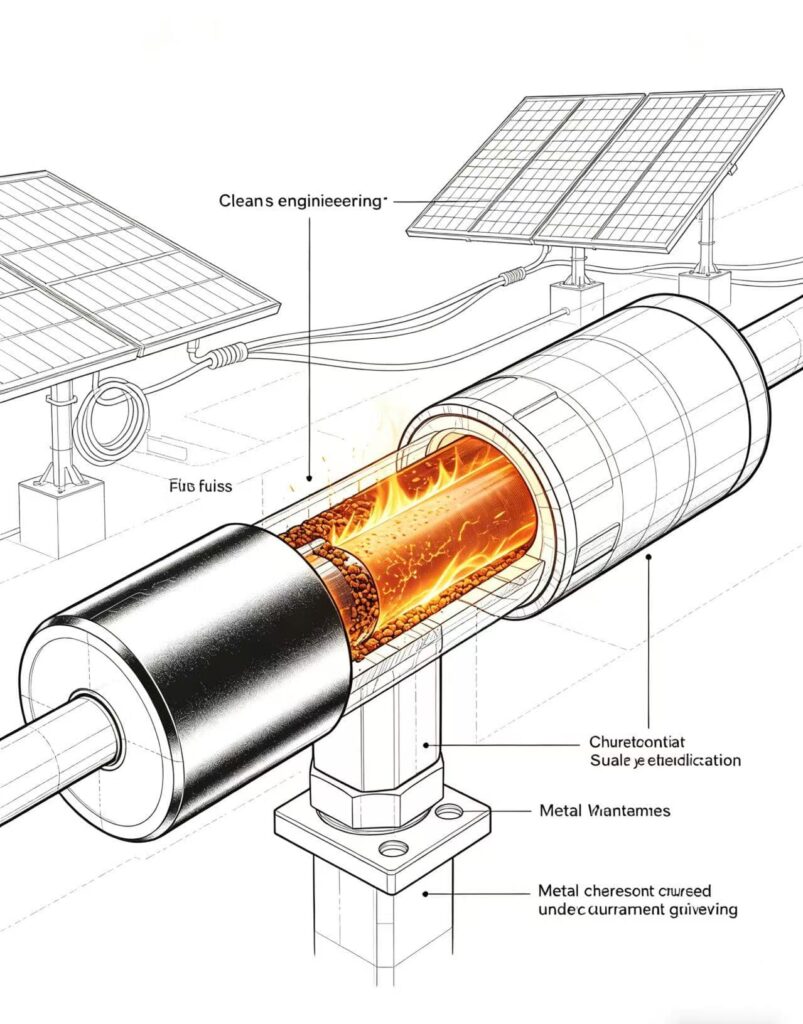
When abnormal current flows through the circuit:
The fuse must then be replaced manually before the system can operate again.
Fuses are widely used in:
A circuit breaker is an automatic electrical switch that protects circuits from overloads and short circuits.
Unlike a fuse, a circuit breaker does not need replacement after operation. It can simply be reset and reused.
DC circuit breakers are essential for solar and battery energy storage systems.
Explore our circuit breaker products at Site oficial do Kuangya
Many modern circuit breakers are designed according to IEC 60947-2 standards for low-voltage switchgear and controlgear.
For more information, visit the official IEC Website.
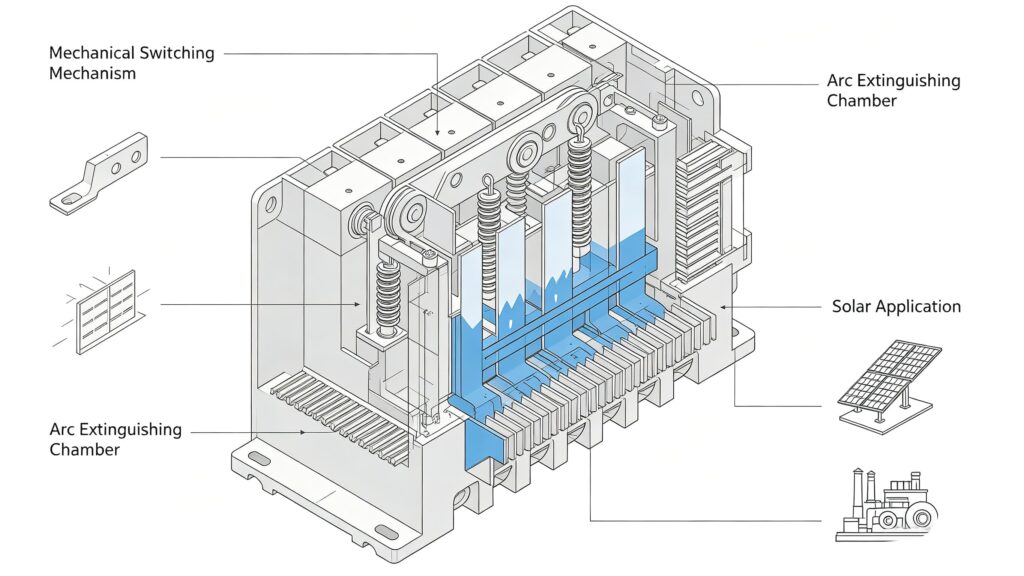
A circuit breaker detects abnormal current using thermal or magnetic mechanisms.
When overcurrent occurs:
Circuit breakers are commonly used in:
| Recurso | Fusível | Disjuntor |
|---|---|---|
| Princípio de funcionamento | Melts under overcurrent | Trips mechanically |
| Reutilização | De uso único | Reutilizável |
| Capacidade de reinicialização | Não | Sim |
| Replacement Needed | Sim | Não |
| Velocidade de resposta | Muito rápida | Rápido |
| Manutenção | Requires replacement | Baixa manutenção |
| Custo inicial | Inferior | Mais alto |
| Long-Term Cost | Higher due to replacement | Lower over time |
| Recursos de segurança | Basic protection | Proteção avançada |
| Operação Remota | Not available | Available in some models |
| Arc Control | Limitada | Melhor supressão de arco |
| Suitable for Automation | Não | Sim |
Fuses react extremely quickly to short circuits and severe overcurrent conditions.
Fuses are generally cheaper than circuit breakers.
No moving mechanical parts.
Can handle very high fault currents.
Simple and stable design.
Must be replaced after blowing.
Replacement takes time.
No monitoring or remote control.
Wrong rating can cause safety issues.
Can be reset after tripping.
Includes multiple protection functions.
No replacement needed.
Supports IoT and smart systems.
ON / OFF / TRIP display.
More expensive upfront.
Internal parts may age.
Compared to semiconductor fuses.
Periodic testing needed.
In photovoltaic systems, both devices are widely used.
Proper surge protection is also important in photovoltaic systems.
Read more about solar SPD protection devices at Site oficial do Kuangya
PV systems require reliable overcurrent protection devices designed for high-voltage DC applications.
Electrical systems are often designed according to standards such as NFPA 70 National Electrical Code.
In solar PV systems, the choice between circuit breaker vs fuse affects both safety and reliability.
DC systems are more difficult because arc extinction is harder.
Many PV systems use both together for best protection.
Sim.
Configuração típica:
Many solar combiner boxes integrate both.
Discover our PV combiner box solutions at Site oficial do Kuangya
Not always. It depends on the application.
In some cases, yes.
Circuit breakers last longer because they are reusable.
Yes, widely used in industrial and solar systems.
In solar PV systems, the choice between circuit breaker vs fuse affects both safety and reliability.
Choosing between a circuit breaker and a fuse is not simply about price.
It is about:
In modern photovoltaic systems, both technologies are often combined for maximum protection.
At Kuangya, we provide reliable DC & AC protection solutions for solar and industrial applications.
✅ Free product consultation
✅ OEM & ODM service
✅ Fast quotation support
✅ 5-Year Warranty
✅ Global export experience
📩 Email: export@cnkuangya.com
Follow us for more solar and electrical protection insights.
🎥 TikTok: @kuangya3
▶ YouTube: @elainesun-m3t3j
📸 Instagram: @cnkuangya6
📘 Facebook: CNkuangya
Want a complete guide to:
📩 Contact us to get your FREE technical PDF guide.

