WengYang Industrial Zone Yueqing Wenzhou 325000
Horas de trabalho
De segunda a sexta-feira: das 7h às 19h
Fim de semana: 10:00 - 17:00
WengYang Industrial Zone Yueqing Wenzhou 325000
Horas de trabalho
De segunda a sexta-feira: das 7h às 19h
Fim de semana: 10:00 - 17:00

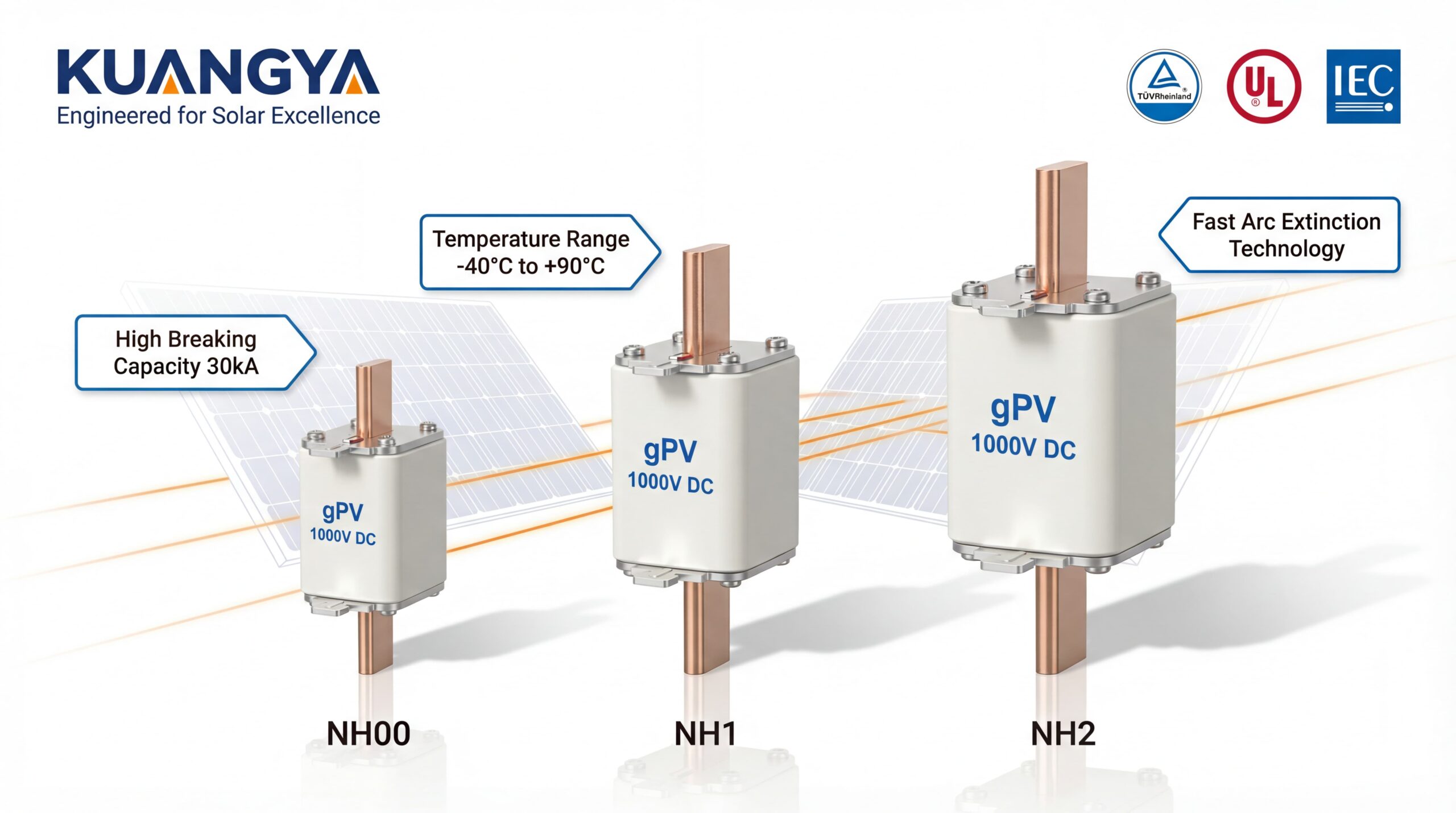
Solar photovoltaic systems demand robust overcurrent protection to ensure safety, reliability, and long-term performance. At the heart of this protection strategy lies the Fusível CC installed within solar combiner boxes—a critical component that safeguards PV strings, inverters, and electrical infrastructure from fault conditions. This comprehensive guide explores DC fuse selection, installation practices, and real-world applications for both residential and commercial solar installations, with detailed product examples from Kuangya’s DC fuse solutions.
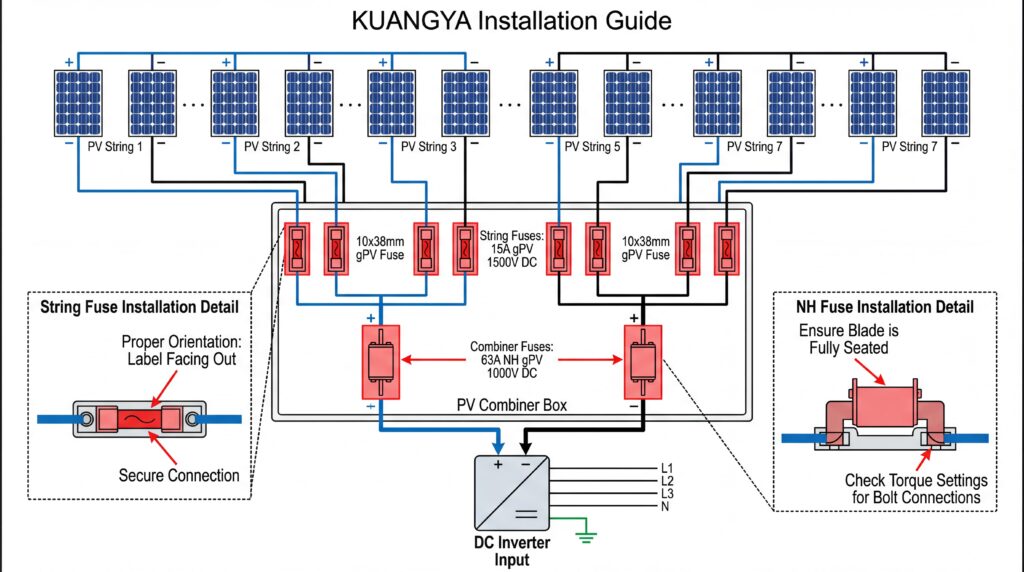
A solar combiner box serves as the central junction point where multiple PV strings converge before connecting to the inverter. Within this enclosure, gPV-rated DC fuses provide individual string protection, preventing reverse current damage and isolating faulty circuits without affecting the entire array. Unlike standard AC fuses or general-purpose DC fuses, photovoltaic fuses are specifically engineered to interrupt high-voltage DC arcs at 1000V CC ou 1500V CC, handle low fault currents typical of PV systems, and operate reliably in elevated ambient temperatures often exceeding 70°C in rooftop installations.
The designation “gPV” indicates full-range breaking capability per IEC 60269-6 e UL 248-19 standards, meaning these fuses protect against both gradual overloads and catastrophic short circuits. This distinguishes them from “aM” motor fuses that only interrupt short circuits, making gPV fuses mandatory for NEC 690.9 compliance in photovoltaic applications. When selecting DC fuses for combiner boxes, engineers must consider string short-circuit current (Isc), system open-circuit voltage (Voc), ambient temperature derating, conductor ampacity, and coordination with downstream protection devices.
Proper fuse selection begins with accurate system characterization. The Artigo 690 do National Electrical Code (NEC) requires fuse ratings to be calculated using a 1.56× multiplier applied to the string’s short-circuit current under standard test conditions. For example, if a PV string generates 9.5A Isc, the minimum fuse rating would be 9.5A × 1.56 = 14.82A, requiring a standard 15A fuse. However, installers must also account for temperature derating—combiner boxes mounted on rooftops can experience internal temperatures of 60-70°C, reducing effective fuse capacity by 15-20%. In this scenario, a 15A fuse at 65°C effectively becomes 12.75A, creating insufficient margin; upgrading to a 20A fuse ensures reliable protection without nuisance blowing.
Voltage rating selection demands equal attention. The fuse’s DC voltage rating must exceed the array’s maximum open-circuit voltage by at least 25% to account for cold-temperature voltage rise. On clear winter mornings, Voc can increase 15-20% above nameplate ratings. A residential system with 450V nominal Voc might reach 540V under cold conditions, necessitating 1000V DC-rated gPV fuses rather than 600V units. For utility-scale installations with series strings exceeding 1000V, 1500V DC gPV fuses become essential for both safety and future expansion capability.
Physical fuse dimensions directly correlate with current-handling capacity and thermal performance. The most common cylindrical formats include:
Kuangya's cylindrical gPV fuse series offers comprehensive coverage across these formats, with breaking capacities up to 33kA DC and voltage ratings spanning 1000V to 1500V DC, ensuring compatibility with residential rooftop systems through utility-scale solar farms.
| Fuse Series | Format | Classificação da tensão | Faixa atual | Capacidade de ruptura | Aplicação típica | Conformidade padrão |
|---|---|---|---|---|---|---|
| Cylindrical gPV 10×38 | 10×38mm | 1000V DC / 1500V DC | 1A - 30A | 33kA DC | Residential string protection, small commercial arrays | IEC 60269-6, UL 248-19 |
| Cylindrical gPV 14×51 | 14×51mm | 1000V DC / 1500V DC | 32A – 63A | 33kA DC | Mid-size commercial strings, multiple-panel configurations | IEC 60269-6, UL 248-19 |
| Cylindrical gPV 10×85 | 10×85mm | 1000V DC / 1500V DC | 2A – 50A | 50kA DC | High-voltage commercial systems, enhanced thermal performance | IEC 60269-6 |
| Square-Body H0-H3 | NH00-NH3 | 1000V DC / 1500V DC | 63A – 400A | 50kA DC | Central inverter DC inputs, combiner output feeders | IEC 60269-6 |
| Square-Body H1-XL to H3-XL | NH1XL-NH3XL | 1500V CC | 400A – 630A | 50kA DC | Utility-scale arrays, ESS battery racks, DC busbars | IEC 60269-6 |
This selection matrix enables system designers to match fuse specifications with installation requirements efficiently. All Kuangya products include certified fuse holders with proper creepage/clearance distances, low contact resistance, and specified torque requirements to ensure safe operation and warranty compliance.
Consider a typical residential installation featuring a 6kW rooftop array with three PV strings, each comprising ten 300W panels connected in series. System specifications include:
Applying NEC 690.9 requirements: 9.8A Isc × 1.56 = 15.29A minimum rating. Accounting for 65°C ambient temperature with 15% derating: 15.29A ÷ 0.85 = 17.99A effective requirement. Selected fuse: Kuangya 20A, 1000V DC, 10×38mm gPV fuse with DIN-rail holder.
The installer chose Kuangya’s cylindrical 10×38mm format because it provides adequate current capacity with proper safety margin, fits standard residential combiner boxes with DIN-rail mounting, offers 1000V DC rating exceeding the 480V cold-weather Voc by 108%, and maintains 33kA breaking capacity sufficient for residential fault levels. Each of the three strings receives individual 20A gPV fuse protection mounted on a DIN-rail assembly within the combiner box.
The combiner box features three input positions with MC4 connectors receiving positive conductors from each string, three Kuangya 10×38mm fuse holders mounted on 35mm DIN rail, with each string’s positive conductor routed through its dedicated fuse, a common negative busbar collecting all string negative conductors, integrated DC surge protection device (SPD) with proper grounding, and a single output pair (positive/negative) feeding the inverter DC input. The fuse holders are torqued to manufacturer specifications (typically 1.2-1.5 Nm for 10×38mm holders), with proper wire gauge (10 AWG copper) matching the 20A fuse rating and conductor ampacity.
During a ground fault event on String 2 caused by damaged cable insulation, the 20A gPV fuse on the affected string interrupted the fault current within milliseconds, isolating String 2 while Strings 1 and 3 continued normal operation. The homeowner experienced only 33% power reduction rather than complete system shutdown, and the installer quickly identified and repaired the damaged cable section, replacing the blown fuse with an identical Kuangya 20A unit. This incident demonstrates the value of individual string protection—without fuses, the fault could have damaged the inverter or triggered complete system shutdown.
Commercial installations demand more sophisticated protection strategies due to higher power levels, multiple inverter configurations, and complex fault scenarios. This case study examines a 100kW ground-mount commercial array serving a manufacturing facility.
This installation implements a two-tier fusing approach: proteção no nível da corda using individual fuses for each of the 20 strings, and feeder-level protection using higher-current fuses on the combiner output feeding each inverter.
Calculation: 10.2A Isc × 1.56 = 15.91A minimum. Temperature derating for 60°C combiner environment: 15.91A ÷ 0.88 = 18.08A effective requirement. Selected fuse: Kuangya 20A, 1000V DC, 10×38mm gPV fuse (same as residential example, demonstrating the versatility of this format).
However, the electrical contractor opted for Kuangya 25A, 1000V DC, 14×51mm gPV fuses instead, providing additional thermal margin for the commercial environment, accommodating potential future panel upgrades without fuse replacement, offering improved heat dissipation in the densely-packed combiner enclosure, and maintaining compatibility with the facility’s standardized maintenance inventory.
Each combiner box consolidates 10 strings (10 × 10.2A = 102A maximum combined current) into a single output feeding the inverter. Applying the same NEC multiplier: 102A × 1.56 = 159A minimum rating. Selected fuse: Kuangya 200A, 1000V DC, Square-Body NH1 gPV fuse mounted in a certified NH base with proper busbar connections.
This square-body format provides the high current capacity required for feeder protection (200A rating with margin), 50kA DC breaking capacity suitable for the higher fault levels in commercial arrays, robust mechanical construction for the demanding commercial environment, and easy visual inspection and replacement without disturbing string-level wiring.
Each combiner box contains ten DIN-rail mounted fuse holders (14×51mm format) for individual string protection, clearly labeled string identification (String 1-10) with corresponding panel array locations, a main output busbar protected by the 200A NH1 square-body fuse, integrated DC SPD with remote monitoring capability, and a lockable dead-front cover meeting OSHA electrical safety requirements.
The installation team documented several best practices: torque verification using calibrated tools per manufacturer datasheets, thermal imaging inspection three months post-commissioning to identify hot spots, quarterly visual inspection of fuse condition and holder integrity, and maintaining spare fuse inventory on-site (both 25A string fuses and 200A feeder fuses).
Six months after commissioning, a module-level failure in String 7 created a reverse current condition. The monitoring system detected voltage anomaly on String 7, and the 25A gPV fuse interrupted the reverse current before cable damage occurred. The facility experienced only 5% power reduction (1 of 20 strings offline), and maintenance staff replaced the faulty module and fuse during a scheduled maintenance window. The 200A feeder fuse remained intact, confirming proper coordination between string and feeder protection levels.
This incident validated the two-tier protection strategy—the string-level fuse isolated the specific fault without affecting other strings or the feeder circuit, while the feeder-level fuse provided backup protection against combiner box internal faults. The selective coordination prevented unnecessary downtime and simplified troubleshooting.
Regardless of system size, proper DC fuse installation follows critical safety protocols. Before any work, installers must isolate and lock-out all DC sources, verify zero voltage using a calibrated multimeter rated for DC service, and confirm that all capacitors have discharged. Fuse holder selection requires certified holders matching the fuse format (10×38mm, 14×51mm, NH, etc.), proper voltage and current ratings exceeding fuse specifications, and adequate creepage and clearance distances per IEC or UL standards.
Wire termination demands attention to detail: strip wire to the exact length specified in the holder datasheet (typically 10-12mm for cylindrical holders), use ferrules or properly crimped terminals to prevent strand fraying, torque connections to specified values (typically 1.2-1.5 Nm for small holders, 8-12 Nm for NH bases), and verify secure mechanical connection before energizing. Environmental protection considerations include NEMA-rated enclosures appropriate for the installation location (NEMA 3R minimum for outdoor combiner boxes), proper cable gland seals preventing moisture ingress, adequate ventilation to prevent excessive internal temperature rise, and UV-resistant materials for rooftop installations.
Documentation and labeling prove essential for long-term system maintenance. Every installation should include clear string identification labels on each fuse holder, a one-line diagram showing fuse locations and ratings posted inside the combiner box cover, commissioning date and installer information, and as-built drawings reflecting any field modifications. Maintenance procedures should establish quarterly visual inspection schedules, annual thermal imaging surveys to detect developing hot spots, immediate fuse replacement after any interruption event with root cause analysis, and maintaining adequate spare fuse inventory matching all installed ratings.
DC fuses function as part of a comprehensive protection ecosystem. Proper coordination with DC circuit breakers involves using gPV fuses for primary overcurrent protection with low let-through energy (I²t), installing DC-rated circuit breakers downstream for manual isolation and switching functions, and ensuring breaker trip curves don’t overlap with fuse characteristics to prevent nuisance tripping. Surge protection device (SPD) integration requires installing DC SPDs with proper upstream overcurrent protection (the fuse), following manufacturer grounding and bonding requirements, and coordinating SPD voltage protection level (VPL) with system Voc.
String monitoring systems benefit from fuse protection by enabling remote current monitoring to detect fuse operation, implementing voltage differential alarms indicating blown fuses, and integrating fault notifications with maintenance management systems. This combination of passive protection (fuses) and active monitoring creates robust, maintainable solar installations.
Field experience reveals recurring installation errors that compromise safety and performance. Using AC-rated or general DC fuses instead of gPV-certified units creates catastrophic failure risk—AC fuses cannot reliably interrupt DC arcs, potentially causing fuse explosion or sustained fault current. Always verify fuses carry the “gPV” designation and appropriate DC voltage rating (1000V DC or 1500V DC) per IEC 60269-6 or UL 248-19.
Oversizing fuse ratings for “extra safety margin” actually reduces protection effectiveness. A 40A fuse on a 10A string provides no meaningful overcurrent protection, allowing conductor damage before interruption. Follow NEC 690.9 calculations precisely, applying the 1.56× multiplier and temperature derating factors. Neglecting temperature derating for rooftop installations leads to nuisance fuse operation during peak summer conditions. Always apply manufacturer derating curves based on actual ambient temperature measurements or conservative estimates (65-70°C for rooftop combiner boxes).
Improper torque application causes contact resistance, localized heating, and premature failure. Under-torqued connections create high-resistance joints that overheat; over-torqued connections damage holder threads and deform terminals. Use calibrated torque drivers and follow manufacturer specifications exactly. Mixing fuse brands and ratings within a single combiner box complicates maintenance and increases error risk during replacement. Standardize on a single manufacturer (such as Kuangya) and minimize the number of different ratings used, maintaining clear documentation of which rating protects which string.
When designing combiner box protection, consider future expansion scenarios. Installing 1500V DC-rated fuses in a current 1000V system adds minimal cost but enables future voltage upgrades without complete fuse replacement. Selecting combiner boxes with spare fuse positions accommodates array expansion—a 6-position box for a current 4-string array provides room for two additional strings. Documenting fuse specifications and maintaining manufacturer relationships ensures long-term parts availability, critical for systems with 25-30 year operational lifespans.
Q: Can I replace a blown DC fuse with a higher current rating to prevent repeated failures?
A: No, this practice is extremely dangerous and violates electrical codes. Fuses are sized to protect the downstream conductors and equipment from overcurrent damage. If a fuse blows repeatedly, it indicates an underlying fault condition—such as a damaged cable, failing module, or ground fault—that requires investigation and repair. Installing a higher-rated fuse allows excessive current to flow, potentially causing conductor overheating, insulation damage, or fire. Always replace fuses with identical ratings and investigate the root cause of repeated failures. The proper response involves isolating the affected circuit, measuring string voltage and current under various conditions, inspecting cables and connectors for damage, testing individual modules for defects, and verifying proper system grounding. Only after identifying and correcting the fault should the original fuse rating be reinstalled.
Q: What is the difference between 1000V DC and 1500V DC fuse ratings, and how do I choose between them?
A: The voltage rating indicates the maximum DC voltage at which the fuse can safely interrupt fault current and withstand continuous operation. The choice depends on your system’s maximum open-circuit voltage (Voc), which varies with temperature and string configuration. For residential and small commercial systems with string voltages typically below 600V DC (accounting for cold-weather voltage rise), 1000V DC-rated gPV fuses provide adequate safety margin and are widely available at competitive prices. Utility-scale installations and energy storage systems increasingly use 1500V DC architectures to reduce conductor losses and improve efficiency—these applications require 1500V DC-rated fuses. As a general rule, select a fuse voltage rating at least 25% higher than your system’s maximum Voc under coldest expected conditions. For example, a system with 800V maximum Voc requires 1000V DC fuses (800V × 1.25 = 1000V), while a system with 1200V maximum Voc requires 1500V DC fuses. If you anticipate future system expansion that might increase string voltage, choosing 1500V DC-rated fuses initially provides flexibility without significant cost penalty. Kuangya offers both voltage classes across their cylindrical and square-body product lines, ensuring compatibility with any system architecture.
DC fuse selection and installation in solar combiner boxes represents a critical safety and performance consideration for both residential and commercial photovoltaic systems. By understanding gPV fuse characteristics, applying proper sizing calculations, following installation best practices, and implementing appropriate coordination with other protection devices, installers create robust systems that protect equipment, prevent fire hazards, and maximize uptime. The case studies presented demonstrate how proper fuse selection—from Kuangya’s 20A cylindrical units in residential applications to 200A square-body fuses in commercial installations—provides reliable, code-compliant protection tailored to specific system requirements.
Whether designing a 6kW rooftop array or a 100kW commercial installation, investing in quality photovoltaic-rated overcurrent protection from manufacturers like Kuangya ensures reliable operation throughout the system’s multi-decade lifespan. As solar technology continues advancing toward higher voltages and larger installations, the fundamental principles of proper DC fuse selection and installation remain constant—protecting people, property, and the solar investment itself.

