웽양 공업구 웨칭 원저우 325000
근무 시간
월요일~금요일: 오전 7시~오후 7시
주말: 주말: 오전 10시 - 오후 5시
웽양 공업구 웨칭 원저우 325000
근무 시간
월요일~금요일: 오전 7시~오후 7시
주말: 주말: 오전 10시 - 오후 5시

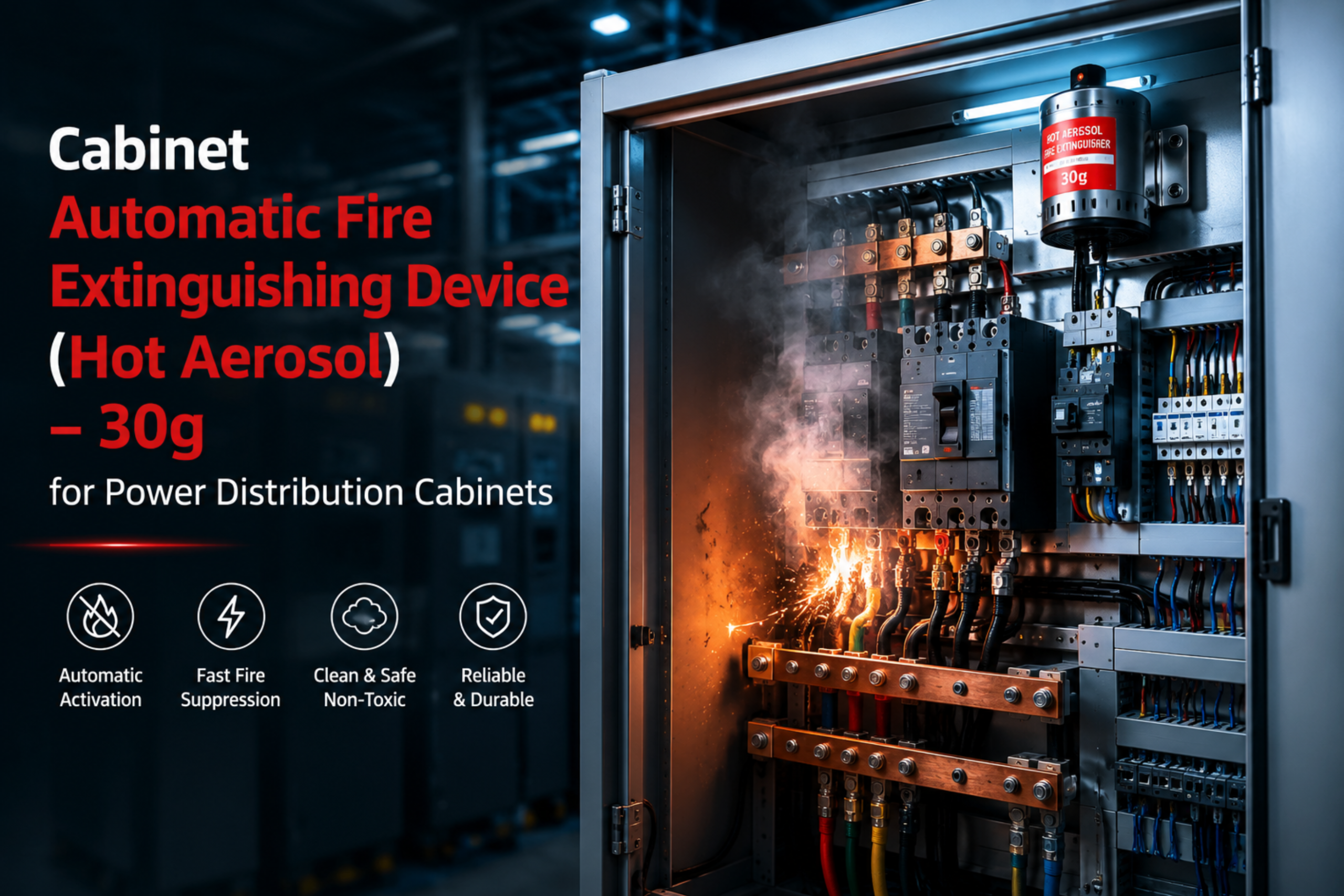
Electrical cabinet fires continue to be one of the leading causes of industrial downtime, equipment damage, and costly production interruptions worldwide. As factories become increasingly automated and electrical loads continue to rise, power distribution cabinets, control panels, switchgear, PLC cabinets, and solar combiner boxes operate under higher thermal stress than ever before.
While many facilities invest heavily in electrical equipment, fire protection inside the cabinet itself is often overlooked until a failure occurs.
A single loose terminal, overloaded cable, deteriorated insulation, or electrical arc can rapidly develop into a fire within seconds. Because cabinet doors remain closed during operation, fires often grow unnoticed until smoke escapes or alarms activate—by which point significant damage has already occurred.
This is exactly why Cabinet Automatic Fire Extinguishing Devices using Hot Aerosol technology have become one of the fastest-growing fire protection solutions for enclosed electrical equipment.
Among the available sizes, the 30g Hot Aerosol Fire Extinguishing Device has become one of the most widely used models due to its balance between protection capacity, compact dimensions, installation flexibility, and cost-effectiveness.
In this guide, we’ll explain not only how a 30g aerosol fire suppression device works, but also how engineers select the correct model, calculate cabinet volume, comply with international standards, avoid installation mistakes, and determine whether 30g is truly the right choice for their project.
A 30g Cabinet Automatic Fire Extinguishing Device is a self-activating aerosol fire suppression unit designed to detect excessive temperatures inside electrical cabinets and automatically release condensed aerosol particles that interrupt the combustion process before a fire spreads. It is commonly installed inside power distribution cabinets, PLC cabinets, switchgear, MCC panels, communication cabinets, and solar PV combiner boxes.
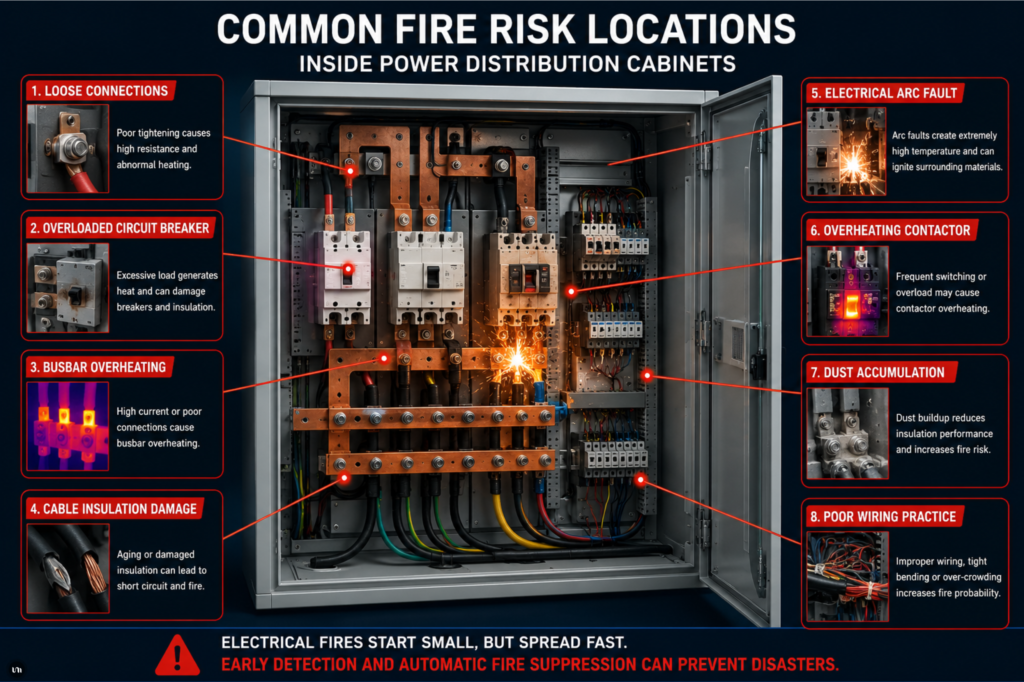
Many people assume electrical cabinet fires begin with catastrophic equipment failures. In reality, most fires start from relatively small electrical abnormalities that gradually generate excessive heat over time.
The confined space inside an electrical enclosure accelerates temperature accumulation, allowing ignition to occur much faster than in open environments.
The most common ignition sources include:
As industrial equipment ages, these risks increase significantly.
| Fire Cause | 설명 | 위험 수준 |
|---|---|---|
| 느슨한 터미널 연결 | Increased resistance generates heat | 매우 높음 |
| Cable overload | Excessive current damages insulation | 매우 높음 |
| Arc fault | Extremely high temperature ignition source | 중요 |
| 먼지 축적 | Acts as combustible fuel | 높음 |
| 습기 유입 | Causes short circuits | 높음 |
| 단열재 노후화 | Cracking leads to electrical leakage | 높음 |
| Component failure | Internal overheating | Medium |
| 환기 불량 | 열 축적 | Medium |
| Incorrect cable sizing | 장기적인 과열 | 높음 |
| 유지 관리 부족 | Hidden defects remain undetected | 높음 |
Even a single loose terminal can exceed 300°C under heavy load, creating enough heat to ignite surrounding insulation materials.
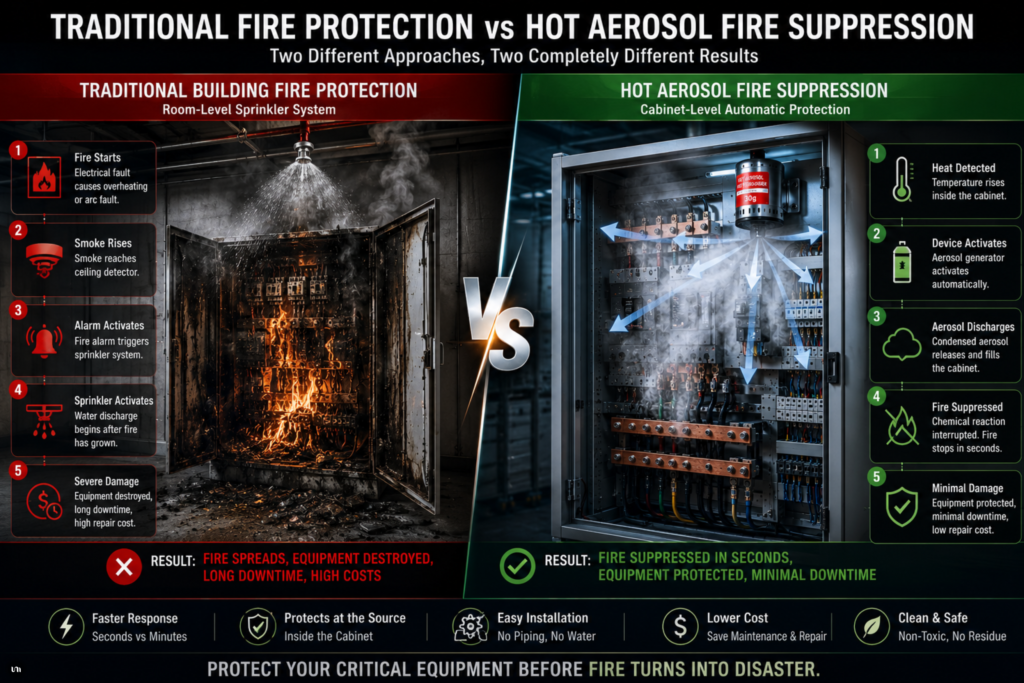
Traditional fire protection systems are designed primarily to protect rooms, buildings, or production areas—not the inside of an electrical cabinet.
This creates a dangerous time gap.
By the time smoke reaches the ceiling detector or activates the building’s fire alarm, the internal components of the cabinet may already be destroyed.
For electrical cabinets, response time is everything.
A fire that is extinguished within the first few seconds typically causes only minor repair costs. However, a fire allowed to burn for several minutes can destroy busbars, circuit breakers, relays, PLC modules, communication equipment, and adjacent cabinets.
| 비교 | Traditional Building Fire Protection | 배전반용 자동 소화 장치 |
| Detection location | Room level | 캐비닛 내부 |
| Response speed | 분 | 초 |
| Fire suppression location | Building | Fire source |
| 장비 손상 | Often severe | Usually minimal |
| 다운타임 | Days or weeks | Often reduced to hours |
| 설치 복잡성 | 높음 | 낮음 |
| Retrofitting | 어려움 | Easy |
| 유지 관리 | Periodic system inspection | 최소 |
| Suitable for enclosed cabinets | 아니요 | 예 |
| Automatic operation | 예 | Yes, directly at the source |
The biggest advantage of an automatic cabinet fire suppression device is that it attacks the fire where it starts—inside the enclosure—before flames have the opportunity to spread beyond the cabinet.
Although aerosol generators are available in capacities ranging from 10g to over 500g, the 30g model has become one of the most frequently specified options by EPC contractors, panel builders, and industrial maintenance engineers.
The reason is not simply price.
A 30g unit offers an optimal balance between:
For many low-voltage distribution cabinets, PLC control panels, and combiner boxes, a properly selected 30g device provides sufficient fire suppression without the unnecessary expense or space requirements of larger units.
However, selecting a 30g unit should never be based on cabinet dimensions alone. Engineers should also consider compartment layout, airflow restrictions, cable density, combustible material load, and potential ignition sources—topics that will be covered in the next section.
A 30g Cabinet Automatic Fire Extinguishing Device is a compact, self-contained fire suppression unit specifically engineered to protect enclosed electrical equipment from fire. Unlike portable fire extinguishers that require human intervention, this device automatically activates when the temperature inside the cabinet reaches a predetermined threshold, typically between 170°C and 180°C, depending on the thermal activation mechanism.
Once activated, the device rapidly releases a finely dispersed condensed aerosol composed primarily of microscopic potassium-based particles suspended in inert gases. These particles interrupt the chemical chain reaction of combustion, extinguishing the fire within seconds without flooding the cabinet with water or damaging sensitive electrical components.
Because the extinguishing agent is generated only when activation occurs, there is no stored pressure inside the unit during normal operation. This significantly reduces maintenance requirements and minimizes the risk of accidental leakage over its service life.
Compared with traditional gas suppression systems such as FM-200 or Novec 1230, a hot aerosol device requires no cylinders, piping, nozzles, or centralized control panel. Everything is integrated into a single compact generator that can be mounted directly inside the cabinet.
Many people assume aerosol suppression works by “blowing out” the flames. In reality, the extinguishing mechanism is far more sophisticated.
Fire requires four essential elements, commonly known as the Fire Tetrahedron:
Traditional extinguishing agents mainly remove heat or oxygen. Hot aerosol technology works differently by interrupting the chemical chain reaction, making combustion impossible even if oxygen is still present.
When abnormal heating caused by an electrical fault raises the internal cabinet temperature beyond the activation threshold, the thermal sensor or thermal cord activates the aerosol generator automatically.
Inside the generator, a specially formulated solid aerosol compound is ignited under controlled conditions.
Rather than exploding, it undergoes a controlled combustion process that generates a dense cloud of microscopic fire-suppressing particles.
The aerosol particles rapidly fill every corner of the enclosed cabinet, flowing around busbars, circuit breakers, contactors, relays, wiring ducts, and cable bundles.
Unlike water spray, aerosol easily reaches hidden areas where flames often originate.
Potassium radicals released by the aerosol react with flame radicals such as:
These radicals are essential for sustaining combustion.
Once neutralized, the flame can no longer maintain itself and is extinguished rapidly.
Even after visible flames disappear, residual aerosol particles remain suspended for a short period, helping suppress potential re-ignition while the cabinet cools.
| 스테이지 | 일어나는 일 | Typical Duration |
|---|---|---|
| 열 축적 | Electrical fault generates abnormal temperature | Minutes to hours |
| 활성화 | Thermal sensor triggers generator | <1 second |
| Aerosol generation | Solid compound converts into condensed aerosol | 3–8 seconds |
| Fire suppression | Chemical chain reaction interrupted | Within seconds |
| Cooling period | Residual aerosol prevents re-ignition | Several minutes |
Electrical cabinets present unique fire protection challenges:
Traditional suppression methods often struggle in these environments.
| 기술 | 미분무 소화 설비 | CO₂ | FM-200 | Novec 1230 | Hot Aerosol |
| Safe for energized equipment | ✗ | ✓ | ✓ | ✓ | ✓ |
| Requires piping | 예 | 예 | 예 | 예 | 아니요 |
| Requires cylinders | 예 | 예 | 예 | 예 | 아니요 |
| Cabinet retrofit friendly | 낮음 | 낮음 | Medium | Medium | 우수 |
| Independent operation | 아니요 | 아니요 | 아니요 | 아니요 | 예 |
| Installation cost | 높음 | 높음 | 높음 | 높음 | 낮음 |
| 유지 관리 | 높음 | Medium | Medium | Medium | 매우 낮음 |
| Space requirement | 대형 | 대형 | 대형 | 대형 | Very Small |
For individual electrical enclosures, hot aerosol technology often provides the most practical balance between effectiveness, installation simplicity, and lifecycle cost.
One question engineers frequently ask is:
Why not simply install the largest aerosol generator available?
The answer lies in engineering optimization.
Oversizing a fire suppression device increases project costs without necessarily improving protection. Conversely, undersizing may leave parts of the cabinet inadequately protected.
The 30g model has become popular because it matches the internal volume of many standard industrial electrical cabinets.
일반적인 예는 다음과 같습니다:
It offers an excellent balance between suppression capability, installation space, and affordability.
This is one of the most overlooked topics online, yet it is one of the first questions professional EPC engineers ask.
Selecting a fire suppression device should never rely solely on cabinet height or width.
Instead, engineers evaluate:
The basic formula is:
Cabinet Volume = Height × Width × Depth
예를 들어
Height = 1800 mm
Width = 800 mm
Depth = 600 mm
Cabinet volume:
1.8 × 0.8 × 0.6 = 0.864 m³
However, this is only the geometric volume.
Electrical components occupy a significant portion of the cabinet.
Busbars, cable ducts, breakers, contactors, drives, and transformers reduce the free air volume while also creating obstacles that influence aerosol distribution.
Experienced designers therefore assess:
Rather than relying on geometry alone, the objective is to ensure the extinguishing aerosol can disperse effectively throughout every compartment where a fire could originate.
| Design Factor | Effect on Selection |
| 배전반 체적 | Determines baseline capacity |
| Cable density | Higher density may require greater suppression margin |
| Multiple compartments | May require separate devices |
| Ventilation openings | Can reduce aerosol concentration |
| Internal fans | Affect aerosol retention |
| High-power equipment | Higher fire risk |
| 주변 온도 | Influences activation environment |
| Installation position | Affects aerosol distribution |
아니요.
This is one of the biggest misconceptions in the market.
A larger cabinet does not automatically require a larger generator, and a smaller cabinet does not always mean one 30g unit is sufficient.
Consider the following scenarios:
If a cabinet is divided into several sealed compartments, aerosol released in one compartment may not effectively reach another.
In this case, engineers often install one device per compartment rather than relying on a single larger generator.
Cabinets equipped with cooling fans or ventilation openings can lose aerosol concentration rapidly after discharge.
Additional protection measures or different device sizing may be required to maintain effective suppression.
Cabinets containing:
may present a greater combustible load than standard control cabinets. Engineers typically account for this increased risk when determining the overall suppression strategy.
Many purchasing decisions focus only on price, but improper selection can compromise fire protection performance.
가장 흔한 실수는 다음과 같습니다:
Proper selection should always balance cabinet geometry, fire load, airflow characteristics, and installation conditions rather than relying on a single parameter.
In the next section, we’ll examine installation best practices, compare hot aerosol with traditional suppression systems in greater engineering detail, explain international standards (IEC, EN, NFPA), and explore real-world applications in power distribution, solar PV, industrial automation, and data centers.
One of the biggest advantages of a 30g Hot Aerosol Fire Extinguishing Device is its simplicity. Unlike centralized gas suppression systems that require cylinders, piping, nozzles, pressure testing, and control panels, a cabinet aerosol generator can typically be installed in less than an hour with minimal modifications.
However, easy installation does not mean installation location is unimportant. Incorrect positioning can significantly reduce aerosol distribution efficiency and delay fire suppression.
Before installation, engineers should inspect the cabinet and identify the components most likely to generate excessive heat.
Typical high-risk components include:
These components are statistically responsible for most cabinet fire incidents due to high current loads, loose connections, insulation failure, or arc faults.
The generator should be installed where aerosol can disperse evenly throughout the enclosure.
General recommendations include:
Avoid mounting directly behind:
These components can create “dead zones” that reduce aerosol distribution.
| Cabinet Type | Recommended Installation Position |
|---|---|
| Power Distribution Cabinet | Upper rear corner |
| PLC Cabinet | Upper side wall |
| MCC Cabinet | Top compartment |
| 솔라 컴바이너 박스 | Upper center |
| Communication Cabinet | Upper rear |
| Control Cabinet | Near cabinet roof |
| UPS Cabinet | Above battery compartment (following manufacturer guidance) |
Every aerosol generator requires sufficient discharge space.
Never install directly against:
The discharge outlet should remain unobstructed to ensure rapid aerosol expansion.
Many industrial cabinets include:
These openings can allow aerosol to escape before it reaches an effective concentration.
Possible engineering solutions include:
Before commissioning, verify:
✓ Generator securely mounted
✓ Discharge outlet unobstructed
✓ Correct activation temperature
✓ Cabinet dimensions confirmed
✓ Components documented
✓ Maintenance label attached
Although aerosol generators are simple devices, several installation errors repeatedly appear in industrial projects.
Because hot smoke naturally rises, fires generally develop upward.
Mounting the generator near the cabinet floor often delays suppression.
Many switchgear cabinets contain separate compartments for:
Aerosol cannot always move efficiently between sealed compartments.
Each isolated compartment should be evaluated independently.
Some installers accidentally position:
directly in front of the aerosol outlet.
This significantly reduces particle distribution.
The generator should protect equipment—not become part of the heat source.
Avoid mounting directly beside:
Constant high temperatures may reduce long-term reliability or cause premature activation under abnormal conditions.
Some users attempt to install one generator between adjacent cabinets.
This approach is generally ineffective because:
Each cabinet should be evaluated individually.
| 일반적인 실수 | 잠재적 결과 | Recommended Solution |
| Installed near floor | Slower suppression | Mount near upper section |
| Blocked outlet | Poor aerosol distribution | Keep discharge path clear |
| Shared between cabinets | Insufficient concentration | Protect each cabinet independently |
| Ignoring ventilation | Aerosol leakage | Reduce air leakage or reassess design |
| Wrong activation device | Delayed response | Select appropriate activation method |
Professional fire protection design extends beyond selecting a generator size.
Engineers typically evaluate the entire operating environment.
Important considerations include:
Internal component arrangement affects aerosol flow.
Closely packed equipment may create localized dead zones requiring careful placement.
Not every cabinet generates the same thermal load.
예시:
낮은 위험
중간 위험
고위험
Forced-air cooling changes aerosol concentration over time.
Large exhaust fans should be considered during system design.
Fire load depends on combustible materials inside the enclosure.
예를 들면 다음과 같습니다:
Higher fire loads may require a more conservative protection strategy.
Engineers should also evaluate:
Environmental conditions influence equipment durability and maintenance planning.
| Design Item | Should Be Evaluated |
| 배전반 체적 | ✓ |
| 내부 레이아웃 | ✓ |
| Cable density | ✓ |
| Fire load | ✓ |
| 환기 | ✓ |
| 주변 온도 | ✓ |
| 접근성 | ✓ |
| Future expansion | ✓ |
| 유지 관리 요구 사항 | ✓ |
A common misconception is that aerosol generators are “non-standard” products.
In fact, cabinet fire protection projects often reference several international standards depending on the application, jurisdiction, and project specifications.
Provides requirements for condensed aerosol fire extinguishing systems, including performance and testing methods.
Defines requirements for low-voltage switchgear and controlgear assemblies. While it does not prescribe a specific suppression technology, it is relevant when integrating fire protection into electrical cabinets.
Covers condensed aerosol extinguishing technology, including system design and application considerations.
Addresses electrical installation safety and helps reduce ignition risks through proper electrical design.
Frequently referenced for energy storage systems where fire protection strategies may include cabinet-level suppression as part of the overall design.
| 표준 | Primary Focus | Relevance |
| EN 15276 | Condensed aerosol systems | Product/system performance |
| IEC 61439 | Electrical cabinet assemblies | 캐비닛 통합 |
| NFPA 2010 | Aerosol extinguishing systems | System application |
| NFPA 70 | Electrical safety | 화재 예방 |
| NFPA 855 | 에너지 저장 시스템 | ESS fire protection planning |
A 30g aerosol generator is suitable for a wide range of industrial electrical enclosures.
Protects:
These cabinets often operate continuously and carry high electrical loads, making early fire suppression particularly valuable.
Widely used in:
As photovoltaic installations expand, protecting electrical enclosures against arc faults and overheating becomes increasingly important.
일반적인 애플리케이션은 다음과 같습니다:
Unplanned downtime in automated facilities can be extremely costly, making cabinet-level fire protection an effective risk mitigation measure.
Installed in:
Because electronic equipment is highly sensitive to water damage, clean cabinet-level suppression technologies are often preferred.
예를 들면 다음과 같습니다:
These remote installations benefit from autonomous fire suppression with minimal maintenance requirements.
애플리케이션에는 다음이 포함됩니다:
As renewable energy systems become more distributed, localized fire protection continues to gain importance.
| 산업 | Typical Cabinet |
| 제조 | MCC, PLC, control cabinet |
| 태양광 발전 | Combiner box, inverter cabinet |
| 유틸리티 | Distribution cabinet |
| Oil & Gas | Instrument cabinet |
| 통신 | Communication cabinet |
| 데이터 센터 | Server rack, UPS cabinet |
| Transportation | Signal control cabinet |
| 재생 에너지 | Wind and ESS control cabinets |
Rather than relying solely on building-wide fire suppression, many EPC contractors now specify cabinet-level protection because it offers several project advantages:
For projects involving power distribution, industrial automation, solar PV, or critical infrastructure, cabinet automatic fire extinguishing devices are increasingly viewed as an effective layer within a broader fire protection strategy rather than a replacement for facility-wide fire safety systems.
One of the most common mistakes buyers make is assuming that a larger aerosol generator always provides better protection. In reality, fire suppression system selection should be based on engineering principles rather than simply choosing the highest-capacity model.
The right solution depends on multiple factors, including cabinet volume, internal layout, fire load, ventilation, and future expansion plans.
Different electrical cabinets present different fire risks.
예를 들어
Selecting a suppression device begins with understanding the cabinet’s function—not just its size.
Engineers typically evaluate:
The higher the fire risk, the more conservative the protection strategy should be.
The following table provides a general engineering reference. Final selection should always consider the manufacturer’s technical specifications and project requirements.
| Aerosol Capacity | 일반적인 애플리케이션 |
|---|---|
| 10g | Small junction boxes, terminal boxes |
| 20g | Compact control panels |
| 30g | Standard PLC cabinets, distribution cabinets, combiner boxes |
| 50g | Large control cabinets, MCC sections |
| 100g | Large switchgear compartments and specialized industrial cabinets |
그리고 30g model remains the most versatile option for many low-voltage electrical cabinet applications because it offers a strong balance between protection capability, installation flexibility, and cost.
아니요.
Although 30g is one of the most popular models, it is not universally suitable.
Proper engineering assessment is always preferable to simply selecting the largest available generator.
Many facility managers initially focus on the purchase price of a fire suppression device. However, the true financial impact should be evaluated over the entire lifecycle of the equipment.
A single electrical cabinet fire can result in:
In comparison, installing cabinet-level fire suppression is often a relatively small investment.
| 항목 | Without Cabinet Protection | With Cabinet Protection |
| 장비 손상 | 높음 | Potentially reduced |
| 생산 중단 시간 | Days or weeks | Often significantly shorter |
| 유지 관리 비용 | High after incident | Routine inspection only |
| Equipment replacement | Frequently required | May be minimized |
| Installation cost | None initially | Relatively low |
| Long-term risk | 더 높음 | Reduced |
For many industrial facilities, preventing even one cabinet fire may offset the cost of installing protection across multiple cabinets.
One advantage of hot aerosol technology is its relatively low maintenance compared with centralized suppression systems.
However, periodic inspection remains important.
Recommended inspection items include:
✓ Verify the device is securely mounted.
✓ Ensure the discharge outlet remains unobstructed.
✓ Check for signs of mechanical damage or corrosion.
✓ Confirm identification labels remain legible.
✓ Inspect surrounding cabinet modifications that could affect aerosol distribution.
✓ Follow the manufacturer’s recommended inspection and replacement intervals.
Routine visual inspections can often be incorporated into scheduled electrical maintenance programs.
False.
Oversized generators may increase costs without improving protection if the cabinet design has not been properly evaluated.
Generally false.
Each cabinet should be assessed individually, particularly if cabinets are separated by barriers or independent enclosures.
False.
Cabinet-level suppression is designed to complement—not replace—building-wide fire protection systems.
False.
Condensed aerosol suppresses fire through chemical interruption of the combustion process and typically leaves far less residue than conventional dry chemical extinguishing agents.
Generally, no. Unless the cabinets are specifically designed as a single protected enclosure, each cabinet should be evaluated and protected independently to ensure adequate aerosol concentration.
No. The activation temperature is significantly higher than normal operating conditions. However, cabinets should always be installed within the environmental limits specified by the manufacturer.
Installation orientation depends on the manufacturer’s design. Always follow the installation instructions provided for the specific model.
Condensed aerosol systems are intended for use in electrical enclosures, but equipment should be inspected after any fire event. Follow the manufacturer’s cleaning recommendations before returning equipment to service.
Yes. Larger cabinets or cabinets with separate compartments may use multiple generators as part of the overall protection strategy.
Neither method is universally better. Thermal activation provides autonomous operation, while electrically activated systems can be integrated into larger fire detection and control systems.
For most standard electrical cabinets, installation can often be completed within a relatively short maintenance window, depending on cabinet accessibility and project requirements.
No. An arc flash is an electrical event that requires proper electrical protection devices. Aerosol suppression helps control secondary fires that may result after the arc event but is not a substitute for arc flash protection.
Yes. One of the key advantages of compact aerosol generators is that they can often be installed in existing electrical cabinets with minimal structural modification.
Inspection intervals should follow the manufacturer’s recommendations and the facility’s maintenance program. Visual inspections are commonly included during routine electrical maintenance.
Not necessarily. Battery energy storage systems present unique fire hazards, including thermal runaway. Fire protection strategies for battery cabinets should be designed specifically for the battery technology and applicable standards.
For individual electrical cabinets, aerosol systems are often favored because they require no cylinders, no piping, minimal installation space, and can be retrofitted more easily into existing equipment.
Before selecting a cabinet automatic fire extinguishing device, confirm the following:
As electrical systems become more compact, interconnected, and mission-critical, the consequences of an electrical cabinet fire continue to increase. Traditional room-level fire protection often cannot respond quickly enough to stop a fire before severe equipment damage occurs.
A 30g Cabinet Automatic Fire Extinguishing Device (Hot Aerosol) provides a practical solution by delivering rapid, localized suppression directly inside the enclosure where most electrical fires begin. Its compact design, straightforward installation, and suitability for a wide range of power distribution and control cabinets have made it a popular choice among panel builders, EPC contractors, industrial facilities, renewable energy projects, and critical infrastructure operators.
However, achieving effective protection requires more than simply selecting a device. Engineers should carefully evaluate cabinet volume, internal configuration, ventilation, fire load, and applicable standards before making a final decision. A well-designed cabinet fire protection strategy can help reduce equipment damage, minimize production downtime, and improve the overall resilience of electrical systems.
Whether you are designing a new power distribution project or upgrading existing electrical cabinets, choosing the appropriate automatic fire extinguishing solution is an investment in operational continuity, equipment reliability, and long-term safety.
If you are looking for a reliable Cabinet Automatic Fire Extinguishing Device (Hot Aerosol) for power distribution cabinets, PLC control panels, MCCs, switchgear, solar PV systems, or industrial automation equipment, our engineering team can assist with:
Contact us today to discuss the most suitable fire suppression solution for your electrical cabinet application.

