What Is a Fuse: Principles, Types, Applications and Professional Selection Guide 2026

A fuse is a critical passive electrical safety device that provides fail-safe overcurrent protection for electrical circuits and equipment. It operates as a sacrificial component that intentionally melts a precisely calibrated metal element when excessive current flows through it, creating an open circuit and interrupting electrical flow before thermal or mechanical damage can occur to wiring, motors, transformers, semiconductors, or other connected assets.

In practical terms, a fuse is the simplest, most reliable, and fastest-acting form of overcurrent protection available. Its inherent fail-safe design—once operated, it cannot be reset—makes it indispensable for preventing electrical fires, catastrophic equipment failure, and personal injury in residential, commercial, industrial, and aerospace electrical systems worldwide.

After the last paragraph of the introduction, before the  What a Fuse Is" heading


What a Fuse Is

A fuse is a fundamental component of every electrical distribution system, designed exclusively to protect circuits from the damaging effects of overcurrent conditions, including short circuits, overloads, and ground faults. Unlike active protection devices that require external power or control signals, a fuse operates autonomously based solely on the current flowing through it.

Compared to other overcurrent protection devices, a fuse offers these unique and irreplaceable advantages:

  • provides ultra-fast fault interruption, often in less than 1 millisecond for semiconductor fuses
  • operates completely independently of external power, control signals, or human intervention
  • contains no moving parts, resulting in exceptional reliability and virtually unlimited shelf life
  • cannot be accidentally or intentionally overridden, ensuring fail-safe operation
  • offers precise current rating matching from milliamps to thousands of amperes
  • exhibits predictable and consistent time-current characteristics across its entire operating range

This makes fuses especially valuable in systems where rapid fault clearance is critical, where equipment must be protected from even brief overcurrent events, or where regulatory compliance requires fail-safe protection.

A fuse is always installed in series with the circuit it protects. It is typically housed in fuse holders, fuse blocks, disconnect switches, or combination motor starters for safe isolation and replacement after operation. For broader electrical protection context, “Fuse vs Circuit Breaker: A Complete Technical Comparison” and “IEC 60269 vs UL 248: Fuse Standard Differences Explained” are natural companion reads.

퓨즈의 작동 원리

How a Fuse Works" heading


All fuses operate on the same fundamental physical principle: Joule’s first law of heating, which states that the heat generated in a conductor is proportional to the square of the current flowing through it multiplied by the resistance and time (H = I²Rt).

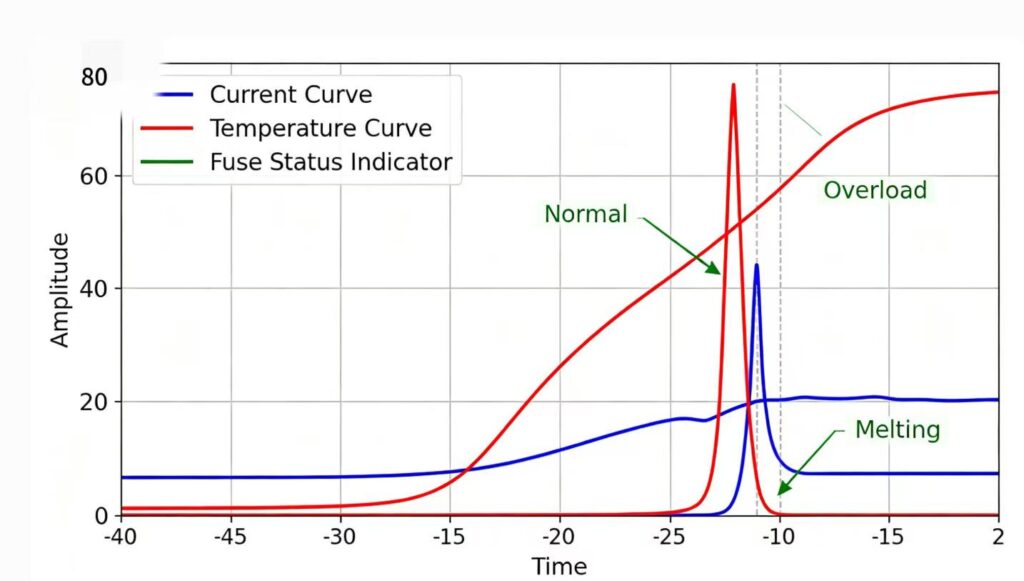
In practical electrical terms, during normal operation, the current flowing through the fuse element generates a small amount of heat that dissipates safely into the surrounding air, ceramic body, or quartz sand filler. The element remains intact, and current flows unimpeded through the circuit.

Time sequence diagram showing fuse operation during normal current, overload and short circuit

When an overcurrent condition occurs, the sequence of events is:

  1. Excessive current generates more heat than the fuse can dissipate through its designed thermal path
  2. The temperature of the fuse element rises rapidly to its melting point
  3. The element melts at its pre-engineered weakest point, creating an initial gap
  4. An electric arc forms across the gap as current attempts to continue flowing
  5. The arc is rapidly extinguished by the fuse’s internal design (quartz sand, deionizing gas, or vacuum)
  6. The circuit is permanently broken, stopping all current flow

The speed at which a fuse operates follows a strict inverse time-current characteristic: higher overcurrents cause faster melting, while lower overloads result in slower operation. This characteristic is carefully calibrated during manufacturing to match the specific protection requirements of different circuits and equipment.

From a system perspective, the fuse is a one-time-use device. Once it has operated (blown), it must be replaced with a new fuse of identical rating, type, and standard before the circuit can be safely restored to service.

Main Types of Fuses

Not all fuses are built the same. The main categories are defined by their construction, operating characteristics, interrupting capacity, and intended applications, with each type optimized for specific protection duties.

Standard Fuse Classification by IEC 60269

Fuse ClassDesignation주요 기능Typical Interrupting Capacity
General PurposegGProtection against both overloads and short circuits50kA – 120kA
Motor ProtectionaMShort-circuit protection only for motor circuits50kA – 100kA
Semiconductor ProtectionaRUltra-fast protection for power semiconductors50kA – 200kA
Cable ProtectiongLOverload and short-circuit protection for cables50kA – 120kA
Transformer ProtectiongTrOptimized for transformer inrush currents50kA – 150kA


Common Fuse Types by Construction

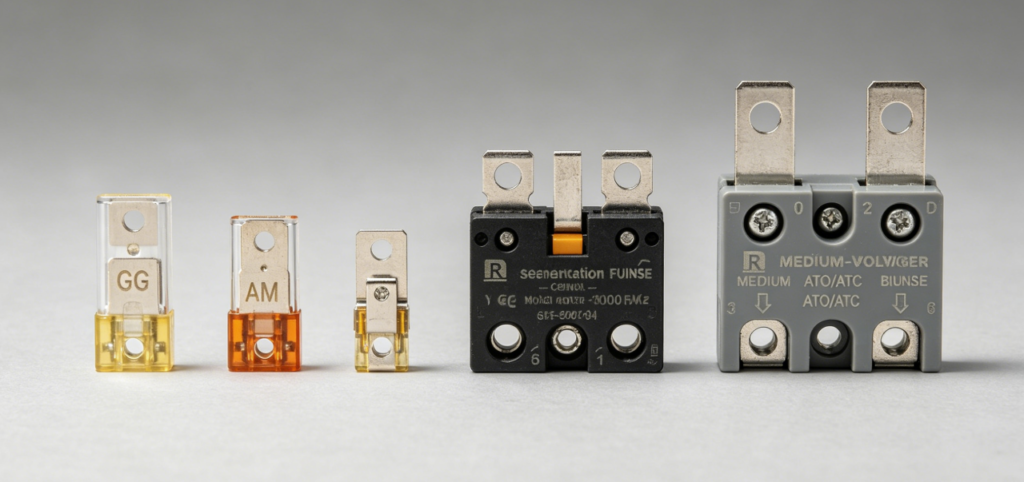
Cartridge Fuses

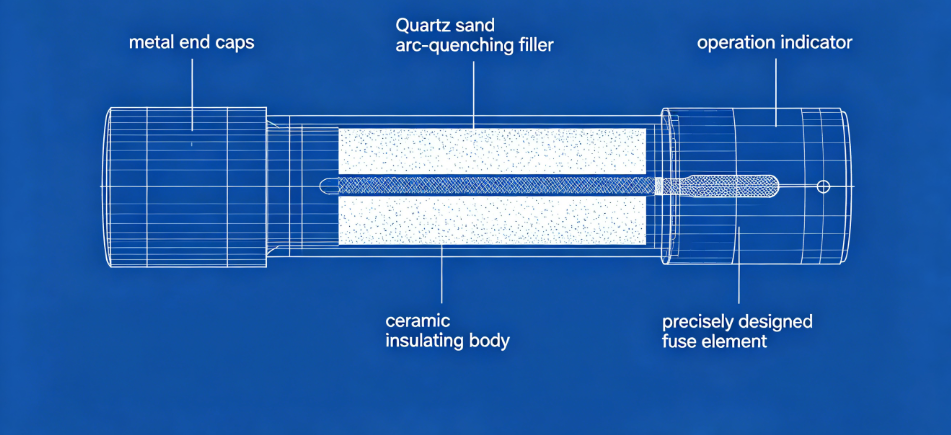
These are the most widely used industrial and commercial fuses, consisting of a precisely calibrated fuse element enclosed in a cylindrical ceramic or glass body with metal end caps. They are available in a wide range of current ratings (0.5A to 6000A) and voltage ratings (up to 1000V AC/DC).

Typical fit:

  • General purpose circuit protection
  • Motor branch circuits
  • Transformer primary and secondary protection
  • Main distribution panels
  • 산업용 제어 시스템

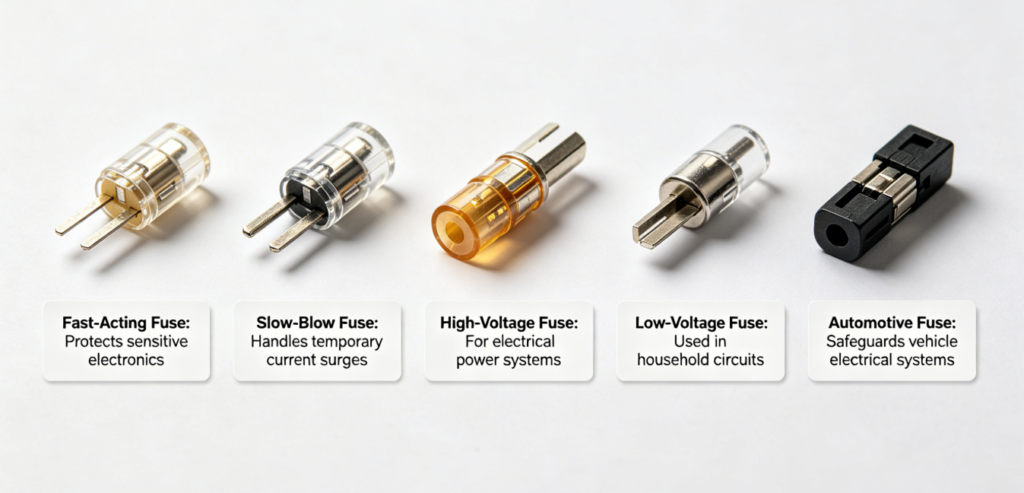
Blade Fuses (ATO/ATC/MAXI)

These are compact, plug-in fuses with two flat metal prongs that insert into molded plastic fuse holders. They are standardized for automotive and low-voltage DC applications.

Typical fit:

  • Automotive electrical systems
  • Marine and recreational vehicle applications
  • Low-voltage DC circuits (12V, 24V, 48V)
  • Consumer electronics and power supplies

Time-Delay Fuses (Slow-Blow)

These fuses incorporate a dual-element design that allows them to withstand temporary inrush currents (typically 5-10 times rated current for up to 10 seconds) without blowing, while still providing reliable protection against sustained overloads and short circuits.

Typical fit:

  • Induction motor circuits (to handle startup inrush current)
  • Transformer circuits
  • Capacitor bank circuits
  • Lighting circuits with high inrush characteristics

Fast-Acting Fuses (Quick-Blow)

These fuses have a single-element design that operates very rapidly when exposed to overcurrent, providing maximum protection for sensitive equipment that cannot tolerate even brief overcurrent events.

Typical fit:

  • Power semiconductor devices (diodes, thyristors, IGBTs)
  • Electronic control circuits
  • Precision instrumentation
  • 의료 장비

High-Voltage Fuses

These are specially designed for use in electrical systems above 1000V AC. They incorporate advanced arc-extinguishing technologies such as boric acid, silica sand, or SF6 gas to safely interrupt high-voltage faults.

Typical fit:

  • Medium-voltage power distribution systems (1kV – 36kV)
  • Substation equipment
  • High-voltage transformers
  • Capacitor banks
  • Wind and solar power generation systems

Typical Industrial Applications

Fuses are universal electrical protection devices. They are used in virtually every electrical system where overcurrent protection is required, from the smallest consumer electronics to the largest industrial power plants.


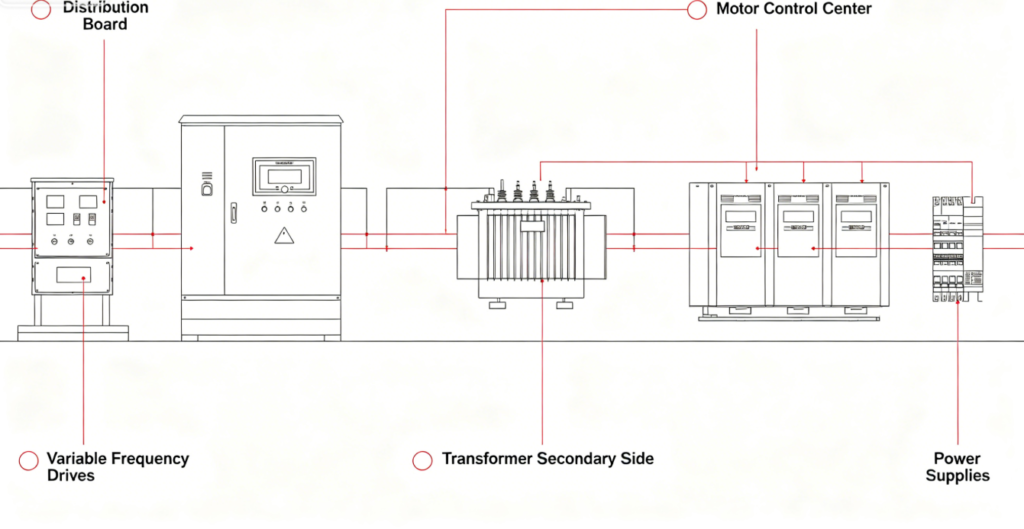
Motor Circuit Protection

Fuses provide primary short-circuit protection for motor circuits, working in conjunction with thermal overload relays to provide complete motor protection. Time-delay (aM class) fuses are specifically engineered to handle the 6-8 times rated inrush current that occurs when induction motors start, while still providing fast protection against short circuits.

In real industrial projects, fuse-based motor protection is often preferred for its simplicity, reliability, and low cost. When properly coordinated with overload relays, fuses provide selective protection that isolates only the faulty circuit without affecting other parts of the electrical system.

Transformer Protection

Transformers are expensive and critical components that require reliable overcurrent protection. Fuses are commonly used to protect both the primary and secondary windings of transformers from short circuits and overloads. gTr class fuses are optimized to withstand the magnetizing inrush current that occurs when transformers are energized.

Distribution Panel Protection

Fuses are used in main distribution panels and sub-panels to protect individual branch circuits. They provide a cost-effective and reliable method of isolating faulty circuits from the rest of the electrical system, preventing cascading failures and minimizing downtime.

Power Semiconductor Protection

Fast-acting (aR class) semiconductor fuses are essential for protecting power electronic devices such as diodes, thyristors, and IGBTs. These devices can be destroyed in microseconds by overcurrent, requiring fuses that operate faster than the semiconductor itself can fail.

Power Supply and UPS Protection

Fuses are installed in all types of power supplies, uninterruptible power supply (UPS) systems, and battery banks to protect against short circuits and overloads. They help prevent catastrophic failures that could result in fire, equipment damage, or loss of critical data.

From an application perspective, this is the pattern seen most often in the field: if you need simple, reliable, and fast-acting overcurrent protection that cannot be overridden, a fuse is frequently the best and most economical solution available.

산업용 AC 퓨즈 홀더 RT18 시리즈 32A-125A | Kuangya
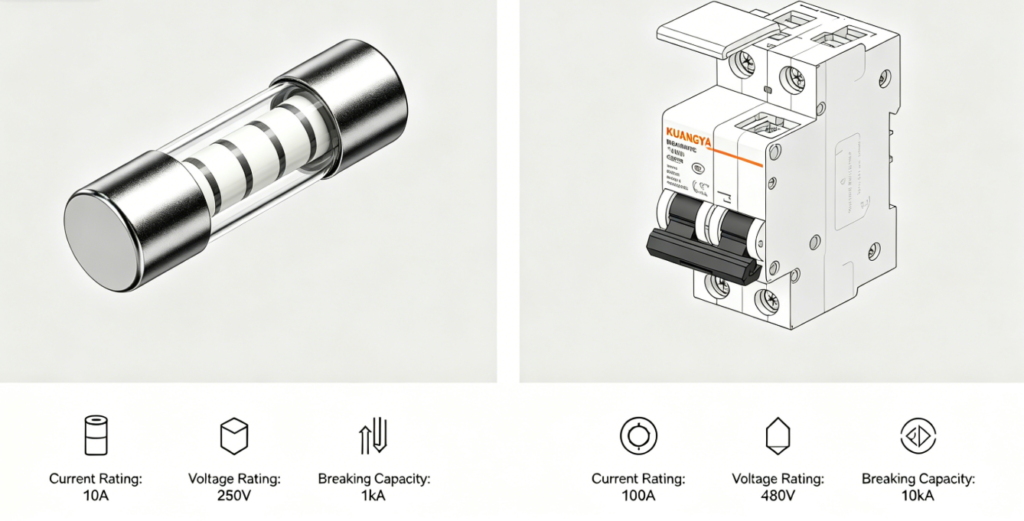
Fuse vs Circuit Breaker: Comprehensive Technical Comparison


This is one of the most important comparisons in electrical engineering because many users consider these two devices interchangeable when they actually serve different but complementary roles in overcurrent protection.

Technical Factor퓨즈몰드 케이스 회로 차단기(MCCB)
Primary functionOne-time overcurrent protectionResettable overcurrent protection and switching
Short-circuit interruption speedUltra-fast (0.001 – 0.01 seconds)Slower (0.01 – 0.1 seconds)
Reset capabilityNo, must be replaced after operationYes, can be reset multiple times
Moving parts없음Multiple moving parts (contacts, springs, trip mechanisms)
Interrupting capacity rangeUp to 200kA (standard)Up to 150kA (standard)
Override protectionCannot be overridden or bypassedCan be accidentally or intentionally reset
Maintenance requirementsVirtually none until operatedRegular inspection and testing required
Cost per protection pointLower더 높음
Remote operation capability아니요Yes (with shunt trip and auxiliary contacts)
Additional protection features제한적Overload, short-circuit, ground fault, undervoltage
선택적 조정Excellent and predictableMore complex to achieve

A fuse provides faster and more reliable short-circuit protection. A circuit breaker provides resettable overload protection and the convenience of not needing replacement after operation.

That means the practical decision is usually:

  • Choose a fuse when ultra-fast fault clearance, fail-safe operation, and selective coordination are critical
  • Choose a circuit breaker when convenience of reset, remote operation, and additional protection features are more important

In most modern industrial systems, both devices are used together in a coordinated protection scheme: fuses provide primary short-circuit protection, while circuit breakers provide overload protection and switching capability.

When to Choose a Fuse

A fuse is usually the better fit when:

  • Ultra-fast short-circuit interruption is required to protect sensitive equipment
  • Fail-safe operation is critical (cannot be accidentally reset)
  • Selective coordination with other protection devices is essential
  • Cost per protection point is a primary consideration
  • The circuit is not expected to trip frequently
  • High reliability with minimal maintenance is needed
  • Regulatory requirements mandate fail-safe protection

A fuse is usually not the best fit when:

  • The circuit trips frequently, requiring frequent replacement
  • Remote operation or monitoring is required
  • Overload protection is the primary concern
  • The ability to quickly restore power without replacement is essential
  • Advanced protection features such as ground fault or arc flash protection are needed
  • The application requires adjustable trip settings

In system design, overcurrent protection selection should always consider both short-circuit and overload protection requirements, as well as the need for selective coordination. If the project also includes device coordination, “How to Perform Selective Coordination Studies for Industrial Electrical Systems” is a useful companion reference.

Fuse Rating Selection Guide

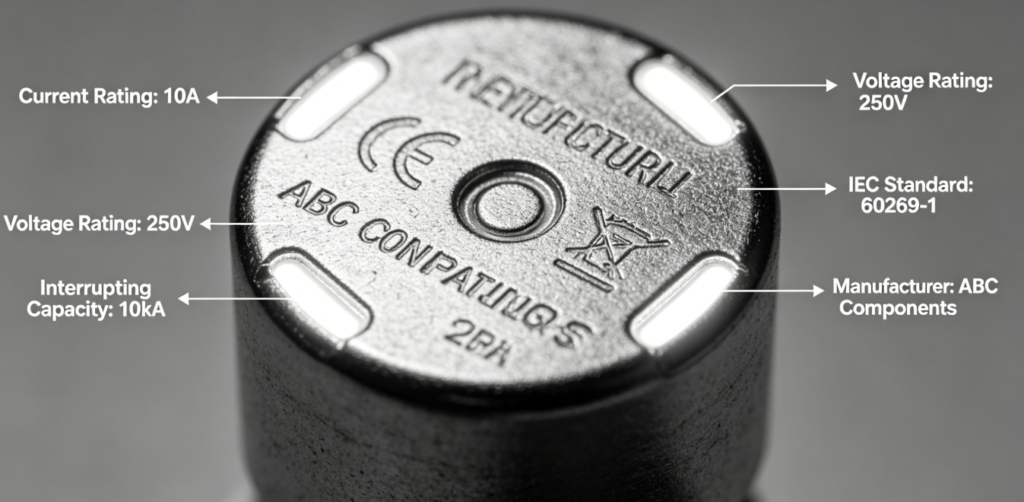
Close-up view of industrial cartridge fuse showing current, voltage and standard markings

애플리케이션 유형Fuse ClassCurrent Rating MultiplierVoltage Rating Requirement
Resistive loads (heaters, lighting)gG1.25 × full load current≥ system voltage
Induction motors (DOL start)aM1.5 – 2.5 × full load current≥ system voltage
TransformersgTr1.25 – 2.0 × full load current≥ system voltage
Capacitor banksgG1.5 – 2.0 × rated current≥ system voltage
Power semiconductorsaR1.2 – 1.5 × rated current≥ system voltage
DC 회로gG (DC rated)1.5 × full load current≥ system voltage

PV 퓨즈(gPV 퓨즈 링크 및 홀더) | 고전압 DC 퓨즈 1000V/1500V | 쿠앙야

Common Selection Questions

Before choosing a fuse for a specific application, professional engineers usually ask:

  • What is the normal full-load current of the circuit?
  • What is the maximum prospective short-circuit current at the point of installation?
  • What is the system voltage (AC or DC)?
  • Does the circuit have high inrush current that requires a time-delay fuse?
  • What type of load is being protected (motor, transformer, semiconductor, etc.)?
  • What are the ambient temperature conditions at the installation location?
  • Does the application require compliance with IEC, UL, or other regional standards?
  • How will the fuse coordinate with other overcurrent protection devices in the system?
  • What is the required interrupting capacity?
  • Are there any regulatory or insurance requirements that must be met?

Those questions usually matter more than the product label alone when selecting the correct fuse for an application.

자주 묻는 질문

What is a fuse?

A fuse is an electrical safety device that protects circuits from overcurrent damage by melting a precisely calibrated sacrificial metal element, which creates an open circuit and stops current flow.

How does a fuse work?

A fuse operates on the principle of Joule heating. When excessive current flows through the fuse element, it generates enough heat to melt the element, breaking the circuit and preventing damage to connected equipment.

What is the difference between a fuse and a circuit breaker?

A fuse is a one-time-use device that operates very quickly and cannot be reset. A circuit breaker is a resettable device that can be used multiple times but operates more slowly and has moving parts that require maintenance.

Where are fuses used?

Fuses are used in residential, commercial, industrial, aerospace, and automotive electrical systems to protect wiring, motors, transformers, electronic equipment, and other electrical devices from overcurrent damage.

What are the different types of fuses?

Common types include cartridge fuses, blade fuses, time-delay fuses, fast-acting fuses, and high-voltage fuses. They are also classified by their protection function into gG general-purpose, aM motor protection, and aR semiconductor protection classes.

How do I choose the right fuse for my application?

Select a fuse with a current rating appropriate for the load type (using the multipliers in the selection guide), a voltage rating equal to or higher than the system voltage, the correct time-current characteristic for the load, and an interrupting capacity greater than the maximum prospective short-circuit current.

Can I replace a fuse with a higher rating?

No. Using a fuse with a higher rating than specified defeats the purpose of overcurrent protection and can result in equipment damage, electrical fire, or personal injury. Always replace a fuse with one of identical rating, type, and standard.

What is selective coordination?

Selective coordination is the practice of designing an electrical protection system so that only the fuse or circuit breaker closest to a fault operates, isolating the faulty circuit without affecting other parts of the electrical system.

elaine
elaine

전기 보호 및 배전 솔루션의 글로벌 홍보에 주력하는 쿠앙야의 마케팅 책임자 ● 핵심 분야: 태양광, 에너지 저장 및 산업용 전력 시장에서의 브랜드 구축.● 전문 제품: 퓨즈, 서지 보호 장치(SPD), 미니어처 회로 차단기(MCB), 전송 스위치.● 가치 제안: "안전, 신뢰성, 혁신"을 초석으로 글로벌 재생 에너지 시장에 서비스를 제공합니다.지능형 배전 기술의 발전을 공동으로 발전시키기 위해 연결하고 협력하는 것을 환영합니다.

기사 : 129