웽양 공업구 웨칭 원저우 325000
근무 시간
월요일~금요일: 오전 7시~오후 7시
주말: 주말: 오전 10시 - 오후 5시
웽양 공업구 웨칭 원저우 325000
근무 시간
월요일~금요일: 오전 7시~오후 7시
주말: 주말: 오전 10시 - 오후 5시

When designing or maintaining a solar photovoltaic system, one critical question often arises: “Can I use AC fuses or standard gG fuses if they have DC voltage ratings?” The short answer is no—and understanding why requires a journey through the evolution of fuse technology and the unique demands of DC solar applications.
The story of electrical fuses begins in the pioneering days of electricity distribution. When Thomas Edison built the historic Pearl Street Station in New York City in 1882—the world’s first complete electric power system—it operated on direct current (DC). Edison’s system included generators, cables, meters, loads, and crucially, 퓨즈 as the primary safety mechanism. In 1890, Edison patented one of the first electrical fuses, a simple device consisting of a low-melting-point wire soldered between two terminals. When current surged beyond safe limits, the wire melted, creating an open circuit and preventing equipment damage or fire.
These early fuses were rudimentary but revolutionary. They represented humanity’s first line of defense against the dangers of electrical overcurrent, making electricity safe enough for widespread adoption. Without this fundamental protection, the electrical revolution might never have occurred.
By the 1890s, the “War of Currents” between Edison’s DC system and Nikola Tesla’s alternating current (AC) system was in full swing. AC ultimately won due to its superior ability to transmit power over long distances using transformers. This technological shift fundamentally changed fuse design requirements. AC current naturally crosses zero 100 or 120 times per second (depending on frequency), which helps extinguish electrical arcs when a fuse interrupts a circuit. This natural zero-crossing made AC fuse design relatively straightforward compared to DC applications.
During this period, manufacturers developed cartridge fuses with sand filling to efficiently extinguish electric arcs, glass fuses for small electronic devices, and blade-type (NH) fuses for industrial installations. By the 1930s, fuses had become standardized protective equipment in electrical installations worldwide.
The second half of the 20th century brought unprecedented specialization in fuse technology. As electrical systems became more complex and diverse, engineers recognized that a one-size-fits-all approach to overcurrent protection was inadequate. This led to the development of specialized fuse classes under the International Electrotechnical Commission (IEC) 60269 standard:
| 퓨즈 클래스 | Full Name | 기본 애플리케이션 | 주요 특징 | 표준 |
|---|---|---|---|---|
| gG | 일반 목적 | AC distribution circuits, cables, feeders | Full-range protection (overload + short-circuit), natural zero-crossing interruption | IEC 60269-1 |
| aM | 모터 보호 | Motor circuits with high inrush current | Partial-range (short-circuit only), allows motor starting surges | IEC 60269-2 |
| gPV | Photovoltaic | Solar DC systems, string/combiner protection | DC arc extinction, reverse current capability, high voltage (up to 1500V DC) | IEC 60269-6, UL 2579 |
| gBat | 배터리 저장 | 배터리 에너지 저장 시스템(BESS) | Charge/discharge cycle tolerance, DC interruption | IEC 60269-7 |
This evolution reflects a fundamental principle: electrical protection must be engineered for the specific electrical environment it will encounter. A fuse designed for AC industrial motors faces entirely different challenges than one protecting a DC solar array.
The fundamental difference between AC and DC protection lies in arc interruption physics. When a fuse opens under fault conditions, it must extinguish the electrical arc that forms between the separating contacts. In AC systems, the current naturally crosses zero 100-120 times per second, providing regular opportunities for the arc to extinguish. DC current, however, maintains constant polarity with no zero-crossing, creating a sustained plasma arc with temperatures exceeding 10,000°C.
To extinguish a DC arc, a fuse must physically stretch the arc until its voltage demand exceeds the system voltage, while simultaneously absorbing enormous thermal energy. This is why gPV fuses contain specialized quartz sand filler that melts into a glass-like substance (fulgurite) during interruption, smothering the arc. Standard AC fuses or gG fuses—even those marked with a DC voltage rating—lack the robust arc-quenching mechanisms required for reliable DC interruption.
Solar PV systems present unique electrical challenges that standard fuses cannot address:
1. Low Fault Current Conditions\
Unlike grid-connected AC systems where fault currents can reach tens of thousands of amperes, solar arrays produce relatively low fault currents limited by the panels’ short-circuit current (Isc). A typical 400W solar panel might produce only 10-12A short-circuit current. Standard gG fuses are calibrated for high-fault AC environments and may not reliably operate under these low-current DC conditions. gPV fuses are specifically engineered with time-current characteristics optimized for photovoltaic fault profiles.
2. Reverse Current and Backfeed Protection\
In solar systems with battery storage, current can flow in reverse direction during certain fault conditions (backfeed from batteries through a faulted string). Standard AC fuses are not tested for bidirectional current interruption. gPV fuses must safely interrupt current flowing in either direction.
3. High DC Voltage Requirements\
Modern solar systems operate at increasingly high DC voltages: 1000V DC for residential systems, 1500V DC for commercial installations, and emerging 2000V DC systems for utility-scale projects. The voltage rating on a fuse is not simply about insulation—it directly relates to the fuse’s ability to develop sufficient arc voltage to force current interruption. A fuse rated “600V AC” typically cannot safely interrupt faults at 600V DC due to the sustained arc challenge.
4. Extreme Environmental Conditions\
Solar fuses must operate reliably in outdoor combiner boxes exposed to temperature extremes (-40°C to +90°C), direct sunlight, UV radiation, humidity, and dust. gPV fuses are tested and certified for these harsh conditions, with specialized materials and construction that standard industrial fuses lack.
| 매개변수 | gG Fuses (General Purpose) | gPV Fuses (Photovoltaic) |
|---|---|---|
| Electrical System | AC distribution networks | DC photovoltaic systems |
| 전압 등급 | Up to 1000V AC | Up to 1500V DC (some to 2000V DC) |
| Arc Interruption | Relies on natural AC zero-crossing | Forced DC arc extinction with enhanced quenching media |
| 현재 범위 | Full-range (overload + short-circuit) | Full-range optimized for low PV fault currents |
| 역전류 | Not tested/rated | Tested for bidirectional interruption |
| Time-Current Curve | Optimized for AC grid characteristics | Optimized for PV module I-V characteristics |
| 차단 용량 | Typically 50-100 kA AC | 20-30 kA DC (sufficient for PV applications) |
| 환경 등급 | Indoor industrial environments | Outdoor harsh environments (-40°C to +90°C, UV resistant) |
| 표준 | IEC 60269-1, IEC 60269-2 | IEC 60269-6, UL 2579, UL 248-19 |
| 일반적인 애플리케이션 | Feeders, cables, distribution boards | PV strings, combiner boxes, inverter DC inputs |
| 비용 | Lower (mature mass production) | Higher (specialized design and testing) |
Using AC-rated or gG fuses in DC solar applications creates catastrophic failure risks:
Arc Flash and Fire Hazard\
When an AC fuse attempts to interrupt DC current, the arc may not extinguish. Instead, it continues burning, overheating the fuse body until it ruptures violently, ejecting molten material and potentially igniting surrounding components in the combiner box. Multiple documented cases show combiner box fires resulting from improper fuse selection.
장비 피해\
If a fuse fails to interrupt a fault, sustained fault current can damage expensive components including solar panels, inverters, and wiring. One solar installer reported recurring fuse failures on a 100kW commercial system where the engineer had used standard fuses sized at 1.25x continuous current instead of following NEC-mandated calculations for gPV fuses. The fix required complete re-fusing of combiner boxes, resulting in lost production, frustrated clients, and eroded profit margins.
Warranty Voidance and Liability\
Using non-compliant fuses voids equipment warranties and creates liability exposure. Insurance claims may be denied if fire investigations reveal non-code-compliant protection devices.
According to the National Electrical Code (NEC) Article 690.9, solar fuse ratings must account for continuous operation and irradiance variations:
Fuse Rating = Module Isc × 1.56
여기서:
계산 예시:\
For a solar module with Isc = 11.2A:\
Fuse Rating = 11.2A × 1.56 = 17.47A → Select next standard size: 20A gPV fuse
Ensure the fuse DC voltage rating exceeds your system’s maximum open-circuit voltage:
Verify the fuse carries proper certifications:
Look for “gPV” marking on the fuse body—this designation confirms it meets photovoltaic-specific requirements.
| 퓨즈 크기 | 현재 범위 | 일반적인 애플리케이션 |
|---|---|---|
| 10×38 mm | 1-32A | Residential string protection |
| 14×51mm | 2-50A | Commercial string protection |
| 10×85mm | 1-30A | High-voltage (1500V) string protection |
| 14×85mm | 2-50A | High-voltage commercial applications |
| NH00-NH3 | 20-630A | Combiner boxes, inverter DC inputs, utility-scale |
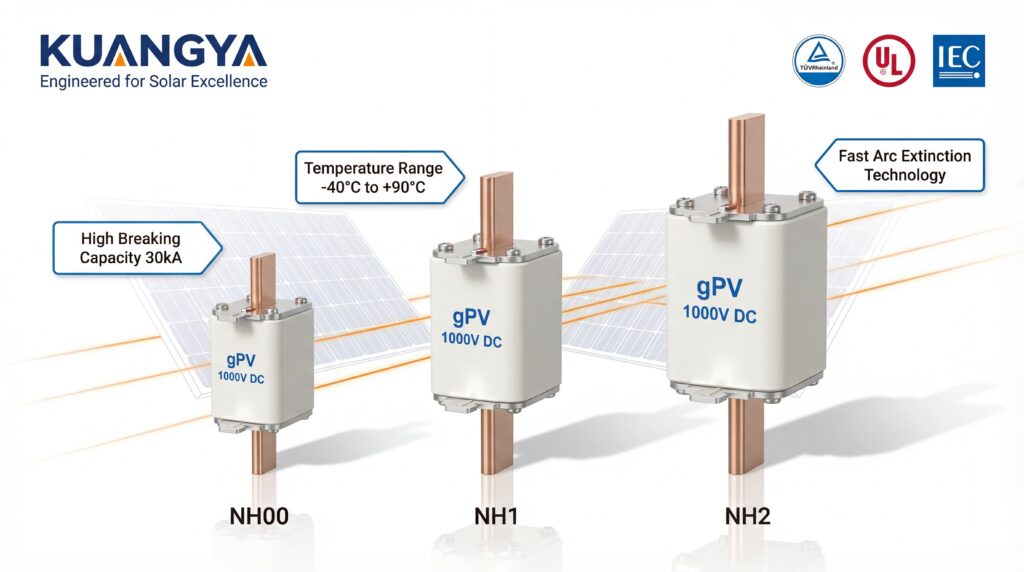
At KUANGYA (cnkuang.com), we specialize in high-quality gPV fuses engineered specifically for photovoltaic applications. Our product range includes:
Cylindrical gPV Fuses\
Available in 10×38mm, 14×51mm, 10×85mm, and 14×85mm formats for string and combiner box protection. Rated up to 1500V DC with breaking capacity of 30kA. Certified to IEC 60269-6 and UL standards.
NH-Type gPV Fuses\
Square-body fuses in NH00, NH1, NH2, and NH3 sizes for high-current applications (up to 630A). Ideal for central inverters, DC busbars, and utility-scale installations. Features silver-plated copper contacts and high thermal shock-resistant ceramic construction.
Complete System Solutions\
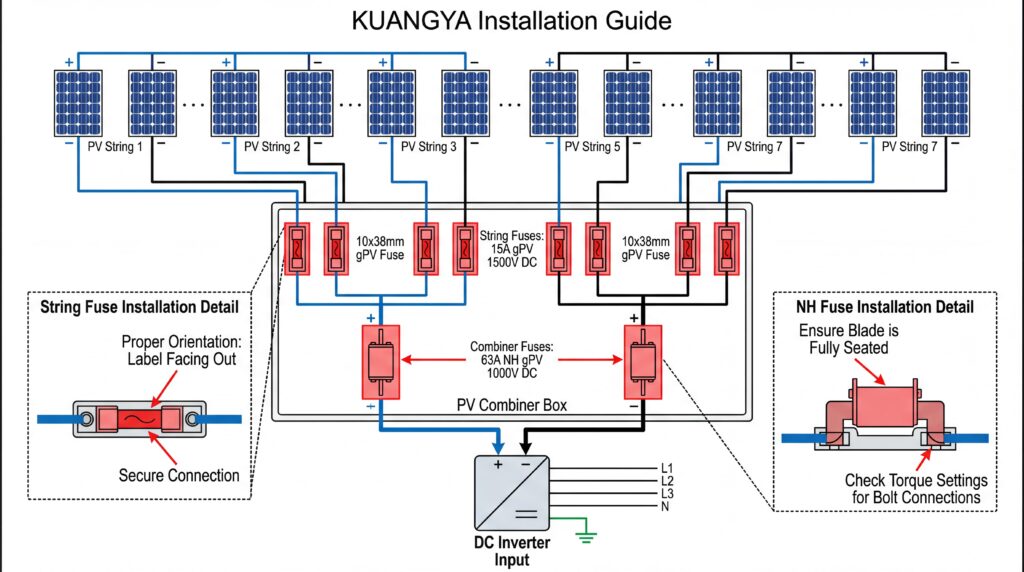
We provide matched fuse holders, DIN-rail mounting solutions, and technical support to ensure proper installation and code compliance. Our products undergo 100% routine testing with automated assembly for consistent quality.
Every KUANGYA fuse is engineered to deliver safe, certified, and reliable protection for residential rooftops, commercial installations, and utility-scale solar farms. 인용
아니요. While a standard DC fuse may have an adequate voltage rating, it lacks the specialized characteristics required for photovoltaic applications. Solar systems present unique challenges including low fault currents, reverse current conditions, and the specific I-V curve behavior of PV modules. Only fuses tested and certified to IEC 60269-6 (gPV designation) are engineered to handle these conditions safely. Standard DC fuses may fail to interrupt PV faults reliably, potentially causing equipment damage or fire hazards. The gPV certification ensures the fuse has been specifically tested for photovoltaic fault profiles, temperature cycling, UV exposure, and bidirectional current interruption—requirements that standard DC fuses do not meet.
The price difference reflects specialized engineering and certification costs. gPV fuses require enhanced arc-quenching materials (specialized quartz sand fillers), robust construction to withstand outdoor environmental extremes (-40°C to +90°C, UV radiation, humidity), and extensive testing to multiple international standards (IEC 60269-6, UL 2579, TÜV certification). The time-current characteristics must be precisely calibrated for low-current PV fault conditions rather than high-current AC grid faults. Additionally, gPV fuses undergo rigorous testing for reverse current interruption and long-term reliability under continuous DC stress. While the initial cost is higher, this investment protects expensive solar equipment (panels, inverters, batteries) and prevents catastrophic failures that would cost far more in equipment replacement, downtime, and potential liability. Consider it essential insurance for your solar investment.
Installing AC-rated fuses in DC solar systems creates serious safety hazards. AC fuses rely on the natural current zero-crossing (occurring 100-120 times per second) to extinguish arcs during interruption. DC current has no zero-crossing, resulting in a sustained arc that AC fuses cannot reliably extinguish. When an AC fuse attempts to interrupt DC current, the arc continues burning inside the fuse body, generating extreme heat (over 10,000°C). This can cause the fuse to rupture violently, ejecting molten material and potentially igniting the combiner box or surrounding components. Even if the fuse has a DC voltage marking, it has not been tested for the specific fault characteristics of photovoltaic systems (low fault current, reverse current, sustained DC arc). Real-world incidents have documented combiner box fires, equipment damage, and system failures resulting from improper fuse selection. Additionally, using non-compliant fuses voids equipment warranties, violates electrical codes (NEC Article 690), and creates liability exposure. Always use properly certified gPV fuses for solar applications—the safety of your system and compliance with regulations depend on it.
The question “Can I use AC fuses or standard gG fuses in my solar system if they have DC voltage ratings?” has a clear answer: absolutely not. The evolution of fuse technology from Edison’s simple melting wires to today’s sophisticated gPV devices reflects our growing understanding of electrical protection requirements. Just as early electrical pioneers recognized that safety devices were essential for electricity’s widespread adoption, modern solar engineers must recognize that application-specific protection is non-negotiable.
DC solar systems operate in a fundamentally different electrical environment than AC distribution networks. The absence of natural zero-crossings, the unique fault characteristics of photovoltaic arrays, the challenges of reverse current, and the harsh outdoor operating conditions all demand specialized protection that only gPV-certified fuses can provide. While the initial cost difference may seem significant, the investment in proper gPV fuses protects expensive equipment, ensures code compliance, maintains warranties, and most importantly, prevents potentially catastrophic failures.
When designing or maintaining your solar photovoltaic system, always specify fuses certified to IEC 60269-6 or UL 2579 standards with clear “gPV” designation. Calculate ratings using proper NEC multipliers (1.56× module Isc), verify voltage ratings exceed system open-circuit voltage, and select appropriate physical sizes for your application. Partner with reputable manufacturers like KUANGYA who specialize in photovoltaic protection and can provide technical support throughout your project.
The future of renewable energy depends on safe, reliable solar installations. Choosing the right fuses is not just a technical detail—it’s a fundamental commitment to safety, quality, and the long-term success of solar technology.
About KUANGYA\
KUANGYA (cnkuang.com) is a leading manufacturer of DC fuses and photovoltaic protection solutions. With own production lines, automated assembly, and 100% routine testing, we deliver certified gPV fuses for residential, commercial, and utility-scale solar installations worldwide. Our products meet IEC, UL, and TÜV standards, ensuring safe and reliable protection for your solar investment.
Contact us today for technical specifications, product selection guidance, and volume pricing for your solar projects.

