웽양 공업구 웨칭 원저우 325000
근무 시간
월요일~금요일: 오전 7시~오후 7시
주말: 주말: 오전 10시 - 오후 5시
웽양 공업구 웨칭 원저우 325000
근무 시간
월요일~금요일: 오전 7시~오후 7시
주말: 주말: 오전 10시 - 오후 5시

Every day, millions of electrical surges occur in power grids worldwide. Most are too small to notice, but some can destroy expensive electronics in an instant.
SPDs (Surge Protective Devices) are the only technology specifically designed to detect and neutralize these dangerous voltage spikes before they damage your equipment.
Without proper protection, a single lightning strike or utility switching surge can destroy computers, televisions, refrigerators, and entire industrial control systems.
The cost of surge damage runs into billions of dollars annually, making these devices one of the most cost-effective safety investments you can make. Authoritative guidelines are available from the International Electrotechnical Commission website.
에 따르면 National Fire Protection Association, lightning strikes cause an average of $1.1 billion in property damage each year in the United States alone.
그리고 Institute of Electrical and Electronics Engineers reports that 60-80% of all power surges are actually caused by internal equipment switching, not lightning.
A single nearby lightning strike can induce surges of 10,000 volts or more in nearby wiring. Even small surges of 500 volts can permanently damage sensitive electronic components.
These statistics highlight the critical need for comprehensive protection in every home, office, and industrial facility.

These electrical devices are installed in parallel with power circuits to protect sensitive equipment from transient overvoltages.
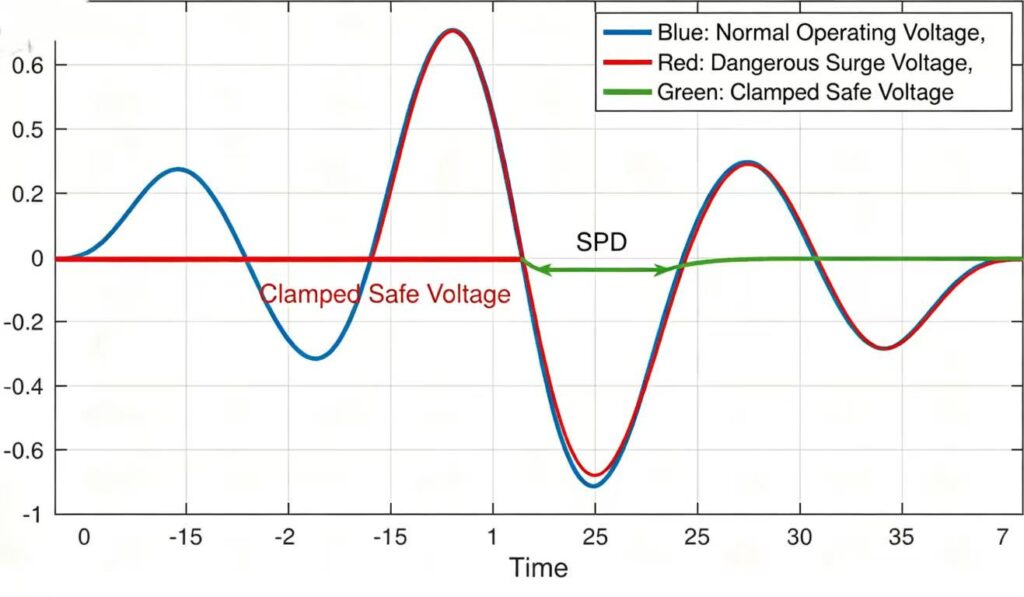
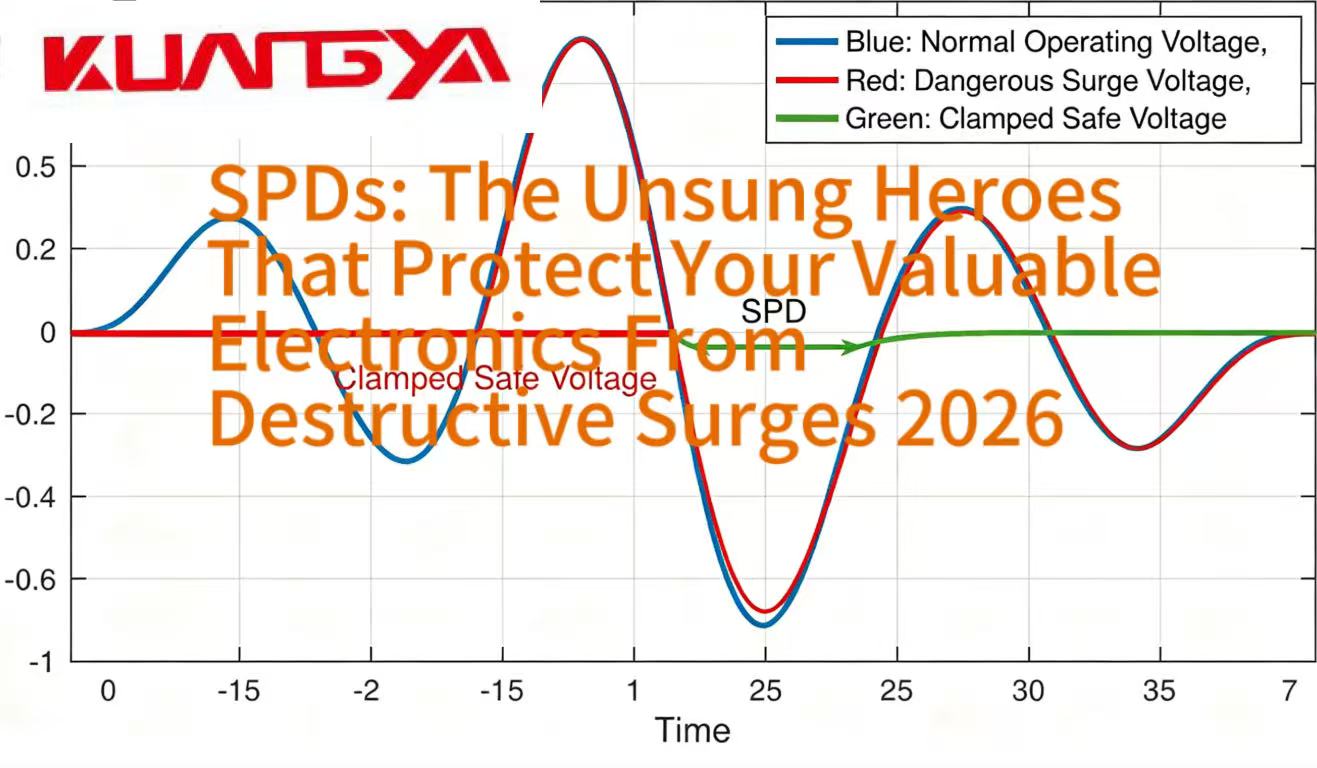
They act as a pressure relief valve for your electrical system, allowing normal operating voltage to pass through while diverting excess surge energy to ground.
Unlike circuit breakers that interrupt power, these protectors operate continuously in the background without disrupting normal electricity flow.
Modern units use advanced semiconductor technology to respond to surges in less than 25 nanoseconds, faster than the blink of an eye.
An electrical surge is a brief but intense increase in voltage that lasts from microseconds to milliseconds.
Surges can be caused by:
Even a small surge can cause cumulative damage to electronic components over time, shortening their lifespan significantly.
Surge protectors contain one or more nonlinear components that change their electrical resistance based on the applied voltage.
Under normal operating conditions, these components have very high resistance and draw almost no current.
When a surge occurs and voltage exceeds a predetermined threshold, the resistance drops dramatically, creating a low-impedance path to ground.
Once the surge has passed, the device automatically returns to its high-resistance state, ready for the next event. The UL 1449 standard defines the performance requirements for these units.

그리고 IEC 61643 series is the international standard that defines the classification and performance requirements for surge protection devices.
Units are classified based on their installation location, expected surge energy, and test waveform parameters.
This classification system ensures that protectors are properly matched to the specific risks and requirements of each application.
Using the wrong type can result in inadequate protection or premature device failure.
Type 1 SPDs are designed for installation at the main service entrance of a building. They protect against direct lightning strikes and very high energy surges.
These devices are tested using a 10/350μs waveform, which simulates the high energy characteristics of lightning current.
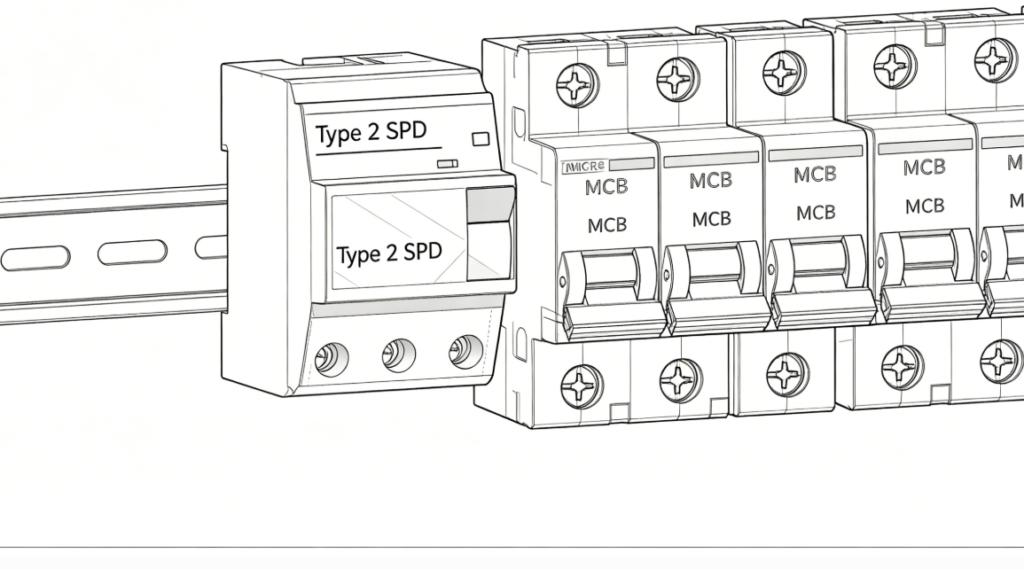
Type 2 units are installed at distribution panels or sub-panels throughout a building. They protect against indirect lightning strikes and switching surges.
Type 3 protectors are point-of-use units installed directly at or inside sensitive equipment. They provide the final level of protection for critical electronics.
表格
| 디바이스 유형 | 파형 테스트 | 설치 위치 | Primary Protection Purpose | Typical Current Rating |
|---|---|---|---|---|
| 유형 1 SPD | 10/350μs | 주요 서비스 입구 | 직격뢰 | 12.5-100kA Iimp |
| 유형 2 SPD | 8/20μs | Distribution panels | Indirect lightning, switching surges | 20-80kA Imax |
| 유형 3 SPD | 8/20μs | Point-of-use | Fine protection for sensitive electronics | 5-20kA Imax |
Maximum Continuous Operating Voltage (Uc): The highest voltage that the device can withstand continuously without degradation.
Nominal Discharge Current (In): The maximum surge current that the unit can withstand repeatedly without failure.
Voltage Protection Level (Up): The maximum voltage that will appear across the terminals during a surge. This is the most important parameter for equipment protection.
Response Time: The time it takes for the device to begin conducting surge current. Modern units have response times of less than 25 nanoseconds.
For residential applications, select Type 2 units with Uc ≥ 385V, In ≥ 20kA, and Up ≤ 1.5kV.
For commercial buildings, use a combination of Type 1 at the main entrance and Type 2 at distribution panels.
For industrial facilities with high lightning risk, install Type 1+2 combined units with higher current ratings.
For sensitive equipment like servers and medical devices, add Type 3 point-of-use protectors with Up ≤ 1.0kV.
www.cnkuangya.com offers a complete range of SPD 제품 for all applications, certified to international standards.
表格
| 애플리케이션 | 권장 유형 | Minimum Uc | Minimum In | Maximum Up |
|---|---|---|---|---|
| 주거용 | 유형 2 SPD | 385V | 20kA | 1.5kV |
| Commercial Office | Type 1+2 SPD | 385V | 25kA | 1.2kV |
| Industrial Plant | Type 1+2 SPD | 385V | 50kA | 1.5kV |
| Data Center | Type 1+2+3 SPD | 385V | 40kA | 1.0kV |
| Solar PV System | 유형 1+2 DC SPD | 1000V DC | 20kA | 2.0kV |
Surge protectors should always be installed by a qualified electrician familiar with local electrical codes.
Follow the “three short and one thick” principle: connecting wires should be short, straight, and thick (minimum 6mm² copper).
The total length of connecting wires should not exceed 0.5 meters to minimize inductance and voltage drop.
Units must be properly grounded to a low-impedance earth connection with a resistance of less than 4 ohms. Installation guidelines are available from the Occupational Safety and Health Administration.
One of the most common mistakes is installing protectors with excessively long connecting wires, which can reduce protection effectiveness by 50% or more.
Another critical error is improper grounding. Without a good earth connection, these devices cannot effectively divert surge energy.
Never install surge protectors without appropriate overcurrent protection (fuses or circuit breakers) to prevent fire hazards in case of device failure.
Avoid mixing different types or brands in the same system without verifying their coordination compatibility.
These devices are not lifetime products. They degrade over time with each surge they absorb.
Inspect units visually every 3 months for signs of damage, discoloration, or indicator light failure.
Test units annually using specialized surge test equipment to verify their performance.
Replace devices immediately if they show signs of damage, if the indicator light is off, or after a major lightning strike. Most units have a service life of 5-10 years under normal conditions.
For more detailed maintenance instructions, read our comprehensive electrical equipment maintenance guide.
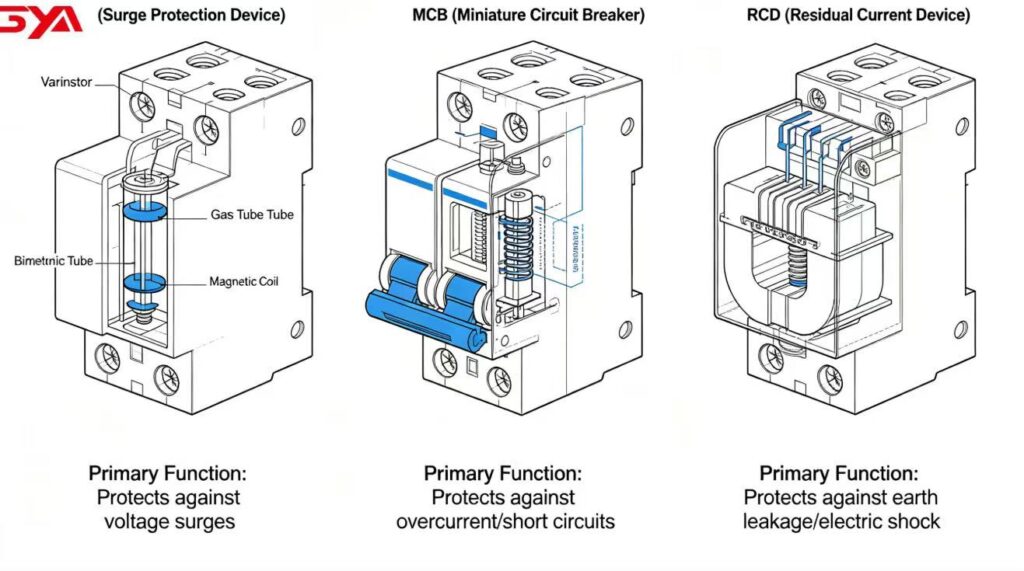
SPDs protect against transient overvoltages (surges) that last microseconds to milliseconds.
MCBs (Miniature Circuit Breakers) protect against overcurrents and short circuits that last seconds or longer.
RCDs (Residual Current Devices) protect against electric shock by detecting current leakage to ground.
Each device protects against different types of electrical hazards, and they work together to provide comprehensive safety.
Many people mistakenly believe that circuit breakers provide surge protection, but this is not true.
Circuit breakers are too slow to respond to the fast transients caused by surges. A surge can destroy equipment before a circuit breaker even begins to trip.
Similarly, RCDs do not detect or protect against voltage surges. They only respond to current imbalance.
Only a complete protection system including surge protectors, MCBs, and RCDs can protect against all common electrical hazards.AC SPD(서지 보호 장치) | 쿠앙야
| 디바이스 유형 | 다음으로부터 보호 | 응답 시간 | 재사용 가능 | 주요 목적 |
|---|---|---|---|---|
| SPD | Voltage surges | <25ns | 예 | Equipment protection |
| MCB | Overcurrent, short circuit | Milliseconds | 예 | Wire and equipment protection |
| RCD | Current leakage | <30ms | 예 | Electric shock prevention |
| 퓨즈 | Overcurrent, short circuit | Milliseconds | 아니요 | 과전류 보호 |

SEO 填写内容(全英文):
Comparison of SPD, MCB and RCD electrical protection devicesElectrical Protection Device ComparisonFigure 3: Side-by-side comparison of SPD, MCB and RCD devices, showing their different physical appearance and protection functions.Visual comparison chart illustrating the differences between SPD (surge protection), MCB (overcurrent protection) and RCD (leakage protection) devices.Every home should have at least one Type 2 unit installed at the main electrical panel.
Additional point-of-use protectors should be used to protect expensive electronics like televisions, computers, and home theater systems.
These devices are especially important in areas with high lightning activity or unstable power grids.
Even in urban areas with reliable power, switching surges from utility operations can still cause significant damage.
Commercial buildings require a layered protection approach with Type 1 units at the main entrance and Type 2 units at each distribution panel.
Critical facilities like hospitals, data centers, and financial institutions need the highest level of protection.
Industrial facilities with large motors and variable frequency drives generate significant internal surges that require specialized solutions.
www.cnkuangya.com provides custom industrial surge protection solutions designed for harsh industrial environments.
Solar photovoltaic systems require special DC units to protect both the DC side (panels and inverters) and AC side (grid connection).
Electric vehicle charging stations need robust protection to safeguard the expensive charging equipment and vehicles.
Telecommunication systems, security systems, and medical equipment all require specialized protection for their sensitive electronics.
그리고 IEC 62548 standard specifically addresses surge protection requirements for photovoltaic systems.
A: No, SPDs only protect against transient voltage surges. They cannot prevent power outages, brownouts, or sustained overvoltages.
For protection against these issues, you need an uninterruptible power supply (UPS) or voltage regulator in addition to surge protection.
However, many UPS systems include built-in surge protection to provide comprehensive power conditioning.
It is important to understand the limitations of each protection device and use them in combination for complete safety.
A: Yes, but the amount is negligible. Modern units consume less than 1 watt of power in standby mode.
This is equivalent to the power consumption of a small LED indicator light and costs only a few cents per year in electricity.
The tiny power consumption is well worth the investment to protect thousands of dollars worth of electronic equipment.
Some energy-efficient models consume even less power, making them suitable for battery-powered applications.
A: Yes, in fact, this is recommended for comprehensive protection. A layered approach with devices at the main panel, sub-panels, and point-of-use provides the best protection.
However, it is important to ensure that the units are properly coordinated to prevent one device from diverting all the surge energy and failing prematurely.
Most modern SPDs are designed to work together in a coordinated system when installed according to manufacturer instructions.
Consult with a qualified electrician to design a properly coordinated protection system for your specific needs.
A: When a device has absorbed its maximum rated surge energy, it will fail. Most units are designed to fail safely by short-circuiting, which will cause the upstream overcurrent protection to trip.
Many SPDs include visual indicators (usually LED lights) that show when the device has failed and needs replacement.
It is important to replace failed units immediately, as they no longer provide any protection.
Some advanced models include remote monitoring capabilities to alert facility managers when a device needs replacement.
A: Yes, ambient temperature has a significant impact on performance and lifespan.
High temperatures reduce the surge handling capacity of these devices and accelerate component degradation.
Units installed in hot environments like attics, boiler rooms, or outdoor enclosures may have a shorter service life than those installed in cool, dry locations.
When selecting SPDs for high-temperature applications, choose models with higher temperature ratings and derate their current ratings accordingly.
The next generation of surge protectors will include smart features and IoT connectivity for remote monitoring and management.
Smart SPDs will be able to track surge events, measure energy consumption, and send alerts to smartphones or building management systems.
They will also be able to self-diagnose and predict when they need replacement, eliminating the need for manual inspections.
This technology will make surge protection more reliable and cost-effective, especially for large commercial and industrial facilities.
Advances in semiconductor materials are leading to units with better performance, smaller size, and longer lifespan.
New materials like silicon carbide (SiC) and gallium nitride (GaN) are enabling SPDs with faster response times and lower voltage protection levels.
These innovations will allow these devices to protect even the most sensitive next-generation electronics from increasingly complex surge threats.
Manufacturers are also developing more environmentally friendly units with reduced lead and other hazardous materials.
The global surge protection market is expected to grow steadily in the coming years, driven by increasing awareness of electrical safety and the growth of sensitive electronic equipment.
Emerging markets in Asia, Africa, and Latin America are experiencing rapid growth as infrastructure development accelerates.
International standards are becoming more unified, making it easier for manufacturers to develop products that meet global requirements.
www.cnkuangya.com is at the forefront of these developments, continuously innovating to provide the most advanced smart electrical solutions to customers worldwide.
SPDs are often overlooked, but they are one of the most important components of a modern electrical safety system.
A single surge can destroy thousands of dollars worth of equipment in an instant, but a properly installed device can prevent this damage for a fraction of the cost.
Whether you are a homeowner protecting your family’s electronics or a facility manager safeguarding critical industrial equipment, these devices are an essential investment.
By understanding the different types of surge protectors, selecting the right parameters, and following proper installation and maintenance practices, you can ensure that your electrical system is protected against the hidden danger of voltage surges.
As technology continues to advance and our dependence on electronics grows, the importance of this protection will only increase.
For reliable, certified SPD products and professional surge protection consultation, visit www.cnkuangya.com today. Their team of experts can help you design a comprehensive protection system tailored to your specific needs.
Don’t wait until it’s too late. Protect your valuable electronics and ensure the safety of your electrical system with high-quality surge protectors from a trusted manufacturer.