웽양 공업구 웨칭 원저우 325000
근무 시간
월요일~금요일: 오전 7시~오후 7시
주말: 주말: 오전 10시 - 오후 5시
웽양 공업구 웨칭 원저우 325000
근무 시간
월요일~금요일: 오전 7시~오후 7시
주말: 주말: 오전 10시 - 오후 5시

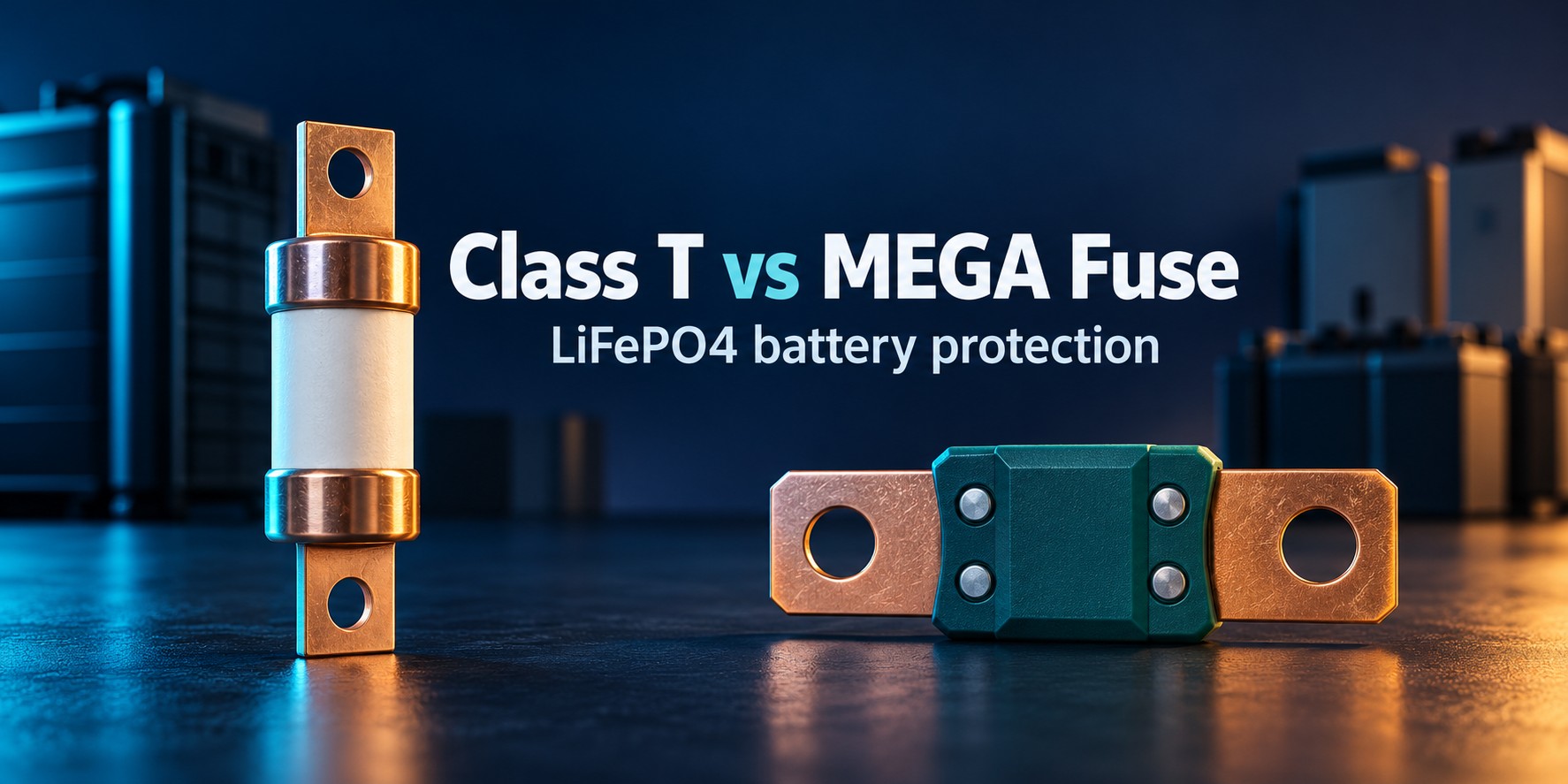
Class T vs MEGA fuse is a useful comparison for a LiFePO4 battery bank, but the family name alone cannot decide the answer. Start with the exact fuse’s DC voltage rating and DC interrupting capacity. Then check its current rating, operating curve and approved holder against the battery, cables and inverter.
A fuse marked 200A does not necessarily interrupt the same fault current as another 200A fuse. That distinction matters when selecting protection for a solar battery, off-grid inverter or home energy storage system.
A suitably rated Class T fuse can be a strong candidate where a battery circuit requires high DC interrupting capacity. A MEGA fuse can be suitable when its exact voltage, interrupt rating and operating characteristics meet the circuit requirements. Neither choice is automatically correct for every lithium battery installation.
The practical decision is therefore not “Which family is better?” It is “Which documented part-and-holder combination satisfies this battery circuit?” The following comparison uses two specific manufacturer examples, not universal ratings for either family.
| 확인 | Eaton Bussmann JJN-200 Class T | Littelfuse MEGA 298 series |
|---|---|---|
| Current rating | 200A for JJN-200 | 40–500A across the series |
| Published DC voltage | 160V DC | 32V DC |
| Published DC interrupt rating | 20kA at 160V DC | 2kA at 32V DC |
| Operating characteristic | Fast acting, current limiting | Time delayed |
| Important qualification | Its separate 200kA AC rating is not its DC rating | 300–500A versions are specified for short-circuit protection only |
Sources: Eaton JJN-200 specifications 및 Littelfuse MEGA 298 series specifications. Ratings checked October 2026; verify the current datasheet for the exact part ordered. Other MEGA and Class T products can have different ratings.
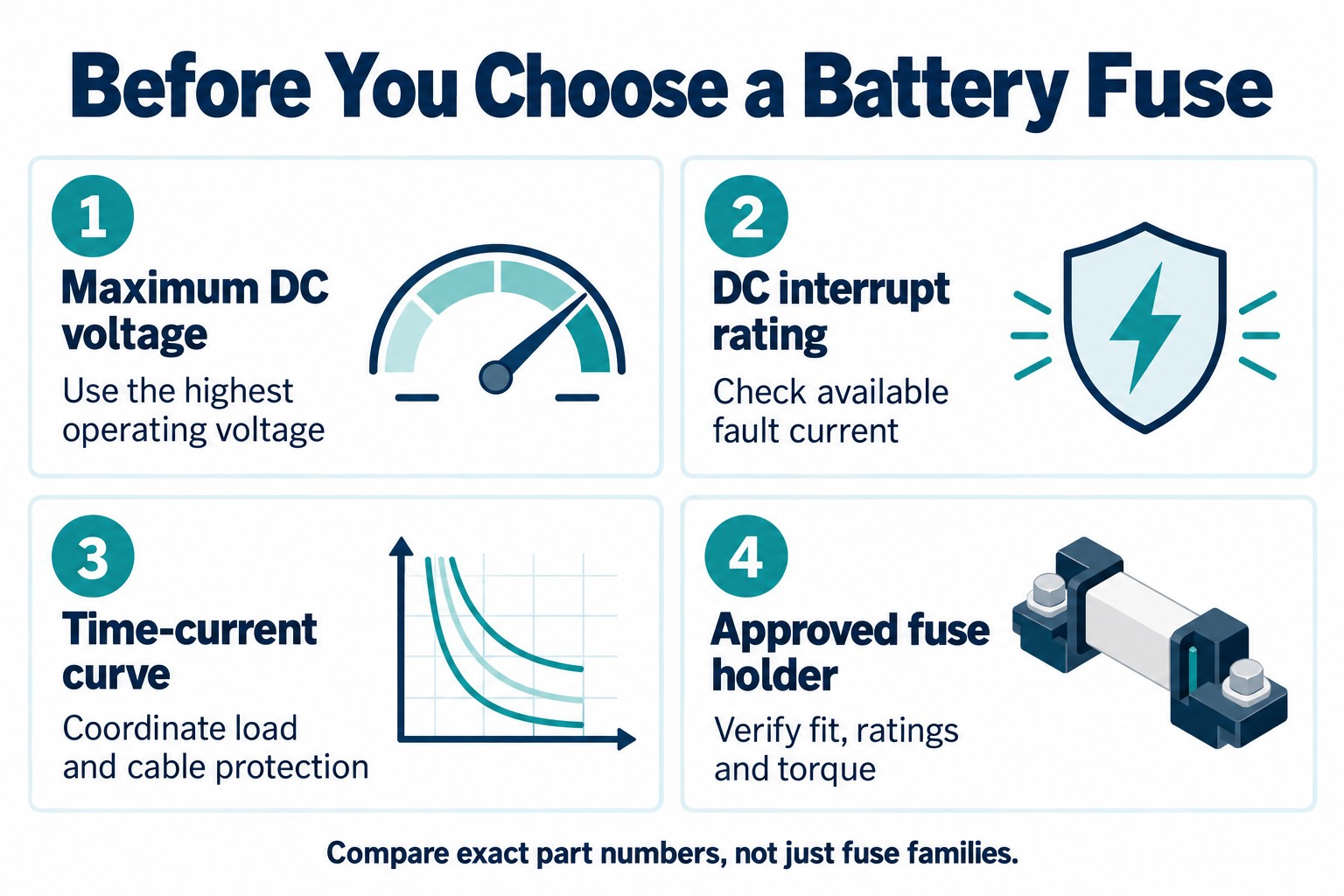
A battery’s nominal voltage is a system label. Fuse selection must account for the highest operating voltage at its location, including charging. A 32V DC fuse is not suitable for a nominal 48V battery circuit simply because its ampere rating looks sufficient.
Record the battery manufacturer’s maximum charging voltage and compare it with the fuse and holder ratings. Do not infer a DC rating from an AC marking. For the wider distinction between protective devices, see our DC 차단기 vs DC 퓨즈 가이드.
Current rating describes the fuse’s intended load-current range under specified conditions. Interrupting capacity describes the fault current it can safely clear under its specified test conditions. Neither number is the battery’s energy capacity in ampere-hours.
LiFePO4 banks can supply substantial short-circuit current. Obtain fault-current information from the battery supplier or have the designer calculate the prospective current at the fuse location, accounting for the bank arrangement and circuit impedance. Victron’s DC wiring guidance explains why breaking capacity is an essential fuse-selection criterion for lithium systems.
Illustrative screening example: if a documented circuit has 3kA available fault current, a fuse rated to interrupt only 2kA at the applicable DC voltage fails that check. A 20kA-rated candidate may pass the interrupt-capacity check, but still needs voltage, cable, curve and installation verification. These figures are a comparison exercise, not an estimate of your battery’s fault current.
Do not choose a fuse from battery capacity alone: a 200Ah battery does not automatically require a 200A fuse. Identify continuous charging and discharging currents, inverter requirements, cable ampacity and the equipment’s specified limits.
Use the inverter manufacturer’s recommended protection as part of that review. For example, Victron’s Inverter Smart installation manual provides model-specific cable and fuse recommendations. A generic online wattage calculation cannot replace those instructions.
If your design also includes a breaker, our 48V ESS and 250A DC MCCB compatibility guide covers the separate checks needed for that device. A breaker ampere rating does not establish compatibility with a particular fuse.
Two fuses with the same ampere marking can operate differently during a temporary overload. Check the manufacturer’s curve against normal load, inverter startup and the cable’s protection requirements. “Fast acting” and “time delayed” are starting descriptions, not enough information to establish coordination.
If a fuse opens repeatedly, investigate the cause before increasing its size. An oversized replacement may leave the cable inadequately protected. Ambient temperature, repeated pulses and mounting conditions also matter; the Littelfuse Fuseology selection guide discusses these application factors.
A fuse that physically fits between two studs is not automatically an approved replacement. Verify the holder’s compatible fuse series, DC voltage, current rating, conductor range, temperature limits and specified tightening torque.
Do not improvise adapters to exchange a MEGA fuse and a Class T fuse. Inspect the complete connection design, including lug dimensions and covers. Our high-current battery terminal guide explains the connection details worth reviewing alongside the fuse holder.
A main inverter fuse and individual battery-branch fuses protect different sections of a system. Adding parallel batteries can change the available fault current and the paths through which a fault is supplied. Recheck the design when the bank expands.
Follow the battery manufacturer’s approved series/parallel configuration and fusing instructions. For a concrete example, Victron’s Lithium NG installation guidance specifies fused battery connections and arrangements for multiple batteries. Do not assume a built-in BMS removes those requirements.
Before ordering, put these items on one schedule: battery model and configuration, maximum voltage, prospective fault current, fuse part number, holder part number, conductor size, load profile and the manufacturer’s supporting documents.
Then have a qualified designer or installer confirm the arrangement against the equipment instructions and applicable installation requirements. A fuse is not, by itself, a load-break disconnect. Any switching device needs its own appropriate DC rating. See our DC circuit breaker guide for ESS for the surrounding battery protection considerations.
No universal choice follows from the chemistry alone. The selected protection must satisfy the manufacturer’s instructions and the circuit’s voltage, fault-current and coordination requirements. Compare documented products rather than assuming one fuse family covers every battery.
Only an exact part with an adequate DC voltage rating and all other required characteristics can be considered. The 32V Littelfuse 298 series example above is unsuitable for a nominal 48V circuit. Do not generalize its rating to every MEGA product.
No. Its response depends on current magnitude, duration and application conditions. Use the manufacturer’s time-current curve; the ampere marking is not an instantaneous trip threshold.
Not as a simple drop-in substitution. Recheck the holder, voltage and interrupt ratings, operating curve, cable protection and equipment instructions. Matching amperes alone is insufficient.
Planning a LiFePO4 protection assembly? Prepare your maximum battery voltage, bank configuration, inverter model, cable details and fault-current information before requesting component selection. That makes a Class T vs MEGA fuse comparison specific enough to support an engineering decision.

