温州市岳陽工業区 325000
勤務時間
月曜日~金曜日:午前7時~午後7時
週末午前10時~午後5時
温州市岳陽工業区 325000
勤務時間
月曜日~金曜日:午前7時~午後7時
週末午前10時~午後5時

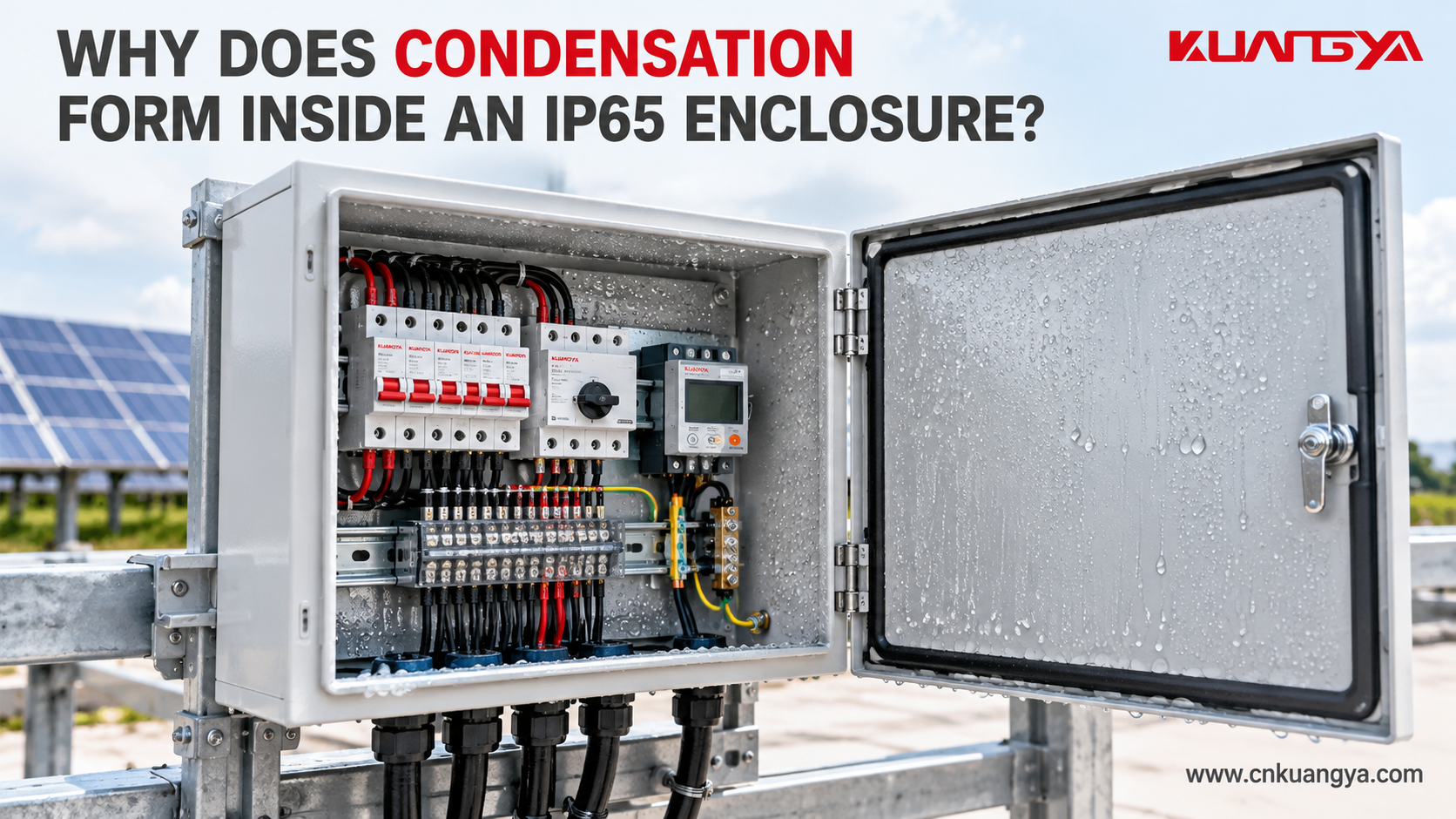
電気エンクロージャーはIP65等級です。ドアはしっかりと閉じられており、ケーブルグランドは適切に取り付けられているように見え、雨水の漏れを示す兆候は目に見えません。.
それでも、定期点検中に、保守担当者がエンクロージャーのドアの内側に水滴を発見します。.
より深刻な状況では、端子台、金属製取り付けプレート、または電子部品の周りに湿気が現れることがあります。.
エンクロージャーは粉塵や水の侵入を防ぐように設計されているのに、なぜIP65の電気エンクロージャー内部に結露が発生するのでしょうか?
その答えは、 水の侵入保護と内部の湿気管理の違いにあります。.
IP65筐体では、外部からの水の侵入がなくても、湿った空気が露点以下の表面に接触すると筐体内部で結露が発生する可能性があります。.
この区別は、屋外用電気盤、太陽光発電用コンバイナボックス、産業用制御盤、熱帯気候に設置される電気機器にとって特に重要です。.
本ガイドでは、結露が発生する理由、結露と水漏れを区別する方法、湿気によって引き起こされる問題、および用途に応じた効果的な防止方法について説明します。.
はい。IP65電気筐体内部では、外部防水機能に目に見える故障がなくても結露が発生する可能性があります。.
IP等級と結露のリスクは、筐体性能の異なる側面を表しています。.
IEA PVPSの IEC 60529: 筐体が提供する保護等級, 、IPコードは、定められた試験条件下でのアクセス、固形異物、および水の侵入に対する保護を分類します。.
IP65エンクロージャーの場合:
いずれの数字も、エンクロージャー内の空気が乾燥した状態を維持することを保証するものではありません。.
| 比較 | IP65保護 | 結露防止 |
|---|---|---|
| 主な目的 | 外部からの塵埃および水の侵入を制限する | 内部の湿気蓄積を制限する |
| 主な懸念事項 | 環境暴露 | 湿度と温度 |
| 関連規格 | IEC 60529 | 用途固有の熱および湿度設計 |
| 内部結露点の形成を防ぐか? | いいえ | リスクを低減できます |
| 主なソリューション | シール、筐体設計、適切なケーブルグランド | 加熱、湿気管理、圧力均等化ベント |
| よくある問題 | キャビネットへの雨水や塵埃の侵入 | 内部表面に水滴が形成されること |
このため、筐体をIP65からIP66にアップグレードしても、内部結露が自動的に解消されるわけではありません。.
より高い定格は、外部からの異なる形態の水への暴露に対する追加の保護を提供する可能性がありますが、結露を引き起こす物理的プロセスに直接対処するものではありません。.
エンクロージャーの侵入保護に関する詳細については、別のガイドを参照してください。 ソーラーコンバイナーボックスのIP65対IP66対IP67.
結露は、湿気を含んだ空気が、その空気の露点以下の温度の表面に接触したときに発生します。.
露点とは、空気中の水分量が変化しないと仮定した場合に、空気が水蒸気で飽和する温度のことです。.
表面がその点を下回って冷却されると、水蒸気は液滴に変化する可能性があります。.
プロセスは単純です。
暖かい湿った空気 → 表面の冷却 → 露点到達 → 水の凝結
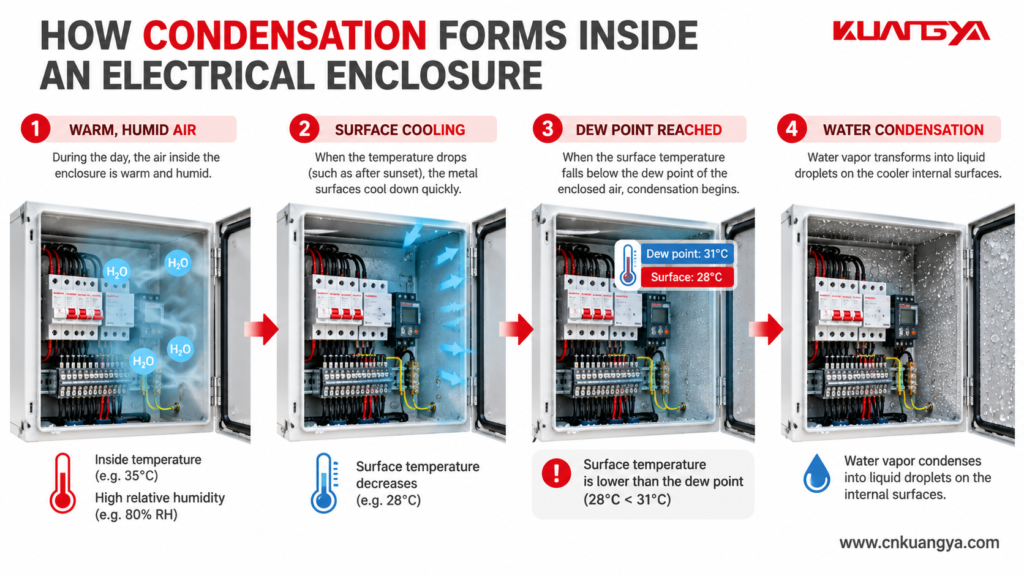
For example, an outdoor electrical cabinet may be relatively warm during the afternoon.
After sunset, its metal enclosure walls can cool rapidly.
If the internal surfaces become colder than the dew point of the trapped air, moisture may begin collecting on those surfaces.
This condensation mechanism is based on the relationship between air temperature, relative humidity, and dew point. When an enclosure surface cools below the dew point, moisture can form even without external water ingress.
Consider an electrical enclosure with the following hypothetical conditions.
| パラメータ | 値の例 |
|---|---|
| Internal air temperature | 35°C |
| Internal relative humidity | 80% |
| Approximate dew point | 31°C |
| Internal enclosure wall temperature after cooling | 28°C |
| Condensation risk | 高い |
At 35°C and 80% relative humidity, the approximate dew point is 31°C.
If the wall temperature falls to 28°C while the enclosed air retains approximately the same moisture content, condensation can occur.
The enclosure does not need to develop a visible leak for this to happen.
The example is a psychrometric calculation, not a reported field failure. Real internal humidity and dew point change as the enclosure exchanges heat and moisture with its environment.
Although dew-point formation is the underlying physical process, several installation and environmental factors make condensation more likely.
Outdoor electrical enclosures experience continuous temperature changes.
During daylight hours, solar radiation heats the enclosure surface. Internal electrical components may also contribute heat.
At night, the cabinet loses heat to the surrounding environment.
If the internal air remains humid while enclosure surfaces cool, condensation can form.
This pattern is especially relevant to exposed rooftop installations and ground-mounted photovoltaic systems.
Humidity is a major factor in condensation risk.
The higher the moisture content of the internal air, the closer its dew point is likely to be to the actual air temperature.
An electrical enclosure installed in a humid environment may contain moist air from the moment its door is closed.
Even if the enclosure seals are correctly installed, that trapped moisture can condense when the enclosure cools.
Not all moisture enters after commissioning.
Water vapor may become trapped inside during initial assembly, field wiring, inspection, or maintenance.
Possible circumstances include:
A correctly sealed enclosure can retain internal moisture if there is no suitable mechanism for removing it.
When air inside an enclosure heats up, it expands. When the air cools, it contracts.
These changes produce pressure differences between the inside and outside of the enclosure.
If pressure differences occur repeatedly, enclosure seals and cable entries may experience additional mechanical stress.
Over time, weaknesses in those interfaces can contribute to moisture ingress.
A purpose-designed pressure-equalization vent may help reduce these pressure differences.
IEA PVPSの GORE’s technical guidance for protective vents, pressure equalization can reduce seal stress and help minimize condensation accumulation.
However, a vent does not guarantee that the enclosure interior will always remain dry.
Cable glands are potential moisture-entry points if they are incorrectly selected or installed.
Common problems include:
In these cases, the problem may be actual liquid-water ingress rather than condensation alone.
A cable gland carrying its own IP rating does not automatically make the completed enclosure assembly IP65.
The installed configuration must maintain the required protection.
Installation position affects both solar heating and direct exposure to rain.
A cabinet installed in strong sunlight may experience higher daytime temperatures.
The same enclosure may subsequently cool during the evening.
Cable routing can also influence moisture movement.
For example, poorly positioned cable entries may allow water to collect around sealing interfaces or travel toward an entry point.
Suitable mounting positions, cable routing, and enclosure orientation should be included in the design.
Some enclosure designs focus heavily on preventing external water from entering but provide little consideration for internal humidity.
Potential weaknesses include:
The appropriate solution depends on the cabinet’s size, environmental conditions, electrical contents, and installation requirements.
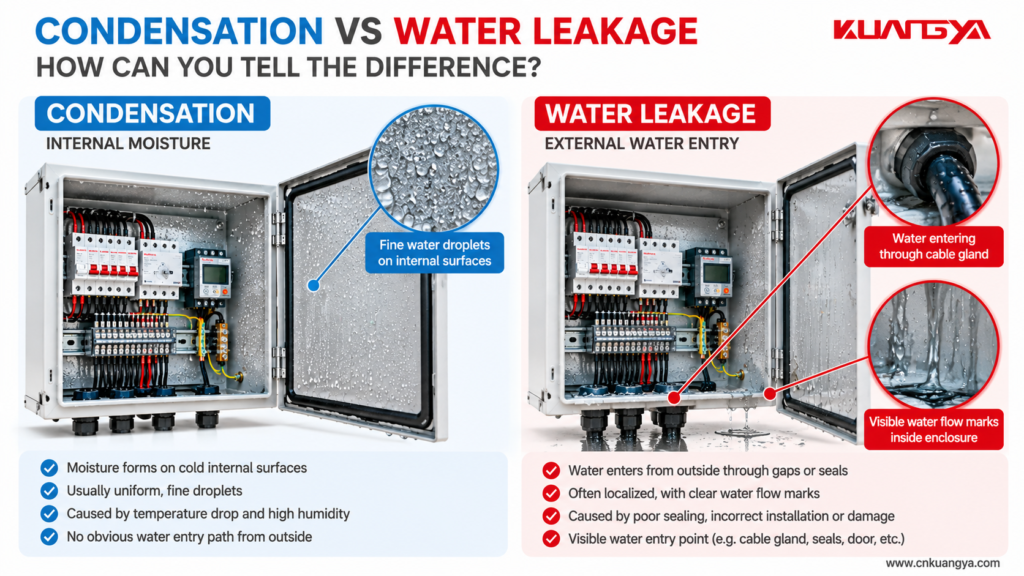
Finding water inside an enclosure does not automatically mean that its sealing system has failed.
Equally, it would be unsafe to assume that every moisture problem is harmless condensation.
The first troubleshooting task is to distinguish between condensation, external water ingress, and other possible moisture sources.
| 観察 | Possible Condensation | Possible Water Ingress |
|---|---|---|
| Fine droplets on cool internal surfaces | Common indication | Also possible |
| Moisture appears after nighttime cooling | Consistent with condensation | Not conclusive |
| Water concentrated below a cable entry | Less characteristic | Check cable gland or entry |
| Water appears immediately after heavy rain | Possible, depending on cooling | Leakage should be investigated |
| Visible water track from a door gasket | Less likely to be pure condensation | Strong leakage indication |
| Repeated moisture without rainfall | Possible | Also possible from trapped water or cable pathways |
| Corrosion concentrated near a penetration | Possible | Inspect for a local leak |
These observations are diagnostic clues, not definitive tests.
Step 1: Make the equipment safe.
Only qualified personnel should inspect electrical cabinets. Follow the applicable isolation, lockout/tagout, and verification procedures.
For photovoltaic installations, remember that DC circuits may remain energized whenever the solar array is illuminated, even if some switches are open.
Step 2: Inspect the enclosure exterior.
Look for damage to the housing, door seals, hinges, latches, cable glands, and unused openings.
Step 3: Inspect moisture distribution.
Check whether droplets are distributed across cool surfaces or concentrated around a specific penetration.
Step 4: Review environmental conditions.
Record ambient temperature, internal temperature, relative humidity, recent rainfall, and relevant operating conditions.
Step 5: Check the dew point.
Compare the calculated internal-air dew point with the measured temperature of the surfaces where moisture appears.
Step 6: Identify the source before modifying the enclosure.
Do not drill drainage or ventilation holes into an IP65 enclosure without a properly engineered solution. Unapproved modifications can compromise ingress protection.
Small water droplets may appear insignificant, but repeated moisture exposure can create serious reliability problems.
The consequences depend on the electrical system, contamination levels, component materials, and duration of exposure.
| Affected Component | Potential Moisture-Related Problem | Possible Consequence |
|---|---|---|
| 端子台 | Corrosion or contamination | Increased contact resistance |
| Metal mounting plate | Surface corrosion | Reduced service life |
| Electronic PCB | Leakage paths and corrosion | Malfunction or communication failure |
| Fuse holder connections | Contact degradation | 局所的な発熱 |
| DC SPD terminals | Corrosion or insulation deterioration | Reduced reliability |
| Monitoring module | Moisture-related electronic faults | Lost or unreliable monitoring |
| Door gasket | Aging or physical deterioration | Increased water-ingress risk |
| Cable gland interface | Seal deterioration | External moisture penetration |
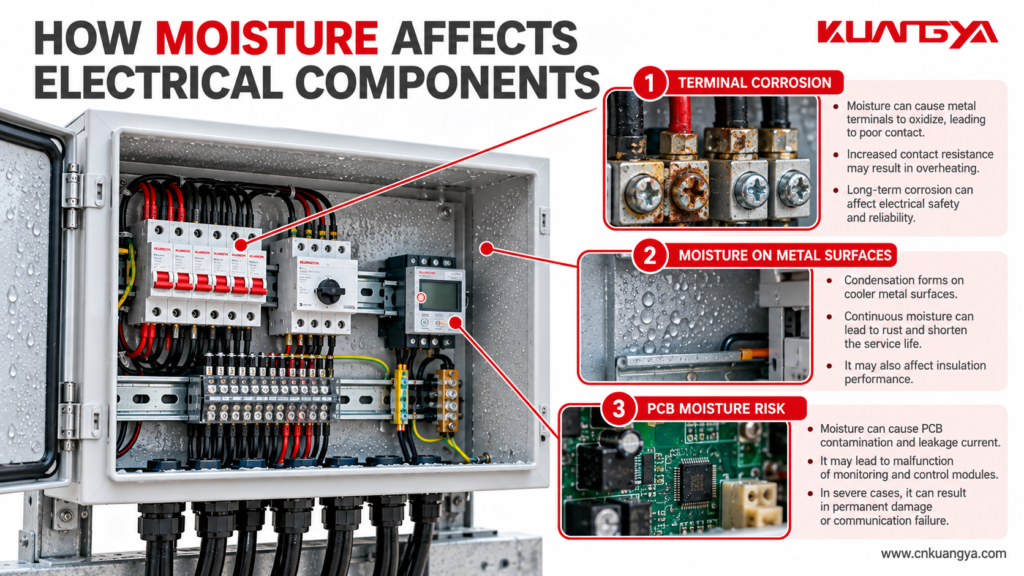
Moisture can accelerate corrosion on susceptible metal surfaces.
Where corrosion affects current-carrying connections, contact resistance may increase.
Higher resistance can produce additional heat during operation.
This does not mean every corroded connection will overheat, but it is a failure mechanism that requires attention.
Moisture and conductive contamination can reduce surface insulation resistance.
Under unfavorable conditions, leakage currents or tracking can develop.
This is particularly important in high-voltage DC installations where appropriate insulation coordination and separation distances are essential.
Modern electrical enclosures may contain sensors, communication interfaces, power supplies, and monitoring modules.
These components can be more sensitive to sustained moisture than simple mechanical structures.
In photovoltaic systems, electronic failures may interrupt data collection or remote monitoring.
For an example of a more complex PV enclosure architecture, see KUANGYA’s 16-String PV Combiner Box with Monitoring and Remote Control.
No single method is suitable for every electrical enclosure.
The correct approach should address the actual moisture source, operating temperature, environmental conditions, and enclosure requirements.
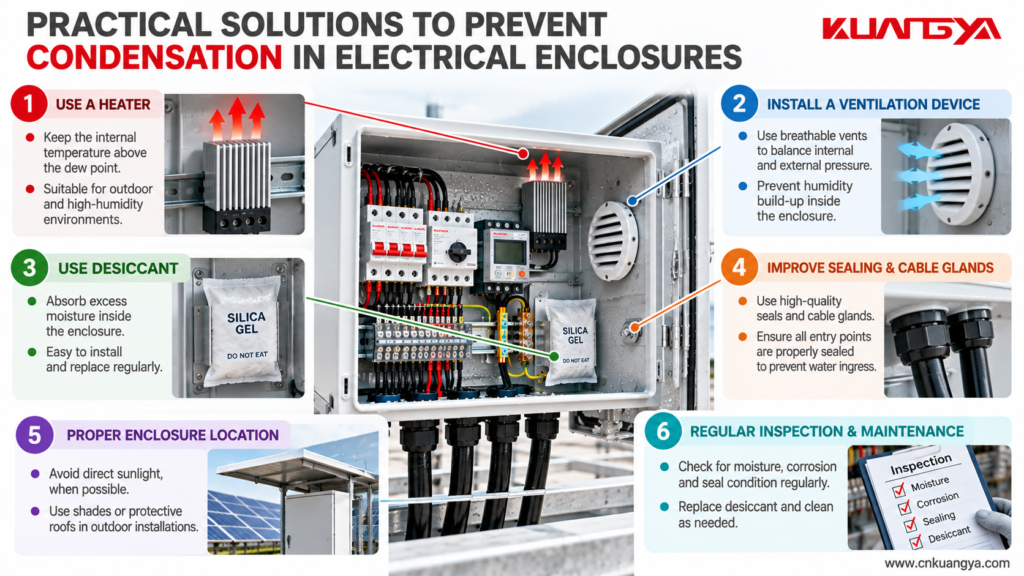
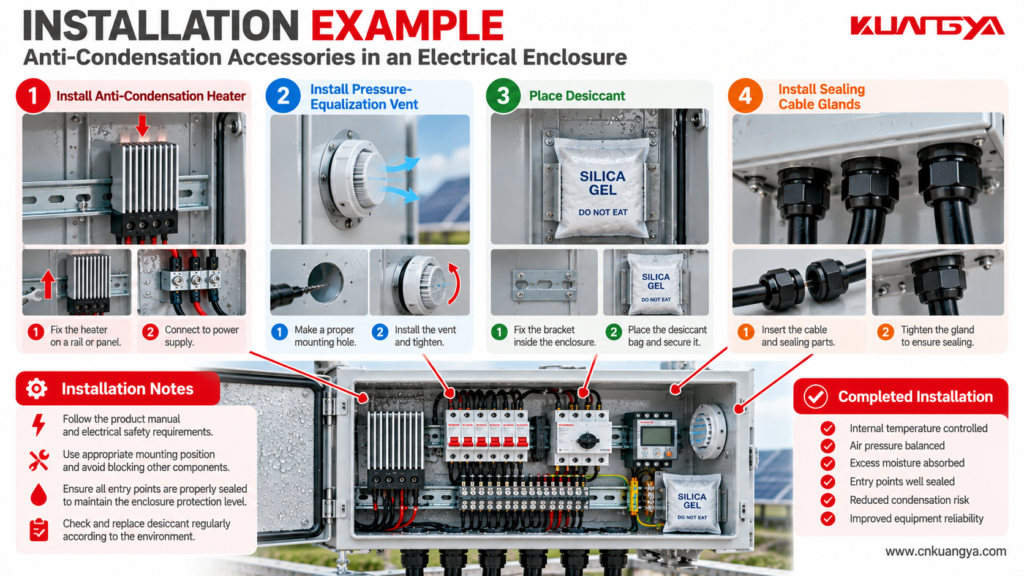
A pressure-equalization vent allows controlled gas exchange between the enclosure interior and external environment.
Certain protective membrane vents can limit entry of liquid water and particles while permitting air and water vapor movement.
Potential benefits include:
For photovoltaic applications, GORE Protective Vents for Solar Energy Systems explains how membrane vents can support pressure equalization and moisture management.
重要: Water vapor can pass in both directions. A vent is not a dehumidifier, and it does not guarantee a dry interior.
The entire enclosure-and-vent configuration must also be suitable for the required ingress protection.
An anti-condensation heater maintains selected internal surfaces at temperatures that reduce the likelihood of reaching the dew point.
Heaters may be controlled by thermostats, hygrostats, or combined temperature-and-humidity controllers.
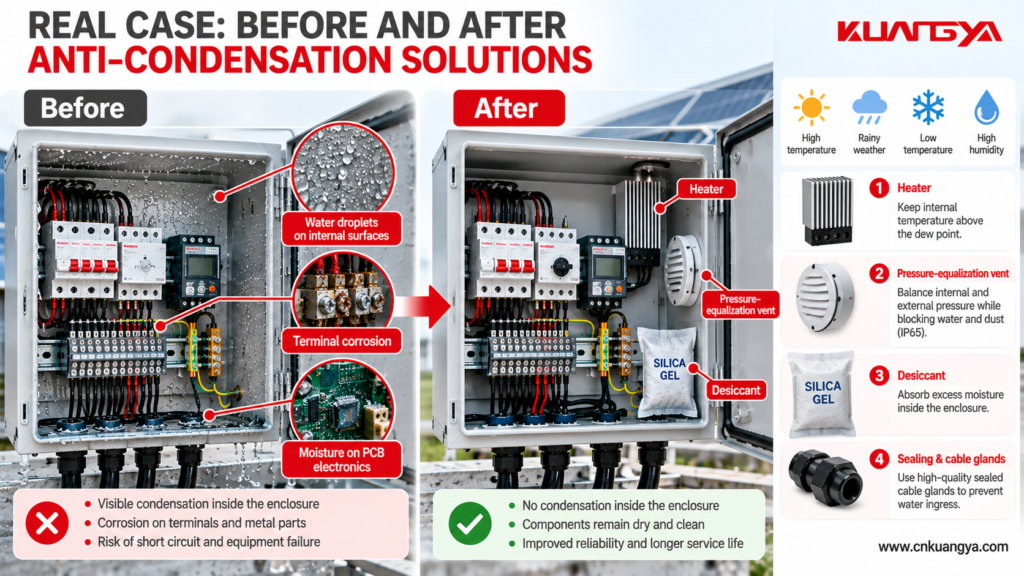
For example, a heater can be activated when the enclosure reaches conditions associated with condensation risk.
Schneider Electric provides dedicated enclosure heating solutions in its ClimaSys CR range.
However, a heater must be correctly sized and controlled.
It also requires a suitable power supply and must not cause internal components to exceed their permitted operating temperatures.
All cable entries should use glands suitable for the cable diameter, enclosure material, and environmental exposure.
Check that:
This primarily addresses external water entry, which can otherwise be confused with condensation.
Direct sunlight can increase cabinet surface temperature.
Where practical, enclosure orientation, location, and suitable shading arrangements can reduce extreme thermal exposure.
However, shading should not obstruct required airflow, compromise maintenance access, or violate product installation requirements.
For enclosures containing significant electrical heat sources, thermal calculations are important.
For critical installations, temperature and relative-humidity sensors can provide useful information.
Continuous or periodic monitoring may help identify conditions in which the internal dew point approaches the temperature of the enclosure walls.
Alarm settings should be based on the actual equipment and environment rather than a universal humidity threshold.
This is particularly useful for remote electrical cabinets that cannot be inspected frequently.
In some applications, approved enclosure drainage devices may help manage liquid water accumulation.
However, drainage is not a universal solution.
A simple open hole can compromise dust and water protection.
Where drainage is needed, use components compatible with the enclosure design and verify the ingress-protection requirements of the completed assembly.
Even a correctly designed enclosure benefits from periodic inspection.
Maintenance should include checking the condition of seals, glands, protective vents, internal moisture indicators, and vulnerable electrical connections.
Any evidence of corrosion, standing water, degraded insulation, or abnormal heating should be investigated.
For photovoltaic installations, additional maintenance information is available in the KUANGYA Solar Combiner Box Protection and Maintenance Guide.
The following table summarizes the advantages and limitations of common solutions.
| 方法 | 主な目的 | メリット | 制限事項 |
|---|---|---|---|
| Pressure-equalization vent | Reduce pressure differences and trapped moisture | Passive operation; no electrical power | Does not actively dry the air |
| Anti-condensation heater | Reduce dew-point formation on surfaces | Suitable for controlled thermal management | Requires power and correct sizing |
| Hygrostat or humidity controller | Control based on humidity conditions | Automatic operation | Requires compatible equipment |
| Improved cable sealing | Prevent external water entry | Essential for enclosure integrity | Does not remove trapped humidity |
| Suitable shading | Reduce solar heating effects | Passive thermal benefit | Site and design dependent |
| Humidity monitoring | Detect unfavorable internal conditions | Supports preventive maintenance | Monitoring alone does not remove moisture |
| Engineered drainage | Remove accumulated liquid water | Useful in selected designs | Must preserve required enclosure protection |
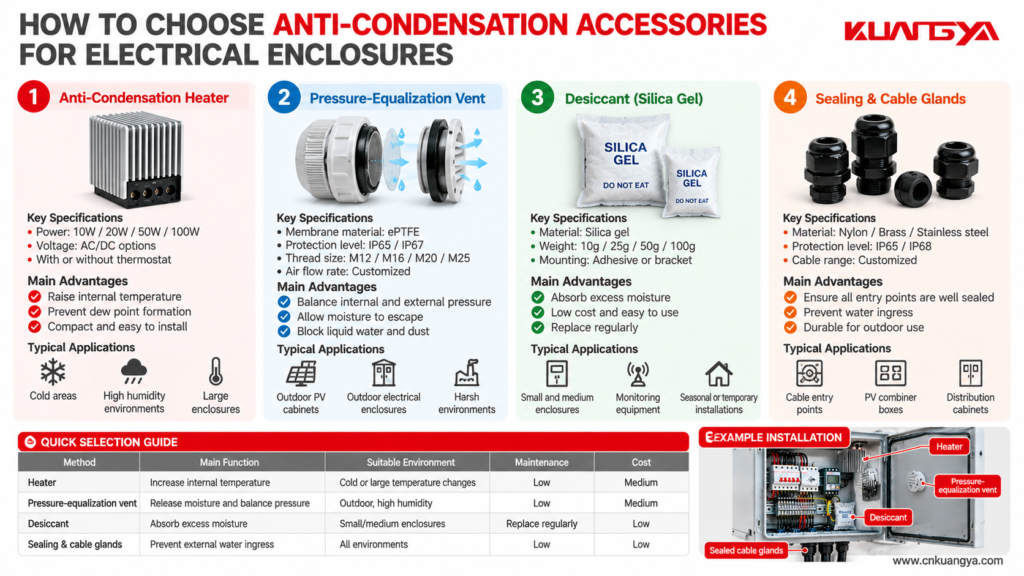
For a relatively small outdoor cabinet with moderate thermal cycling, a suitable pressure-equalization strategy may be worth evaluating.
For an enclosure exposed to low temperatures or persistent condensation risk, a controlled anti-condensation heater may be appropriate.
For complex enclosures containing electronic monitoring equipment, a combined approach involving environmental monitoring, sealing, and moisture control may be preferable.
The best solution is not necessarily the most expensive accessory. It is the solution that addresses the actual failure mechanism without creating a new electrical or environmental risk.
The following examples are illustrative engineering scenarios, not documented KUANGYA customer incidents. They demonstrate how environmental conditions can change the appropriate design response.
アプリケーション Outdoor photovoltaic system in Southeast Asia.
Operating environment: High relative humidity, frequent rainfall, and daily temperature variations.
Observed condition: Fine moisture droplets appear on the inside of the enclosure after cooler nighttime conditions.
Possible explanation:
Humid air inside the enclosure cools below its dew point.
The source of the moisture could be trapped air, vapor exchange, or another route that requires investigation.
Recommended engineering evaluation:
In this example, simply specifying a higher IP rating would not necessarily eliminate condensation.
アプリケーション Industrial control cabinet containing monitoring electronics.
Operating environment: Warm daytime conditions followed by substantial nighttime cooling.
Observed condition: Repeated moisture formation on internal metal surfaces.
Possible explanation:
Temperature cycling causes internal surfaces to fall below the dew point.
Recommended engineering evaluation:
A controlled anti-condensation heater may be considered, subject to power availability, internal temperature limits, and enclosure design.
A humidity sensor can also help determine whether the selected approach improves conditions.
アプリケーション Outdoor electrical control enclosure near a marine environment.
Observed condition: Moisture and corrosion around internal metal connections.
Possible explanations:
Recommended engineering evaluation:
Inspect the enclosure carefully for ingress paths, evaluate material and corrosion resistance, and choose sealing and moisture-management components suitable for the coastal environment.
In a coastal installation, corrosion protection should be considered separately from IP rating.
A solar PV combiner box is more than an outdoor enclosure.
It may contain DC fuse holders, surge protective devices, isolators, busbars, and electronic monitoring equipment.
These components have different thermal, electrical, and environmental requirements.
A moisture-control strategy must therefore be considered alongside the electrical design.
| Design Area | What Should Be Checked? |
|---|---|
| エンクロージャー | Appropriate IP rating for actual exposure |
| Cable entries | Correctly installed and sealed |
| Internal temperature | Ambient heat, solar gain, electrical heat dissipation |
| Internal humidity | Dew-point risk and monitoring requirements |
| DC fuse holders | Contact integrity and operating temperature |
| DC SPD | Manufacturer’s environmental and installation requirements |
| 監視装置 | Humidity and temperature operating limits |
| Vent or heater | Compatibility with enclosure and electrical design |
| メンテナンス | Accessibility and inspection intervals |
For example, a multi-string PV combiner box containing monitoring equipment may have a different thermal profile from a basic enclosure containing only fuse holders and a disconnect device.
Additional components can increase internal heat generation and introduce more environmental requirements.
For larger applications, see KUANGYA’s 16-String PV Combiner Box with Monitoring and Remote Control.
For a broader discussion of DC protection components, see Solar PV Electrical Protection: Complete Guide.
そうだ。.
A sealed enclosure can contain water vapor from the moment it is assembled or closed.
When the temperature changes, that moisture can condense on colder internal surfaces.
Sealing does not remove moisture already present.
Moreover, many practical electrical enclosures are not hermetically sealed.
Their long-term performance depends on the integrity of seals, cable entries, materials, and installation workmanship.
This is one reason why moisture management should be considered during enclosure design rather than treated only as a maintenance issue.
Before replacing an enclosure, use a systematic inspection process.
| 点検項目 | 何をチェックすべきか | Possible Next Action |
|---|---|---|
| Door gasket | Damage, distortion, contamination | Replace or restore sealing as specified |
| ケーブルグランド | Correct size, tightness, condition | 正しい設置 |
| Unused entries | Missing plugs or seals | Install approved sealing accessories |
| Internal water patterns | Droplets, streaks, pooling | Investigate condensation or leakage |
| 温度 | Internal and external conditions | Evaluate thermal management |
| 湿度 | Internal RH and calculated dew point | Evaluate moisture-control strategy |
| Pressure-equalization vent | Condition, location, suitability | Inspect or select suitable component |
| Electrical connections | Corrosion, discoloration | Qualified electrical inspection |
| Electronic modules | Moisture damage or abnormal operation | Follow manufacturer guidance |
| Maintenance records | Recurring seasonal or weather-related patterns | Revise inspection plan |
Document inspection results before changing the enclosure.
If moisture has affected energized components, the equipment should be evaluated by qualified personnel before it is returned to service.
For OEM buyers, distributors, EPC contractors, and electrical equipment purchasers, condensation prevention should be discussed before confirming the final enclosure specification.
| 質問 | なぜ重要なのか |
|---|---|
| Where will the enclosure be installed? | Determines environmental exposure |
| What is the required IP rating? | Defines relevant ingress-protection requirements |
| What is the ambient temperature range? | Supports thermal design |
| What humidity conditions are expected? | Helps evaluate dew-point risk |
| Will the enclosure be exposed to direct sunlight? | Influences temperature cycling |
| Are electronic monitoring components included? | Adds environmental requirements |
| Are additional cable entries required? | May affect completed enclosure protection |
| Is pressure equalization needed? | Can help with seal stress and moisture management |
| Is a heater or humidity controller required? | May reduce condensation risk |
| What tests and documentation are available? | Supports purchasing verification |
Buyers should request specifications for the complete assembly rather than relying solely on the nominal IP rating of an empty enclosure.
IP65 indicates dust-tight protection and resistance to water jets under defined test conditions.
It does not mean that an enclosure is suitable for all water exposures, prolonged immersion, or every installation environment.
It also does not guarantee that condensation will never form inside.
Possible causes include internal condensation, damaged gaskets, unsuitable cable glands, unsealed openings, or water entering along a cable.
Inspect the enclosure before determining the cause.
Not automatically.
IP66 and IP67 describe particular external ingress-protection tests.
Condensation depends primarily on the relationship between internal moisture, dew point, and surface temperature.
そうだ。.
A suitable membrane vent can help equalize pressure and reduce trapped moisture, but it cannot guarantee zero condensation under every environmental condition.
Vent performance also depends on correct selection, positioning, and installation.
そうだ。.
Heaters require appropriate power, space, control, and thermal design.
They must be suitable for the enclosure contents and application environment.
Desiccants such as silica gel can absorb a limited amount of moisture in suitable applications.
However, they have finite capacity and require replacement or regeneration.
They are not a universal substitute for proper sealing, pressure management, or engineered humidity control.
そうだ。.
Outdoor PV equipment may experience strong solar heating, cooler nighttime conditions, humidity, and weather exposure.
Condensation can affect internal electrical connections and electronic components.
The design should consider moisture risk alongside electrical protection.
Not without an engineered and approved design.
An uncontrolled opening may compromise ingress protection and introduce additional contamination or water-entry risks.
Use compatible drainage components where the application requires them.
Condensation inside an IP65 electrical enclosure is not necessarily evidence of defective waterproofing.
An enclosure may successfully resist external water jets while still containing enough internal water vapor to form droplets during temperature changes.
The key is to understand the actual moisture mechanism.
For reliable long-term operation:
IP protection controls external exposure. Condensation prevention requires attention to the environment inside the enclosure.
Both are important for dependable outdoor electrical installations.
KUANGYA supplies electrical protection components and photovoltaic combiner box solutions for industrial and solar energy applications.
Our product scope includes DC surge protective devices, DC fuse holders, DC circuit breakers, and PV combiner box configurations.
For a project involving an outdoor solar combiner box, buyers can discuss environmental exposure, string count, system voltage, internal electrical components, monitoring requirements, and enclosure specifications before confirming the configuration.
If your project requires a customized photovoltaic combiner box, contact KUANGYA with your electrical and environmental requirements.
ウェブサイト www.cnkuangya.com
Eメール Please use the contact information published on the official KUANGYA website.
Discuss your PV combiner box requirements with KUANGYA before finalizing your outdoor enclosure design.
Technical note: This article provides general engineering guidance. Final enclosure selection, thermal design, installation, inspection, and maintenance must comply with applicable electrical requirements and the instructions for the specific products used. Illustrative scenarios are not presented as documented field incidents.

