温州市岳陽工業区 325000
勤務時間
月曜日~金曜日:午前7時~午後7時
週末午前10時~午後5時
温州市岳陽工業区 325000
勤務時間
月曜日~金曜日:午前7時~午後7時
週末午前10時~午後5時

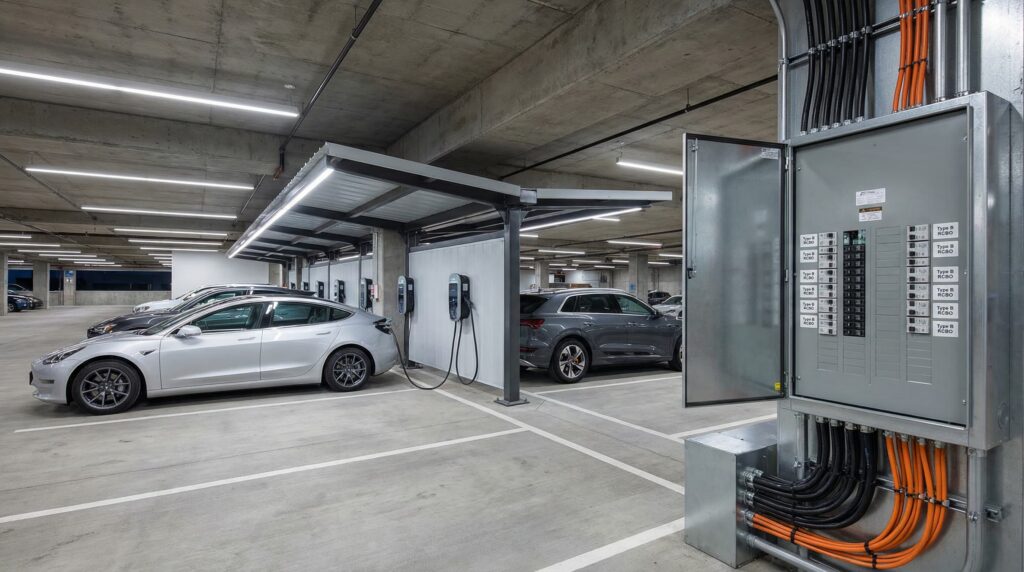
If an EV charger keeps tripping the RCD or RCBO, the protection device is detecting a condition that needs investigation. Common causes include moisture, damaged charging cables, insulation faults, excessive combined leakage, incorrect neutral wiring, the wrong RCD type, overload, loose terminals and poor coordination between upstream and downstream devices.
Do not repeatedly reset the device to finish a charge. Disconnect the vehicle, stop using visibly damaged equipment and arrange testing by a qualified electrician if the trip repeats. Replacing a 30 mA device with a less sensitive RCD can conceal the problem and may remove required protection.
| When it trips | Likely area to investigate | Useful clue |
|---|---|---|
| Immediately when the charger is switched on | Short circuit, wiring fault, neutral fault, damaged EVSE or unsuitable breaker curve | MCB/RCBO handle or trip indicator may identify overcurrent versus residual current |
| When the cable is connected to the car | Connector moisture, cable damage, vehicle insulation fault or handshake-stage leakage | Try no further resets if the plug or cable is wet, hot or damaged |
| When charging current rises | Overload, loose terminal heating, undersized cable or leakage increasing under load | Check whether the trip is thermal and delayed |
| After rain or overnight condensation | Moisture in connector, cable, glands, enclosure or outdoor isolator | Problem may disappear when dry but the insulation fault still needs repair |
| Only when other appliances are running | Accumulated leakage or a fault on another circuit sharing the RCD | A shared RCCB may trip even though the EV circuit is not the only contributor |
| Randomly after weeks of normal use | Ageing cable, loose connection, water ingress, EVSE component or vehicle fault | Review EVSE logs and compare different vehicles if permitted by the manufacturer |
| Main RCD and charger RCBO trip together | Poor RCD selectivity or a high residual-current fault | Review sensitivity, time delay and manufacturer coordination data |
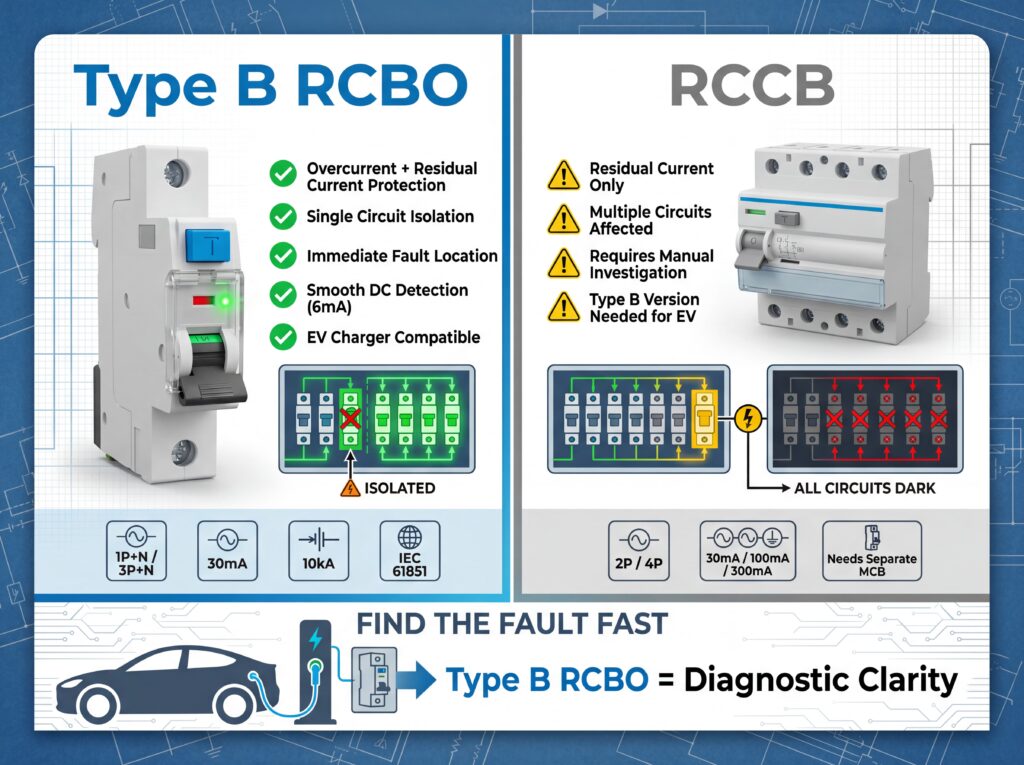
Homeowners often call every protective device an “RCD,” but the device that operates changes the diagnosis.
| 装置 | 主機能 | What a trip can indicate |
|---|---|---|
| エムシービー | Overload and short-circuit protection | Too much current, short circuit, loose or overheated connection, unsuitable rating or curve |
| RCCB / RCD | Residual-current protection | Leakage to earth somewhere in the protected group; no integral overload protection |
| アールシーボ | Residual current plus overload and short circuit | Either leakage or overcurrent; check the product’s trip indicator |
| EVSE internal protection | Charger monitoring and switching | Vehicle, connector, temperature, communication, RDC-DD or internal EVSE fault |
| Main switch | Isolation only on many boards | If it has no trip mechanism, another device may have operated |
Photograph the distribution board and note which handle or indicator changed before resetting. Do not remove covers or touch internal wiring.
Outdoor connectors, wallboxes and isolators are exposed to rain, condensation and temperature changes. Moisture lowers insulation resistance and creates a leakage path to earth. The trip may occur only during wet weather or after the cable has been left on the ground.
A cable can be crushed by a vehicle, pinched by a garage door or weakened near the plug strain relief. Internal damage may not be visible until the cable bends or carries full charging current. Heat, discolouration, exposed insulation or a loose connector requires immediate withdrawal from service.
The fault may be inside the wallbox, contactor, filter, onboard charger or vehicle inlet. EVSE event logs can help distinguish an internal charger alarm from an upstream protective-device trip. A qualified technician may compare behaviour with another compatible vehicle or charger, following the manufacturer’s procedure, but should not bypass any protection.
Electronic equipment normally contributes small protective-conductor currents. If the EV charger, heat pump, solar inverter, appliances and sockets share one 30 mA RCCB, their combined leakage can approach the operating range. The EV starts charging, adds its normal leakage and the shared device trips.
The solution is not automatically a higher IΔn. Measure leakage by circuit, repair faults and consider circuit subdivision or individual RCBO protection where the installation rules permit it.
A neutral connected to the wrong RCD group, a shared neutral or a downstream neutral-to-earth fault can make current return outside the intended sensing path. Trips can appear random and may depend on which other appliance is operating. This is a common reason a main RCCB trips even when the EV charger circuit appears normal.
Mode 3 EV charging can require protection against smooth DC residual current. Depending on the EVSE, the correct arrangement may be a Type B RCD or a Type A/Type F RCD used with an IEC 62955-compliant 6 mA RDC-DD. The EVSE manufacturer and local rules determine the acceptable choice.
For authoritative background, see the IEC 62955 standard overview and the IET article on RCDs for electric vehicle supply equipment.
Changing from Type A to Type B is not a universal cure for nuisance tripping. First verify the actual fault, the charger’s built-in DC detection and the installed device characteristics. For the technical comparison, see the Type B versus Type A + RDC-DD guide.
If an MCB or the overcurrent element of an RCBO trips after charging for some time, the circuit may be overloaded or the protective device may be heating. The EVSE maximum current, cable capacity, terminal condition, ambient temperature, grouping and breaker rating all need checking. Do not fit a larger breaker unless the cable and complete circuit are designed for it.
A loose terminal increases resistance and produces heat during a long charging session. Thermal operation can look like a random trip after one or two hours. Warning signs include a hot enclosure, burning smell, buzzing, discolouration or melted insulation. Isolate the circuit and arrange urgent inspection.
When a charger RCBO and an upstream RCCB are both instantaneous 30 mA devices, a downstream fault can operate either or both. Correct coordination depends on the installation design, sensitivity, operating time and manufacturer data. The goal is for the device closest to the fault to disconnect while unaffected circuits remain supplied.
Do not open the consumer unit or EVSE, perform live tests, bypass the RCD, tape a damaged cable, change the breaker rating or disconnect the protective conductor.
The order of tests should follow the equipment instructions and local safe-isolation procedures. Electronic equipment can be damaged by an inappropriate insulation-test voltage or connection method.
Device-specific instructions take priority. As an example of manufacturer documentation, ABB’s Terra AC installation manual shows how required protection can depend on the selected charger and local regulations.
Wet-weather trips strongly suggest moisture or insulation deterioration, but the exact location may be the plug, tethered cable, socket, wallbox, isolator, underground cable or another outdoor circuit sharing the RCD. Drying out does not prove the equipment is safe. Water marks, corrosion and reduced insulation resistance should be investigated before normal use resumes.
A delayed trip at high power can point to overload, terminal heating, cable derating, EVSE thermal protection or leakage that increases under load. Reducing the charger current may help a technician reproduce and diagnose the fault, but it is not a permanent repair unless the system is formally redesigned and configured to that lower current.
If the EV charger has its own RCBO but the main RCCB trips, possible causes include poor selectivity, the EV circuit being connected through the main RCCB, cumulative leakage from several circuits, a crossed neutral or a high residual-current fault. Review the single-line arrangement and neutral routing. Two 30 mA instantaneous RCDs in series do not guarantee that the downstream device trips first.
Possible causes include moisture, connector damage, an EVSE or vehicle insulation fault, crossed neutral wiring or a fault detected during the charger’s startup checks. Stop repeated resets and arrange testing if it happens again.
Delayed trips can be caused by overload, terminal heating, cable derating, rising leakage, moisture or an EVSE thermal fault. Record the charging current and time to trip for the electrician.
Yes. Moisture can reduce insulation resistance in the plug, cable, wallbox, isolator or wiring. Do not assume the circuit is safe when it dries; have the source identified.
Only if the existing problem is related to an unsuitable residual-current type and the complete design requires Type B. Type B will not repair moisture, damaged insulation, crossed neutrals, overload or poor selectivity.
Do not do this to stop tripping. Where 30 mA additional protection is required, a 100 mA device is not an equivalent replacement. Find the fault or redesign the circuit correctly.
The devices may lack selectivity, the EV circuit may be routed through both, leakage may be accumulating across several circuits, or neutral wiring may be incorrect.
Yes. A vehicle onboard-charger or inlet fault can contribute residual current. Diagnosis should compare EVSE logs and controlled tests without bypassing protection.
A dedicated final circuit with individual protection is common and improves fault isolation. The exact RCCB/RCBO arrangement depends on the EVSE and local wiring rules.
No. A repeated trip indicates a condition that needs investigation. Stop if the trip repeats, equipment is wet or damaged, or there is heat, smell or discolouration.
Clear fault information reduces diagnostic time and avoids unnecessary device replacement. For wiring-reference information, see the RCBO wiring and troubleshooting guide. For suitable circuit-protection products, review KUANGYA’s RCCB そして アールシーボ ranges, or contact the technical team with the EVSE and circuit details.

