Mastering Selectivity: How to Wire Type S RCDs to Avoid Total Blackouts

Electrical safety in modern installations demands more than just protection—it requires intelligent coordination. When a ground fault occurs in your kitchen circuit, should your entire building lose power? The answer lies in understanding Type S RCDs (Residual Current Devices) and their role in selective coordination. This comprehensive guide explores how to wire Type S RCDs correctly to prevent total blackouts while maintaining maximum safety.

Understanding RCD and RCCB: The Foundation of Electrical Safety

Before diving into Type S specifics, it’s essential to clarify the terminology that often confuses installers and engineers. An 漏電遮断器 is the general term for any device that detects leakage currents and disconnects the circuit to prevent electric shock. An RCCB(残留電流サーキットブレーカー) is a specific type of RCD that primarily detects residual currents without providing overcurrent protection. In many regions, these terms are used interchangeably, though RCCB is more commonly used in IEC standards, while RCD encompasses a broader category including RCBOs (which combine residual current and overcurrent protection).

RCDs operate by measuring the current balance between line and neutral conductors using a differential current transformer. When current flowing through the line conductor doesn’t equal the return current through the neutral, the difference indicates leakage to earth—potentially through a person’s body or damaged insulation. The device detects this imbalance and trips within milliseconds, disconnecting power before fatal injury occurs. This protection mechanism works regardless of whether the fault current returns through the installation’s earth wire, making RCDs effective even when earth wiring is compromised.

The Type S Difference: Why Time Delay Matters

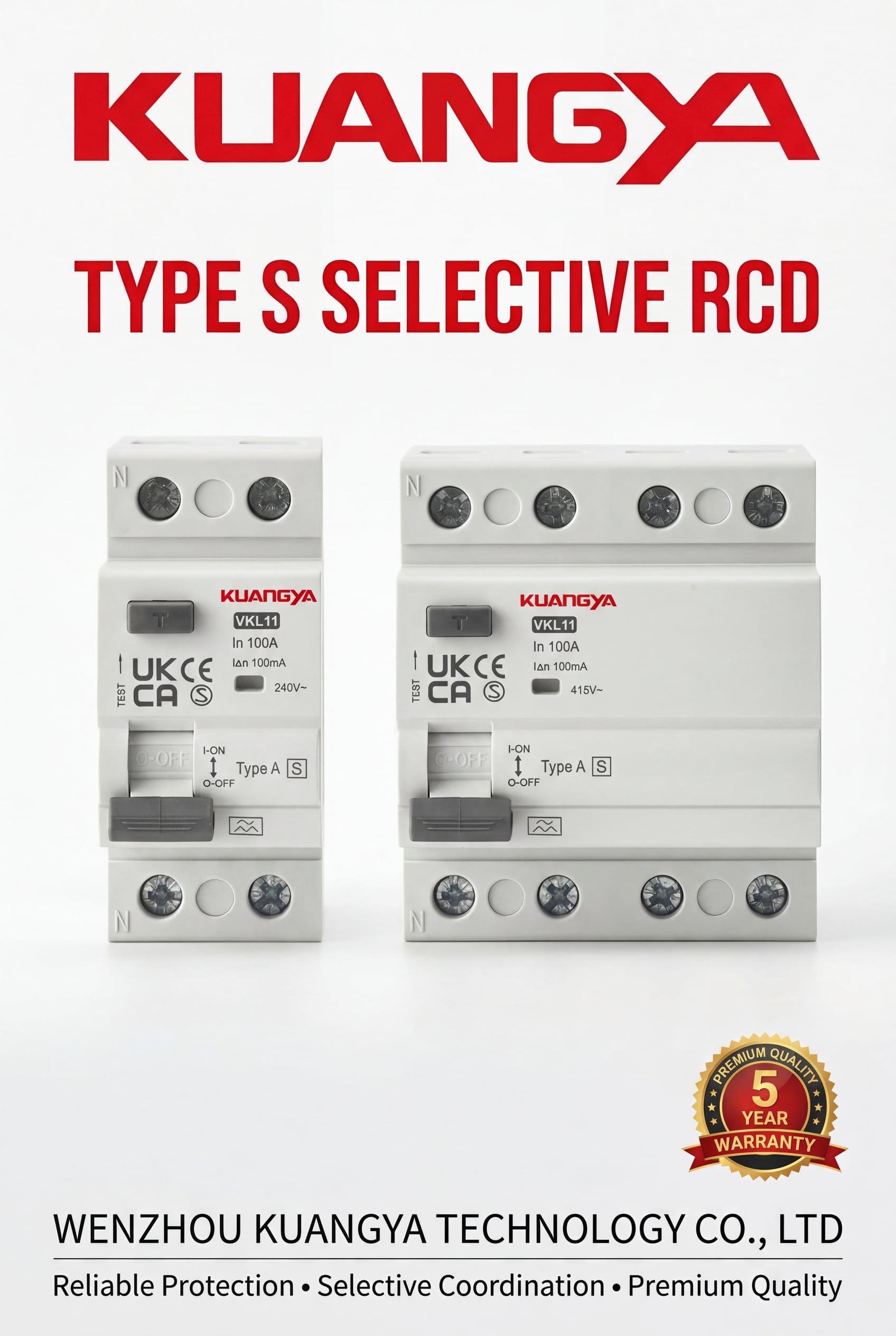
Type S RCDs represent a specialized category designed specifically for 選択的調整 (also called discrimination or selectivity). Unlike standard instantaneous RCDs that trip immediately upon detecting fault current, Type S devices incorporate a deliberate time delay—typically 130-500 milliseconds depending on the fault magnitude. This seemingly counterintuitive delay serves a critical purpose: it allows downstream RCDs to clear faults first, ensuring only the affected circuit loses power rather than the entire installation.

The technical specifications reveal the sophistication of Type S operation. According to IEC standards, a Type S RCD must have a minimum non-actuating time—the maximum delay during which residual current higher than the rated non-operating current can be applied without causing the device to trip. For instantaneous RCDs, maximum trip times are 0.3 seconds at rated current (IΔn), 0.15 seconds at 2×IΔn, and 0.04 seconds at 5×IΔn. Type S devices extend these limits to 0.5 seconds at IΔn and 0.2 seconds at 2×IΔn, creating the temporal window needed for selectivity.

Type S RCDs also feature enhanced surge withstand capability. While standard RCDs must withstand a 200 A ring wave impulse per IEC 61008 and IEC 61009, selective types are required to withstand 3000 A impulse surge currents. This robust construction prevents nuisance tripping from transient events like lightning-induced surges or motor starting currents, further improving system reliability.

The Selectivity Problem: Why Total Blackouts Occur

In installations without proper selectivity, a single ground fault can cascade into a complete power outage. Consider a typical commercial building with one main 300 mA RCD feeding multiple branch circuits, each protected by 30 mA RCDs. When a fault occurs on a single branch—perhaps a damaged appliance cord in an office—both the branch RCD and the main RCD may detect the fault simultaneously. Without time coordination, either device might trip first, and if the main RCD trips, the entire building loses power. Refrigeration systems shut down, security systems fail, emergency lighting may activate unnecessarily, and productivity grinds to a halt—all because of a fault affecting just one circuit.

This lack of selectivity creates secondary safety hazards beyond mere inconvenience. Loss of lighting in stairwells, corridors, or industrial areas can cause falls and injuries. Critical equipment may experience damaging power cycles. In healthcare facilities, life-support systems on backup power create unnecessary risk. Food service operations face spoilage losses. Data centers may experience server disruptions. The economic and safety costs of poor RCD coordination far exceed the modest investment in proper Type S devices.

Achieving Selectivity: The 3:1 Rule and Time Coordination

IEC standards establish clear rules for achieving selectivity between RCDs in series. The fundamental principle requires that the upstream device’s sensitivity must be at least three times the downstream device’s sensitivity. This 3:1 ratio ensures that under normal fault conditions, the more sensitive downstream device will always see the fault first and have time to clear it before the upstream device responds. Additionally, the upstream device must be of selective (S) type if the downstream device is instantaneous, or of delayed (R) type if the downstream device is already selective.

Practical application of this rule creates a protection hierarchy. For personnel protection at final circuits, 30 mA RCDs provide the required sensitivity to prevent ventricular fibrillation. Upstream from these, a 100 mA Type S RCD satisfies the 3:1 ratio (100 ÷ 30 = 3.33) and provides the time delay needed for selectivity. At the installation main, a 300 mA Type S RCD offers fire protection and serves as the final backup, maintaining the 3:1 ratio with the 100 mA intermediate level (300 ÷ 100 = 3). This three-tier approach ensures that faults are cleared at the lowest possible level, maximizing power availability.

Some manufacturers offer RCDs with enhanced measurement accuracy beyond minimum IEC requirements, allowing selectivity ratios lower than 3:1—sometimes as low as 1.25:1 or 2:1 depending on the specific models. However, these reduced ratios require careful verification using manufacturer coordination tables and should not be assumed without documentation. When in doubt, the conservative 3:1 ratio ensures reliable selectivity across all conditions and equipment combinations.

CNKUANGYA Selection Guide: Choosing the Right Type S RCD

Selecting the appropriate Type S RCD involves matching several critical parameters to your installation requirements. CNKUANGYA offers a comprehensive range of Type S RCDs designed for various applications, from residential distribution to industrial power systems.

Sensitivity Rating (IΔn) Selection

The sensitivity rating determines the residual current threshold at which the device will trip. Selection depends on the protection objective and position in the installation hierarchy:

30 mA RCDs provide personnel protection and serve as “additional protection” per IEC 60364 regulations. These devices trip fast enough to prevent ventricular fibrillation in direct contact scenarios. They are mandatory for socket outlets up to 32 A in bathrooms, kitchens, outdoor locations, and other high-risk areas. However, 30 mA devices should 決して be Type S—the time delay would compromise their life-safety function. Always use instantaneous 30 mA RCDs for final circuits.

100 mA Type S RCDs serve as upstream protection in selective coordination schemes. They provide automatic disconnection for fault protection and limited fire protection while maintaining the 3:1 ratio with downstream 30 mA devices. This sensitivity level is ideal for sub-distribution boards, EV charger supply circuits, and intermediate protection layers in commercial buildings. The 100 mA threshold is high enough to avoid nuisance tripping from accumulated leakage currents across multiple downstream circuits, yet sensitive enough to detect dangerous faults.

300 mA Type S RCDs provide fire protection and serve as main incoming protection for entire installations. At this sensitivity level, the device won’t prevent electric shock from direct contact but will detect insulation failures that could cause electrical fires. The 300 mA rating is particularly suitable for TT earthing systems where earth loop impedance is high, and for main distribution boards feeding multiple sub-boards. This level maintains the 3:1 ratio with 100 mA intermediate protection.

RCD Type Selection (Waveform Sensitivity)

Beyond sensitivity rating, RCDs are classified by the types of residual current waveforms they can detect. This classification has become increasingly critical as modern loads generate complex leakage patterns:

  • タイプAC: Detects only sinusoidal AC residual currents. Once the standard for all installations, Type AC is now largely obsolete due to its inability to detect pulsating DC components from common electronic equipment. Many jurisdictions have prohibited new Type AC installations.
  • タイプA: Detects sinusoidal AC and pulsating DC residual currents up to 6 mA. This is the current minimum standard for most residential and commercial applications, suitable for circuits feeding computers, LED lighting, and basic electronic equipment.
  • タイプF: Extends Type A capability to handle higher-frequency residual currents (up to 1 kHz) from variable-speed drives and inverters. Recommended for circuits with frequency converters and modern HVAC systems.
  • タイプB: Detects all waveforms including smooth DC residual currents. Required for EV charging stations, photovoltaic inverters, and industrial variable-speed drives that can generate significant DC leakage. Type B RCDs are essential where DC components could “blind” Type A devices.

For Type S applications, CNKUANGYA recommends Type A as minimum for general upstream protection, with Type F or Type B specified based on downstream load characteristics. When protecting circuits with EV chargers or PV inverters, the upstream Type S RCD should match or exceed the type requirements of downstream devices.

Rated Current and Pole Configuration

The rated current (In) must match or exceed the maximum load current of the protected circuit. CNKUANGYA Type S RCDs are available in ratings from 40 A to 125 A, covering most distribution applications. For single-phase installations, select 2-pole (2P) devices that disconnect both line and neutral. For three-phase systems, choose 4-pole (4P) devices to ensure complete isolation of all live conductors. The rated current should coordinate with upstream overcurrent protection—the Type S RCD provides residual current protection only and must be paired with MCCBs or fuses for overload and short-circuit protection. 引用

Breaking Capacity and Standards Compliance

Quality Type S RCDs must meet IEC 61008-1 requirements for short-circuit making and breaking capacity—typically 500 A to 1000 A depending on the model. This ensures the device can safely interrupt fault currents without contact welding or dangerous arcing. CNKUANGYA devices are tested to international standards including IEC, CE, and RoHS compliance, with documentation available for specification and approval processes. 引用

Type S RCD Wiring Guide: Step-by-Step Installation

Proper wiring is critical for Type S RCD effectiveness. Incorrect connections can compromise selectivity, create safety hazards, or prevent operation entirely.

インストール前の検証

Before beginning installation, verify that:

  1. The Type S RCD rating matches the design specifications (sensitivity, rated current, type)
  2. Upstream overcurrent protection (MCCB or fuses) is correctly sized
  3. The installation earthing system type (TN-S, TN-C-S, TT) is confirmed
  4. Downstream RCDs maintain the 3:1 sensitivity ratio
  5. The enclosure provides adequate IP rating for the environment

Wiring Procedure

Step 1: Power Isolation — De-energize the installation and verify absence of voltage using a proven voltage tester. Lock out and tag the main isolation point.

Step 2: Mounting — Mount the Type S RCD on DIN rail in the distribution board, ensuring adequate clearance for connections and heat dissipation. Position it upstream of the circuits it will protect but downstream of the main isolation switch and overcurrent protection.

Step 3: Line Conductor Connection — Connect the incoming line conductor(s) to the terminals marked “Line In” or with the supply-side symbol. For single-phase, this is typically the top left terminal. For three-phase, connect L1, L2, L3 to the appropriately marked terminals. Torque to manufacturer specifications (typically 2.5-4.0 Nm for M4 terminals).

Step 4: Neutral Conductor Connection — Connect the incoming neutral to the neutral input terminal, typically marked “N In” or positioned adjacent to the line input. Critical: The neutral must pass through the RCD’s current transformer. Never connect neutral directly to the load side, bypassing the RCD—this will prevent operation.

Step 5: Load Conductor Connection — Connect outgoing line and neutral conductors to the load-side terminals, typically marked “Load Out” or with the load-side symbol. Maintain correct polarity—line to line, neutral to neutral.

Step 6: Earth Connection — Connect the earth/ground conductor directly from supply to load, bypassing the RCD. Earth conductors do not pass through the RCD’s current transformer. Use the separate earth bar in the distribution board.

Step 7: Verification — Before energizing, visually verify:

  • Line and neutral are correctly identified and connected
  • All terminal screws are properly torqued
  • No stray wire strands could cause short circuits
  • The test button is accessible
  • Labeling clearly identifies the RCD function and protected circuits

Functional Testing

After energizing the installation:

  1. Test Button Verification — Press the test button. The RCD must trip immediately, disconnecting power. If it doesn’t trip, the device is faulty or incorrectly wired—do not use.
  2. Reset Function — Reset the RCD by moving the operating handle to the ON position. It should latch firmly.
  3. Load Testing — Energize downstream circuits progressively, monitoring for unexpected trips that might indicate wiring errors or pre-existing faults.
  4. Selectivity Testing — If possible, use an RCD tester to verify trip times at 1×IΔn, 2×IΔn, and 5×IΔn. Type S devices should show measurably longer trip times than downstream instantaneous RCDs, confirming proper selectivity.

Common Wiring Errors to Avoid

Reversed Polarity — Connecting supply to load terminals and vice versa can damage the RCD or prevent proper operation. Always observe the supply/load markings.

Neutral Bypass — Running neutral outside the RCD creates a path for return current that the device cannot measure, preventing trip operation. This is a dangerous error that leaves the installation unprotected.

Mixed Neutrals — In split-load boards with multiple RCDs, each RCD must have its own isolated neutral. Shared neutrals between RCD-protected circuits will cause nuisance tripping as the devices see imbalanced currents.

Earth Through RCD — Never pass earth conductors through the RCD. Earth is not part of the normal current path and should not be measured by the device.

Inadequate Overcurrent Protection — RCDs do not protect against overloads or short circuits. Always install appropriate MCCBs or fuses upstream of the Type S RCD.

Type S RCD Performance Data and Coordination Tables

Understanding the technical performance characteristics of Type S RCDs enables proper specification and coordination. The following tables provide essential data for system design.

Table 1: Type S RCD Trip Time Characteristics (IEC 61008-1)

Fault Current LevelInstantaneous RCD (Max Trip Time)Type S RCD (Min Non-Trip Time)Type S RCD (Max Trip Time)
0.5 × IΔnNo trip requiredNo trip requiredNo trip required
1.0 × IΔn0.30 seconds0.13 seconds0.50 seconds
2.0 × IΔn0.15 seconds0.06 seconds0.20 seconds
5.0 × IΔn0.04 seconds-0.15 seconds
500 A surgeMust not tripMust not tripMust not trip

The minimum non-trip time ensures that downstream instantaneous RCDs have cleared the fault before the Type S device begins to respond. The maximum trip time ensures that even if the downstream device fails, the Type S RCD will still provide backup protection within safe limits.

Table 2: Selectivity Coordination Matrix

Upstream DeviceDownstream DeviceSensitivity RatioSelectivity Achieved?Application Example
100 mA Type S30 mA Instantaneous3.33:1✓ YesSub-board feeding final circuits
300 mA Type S100 mA Type S3:1✓ YesMain board feeding sub-boards
300 mA Type S30 mA Instantaneous10:1✓ YesMain board feeding final circuits
100 mA Instantaneous30 mA Instantaneous3.33:1✗ NoBoth may trip—no time coordination
100 mA Type S50 mA Instantaneous2:1✗ No*Ratio too low for guaranteed selectivity

*Some manufacturers offer devices with enhanced selectivity at ratios below 3:1. Consult specific coordination tables.

Table 3: CNKUANGYA Type S RCD Selection Matrix

申し込みRecommended Sensitivity漏電遮断器タイプ定格電流範囲ポール構成
Main incoming (TT system)300 mAType A/F63-125 A2P (1Φ) / 4P (3Φ)
Sub-distribution board100 mAType A/F40-100 A2P (1Φ) / 4P (3Φ)
EV charger supply100 mAType A/B40-80 A2P (1Φ) / 4P (3Φ)
PV inverter supply100 mAタイプB40-63 A2P (1Φ) / 4P (3Φ)
Industrial feeder300 mAType F/B80-125 A4P (3Φ)
Final circuits30 mAType A (Instantaneous)16-40 A2P (1Φ)

Note: Final circuits should never use Type S—always use instantaneous RCDs for personnel protection.

Table 4: Typical Leakage Current Budget

Circuit TypeTypical Leakage Current備考
Computer/IT equipment0.5-3 mA per deviceIncreases with power supply size
LED lighting circuit0.1-0.5 mA per fixtureHigher with poor-quality drivers
Refrigeration equipment1-5 mA per unitCompressor leakage
HVAC variable-speed drives2-10 mA per driveCan include DC components
Long cable runs0.01 mA per meter容量性リーク
EV charger3-6 mA per unitIncludes filter capacitors

When multiple circuits share one RCD, accumulated leakage can approach the trip threshold. If total leakage exceeds 50% of IΔn, nuisance tripping becomes likely. This is why 100 mA and 300 mA Type S RCDs are used upstream—they tolerate higher accumulated leakage while maintaining fire protection.

よくある質問

FAQ 1: Can I use a Type S RCD for socket outlet protection in my home?

No, you should not use Type S RCDs for direct socket outlet protection. Type S devices incorporate a time delay (130-500 ms) that compromises their ability to provide the rapid disconnection required for personnel protection. IEC 60364 and most national electrical codes require 30 mA instantaneous RCDs for additional protection of socket outlets up to 32 A, particularly in high-risk locations like bathrooms, kitchens, and outdoor areas.

The time delay in Type S RCDs exists specifically to achieve selectivity in multi-level installations—allowing downstream devices to trip first. While a Type S RCD will eventually trip on a 30 mA fault, the delayed response increases the duration of shock current through a person’s body, elevating the risk of ventricular fibrillation and fatal injury. Research on electrical shock physiology shows that trip times beyond 40 milliseconds at 30 mA significantly increase danger.

Correct application: Use instantaneous 30 mA Type A (or Type F/B where required) RCDs or RCBOs for all final circuits serving socket outlets. Reserve 100 mA and 300 mA Type S devices for upstream positions—at sub-distribution boards and main incoming positions—where they coordinate with the downstream 30 mA devices to prevent total blackouts while maintaining life-safety protection at the point of use. 引用

FAQ 2: My building keeps experiencing total power outages when a single circuit faults. How can Type S RCDs solve this problem?

Total power outages from single-circuit faults indicate a lack of selectivity in your RCD coordination. This typically occurs when you have instantaneous RCDs at both the main and branch levels, or when the sensitivity ratio between upstream and downstream devices is insufficient.

The solution involves a three-step approach:

Step 1: Verify your current configuration. Identify all RCDs in your installation and note their sensitivity ratings and whether they are instantaneous or Type S. Common problematic configurations include a 100 mA instantaneous RCD at the main feeding 30 mA instantaneous RCDs at branches—both devices can see the fault simultaneously, and either may trip first.

Step 2: Implement proper hierarchy. Replace the main incoming RCD with a 300 mA Type S device (Type A minimum, Type F or B if you have VFDs or EV chargers). If you have intermediate sub-distribution boards, install 100 mA Type S RCDs at those levels. Keep the existing 30 mA instantaneous RCDs at final circuits unchanged—these provide essential personnel protection.

Step 3: Verify the 3:1 ratio. Ensure each upstream device has at least three times the sensitivity of its downstream devices: 300 mA ÷ 100 mA = 3:1 ✓, and 100 mA ÷ 30 mA = 3.33:1 ✓. This ratio, combined with the Type S time delay, ensures the downstream device always trips first.

Example scenario: A commercial office building has a 300 mA Type S RCD at the main incoming panel, feeding three sub-boards each with 100 mA Type S RCDs. Each sub-board feeds multiple office circuits protected by 30 mA instantaneous RCBOs. When a fault occurs in one office (perhaps a damaged laptop charger), the 30 mA RCBO for that circuit trips within 40 milliseconds. The 100 mA Type S RCD on that sub-board sees the fault but waits 130+ milliseconds before beginning to trip—by which time the 30 mA device has already cleared the fault. The 300 mA main RCD provides final backup but never needs to operate. Result: only the affected office loses power; the rest of the building continues operating normally.

This selective coordination dramatically improves power availability, reduces maintenance calls, prevents food spoilage in break room refrigerators, maintains security systems, and eliminates the safety hazards associated with unexpected total blackouts. The modest cost of Type S RCDs at upstream positions delivers substantial operational and safety benefits.

Conclusion: Selectivity as a System Design Principle

Mastering Type S RCD application transforms electrical safety from a simple “trip or don’t trip” binary into a sophisticated, layered defense system. Proper selectivity ensures that protection operates at the lowest possible level, isolating faults while maintaining power to unaffected circuits. This approach delivers multiple benefits: enhanced safety through reliable protection, improved power availability reducing downtime and losses, simplified troubleshooting by localizing faults, and compliance with modern electrical codes that increasingly mandate selective coordination.

The key principles bear repeating: maintain the 3:1 sensitivity ratio between upstream and downstream devices, use Type S only at upstream positions (100 mA and 300 mA), keep 30 mA protection instantaneous for personnel safety, select RCD types (A/F/B) appropriate for connected loads, verify coordination with manufacturer tables, and test regularly to ensure continued protection. When specifying Type S RCDs, CNKUANGYA offers comprehensive solutions backed by IEC compliance, technical support, and global availability.

For detailed product specifications, coordination tables, and application support, visit cnkuangya.com or consult with qualified electrical engineers to design selective RCD systems tailored to your installation’s specific requirements. Proper selectivity isn’t just good engineering—it’s the difference between a minor inconvenience and a facility-wide blackout.


キーワード: Type S RCD, selective RCD, time delay RCD, RCCB selectivity, RCD coordination, residual current device, ground fault protection, electrical safety, 100mA RCD, 300mA RCD, RCD wiring, prevent blackouts, discrimination RCD, Type A RCD, Type B RCD, IEC 61008, electrical installation, circuit protection, nuisance tripping, CNKUANGYA

エレーン
エレーン
記事本文: 112