温州市岳陽工業区 325000
勤務時間
月曜日~金曜日:午前7時~午後7時
週末午前10時~午後5時
温州市岳陽工業区 325000
勤務時間
月曜日~金曜日:午前7時~午後7時
週末午前10時~午後5時

The global transition toward renewable energy has positioned the photovoltaic industry at the forefront of the electrical wholesale market. As a wholesale distributor operating in a major metropolitan market, the decision to expand into photovoltaic electrical equipment represents both a significant opportunity and a complex challenge. The selection of the right brand and manufacturing partner can determine not only your immediate profitability but also your long-term reputation and market position. This comprehensive guide explores the critical factors that should inform your supplier selection process, using practical examples and industry best practices to help you make informed decisions in this rapidly evolving sector.
The photovoltaic electrical equipment sector has experienced unprecedented growth over the past decade, driven by declining solar panel costs, government incentives, and increasing environmental awareness. However, this growth has also led to market saturation with suppliers of varying quality levels. For wholesale distributors, this presents a paradox: while more options exist than ever before, the stakes for making the wrong choice have never been higher.
The photovoltaic system requires a sophisticated array of electrical protection and control devices that must work in harmony to ensure system safety, efficiency, and longevity. Unlike traditional electrical applications, PV systems operate under unique conditions including DC voltage environments, potential induced degradation, and exposure to harsh outdoor conditions over decades of operation. This specialized application demands electrical components specifically engineered for photovoltaic use, not merely adapted from conventional electrical products.
When evaluating potential suppliers, wholesale distributors must recognize that they are not simply purchasing products—they are selecting a partner whose capabilities, reliability, and reputation will directly impact their own business success. The supplier you choose becomes an extension of your brand in the eyes of your customers, making this decision one of the most consequential in your business strategy.
A comprehensive product portfolio stands as the first critical criterion in supplier evaluation. The ability to source multiple product categories from a single manufacturer offers substantial advantages in terms of compatibility assurance, simplified logistics, consolidated technical support, and enhanced negotiating leverage. More importantly, it signals a manufacturer’s serious commitment to the photovoltaic sector rather than opportunistic market entry.
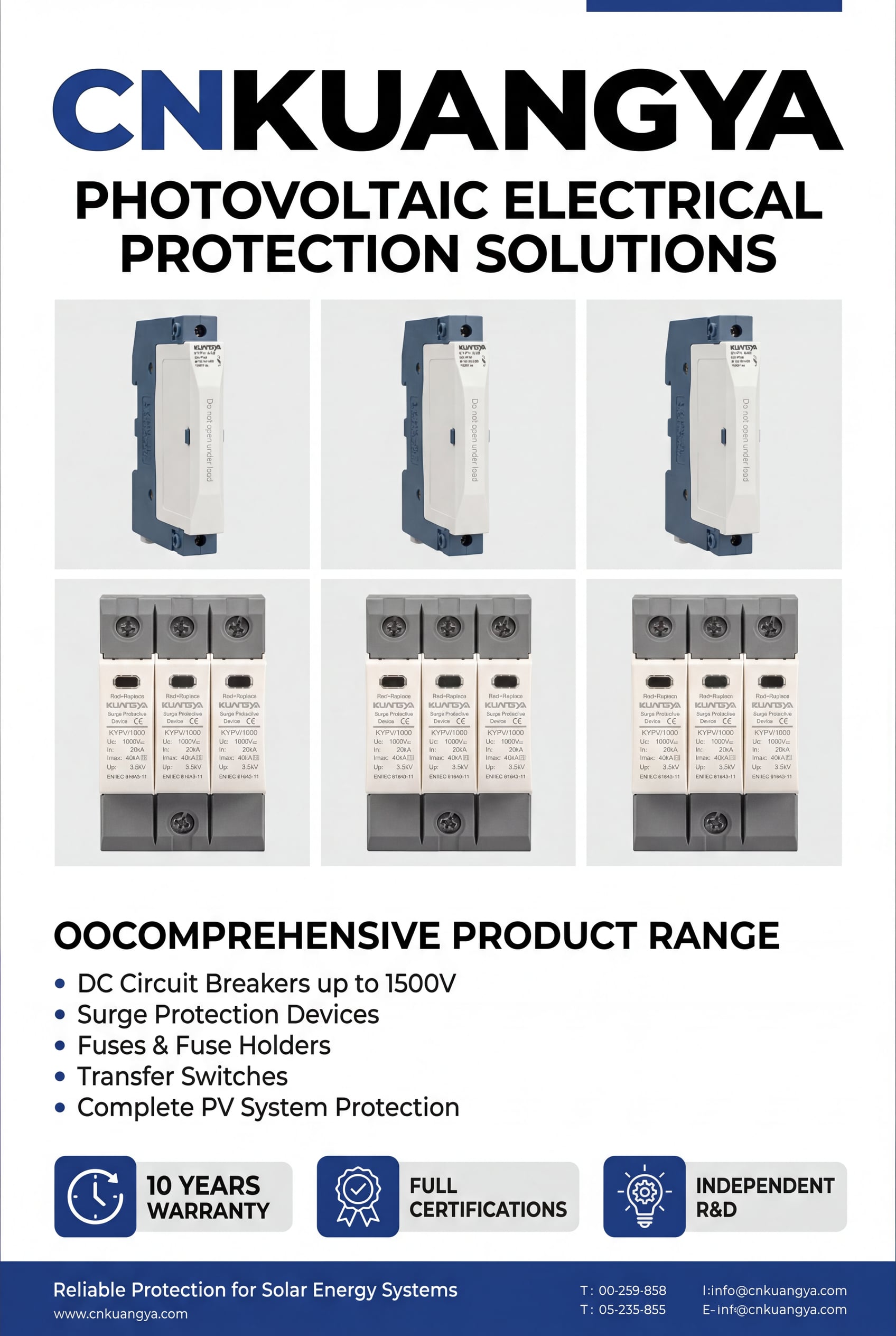
Consider the case of cnkuangya, a manufacturer that exemplifies the comprehensive approach to photovoltaic electrical equipment. Their product range spans the essential protection and control devices required in modern PV installations: surge protection devices (SPDs) engineered specifically for DC applications, photovoltaic-rated fuses and fuse holders, DC circuit breakers designed to interrupt DC arc faults, and specialized transfer switches for system configuration management. This breadth of offering reflects a deep understanding of photovoltaic system requirements and the interdependencies between different protective devices.
The significance of product range completeness extends beyond mere convenience. In photovoltaic applications, the interaction between different protective devices can significantly impact system performance and safety. Surge protection devices must coordinate with circuit breakers; fuse ratings must align with conductor ampacity and module specifications; transfer switches must handle the unique characteristics of DC switching. When these components come from a single manufacturer with integrated design philosophy, the risk of compatibility issues diminishes substantially.
Furthermore, a complete product line indicates manufacturing scale and R&D investment. Companies that offer comprehensive solutions have typically made substantial commitments to the sector, including dedicated engineering teams, specialized testing facilities, and long-term product development roadmaps. These manufacturers are more likely to remain viable partners as the industry evolves and are better positioned to support emerging technologies such as higher voltage systems, energy storage integration, and smart grid connectivity.
For wholesale distributors, partnering with a comprehensive supplier also simplifies inventory management, reduces the number of vendor relationships to maintain, and creates opportunities for volume-based pricing advantages. Your sales team can offer complete solutions rather than piecemeal components, positioning your business as a knowledgeable partner rather than merely a product reseller.
The pace of innovation in photovoltaic technology demands that electrical equipment suppliers maintain robust research and development capabilities. Independent R&D capacity distinguishes manufacturers that drive industry progress from those that merely follow market trends. For wholesale distributors, partnering with innovation-driven manufacturers provides access to cutting-edge products, early awareness of industry developments, and the ability to offer differentiated solutions in competitive markets.
Manufacturers with genuine R&D capabilities demonstrate several distinguishing characteristics. They hold patents and intellectual property related to their products, indicating original innovation rather than reverse engineering. They publish technical papers and contribute to industry standards development, signaling thought leadership. They maintain relationships with research institutions and participate in industry consortia focused on advancing photovoltaic technology. Most importantly, they regularly introduce genuinely new products rather than simply repackaging existing designs.
The benefits of partnering with R&D-focused manufacturers extend beyond product innovation. These companies typically provide superior technical support because their engineering teams possess deep understanding of underlying technologies. They can assist with application-specific challenges, provide detailed technical documentation, and offer training that goes beyond basic product operation. When unusual installation scenarios or system integration challenges arise, R&D-capable manufacturers can provide engineering support that product-focused competitors cannot match.
Independent R&D also correlates strongly with quality control capabilities. The engineering expertise required to develop new products translates directly into the ability to maintain rigorous manufacturing standards. Companies that design their own products understand the critical parameters that determine performance and reliability, enabling them to implement more effective quality assurance processes.
For wholesale distributors evaluating suppliers, evidence of R&D investment should factor prominently in the decision matrix. Ask potential partners about their engineering team size, their testing facilities, their patent portfolio, and their product development pipeline. Manufacturers that can articulate a clear innovation strategy and demonstrate concrete R&D outputs represent safer long-term partnerships than those focused solely on cost-competitive manufacturing.
In the electrical equipment industry, certifications represent far more than bureaucratic formalities—they constitute fundamental evidence of product safety, performance, and manufacturability. For photovoltaic applications, where systems operate unattended for decades in challenging environmental conditions, comprehensive certification becomes absolutely essential. Wholesale distributors who compromise on certification requirements expose themselves to profound risks including product liability, customer dissatisfaction, and reputational damage.
The certification landscape for photovoltaic electrical equipment encompasses multiple dimensions. Product safety certifications such as UL, CE, TUV, and IEC standards verify that devices meet fundamental safety requirements and will not pose fire or shock hazards under normal and fault conditions. Performance certifications validate that products deliver their specified electrical characteristics across their rated operating ranges. Environmental certifications confirm resistance to temperature extremes, humidity, UV exposure, and other conditions typical of outdoor installations.
Particularly critical for photovoltaic applications are certifications specific to DC operation and solar system integration. Standard electrical certifications often focus on AC applications, but photovoltaic systems operate primarily on DC power, which presents unique challenges in arc interruption, insulation coordination, and fault protection. Manufacturers whose products carry photovoltaic-specific certifications have invested in the specialized testing and design validation required for these demanding applications.
cnkuangya’s approach to certification exemplifies industry best practices. By maintaining comprehensive certifications across their product range, they demonstrate commitment to quality and market access. This certification completeness provides wholesale distributors with confidence that products will meet local code requirements regardless of installation jurisdiction. It also facilitates market expansion, as certified products can be sold across multiple regions without requiring separate product lines for different markets.
The certification process itself provides valuable insights into manufacturer capabilities. Achieving major certifications requires substantial documentation, rigorous testing, factory inspections, and ongoing compliance monitoring. Manufacturers that successfully navigate these requirements demonstrate organizational maturity, quality management systems, and commitment to continuous improvement. Conversely, manufacturers that lack comprehensive certifications or rely on questionable certification bodies should raise immediate red flags.
When evaluating potential suppliers, wholesale distributors should request complete certification documentation, verify certifications directly with issuing bodies, and understand the scope and limitations of each certification. Products certified for one application or voltage range may not be suitable for others. Ensure that certifications align with your target markets and typical customer applications.
Behind every certification and product specification lies the fundamental reality of manufacturing quality. The consistency and reliability of electrical equipment depend directly on manufacturing process control, quality assurance systems, and organizational commitment to excellence. For wholesale distributors, understanding a manufacturer’s production capabilities provides crucial insight into long-term partnership viability.
World-class manufacturers implement comprehensive quality management systems that extend from raw material procurement through final product testing. They maintain relationships with certified material suppliers, implement incoming inspection protocols, utilize statistical process control during manufacturing, and conduct rigorous final testing on every product. They document these processes thoroughly and continuously analyze quality data to identify improvement opportunities.
The physical manufacturing environment itself reveals much about quality commitment. Modern electrical equipment manufacturing requires climate-controlled facilities, contamination-free assembly areas, calibrated testing equipment, and proper material handling systems. Manufacturers that invest in appropriate facilities demonstrate understanding that quality cannot be inspected into products—it must be built in through proper processes and environments.
Equally important is the human element of manufacturing quality. Well-trained operators, experienced quality engineers, and engaged management create the organizational culture necessary for consistent excellence. Manufacturers that invest in workforce development, maintain low turnover, and empower employees to identify and resolve quality issues typically deliver superior products compared to those focused solely on cost minimization.
For wholesale distributors, assessing manufacturing quality requires going beyond product samples and marketing materials. Whenever possible, visit manufacturing facilities to observe operations firsthand. Examine quality documentation and certifications such as ISO 9001. Request quality data including defect rates, testing protocols, and continuous improvement initiatives. Speak with existing customers about their experience with product consistency and reliability.
The manufacturing quality assessment should also consider supply chain resilience. Manufacturers with diversified supplier bases, appropriate inventory buffers, and robust logistics capabilities can maintain delivery consistency even during market disruptions. This reliability becomes especially valuable during periods of high demand when less capable manufacturers struggle to maintain quality while scaling production.
The relationship between wholesale distributor and manufacturer extends far beyond the initial product purchase. In the photovoltaic industry, where system lifespans exceed 25 years and customer expectations for reliability run high, after-sales service and warranty support constitute critical differentiators. The quality of post-sale support often determines whether a supplier relationship strengthens into a strategic partnership or deteriorates into a source of frustration and financial risk.
Comprehensive warranty coverage provides the foundation for effective after-sales support. Extended warranties signal manufacturer confidence in product reliability and willingness to stand behind their products over the long term. cnkuangya’s offering of warranties extending up to 10 years exemplifies this commitment and provides wholesale distributors with a powerful competitive advantage. Such extended coverage reduces customer risk, facilitates larger project sales, and differentiates your offering in price-sensitive markets.
However, warranty duration alone tells an incomplete story. The warranty terms, claim process, and manufacturer responsiveness determine the practical value of warranty coverage. Favorable warranty terms cover a broad range of failure modes, impose reasonable limitations, and provide clear claim procedures. Responsive manufacturers process claims quickly, minimize customer disruption, and use warranty data to drive product improvements.
Technical support capabilities represent another crucial dimension of after-sales service. Photovoltaic installations often involve complex system integration challenges, unusual site conditions, and evolving code requirements. Manufacturers that provide accessible technical support—through phone hotlines, email support, online resources, and field application engineers—enable wholesale distributors to serve customers more effectively and resolve issues before they escalate.
Training and education programs further enhance the value of manufacturer partnerships. Suppliers that offer product training, application seminars, and certification programs help wholesale distributors develop internal expertise. This knowledge transfer enables your sales team to specify products correctly, your technical staff to support customers effectively, and your organization to position itself as a knowledgeable industry resource rather than merely a product reseller.
The logistics of after-sales support also merit careful evaluation. Consider the manufacturer’s stock availability for replacement products, their ability to provide emergency shipments when needed, and their policies regarding obsolescence and long-term product availability. Photovoltaic systems require maintenance and occasional component replacement throughout their operational lives. Manufacturers that maintain product availability and provide clear obsolescence roadmaps enable better long-term customer support.
For wholesale distributors, the after-sales service evaluation should include conversations with existing customers about their support experiences, review of warranty claim data and resolution times, assessment of technical support accessibility and quality, and understanding of the manufacturer’s approach to product lifecycle management. Manufacturers that excel in these areas transform from simple suppliers into strategic partners that contribute directly to your business success.
Price inevitably factors into supplier selection decisions, but sophisticated wholesale distributors recognize that initial purchase price represents only one component of total cost of ownership. A comprehensive value assessment considers product quality, reliability, warranty coverage, technical support, logistics efficiency, and the intangible benefits of partnering with reputable manufacturers. This holistic perspective often reveals that apparently expensive products deliver superior value compared to cheaper alternatives.
The true cost of electrical equipment extends across multiple dimensions. Direct costs include the purchase price, shipping, and inventory carrying costs. Indirect costs encompass warranty claims, customer support time, reputation damage from product failures, and lost opportunities when inadequate products limit your market access. Hidden costs include the time spent managing problematic supplier relationships, the complexity of maintaining multiple vendor relationships, and the opportunity cost of capital tied up in slow-moving inventory.
Premium manufacturers typically command higher initial prices, but they often deliver lower total cost of ownership through superior reliability, comprehensive support, and stronger warranties. Products that rarely fail reduce warranty claim processing costs and customer service time. Comprehensive technical support reduces the internal resources required to support customers. Extended warranties transfer risk from distributor to manufacturer, reducing financial exposure.
The value equation also includes strategic considerations. Partnering with innovative manufacturers provides early access to new technologies and market trends. Aligning with quality-focused brands enhances your reputation and facilitates premium positioning. Comprehensive product ranges simplify operations and create cross-selling opportunities. These strategic benefits often outweigh modest price differences when viewed across the full business relationship.
For wholesale distributors developing pricing strategies, the key lies in understanding and communicating value to customers. Rather than competing solely on price, emphasize the total value proposition: certified products, extended warranties, comprehensive technical support, and the reliability that comes from partnering with established manufacturers. Educate customers about the risks of inferior products and the long-term benefits of quality equipment. Position your business as a trusted advisor that helps customers make informed decisions rather than simply offering the lowest price.
When negotiating with manufacturers, focus on total relationship value rather than individual transaction prices. Discuss volume commitments, payment terms, marketing support, technical training, and other elements that contribute to mutual success. Manufacturers willing to invest in distributor partnerships through these mechanisms often prove more valuable than those offering the lowest unit prices but minimal support.
In the interconnected photovoltaic industry, manufacturer reputation serves as a powerful signal of reliability, quality, and long-term viability. Companies that have earned strong reputations through consistent performance, ethical business practices, and customer focus provide wholesale distributors with valuable brand equity. Conversely, partnering with manufacturers that carry negative reputations or operate in ethical gray areas exposes distributors to significant risks.
Assessing manufacturer reputation requires gathering information from multiple sources. Industry associations, trade publications, and online forums provide insights into how manufacturers are perceived within the professional community. Existing customers offer firsthand perspectives on product performance and partnership quality. Competitors’ opinions, while requiring careful interpretation, can reveal important information about market positioning and comparative strengths.
Longevity in the photovoltaic sector provides another important indicator. The industry has experienced numerous boom-and-bust cycles, with many manufacturers entering during growth periods only to exit when conditions tighten. Manufacturers that have sustained operations through multiple market cycles demonstrate resilience, financial stability, and genuine commitment to the sector. These established players represent safer partnership choices than newcomers with unproven track records.
Industry participation and leadership also signal manufacturer standing. Companies that contribute to standards development, participate in trade associations, exhibit at major industry events, and engage in thought leadership demonstrate commitment beyond simple product sales. This industry engagement often correlates with higher quality products, better market understanding, and more sustainable business practices.
For wholesale distributors, aligning with reputable manufacturers provides multiple benefits. Strong manufacturer brands facilitate sales by providing customer confidence. Industry-recognized partners enhance your own reputation through association. Established manufacturers typically maintain more stable operations, reducing supply chain disruption risks. Perhaps most importantly, reputable partners share your interest in long-term relationship success rather than short-term transaction optimization.
Given the multiple factors influencing supplier selection, wholesale distributors benefit from implementing a structured evaluation framework. This systematic approach ensures comprehensive assessment, facilitates comparison across potential partners, and provides documentation for stakeholder communication.
Begin by defining your specific requirements across key dimensions: product categories needed, certification requirements for your target markets, technical support expectations, warranty terms, pricing parameters, and strategic objectives. These requirements should reflect both immediate needs and longer-term business strategy.
Next, identify potential suppliers through industry research, trade show participation, customer recommendations, and market intelligence. Cast a reasonably wide net initially, recognizing that some candidates will be eliminated quickly while others merit deeper evaluation.
Conduct preliminary screening to eliminate candidates that fail to meet fundamental requirements. Verify that candidates offer the necessary product range, hold required certifications, and demonstrate basic manufacturing capabilities. This screening should reduce your candidate list to a manageable number for detailed evaluation.
For remaining candidates, conduct comprehensive assessment across all relevant dimensions: product range completeness, R&D capabilities, certification portfolio, manufacturing quality, after-sales support, pricing and terms, market reputation, and strategic fit. Gather information through multiple channels including facility visits, reference checks, product testing, and detailed discussions with manufacturer representatives.
Develop a scoring framework that weights different factors according to your priorities. Some distributors prioritize product quality and warranty support, while others emphasize price competitiveness or product range breadth. Your scoring should reflect your specific business model and market positioning.
Based on this structured evaluation, select your primary partner or partners. Recognize that you may choose to work with multiple manufacturers to access different product categories, serve different market segments, or maintain supply chain redundancy. However, limiting your manufacturer relationships to a focused set of strategic partners typically delivers better results than spreading business across numerous suppliers.
Selecting the right manufacturer represents only the beginning of successful partnership. Effective implementation and ongoing relationship management determine whether the partnership delivers its full potential value.
Begin the relationship with clear communication of expectations, requirements, and objectives. Establish points of contact for different functions including sales, technical support, logistics, and quality issues. Define performance metrics and review processes to ensure alignment and accountability.
Invest in product knowledge development across your organization. Utilize manufacturer training resources, conduct internal education sessions, and ensure that your team understands not just product features but also application best practices and competitive positioning. This knowledge investment pays dividends through more effective sales, better customer support, and enhanced market credibility.
Develop marketing and sales strategies that leverage your manufacturer partnerships. Utilize manufacturer-provided marketing materials, co-brand where appropriate, and emphasize the value of certified, warranted products from reputable manufacturers. Position your business as a knowledgeable partner that helps customers select the right solutions rather than simply offering products.
Implement feedback mechanisms to share market intelligence, customer input, and product performance data with your manufacturing partners. This information flow helps manufacturers improve products, understand market needs, and support your business more effectively. The best partnerships involve bidirectional communication and mutual learning.
Monitor relationship performance regularly through defined metrics including product quality, delivery performance, technical support responsiveness, warranty claim resolution, and overall business results. Address issues promptly and constructively, recognizing that even strong partnerships encounter occasional challenges. Use performance reviews to strengthen the relationship and identify improvement opportunities.
The selection of electrical equipment suppliers for photovoltaic applications represents one of the most consequential strategic decisions facing wholesale distributors in today’s renewable energy market. The complexity of this decision reflects the multifaceted nature of successful supplier partnerships, which must deliver not only quality products but also comprehensive support, market credibility, and long-term stability.
Manufacturers like cnkuangya, which combine comprehensive product ranges, independent R&D capabilities, thorough certification portfolios, and extended warranty support, exemplify the characteristics that wholesale distributors should prioritize. These manufacturers understand that success in the photovoltaic sector requires more than simply producing electrical components—it demands deep technical expertise, commitment to quality, and genuine partnership with distribution channels.
For wholesale distributors, the supplier selection process should emphasize long-term value creation over short-term cost minimization. While price competitiveness matters, it should be evaluated within the broader context of total cost of ownership, strategic alignment, and partnership quality. The most successful distributors recognize that their manufacturer partners become extensions of their own brands, making supplier selection a fundamental element of competitive positioning.
As the photovoltaic industry continues its rapid evolution, the importance of strong manufacturer partnerships will only increase. Emerging technologies, evolving standards, and intensifying competition will reward distributors that have aligned with capable, committed manufacturing partners. By implementing structured evaluation processes, prioritizing comprehensive value over narrow price considerations, and investing in relationship development, wholesale distributors can build sustainable competitive advantages that drive long-term business success in the dynamic photovoltaic electrical equipment market.
To assist wholesale distributors in making informed product selection decisions, the following comprehensive tables outline the key specifications, applications, and selection criteria for cnkuangya’s photovoltaic electrical equipment product range.
| モデルシリーズ | 定格電圧 | 現在の範囲 | ポール | 破断能力 | Key Applications | 認証 | Typical Use Cases |
|---|---|---|---|---|---|---|---|
| KY-PV-63 | 最大1500V DC | 1A – 63A | 1P、2P、3P、4P | 6kA – 10kA | Residential & Commercial PV | CE, TUV, IEC 60947-2 | String protection, combiner boxes |
| KY-PV-125 | 最大1500V DC | 16A – 125A | 2P、3P、4P | 10kA – 15kA | 商業・産業用PV | CE, TUV, UL 489 | Main DC disconnects, large arrays |
| KY-PV-250 | 最大1500V DC | 100A – 250A | 2P、3P、4P | 15kA – 25kA | Utility-Scale PV Systems | CE, TUV, IEC 60947-2 | Central inverter protection |
| KY-PV-630 | 最大1500V DC | 250A – 630A | 3P, 4P | 25kA – 35kA | Large-Scale Solar Farms | CE, TUV, UL 489 | Main distribution, substation |
選考基準
| モデルシリーズ | システム電圧 | 構成 | Uc(最大連続) | Imax (Max Discharge) | アップ(保護レベル) | 応答時間 | アプリケーション |
|---|---|---|---|---|---|---|---|
| KYPV-500 | Up to 500V DC | 1P+N, 2P | 500V DC | 20kA (8/20μs) | ≤2.5kV | <25ナノ秒 | Small residential systems |
| KYPV-1000 | Up to 1000V DC | 1P+N, 2P, 3P | DC1000V | 40kA (8/20μs) | ≤3.5kV | <25ナノ秒 | Standard commercial systems |
| KYPV-1500 | 最大1500V DC | 2P、3P、4P | DC1500V | 60kA (8/20μs) | ≤4.5kV | <25ナノ秒 | High-voltage industrial systems |
| KYPV-1500-T2 | 最大1500V DC | 2P、3P、4P | DC1500V | 100kA (10/350μs) | ≤4.0kV | <25ナノ秒 | Lightning-prone areas, Type 2 |
選考基準
| Product Type | 定格電圧 | 現在の範囲 | 破断能力 | gPV Rating | アプリケーション | 規格遵守 |
|---|---|---|---|---|---|---|
| KY-FH-10×38 | 最大1500V DC | 1A – 30A | 30kA | はい | ストリング保護 | IEC 60269-6、UL 2579 |
| KY-FH-14×51 | 最大1500V DC | 10A – 50A | 50kA | はい | コンバイナーボックス | IEC 60269-6, EN 60269-6 |
| KY-FH-22×58 | 最大1500V DC | 32A – 100A | 80kA | はい | Array main protection | IEC 60269-6、UL 2579 |
| KY-FH-Holder-DIN | 最大1500V DC | Compatible with above | – | – | DIN rail mounting | IEC 60947-3 |
| KY-FH-Holder-Panel | 最大1500V DC | Compatible with above | – | – | Panel mounting | IEC 60947-3 |
選考基準
| モデルシリーズ | 定格電圧 | 現在の評価 | ポール構成 | スイッチング・タイプ | 代表的なアプリケーション | 特徴 |
|---|---|---|---|---|---|---|
| KY-TS-63 | Up to 1000V DC | 16A – 63A | 2P、3P、4P | Manual, 3-position | Residential systems | Compact design, DIN rail mount |
| KY-TS-125 | 最大1500V DC | 63A – 125A | 2P、3P、4P | Manual, 3-position | 商用システム | Load break rated, padlockable |
| KY-TS-250-Auto | 最大1500V DC | 100A – 250A | 3P, 4P | 自動 | Grid-tied with backup | Automatic transfer, <100ms |
| KY-TS-400 | 最大1500V DC | 250A – 400A | 3P, 4P | Manual, 4-position | Industrial systems | Heavy-duty, IP65 enclosure |
選考基準
| システム・タイプ | システム・サイズ | Recommended Circuit Breaker | Recommended SPD | 推奨ヒューズ | Recommended Transfer Switch |
|---|---|---|---|---|---|
| 住宅屋上 | 3-10 kW | KY-PV-63 (16-32A, 2P) | KYPV-500 or KYPV-1000 | KY-FH-10×38 (10-20A) | KY-TS-63 (2P, Manual) |
| スモール・コマーシャル | 10-50 kW | KY-PV-63 (32-63A, 2P/3P) | KYPV-1000 (2P/3P) | KY-FH-14×51 (20-40A) | KY-TS-125 (3P, Manual) |
| Large Commercial | 50-250 kW | KY-PV-125 (63-125A, 3P) | KYPV-1000 or KYPV-1500 | KY-FH-22×58 (50-100A) | KY-TS-250-Auto (3P) |
| インダストリアル | 250-1000 kW | KY-PV-250 (125-250A, 3P/4P) | KYPV-1500 (3P/4P) | KY-FH-22×58 (80-100A) | KY-TS-400 (4P, Manual) |
| ユーティリティ・スケール | >1 MW | KY-PV-630 (250-630A, 4P) | KYPV-1500-T2 (4P) | Multiple parallel units | Custom engineered solution |
| 製品カテゴリー | 動作温度 | 保存温度 | Humidity Rating | IP等級 | 主要認定資格 | 保証期間 |
|---|---|---|---|---|---|---|
| DCサーキットブレーカー | -40°C ~ +85°C | -50°C to +90°C | 5% to 95% RH | IP20 (standard), IP65 (optional) | CE, TUV, UL, IEC 60947-2 | 10年 |
| Surge Protection Devices | -40°C ~ +85°C | -50°C to +90°C | 5% to 95% RH | IP20 (standard), IP65 (optional) | CE, TUV, IEC 61643-11, EN 61643-11 | 10年 |
| PV Fuses & Holders | -40°C ~ +85°C | -50°C to +90°C | 5% to 95% RH | IP20 (holders) | CE, TUV, UL 2579, IEC 60269-6 | 10年 |
| Transfer Switches | -25°C to +70°C | -40°C ~ +85°C | 5% to 95% RH | IP40 to IP65 | CE, TUV, IEC 60947-3, IEC 60947-6-1 | 10年 |
| 特徴 | CNKUANGYA | Competitor A | Competitor B | Competitor C |
|---|---|---|---|---|
| Product Range Completeness | ★★★★★ Complete portfolio | ★★★★☆ Most categories | ★★★☆☆ Limited range | ★★★☆☆ Moderate range |
| Independent R&D Capability | ★★★★★ In-house design | ★★★☆☆ Some R&D | ★★☆☆☆ OEM focus | ★★★★☆ Strong R&D |
| Certification Portfolio | ★★★★★ Comprehensive global | ★★★★☆ Major markets | ★★★☆☆ Regional only | ★★★★☆ Good coverage |
| Maximum Warranty Period | 10年 | 5年 | 2年 | 5年 |
| テクニカルサポート | ★★★★★ 24/7 multilingual | ★★★☆☆ Business hours | ★★☆☆☆ Limited | ★★★★☆ Good support |
| Price Positioning | Mid to Premium | プレミアム | 予算 | Mid-range |
| Delivery Lead Time | 2~4週間 | 4~6週間 | 6~8週間 | 3-5 weeks |
| 最小注文数量 | Flexible | 高い | Very flexible | 中程度 |
| Market Presence (Years) | 15+ years | 20+ years | 5年 | 10+ years |
Step 1: Define System Parameters
Step 2: Apply Safety Margins
Step 3: Consider Application-Specific Requirements
Step 4: Evaluate Total Cost of Ownership
Step 5: Verify Compatibility
For detailed technical specifications, installation guidelines, and application support, cnkuangya provides:
This comprehensive selection guide enables wholesale distributors to specify appropriate cnkuangya products for diverse photovoltaic applications. The combination of complete product range, rigorous certifications, extended warranty coverage, and comprehensive technical support positions cnkuangya as an ideal manufacturing partner for distributors seeking to build competitive advantage in the growing photovoltaic electrical equipment market.
The global transition toward renewable energy has positioned the photovoltaic industry at the forefront of the electrical wholesale market. As a wholesale distributor operating in a major metropolitan market, the decision to expand into photovoltaic electrical equipment represents both a significant opportunity and a complex challenge. The selection of the right brand and manufacturing partner can determine not only your immediate profitability but also your long-term reputation and market position. This comprehensive guide explores the critical factors that should inform your supplier selection process, using practical examples and industry best practices to help you make informed decisions in this rapidly evolving sector.
The photovoltaic electrical equipment sector has experienced unprecedented growth over the past decade, driven by declining solar panel costs, government incentives, and increasing environmental awareness. However, this growth has also led to market saturation with suppliers of varying quality levels. For wholesale distributors, this presents a paradox: while more options exist than ever before, the stakes for making the wrong choice have never been higher.
The photovoltaic system requires a sophisticated array of electrical protection and control devices that must work in harmony to ensure system safety, efficiency, and longevity. Unlike traditional electrical applications, PV systems operate under unique conditions including DC voltage environments, potential induced degradation, and exposure to harsh outdoor conditions over decades of operation. This specialized application demands electrical components specifically engineered for photovoltaic use, not merely adapted from conventional electrical products.
When evaluating potential suppliers, wholesale distributors must recognize that they are not simply purchasing products—they are selecting a partner whose capabilities, reliability, and reputation will directly impact their own business success. The supplier you choose becomes an extension of your brand in the eyes of your customers, making this decision one of the most consequential in your business strategy.
A comprehensive product portfolio stands as the first critical criterion in supplier evaluation. The ability to source multiple product categories from a single manufacturer offers substantial advantages in terms of compatibility assurance, simplified logistics, consolidated technical support, and enhanced negotiating leverage. More importantly, it signals a manufacturer’s serious commitment to the photovoltaic sector rather than opportunistic market entry.
Consider the case of cnkuangya, a manufacturer that exemplifies the comprehensive approach to photovoltaic electrical equipment. Their product range spans the essential protection and control devices required in modern PV installations: surge protection devices (SPD) engineered specifically for DC applications, photovoltaic-rated fuses and fuse holders, DC circuit breakers designed to interrupt DC arc faults, and specialized transfer switches for system configuration management. This breadth of offering reflects a deep understanding of photovoltaic system requirements and the interdependencies between different protective devices.
The significance of product range completeness extends beyond mere convenience. In photovoltaic applications, the interaction between different protective devices can significantly impact system performance and safety. Surge protection devices must coordinate with circuit breakers; fuse ratings must align with conductor ampacity and module specifications; transfer switches must handle the unique characteristics of DC switching. When these components come from a single manufacturer with integrated design philosophy, the risk of compatibility issues diminishes substantially.
Furthermore, a complete product line indicates manufacturing scale and R&D investment. Companies that offer comprehensive solutions have typically made substantial commitments to the sector, including dedicated engineering teams, specialized testing facilities, and long-term product development roadmaps. These manufacturers are more likely to remain viable partners as the industry evolves and are better positioned to support emerging technologies such as higher voltage systems, energy storage integration, and smart grid connectivity.
For wholesale distributors, partnering with a comprehensive supplier also simplifies inventory management, reduces the number of vendor relationships to maintain, and creates opportunities for volume-based pricing advantages. Your sales team can offer complete solutions rather than piecemeal components, positioning your business as a knowledgeable partner rather than merely a product reseller.
The pace of innovation in photovoltaic technology demands that electrical equipment suppliers maintain robust research and development capabilities. Independent R&D capacity distinguishes manufacturers that drive industry progress from those that merely follow market trends. For wholesale distributors, partnering with innovation-driven manufacturers provides access to cutting-edge products, early awareness of industry developments, and the ability to offer differentiated solutions in competitive markets.
Manufacturers with genuine R&D capabilities demonstrate several distinguishing characteristics. They hold patents and intellectual property related to their products, indicating original innovation rather than reverse engineering. They publish technical papers and contribute to industry standards development, signaling thought leadership. They maintain relationships with research institutions and participate in industry consortia focused on advancing photovoltaic technology. Most importantly, they regularly introduce genuinely new products rather than simply repackaging existing designs.
The benefits of partnering with R&D-focused manufacturers extend beyond product innovation. These companies typically provide superior technical support because their engineering teams possess deep understanding of underlying technologies. They can assist with application-specific challenges, provide detailed technical documentation, and offer training that goes beyond basic product operation. When unusual installation scenarios or system integration challenges arise, R&D-capable manufacturers can provide engineering support that product-focused competitors cannot match.
Independent R&D also correlates strongly with quality control capabilities. The engineering expertise required to develop new products translates directly into the ability to maintain rigorous manufacturing standards. Companies that design their own products understand the critical parameters that determine performance and reliability, enabling them to implement more effective quality assurance processes.
For wholesale distributors evaluating suppliers, evidence of R&D investment should factor prominently in the decision matrix. Ask potential partners about their engineering team size, their testing facilities, their patent portfolio, and their product development pipeline. Manufacturers that can articulate a clear innovation strategy and demonstrate concrete R&D outputs represent safer long-term partnerships than those focused solely on cost-competitive manufacturing.
In the electrical equipment industry, certifications represent far more than bureaucratic formalities—they constitute fundamental evidence of product safety, performance, and manufacturability. For photovoltaic applications, where systems operate unattended for decades in challenging environmental conditions, comprehensive certification becomes absolutely essential. Wholesale distributors who compromise on certification requirements expose themselves to profound risks including product liability, customer dissatisfaction, and reputational damage.
The certification landscape for photovoltaic electrical equipment encompasses multiple dimensions. Product safety certifications such as UL, CE, TUV, and IEC standards verify that devices meet fundamental safety requirements and will not pose fire or shock hazards under normal and fault conditions. Performance certifications validate that products deliver their specified electrical characteristics across their rated operating ranges. Environmental certifications confirm resistance to temperature extremes, humidity, UV exposure, and other conditions typical of outdoor installations.
Particularly critical for photovoltaic applications are certifications specific to DC operation and solar system integration. Standard electrical certifications often focus on AC applications, but photovoltaic systems operate primarily on DC power, which presents unique challenges in arc interruption, insulation coordination, and fault protection. Manufacturers whose products carry photovoltaic-specific certifications have invested in the specialized testing and design validation required for these demanding applications.
cnkuangya’s approach to certification exemplifies industry best practices. By maintaining comprehensive certifications across their product range, they demonstrate commitment to quality and market access. This certification completeness provides wholesale distributors with confidence that products will meet local code requirements regardless of installation jurisdiction. It also facilitates market expansion, as certified products can be sold across multiple regions without requiring separate product lines for different markets.
The certification process itself provides valuable insights into manufacturer capabilities. Achieving major certifications requires substantial documentation, rigorous testing, factory inspections, and ongoing compliance monitoring. Manufacturers that successfully navigate these requirements demonstrate organizational maturity, quality management systems, and commitment to continuous improvement. Conversely, manufacturers that lack comprehensive certifications or rely on questionable certification bodies should raise immediate red flags.
When evaluating potential suppliers, wholesale distributors should request complete certification documentation, verify certifications directly with issuing bodies, and understand the scope and limitations of each certification. Products certified for one application or voltage range may not be suitable for others. Ensure that certifications align with your target markets and typical customer applications.
Behind every certification and product specification lies the fundamental reality of manufacturing quality. The consistency and reliability of electrical equipment depend directly on manufacturing process control, quality assurance systems, and organizational commitment to excellence. For wholesale distributors, understanding a manufacturer’s production capabilities provides crucial insight into long-term partnership viability.
World-class manufacturers implement comprehensive quality management systems that extend from raw material procurement through final product testing. They maintain relationships with certified material suppliers, implement incoming inspection protocols, utilize statistical process control during manufacturing, and conduct rigorous final testing on every product. They document these processes thoroughly and continuously analyze quality data to identify improvement opportunities.
The physical manufacturing environment itself reveals much about quality commitment. Modern electrical equipment manufacturing requires climate-controlled facilities, contamination-free assembly areas, calibrated testing equipment, and proper material handling systems. Manufacturers that invest in appropriate facilities demonstrate understanding that quality cannot be inspected into products—it must be built in through proper processes and environments.
Equally important is the human element of manufacturing quality. Well-trained operators, experienced quality engineers, and engaged management create the organizational culture necessary for consistent excellence. Manufacturers that invest in workforce development, maintain low turnover, and empower employees to identify and resolve quality issues typically deliver superior products compared to those focused solely on cost minimization.
For wholesale distributors, assessing manufacturing quality requires going beyond product samples and marketing materials. Whenever possible, visit manufacturing facilities to observe operations firsthand. Examine quality documentation and certifications such as ISO 9001. Request quality data including defect rates, testing protocols, and continuous improvement initiatives. Speak with existing customers about their experience with product consistency and reliability.
The manufacturing quality assessment should also consider supply chain resilience. Manufacturers with diversified supplier bases, appropriate inventory buffers, and robust logistics capabilities can maintain delivery consistency even during market disruptions. This reliability becomes especially valuable during periods of high demand when less capable manufacturers struggle to maintain quality while scaling production.
The relationship between wholesale distributor and manufacturer extends far beyond the initial product purchase. In the photovoltaic industry, where system lifespans exceed 25 years and customer expectations for reliability run high, after-sales service and warranty support constitute critical differentiators. The quality of post-sale support often determines whether a supplier relationship strengthens into a strategic partnership or deteriorates into a source of frustration and financial risk.
Comprehensive warranty coverage provides the foundation for effective after-sales support. Extended warranties signal manufacturer confidence in product reliability and willingness to stand behind their products over the long term. cnkuangya’s offering of warranties extending up to 10 years exemplifies this commitment and provides wholesale distributors with a powerful competitive advantage. Such extended coverage reduces customer risk, facilitates larger project sales, and differentiates your offering in price-sensitive markets.
However, warranty duration alone tells an incomplete story. The warranty terms, claim process, and manufacturer responsiveness determine the practical value of warranty coverage. Favorable warranty terms cover a broad range of failure modes, impose reasonable limitations, and provide clear claim procedures. Responsive manufacturers process claims quickly, minimize customer disruption, and use warranty data to drive product improvements.
Technical support capabilities represent another crucial dimension of after-sales service. Photovoltaic installations often involve complex system integration challenges, unusual site conditions, and evolving code requirements. Manufacturers that provide accessible technical support—through phone hotlines, email support, online resources, and field application engineers—enable wholesale distributors to serve customers more effectively and resolve issues before they escalate.
Training and education programs further enhance the value of manufacturer partnerships. Suppliers that offer product training, application seminars, and certification programs help wholesale distributors develop internal expertise. This knowledge transfer enables your sales team to specify products correctly, your technical staff to support customers effectively, and your organization to position itself as a knowledgeable industry resource rather than merely a product reseller.
The logistics of after-sales support also merit careful evaluation. Consider the manufacturer’s stock availability for replacement products, their ability to provide emergency shipments when needed, and their policies regarding obsolescence and long-term product availability. Photovoltaic systems require maintenance and occasional component replacement throughout their operational lives. Manufacturers that maintain product availability and provide clear obsolescence roadmaps enable better long-term customer support.
For wholesale distributors, the after-sales service evaluation should include conversations with existing customers about their support experiences, review of warranty claim data and resolution times, assessment of technical support accessibility and quality, and understanding of the manufacturer’s approach to product lifecycle management. Manufacturers that excel in these areas transform from simple suppliers into strategic partners that contribute directly to your business success.
Price inevitably factors into supplier selection decisions, but sophisticated wholesale distributors recognize that initial purchase price represents only one component of total cost of ownership. A comprehensive value assessment considers product quality, reliability, warranty coverage, technical support, logistics efficiency, and the intangible benefits of partnering with reputable manufacturers. This holistic perspective often reveals that apparently expensive products deliver superior value compared to cheaper alternatives.
The true cost of electrical equipment extends across multiple dimensions. Direct costs include the purchase price, shipping, and inventory carrying costs. Indirect costs encompass warranty claims, customer support time, reputation damage from product failures, and lost opportunities when inadequate products limit your market access. Hidden costs include the time spent managing problematic supplier relationships, the complexity of maintaining multiple vendor relationships, and the opportunity cost of capital tied up in slow-moving inventory.
Premium manufacturers typically command higher initial prices, but they often deliver lower total cost of ownership through superior reliability, comprehensive support, and stronger warranties. Products that rarely fail reduce warranty claim processing costs and customer service time. Comprehensive technical support reduces the internal resources required to support customers. Extended warranties transfer risk from distributor to manufacturer, reducing financial exposure.
The value equation also includes strategic considerations. Partnering with innovative manufacturers provides early access to new technologies and market trends. Aligning with quality-focused brands enhances your reputation and facilitates premium positioning. Comprehensive product ranges simplify operations and create cross-selling opportunities. These strategic benefits often outweigh modest price differences when viewed across the full business relationship.
For wholesale distributors developing pricing strategies, the key lies in understanding and communicating value to customers. Rather than competing solely on price, emphasize the total value proposition: certified products, extended warranties, comprehensive technical support, and the reliability that comes from partnering with established manufacturers. Educate customers about the risks of inferior products and the long-term benefits of quality equipment. Position your business as a trusted advisor that helps customers make informed decisions rather than simply offering the lowest price.
When negotiating with manufacturers, focus on total relationship value rather than individual transaction prices. Discuss volume commitments, payment terms, marketing support, technical training, and other elements that contribute to mutual success. Manufacturers willing to invest in distributor partnerships through these mechanisms often prove more valuable than those offering the lowest unit prices but minimal support.
In the interconnected photovoltaic industry, manufacturer reputation serves as a powerful signal of reliability, quality, and long-term viability. Companies that have earned strong reputations through consistent performance, ethical business practices, and customer focus provide wholesale distributors with valuable brand equity. Conversely, partnering with manufacturers that carry negative reputations or operate in ethical gray areas exposes distributors to significant risks.
Assessing manufacturer reputation requires gathering information from multiple sources. Industry associations, trade publications, and online forums provide insights into how manufacturers are perceived within the professional community. Existing customers offer firsthand perspectives on product performance and partnership quality. Competitors’ opinions, while requiring careful interpretation, can reveal important information about market positioning and comparative strengths.
Longevity in the photovoltaic sector provides another important indicator. The industry has experienced numerous boom-and-bust cycles, with many manufacturers entering during growth periods only to exit when conditions tighten. Manufacturers that have sustained operations through multiple market cycles demonstrate resilience, financial stability, and genuine commitment to the sector. These established players represent safer partnership choices than newcomers with unproven track records.
Industry participation and leadership also signal manufacturer standing. Companies that contribute to standards development, participate in trade associations, exhibit at major industry events, and engage in thought leadership demonstrate commitment beyond simple product sales. This industry engagement often correlates with higher quality products, better market understanding, and more sustainable business practices.
For wholesale distributors, aligning with reputable manufacturers provides multiple benefits. Strong manufacturer brands facilitate sales by providing customer confidence. Industry-recognized partners enhance your own reputation through association. Established manufacturers typically maintain more stable operations, reducing supply chain disruption risks. Perhaps most importantly, reputable partners share your interest in long-term relationship success rather than short-term transaction optimization.
Given the multiple factors influencing supplier selection, wholesale distributors benefit from implementing a structured evaluation framework. This systematic approach ensures comprehensive assessment, facilitates comparison across potential partners, and provides documentation for stakeholder communication.
Begin by defining your specific requirements across key dimensions: product categories needed, certification requirements for your target markets, technical support expectations, warranty terms, pricing parameters, and strategic objectives. These requirements should reflect both immediate needs and longer-term business strategy.
Next, identify potential suppliers through industry research, trade show participation, customer recommendations, and market intelligence. Cast a reasonably wide net initially, recognizing that some candidates will be eliminated quickly while others merit deeper evaluation.
Conduct preliminary screening to eliminate candidates that fail to meet fundamental requirements. Verify that candidates offer the necessary product range, hold required certifications, and demonstrate basic manufacturing capabilities. This screening should reduce your candidate list to a manageable number for detailed evaluation.
For remaining candidates, conduct comprehensive assessment across all relevant dimensions: product range completeness, R&D capabilities, certification portfolio, manufacturing quality, after-sales support, pricing and terms, market reputation, and strategic fit. Gather information through multiple channels including facility visits, reference checks, product testing, and detailed discussions with manufacturer representatives.
Develop a scoring framework that weights different factors according to your priorities. Some distributors prioritize product quality and warranty support, while others emphasize price competitiveness or product range breadth. Your scoring should reflect your specific business model and market positioning.
Based on this structured evaluation, select your primary partner or partners. Recognize that you may choose to work with multiple manufacturers to access different product categories, serve different market segments, or maintain supply chain redundancy. However, limiting your manufacturer relationships to a focused set of strategic partners typically delivers better results than spreading business across numerous suppliers.
Selecting the right manufacturer represents only the beginning of successful partnership. Effective implementation and ongoing relationship management determine whether the partnership delivers its full potential value.
Begin the relationship with clear communication of expectations, requirements, and objectives. Establish points of contact for different functions including sales, technical support, logistics, and quality issues. Define performance metrics and review processes to ensure alignment and accountability.
Invest in product knowledge development across your organization. Utilize manufacturer training resources, conduct internal education sessions, and ensure that your team understands not just product features but also application best practices and competitive positioning. This knowledge investment pays dividends through more effective sales, better customer support, and enhanced market credibility.
Develop marketing and sales strategies that leverage your manufacturer partnerships. Utilize manufacturer-provided marketing materials, co-brand where appropriate, and emphasize the value of certified, warranted products from reputable manufacturers. Position your business as a knowledgeable partner that helps customers select the right solutions rather than simply offering products.
Implement feedback mechanisms to share market intelligence, customer input, and product performance data with your manufacturing partners. This information flow helps manufacturers improve products, understand market needs, and support your business more effectively. The best partnerships involve bidirectional communication and mutual learning.
Monitor relationship performance regularly through defined metrics including product quality, delivery performance, technical support responsiveness, warranty claim resolution, and overall business results. Address issues promptly and constructively, recognizing that even strong partnerships encounter occasional challenges. Use performance reviews to strengthen the relationship and identify improvement opportunities.
The selection of electrical equipment suppliers for photovoltaic applications represents one of the most consequential strategic decisions facing wholesale distributors in today’s renewable energy market. The complexity of this decision reflects the multifaceted nature of successful supplier partnerships, which must deliver not only quality products but also comprehensive support, market credibility, and long-term stability.
Manufacturers like cnkuangya, which combine comprehensive product ranges, independent R&D capabilities, thorough certification portfolios, and extended warranty support, exemplify the characteristics that wholesale distributors should prioritize. These manufacturers understand that success in the photovoltaic sector requires more than simply producing electrical components—it demands deep technical expertise, commitment to quality, and genuine partnership with distribution channels.
For wholesale distributors, the supplier selection process should emphasize long-term value creation over short-term cost minimization. While price competitiveness matters, it should be evaluated within the broader context of total cost of ownership, strategic alignment, and partnership quality. The most successful distributors recognize that their manufacturer partners become extensions of their own brands, making supplier selection a fundamental element of competitive positioning.
As the photovoltaic industry continues its rapid evolution, the importance of strong manufacturer partnerships will only increase. Emerging technologies, evolving standards, and intensifying competition will reward distributors that have aligned with capable, committed manufacturing partners. By implementing structured evaluation processes, prioritizing comprehensive value over narrow price considerations, and investing in relationship development, wholesale distributors can build sustainable competitive advantages that drive long-term business success in the dynamic photovoltaic electrical equipment market.