住所
304ノース・カーディナル
セント・ドーチェスター・センター(マサチューセッツ州02124
勤務時間
月曜日~金曜日:午前7時~午後7時
週末午前10時~午後5時
住所
304ノース・カーディナル
セント・ドーチェスター・センター(マサチューセッツ州02124
勤務時間
月曜日~金曜日:午前7時~午後7時
週末午前10時~午後5時

It’s 2 a.m. on a Tuesday, and a critical production line has ground to a halt. The initial check shows no tripped main breakers, no obvious signs of a major overload or short circuit. After hours of costly downtime and diagnostics, an electrician finds the culprit: a charred terminal in a control panel. A loose connection created a low-level, high-resistance arc that slowly burned through the insulation. It never drew enough current to trip a standard breaker, but it was enough to stop your operation and could have easily started a fire.
As a senior application engineer, I’ve seen this scenario play out too many times. While most engineers understand basic overcurrent protection, the nuanced differences between modern protective devices are often overlooked—until a costly or dangerous event occurs. In today’s industrial environments, relying solely on traditional circuit breakers is like driving a modern car with only brakes and no airbags or collision avoidance systems.
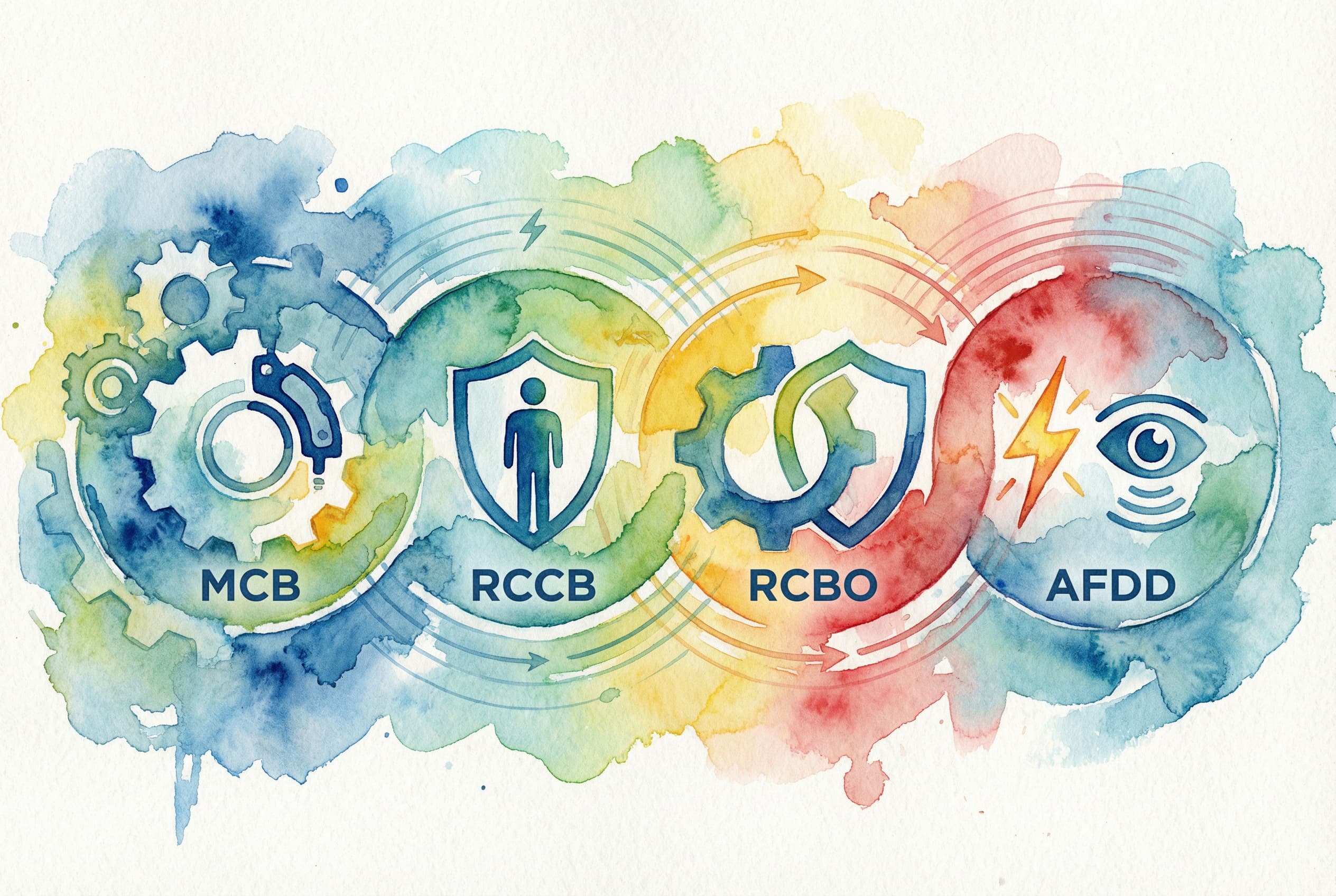
Let’s clarify the roles of these four critical devices using a simple analogy: your car’s safety features.
Understanding which system to use, and where, is the key to creating a truly safe and resilient industrial electrical installation.
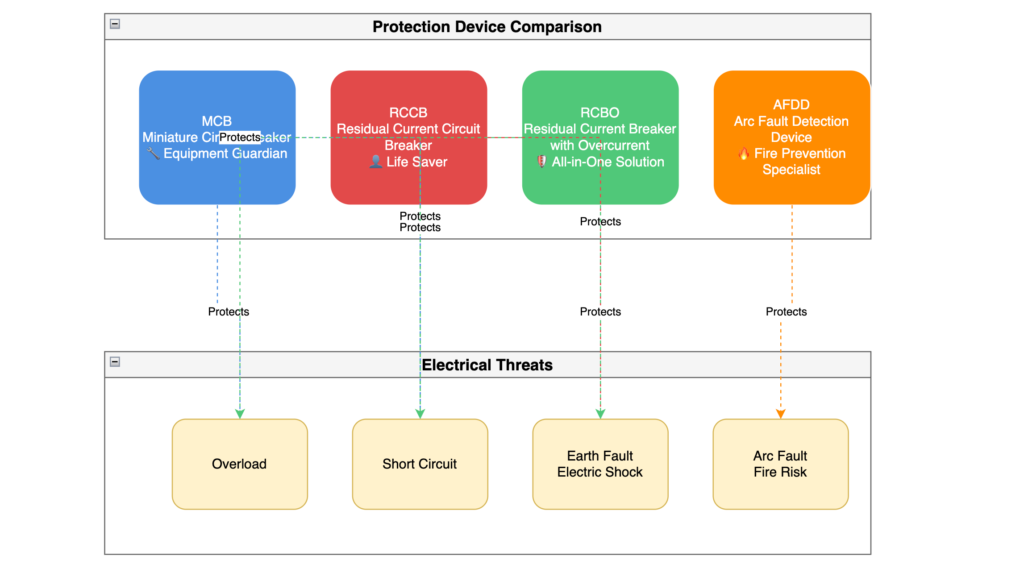
Each of these devices is designed to address a specific type of electrical fault. Using the wrong one for the job leaves you with a critical safety gap.
An MCB is the most common form of circuit protection. Its sole job is to protect the electrical wiring and connected equipment. It does this by automatically disconnecting the power when it detects either a sustained overload (e.g., a motor drawing slightly too much current for too long) or a sudden short circuit (a massive surge of current).
An RCCB, sometimes called an RCD, is designed for one purpose: to save lives. It works by constantly measuring the current flowing in the live and neutral conductors. Based on Kirchhoff’s Law, this flow should be perfectly balanced. If a person touches a live part, a small amount of current will leak through their body to the ground. The RCCB detects this tiny imbalance (as low as 30mA) and trips in milliseconds, long before the shock can become fatal.
An RCBO neatly combines the functionality of both an MCB and an RCCB into a single, compact device. It provides protection against overloads, short circuits, そして earth fault currents. This makes it an ideal choice for protecting individual final circuits where both equipment and personnel safety are critical, such as outlets powering portable tools on the factory floor or in maintenance areas.
The AFDD is the most advanced technology of the four and addresses a danger that the others cannot see. A dangerous arc fault occurs when there is a breakdown in wiring insulation or a loose connection, creating a low-current, high-temperature plasma arc. These “series” or “parallel” arcs often don’t draw enough current to trip an MCB and may not leak to earth to trip an RCCB. Yet, they are a leading cause of electrical fires.
An AFDD uses a sophisticated microprocessor to continuously analyze the electrical waveform’s signature. It is programmed to recognize the unique noise and irregularity characteristic of a dangerous arc, distinguishing it from the normal arcs created by switches or motor brushes. When it detects a hazardous arc, it trips the circuit to prevent a fire.
| 装置 | 機能 | 保護 | Primary Use Case (Industrial) | Key Limitation |
|---|---|---|---|---|
| エムシービー | 過電流保護 | Overload & Short Circuit | General equipment & circuit protection | No protection against electric shock or arc faults. |
| RCCB | Earth Fault Protection | Electric Shock & Fire | Personnel safety; must be paired with an MCB. | No protection against overloads or short circuits. |
| アールシーボ | All-in-One Protection | Overload, Short Circuit, & Earth Fault | Protecting critical individual circuits where both equipment and people are at risk. | Higher cost per circuit. |
| エーエフディー | Arc Fault Detection | Electrical Fires from Arc Faults | Protecting circuits in areas with high fire risk (e.g., storage of flammable materials), sleeping quarters, or irreplaceable assets. | Does not inherently provide overcurrent or earth fault protection (usually combined with RCBO). |

Choosing the right device isn’t just about technical specifications; it’s about risk management. The international standard IEC 60364 (and its local equivalents like BS 7671) provides clear guidance. Here is a practical framework for applying it in your facility.
Step 1: Conduct a Location-Based Risk Assessment\
Instead of a one-size-fits-all approach, evaluate the risk associated with each area and circuit. The standards call for heightened protection in specific locations. Ask yourself:
Step 2: Apply the Right Protection for the Risk\
Based on your assessment, deploy a multi-layered safety strategy:
Step 3: Ensure System Reliability with Selectivity\
In an industrial setting, a fault on a minor lighting circuit shouldn’t shut down the entire production wing. This is the principle of selectivity (or discrimination). It ensures that only the protective device immediately upstream of a fault trips, leaving the rest of the system operational. Achieving proper selectivity requires careful engineering and selection of breakers with the right trip curves and characteristics. Using an all-in-one RCBO on each final circuit is often the simplest way to guarantee selectivity at the final distribution level, preventing costly nuisance tripping across multiple lines.
Ultimately, designing a modern industrial electrical system is about proactive risk management. By moving beyond basic overcurrent protection and embracing a multi-layered approach that includes residual current and arc fault detection, you are not just ticking a compliance box. You are building a safer, more reliable, and more resilient operation.