温州市岳陽工業区 325000
勤務時間
月曜日~金曜日:午前7時~午後7時
週末午前10時~午後5時
温州市岳陽工業区 325000
勤務時間
月曜日~金曜日:午前7時~午後7時
週末午前10時~午後5時

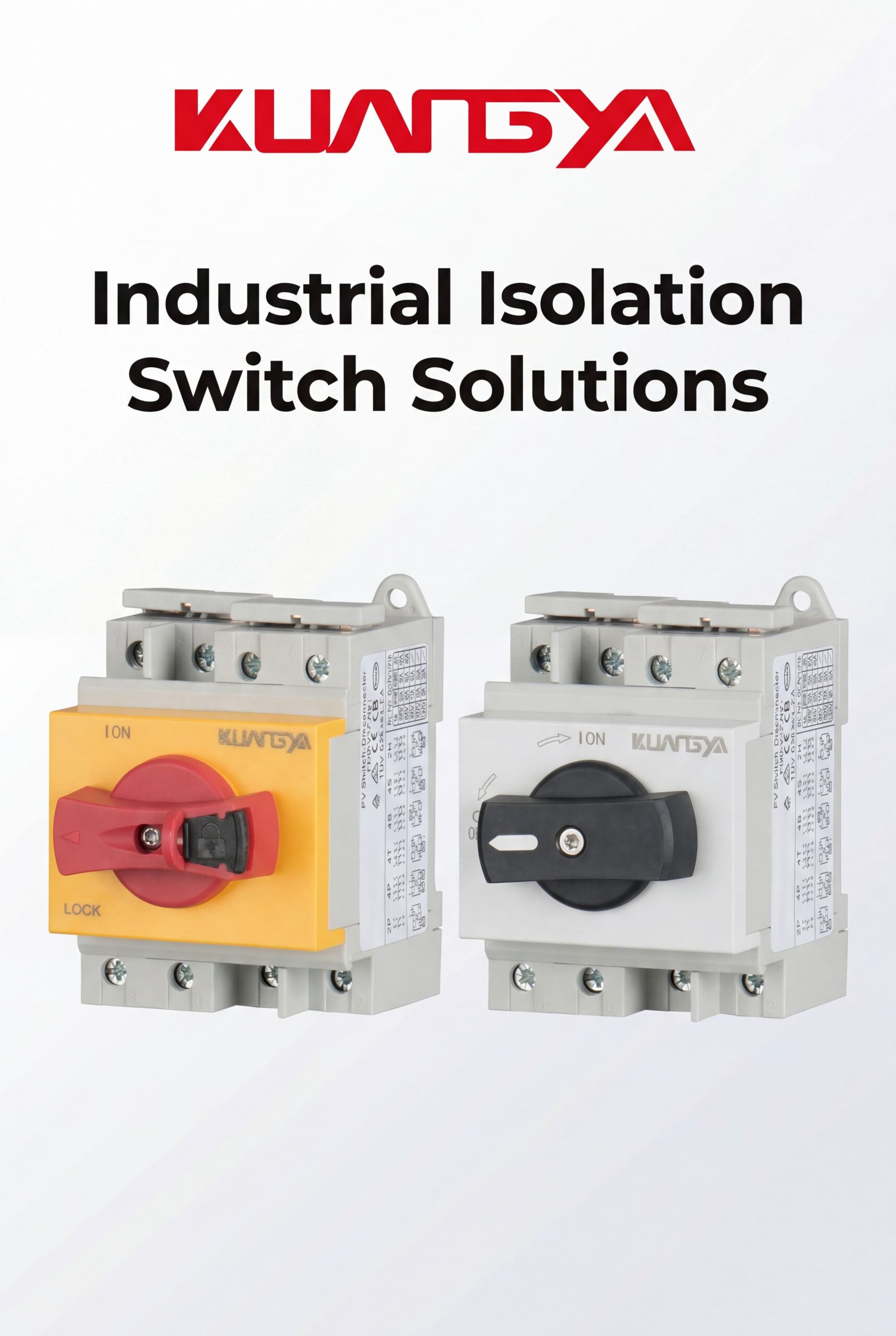
DC disconnector switches serve as critical safety devices in photovoltaic systems, battery storage installations, and industrial DC power distribution networks. Understanding their ratings ensures proper selection, safe operation, and regulatory compliance. This article examines the four fundamental rating parameters that define DC disconnector switch specifications.
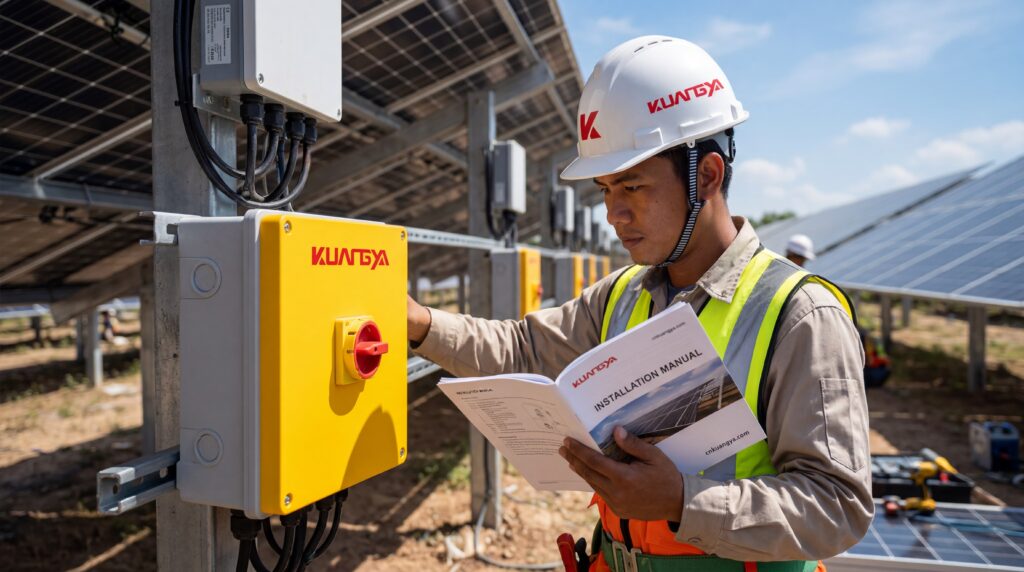
Voltage rating represents the maximum DC voltage a disconnector can safely interrupt and isolate. Unlike AC systems where voltage crosses zero twice per cycle, DC voltage remains constant, creating sustained arcs during switching operations that demand higher interruption capability.
| 定格電圧 | 代表的なアプリケーション | System Compatibility |
|---|---|---|
| 250V DC | Small battery systems, telecom power | 24V-48V battery banks |
| 500V DC | Industrial control systems, medium solar arrays | 400V-500V systems |
| 600V DC | Commercial solar installations, UPS systems | Up to 600V nominal |
| DC1000V | Large-scale PV systems, industrial drives | 800V-1000V systems |
| DC1500V | Utility-scale solar plants, high-voltage storage | 1200V-1500V systems |
DC disconnectors require voltage margin above nominal system voltage to account for:
Selection Example: For a 1150V DC solar system with temperature correction reaching 1320V maximum, specify a 1500V-rated disconnector to maintain adequate safety margin.
When a single-pole contact cannot achieve the required voltage rating, multiple poles connected in series provide the solution:
| Target Voltage | Single Pole Rating | Poles Required in Series |
|---|---|---|
| 600V DC | 300V DC | 2 poles |
| DC1000V | 500V DC | 2 poles |
| DC1500V | 600V DC | 3 poles |
This configuration divides the voltage stress across multiple contact gaps, with each pole interrupting a fraction of the total voltage.
Current rating defines the continuous current-carrying capacity without exceeding temperature limits. DC disconnectors must handle both steady-state operational current and short-duration overcurrent conditions.
| 現在の評価 | Wire Size Compatibility | Typical Load Range |
|---|---|---|
| 16A | 2.5-4 mm² / 14-12 AWG | Small residential systems |
| 32A | 6-10 mm² / 10-8 AWG | Medium residential/commercial |
| 63A | 16-25 mm² / 6-4 AWG | Commercial installations |
| 100A | 35-50 mm² / 2-1/0 AWG | Large commercial systems |
| 200A | 95-120 mm² / 3/0-250 kcmil | Industrial applications |
| 400A | 240-300 mm² / 500-600 kcmil | Utility-scale installations |
| 630A | 400+ mm² / 750+ kcmil | Large-scale power distribution |
| 1200A+ | Multiple parallel conductors | Utility-scale solar plants |
Continuous Current Calculation:
Example Calculation:
Beyond continuous current, disconnectors must withstand short-circuit currents without welding contacts or exploding:
| SCCR Rating | Application Category |
|---|---|
| 6 kA | Residential solar systems |
| 10 kA | Commercial installations |
| 25 kA | Industrial systems |
| 42 kA | Utility-scale plants |
| 65 kA | High-fault current networks |
The SCCR must exceed the maximum available fault current at the installation point, calculated from source impedance and conductor resistance.
Pole configuration determines which conductors the disconnector can simultaneously interrupt. DC systems require different pole arrangements than AC systems due to grounding methods and circuit topology.
| 構成 | Conductors Switched | 代表的なアプリケーション |
|---|---|---|
| 1-Pole | Single conductor (+ or -) | Grounded systems with one conductor switched |
| 2-Pole | Both + and – conductors | Ungrounded DC systems, battery banks |
| 3-Pole | Two circuits or series voltage division | Dual-string arrays, high-voltage systems |
| 4-Pole | Two independent 2-pole circuits | Multiple array strings, redundant systems |
Grounded Systems (Negative or Positive Ground):
Ungrounded Systems (Floating DC):
High-Voltage Systems (>1000V DC):
| システム構成 | Pole Requirement | Switching Arrangement |
|---|---|---|
| Single string, grounded | 1-pole | Ungrounded conductor only |
| Single string, ungrounded | 2-pole | Both + and – |
| Two strings, common disconnect | 4-pole | Two 2-pole circuits |
| Three strings, common disconnect | 6-pole | Three 2-pole circuits |
Utilization categories, defined by IEC 60947-3, specify the switching duty and load characteristics a disconnector can handle. These categories account for load type, inductive energy, and switching frequency—critical factors in DC arc interruption.
| カテゴリー | Load Type | Inductive Time Constant | Making/Breaking Capacity | 代表的なアプリケーション |
|---|---|---|---|---|
| DC-20A | Resistive loads | Non-inductive | Ie at Ue | Heaters, resistive banks |
| DC-20B | Resistive loads | Non-inductive | 1.1 × Ie at Ue | Resistive loads with inrush |
| DC-21A | Slightly inductive | τ ≤ 1 ms | 2 × Ie at Ue | Inverter inputs, capacitive loads |
| DC-21B | Slightly inductive | τ ≤ 2 ms | 2.5 × Ie at Ue | Motor control, light inductive |
| DC-22A | Mixed inductive | τ ≤ 5 ms | 4 × Ie at Ue | Transformer-coupled inverters |
| DC-22B | Highly inductive | τ ≤ 10 ms | 6 × Ie at Ue | Heavy motors, solenoids |
| DC-23A | Highly inductive | τ ≤ 15 ms | 8 × Ie at Ue | Large DC motors, industrial drives |
| DC-23B | Extremely inductive | τ > 15 ms | 10 × Ie at Ue | Field windings, electromagnets |
どこで:
Solar installations use specialized categories due to unique arc-quenching challenges:
| カテゴリー | 申し込み | Arc Interruption Capability | Standard Reference |
|---|---|---|---|
| DC-PV1 | General PV arrays | Standard arc interruption | IEC 60947-3 Annex C |
| DC-PV2 | High-voltage PV systems | Enhanced arc interruption | IEC 60947-3 Annex C |
DC-PV Category Requirements:
Step 1: Identify Load Characteristics
| Load Type | Time Constant (τ) | Recommended Category |
|---|---|---|
| PV array to inverter | < 1 ms | DC-21A or DC-PV1/PV2 |
| 蓄電池 | < 2 ms | DC-21B |
| DC motor (small) | 2-5 ms | DC-22A |
| DC motor (large) | 5-15 ms | DC-23A |
| Field windings | > 15 ms | DC-23B |
Step 2: Verify Making/Breaking Capacity
The disconnector must handle inrush currents during closing and stored inductive energy during opening:
例: A 400A DC-22A disconnector can:
Step 3: Match Application to Category
| アプリケーション・シナリオ | System Parameters | Required Category | Rationale |
|---|---|---|---|
| Residential solar (5 kW) | 600V, 60A, inverter input | DC-21A or DC-PV1 | Low inductance, capacitive load |
| Commercial solar (100 kW) | 1000V, 200A, string inverter | DC-PV2 | High voltage, PV-specific duty |
| Battery ESS | 800V, 150A, battery bank | DC-21B | Slight inductance from cables |
| Utility solar (1 MW) | 1500V, 800A, central inverter | DC-22A or DC-PV2 | Transformer coupling, high power |
| DC motor drive | 750V, 300A, industrial motor | DC-23A | High inductance from motor windings |
Different categories require specific arc-quenching mechanisms:
| テクノロジー | Categories Supported | メカニズム |
|---|---|---|
| Air gap only | DC-20A/B | Simple contact separation |
| Magnetic blow-out | DC-21A/B | Permanent magnets deflect arc |
| Arc chutes | DC-22A/B | Segmented plates cool and divide arc |
| Series contacts | DC-23A/B, DC-PV2 | Multiple breaks per pole |
| Vacuum interrupters | All categories | Vacuum eliminates arc medium |
Proper disconnector selection requires simultaneous consideration of all four rating parameters. A mismatch in any single parameter compromises safety and performance.
| パラメータ | Information Required | Selection Rule |
|---|---|---|
| 電圧 | Maximum system voltage including temperature correction | Rating ≥ 1.2 × Vmax |
| 現在 | Continuous load current with safety factors | Rating ≥ 1.25 × Icontinuous |
| ポール | System grounding and number of circuits | Match grounding method and circuit count |
| カテゴリー | Load type and inductive time constant | Match or exceed load characteristics |
Example 1: Residential Solar System
Selected Disconnector:
Example 2: Utility-Scale Solar Plant
Selected Disconnector:
Example 3: Battery Energy Storage
Selected Disconnector:
DC disconnector switches must comply with international and regional standards to ensure safety and interoperability.
| スタンダード | スコープ | Key Requirements |
|---|---|---|
| IEC 60947-3 | Low-voltage switchgear and controlgear | Utilization categories, testing procedures |
| UL 98 | Enclosed and dead-front switches | North American safety requirements |
| IEC 60947-2 | Circuit breakers | Short-circuit protection coordination |
| EN 60947-3 | European switchgear | CE marking requirements |
| NEC Article 690 | Solar photovoltaic systems | Installation and disconnection requirements |
| IEC 62109 | Power converters for PV systems | Inverter interface requirements |
Disconnectors undergo rigorous testing to verify ratings:
| Test Type | 目的 | Pass Criteria |
|---|---|---|
| Temperature rise test | Verify current rating | ΔT < 50K at rated current |
| Dielectric withstand | Verify voltage rating | No breakdown at 2 × Ue + 1000V |
| Making/breaking capacity | Verify utilization category | Successful operations per IEC cycles |
| Short-circuit withstand | Verify SCCR | No welding or explosion at rated SCCR |
| Endurance testing | Verify mechanical life | 10,000+ operations without failure |
| Arc interruption | Verify DC breaking | Clean arc extinction within time limit |
Understanding typical mistakes prevents dangerous misapplication:
| エラー | 結果 | 訂正 |
|---|---|---|
| Using AC-rated switch for DC | Arc fails to extinguish, fire risk | Always specify DC-rated devices |
| Undersizing voltage rating | Insulation breakdown, flashover | Include temperature and transient margins |
| Ignoring utilization category | Contact welding, failure to interrupt | Match category to load inductance |
| Single-pole on ungrounded system | Incomplete isolation, shock hazard | Use 2-pole for floating DC systems |
| Oversizing current rating | Excessive cost, larger enclosure | Select nearest standard rating above calculated |
DC disconnector switch selection demands comprehensive analysis of voltage, current, pole configuration, and utilization category ratings. Each parameter addresses specific electrical and safety requirements that cannot be compromised. Voltage ratings must accommodate temperature effects and transients, current ratings must include safety factors and derating, pole configurations must match system grounding, and utilization categories must align with load characteristics.
The integrated approach—simultaneously evaluating all four parameters against system requirements and applicable standards—ensures reliable, safe, and compliant installations. As DC power systems proliferate in renewable energy and industrial applications, proper understanding of these ratings becomes increasingly critical for engineers, installers, and maintenance personnel.

