WengYang Industrial Zone Yueqing Wenzhou 325000
勤務時間
月曜日~金曜日:午前7時~午後7時
週末午前10時~午後5時
WengYang Industrial Zone Yueqing Wenzhou 325000
勤務時間
月曜日~金曜日:午前7時~午後7時
週末午前10時~午後5時

Choosing the right circuit protection device is more than a line item on a spec sheet; it’s a strategic decision that underpins plant safety, operational uptime, and financial health. For engineers and facility managers, the choice between an MCB, RCCB, RCBO, or エーエフディー is a calculated risk assessment. An incorrect choice can lead to catastrophic equipment failure, dangerous electrical fires, or costly production halts. This guide provides a definitive technical comparison of these four critical devices in the context of demanding industrial environments. We will explore their core functions, ideal applications, and the strategic trade-offs involved in their selection.
Here’s the essential breakdown:
Understanding these distinctions is the first step toward building a resilient, safe, and compliant industrial electrical system.

To make an informed decision, it’s crucial to understand the technical specifications that differentiate these devices. While they may look similar on a DIN rail, their internal mechanisms and protective functions vary significantly.
| 特徴 | MCB(ミニチュアサーキットブレーカー) | RCCB(残留電流サーキットブレーカー) | RCBO(過電流付き残留電流ブレーカー) | エーエフディー (Arc Fault Detection Device) |
|---|---|---|---|---|
| 主要機能 | Overcurrent & Short Circuit Protection | Earth Leakage (Electric Shock) Protection | All-in-One: Overcurrent, Short Circuit & Earth Leakage | Arc Fault (Fire Prevention) Detection |
| 保護 | Damaged appliances, wiring overheating | Direct/indirect contact, electric shock | All of the above | Series/parallel arcs, loose connections, cable damage |
| 典型的な使用例 | General lighting and motor circuits. | Circuits in wet or high-risk areas (requires MCB backup). | High-density panels, critical circuits requiring total protection. | Sleeping quarters, areas with high fire risk or aged wiring. |
| Standalone Operation? | はい | いいえ. Must be paired with an MCB or fuse. | はい | Yes, but typically integrated with an MCB or RCBO. |
| Key Advantage | Cost-effective, reliable equipment protection. | High sensitivity to leakage currents that can harm humans. | Complete protection in a single, space-saving unit. | Detects fire-starting faults that other breakers miss. |
| Limitation | Offers no protection against electric shock. | Offers no overcurrent or short circuit protection. | Higher cost per unit compared to an MCB+RCCB combo. | Does not inherently provide overload or shock protection. |
The most common point of confusion for designers and technicians is the distinction between an RCCB and an RCBO. The difference is simple but critical:
In an industrial panel, using an RCBO for each final circuit offers the highest level of safety and fault granularity. When an RCBO trips, only that specific circuit is de-energized, which simplifies troubleshooting and minimizes operational downtime. In contrast, if a single RCCB protects multiple circuits (each with its own MCB), a fault on any one of those circuits will de-energize all of them, making it harder to locate the source of the problem.
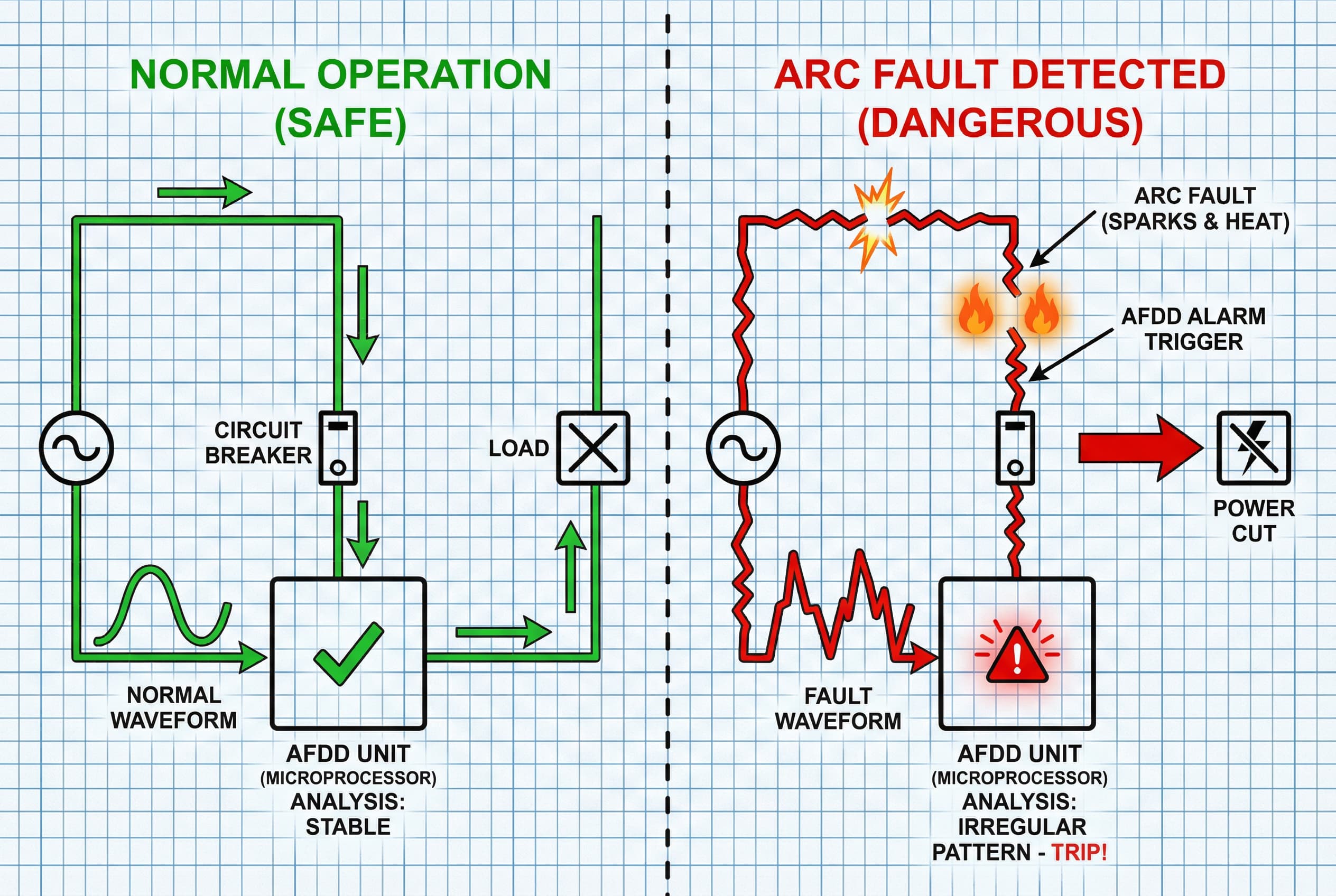
An AFDD uses a microprocessor to analyze the electrical waveform’s “signature.” It is trained to ignore benign arcs (like a light switch turning on) but instantly recognize the high-frequency, erratic patterns of a dangerous arc fault caused by a loose wire or damaged cable—a common precursor to electrical fires.
“We used to have issues with nuisance tripping on our CNC lines, which we traced back to high-frequency noise from the drives. Switching to Type B RCBOs solved it overnight. The initial cost was higher, but the reduction in downtime paid for it within a month.” — Facility Manager, Automotive Plant
“After a small fire in a storage area was traced to faulty wiring, our insurance provider mandated an upgrade. We installed AFDD-integrated RCBOs on all lighting and socket circuits in non-production areas. The peace of mind is invaluable, and the installation has satisfied our compliance requirements.” — Safety Officer, Logistics Warehouse

Choosing the right device requires matching its capabilities to the specific risks and load characteristics of the application. This matrix provides clear recommendations for common industrial scenarios.
| Scenario / Application | Primary Risk(s) | 推奨デバイス | Justification & Notes |
|---|---|---|---|
| CNC Machines / Milling | Overcurrent, short circuits, high inrush current. | C or D-Curve MCB | The high inrush current from motors requires a breaker that won’t trip on startup. A D-curve is for the highest inrush loads. Add an upstream RCCB for personnel safety if required by local code. |
| Variable Frequency Drives (VFDs) | DC residual currents, harmonic distortion, shock. | タイプB RCBO | VFDs can produce smooth DC leakage currents that can “blind” standard Type A or AC RCCBs/RCBOs, rendering them useless. Type B devices are specifically designed to detect both AC and DC residual currents, ensuring safety. |
| Wet Environments (Washdown Areas) | Electric shock, equipment failure due to moisture. | 30mA Type A RCBO | Personnel protection is paramount. A 30mA sensitivity ensures a rapid trip in the event of human contact with a live component. The RCBO provides all-in-one protection, minimizing panel space and potential points of failure. |
| Hazardous Areas (Flammable Dust/Gas) | Electrical sparks causing ignition, fire. | AFDD + MCB/RCBO | Arc faults are a primary ignition source. An AFDD is the only device that can detect these micro-sparks from loose connections. It should be paired with an MCB or RCBO for overcurrent and shock protection. |
| IT & Server Infrastructure | Downtime, data loss from nuisance trips, fire. | Type A RCBO (per circuit) | Granular protection is key. Using one RCBO per server rack or circuit prevents a single fault from taking down an entire data room. Type A is suitable for the pulsating DC produced by modern server power supplies. |
| Industrial Lighting Circuits (LED) | Inrush current, fire from faulty drivers/wiring. | C-Curve MCB or RCBO | Modern LED installations can have significant inrush current when switched on. A C-curve breaker accommodates this. Using an RCBO or adding an upstream AFDD provides an extra layer of fire safety for wiring in ceilings and walls. |
The industry is moving towards more intelligent and communicative devices. Smart circuit breakers with built-in energy monitoring are becoming more common, allowing facility managers to track power consumption, predict failures, and optimize energy use directly from a central dashboard. Furthermore, the integration of AFDD technology into standard breakers is expected to become more widespread as production costs decrease and safety regulations become more stringent, particularly for high-risk or residential-adjacent facilities like dormitories or barracks.
For the busy engineer or facility manager, here are the most critical points to remember:
Selecting between an MCB, RCCB, RCBO, and AFDD is not a simple matter of cost or availability. It is a fundamental part of a facility’s safety and operational strategy. By understanding the specific protections offered by each device and matching them to the risks inherent in your industrial applications, you move from simply buying components to designing a resilient, compliant, and safe electrical infrastructure. The investment in the correct, high-quality circuit protection pays for itself through increased uptime, enhanced safety, and the prevention of catastrophic failures.