温州市岳陽工業区 325000
勤務時間
月曜日~金曜日:午前7時~午後7時
週末午前10時~午後5時
温州市岳陽工業区 325000
勤務時間
月曜日~金曜日:午前7時~午後7時
週末午前10時~午後5時

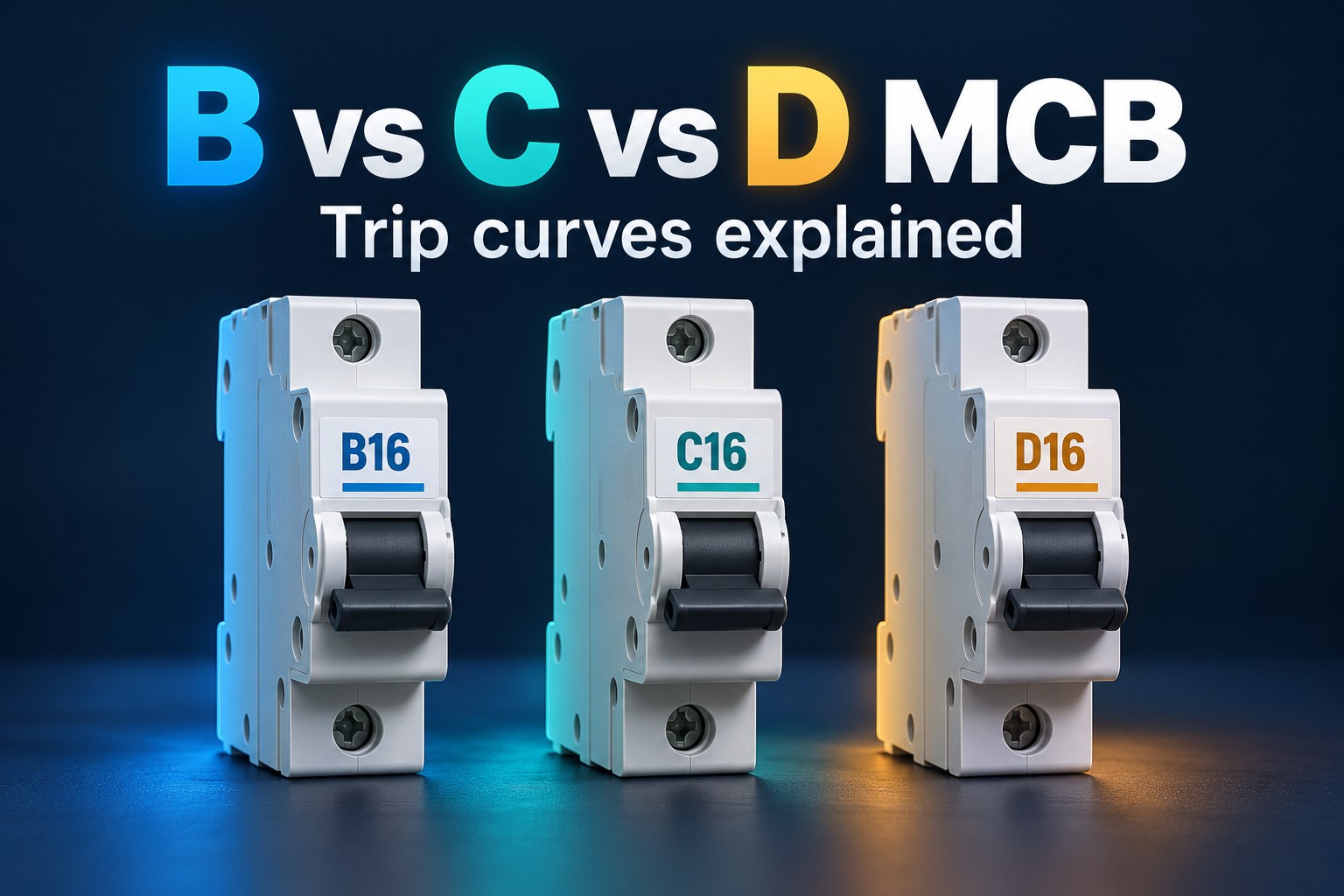
B vs C vs D MCB is a comparison of magnetic trip characteristics, not a ranking from basic to premium. A B16, C16 and D16 miniature circuit breaker can all have a rated current of 16 A while responding differently to a brief, high current.
クイックアンサー: Typical IEC 60898-1 AC magnetic trip bands are 3–5 times rated current for B curve, 5–10 times for C curve and 10–20 times for D curve. Select a curve that accommodates legitimate starting current while still disconnecting faults within the required time. Always check the exact manufacturer’s time-current curve.
This guide helps installers, panel builders and buyers read the markings and prepare a specification. Circuit measurements, replacement and verification belong to qualified electrical personnel.
| 特徴 | B curve | C curve | D curve |
|---|---|---|---|
| Typical AC magnetic band | 3–5 × In | 5–10 × In | 10–20 × In |
| Relative tolerance of brief inrush | より低い | Intermediate | より高い |
| Applications to evaluate | Loads with limited inrush | Loads with moderate inrush | Loads with substantial inrush, such as some motors or transformers |
| Does the letter increase cable ampacity? | いいえ | いいえ | いいえ |
In means the breaker’s rated current. These bands describe magnetic operation under specified test conditions; they are not continuous operating-current allowances. Hager lists the typical B, C and D bands in its circuit protection technical FAQ. Application examples are starting points, not universal selection rules.
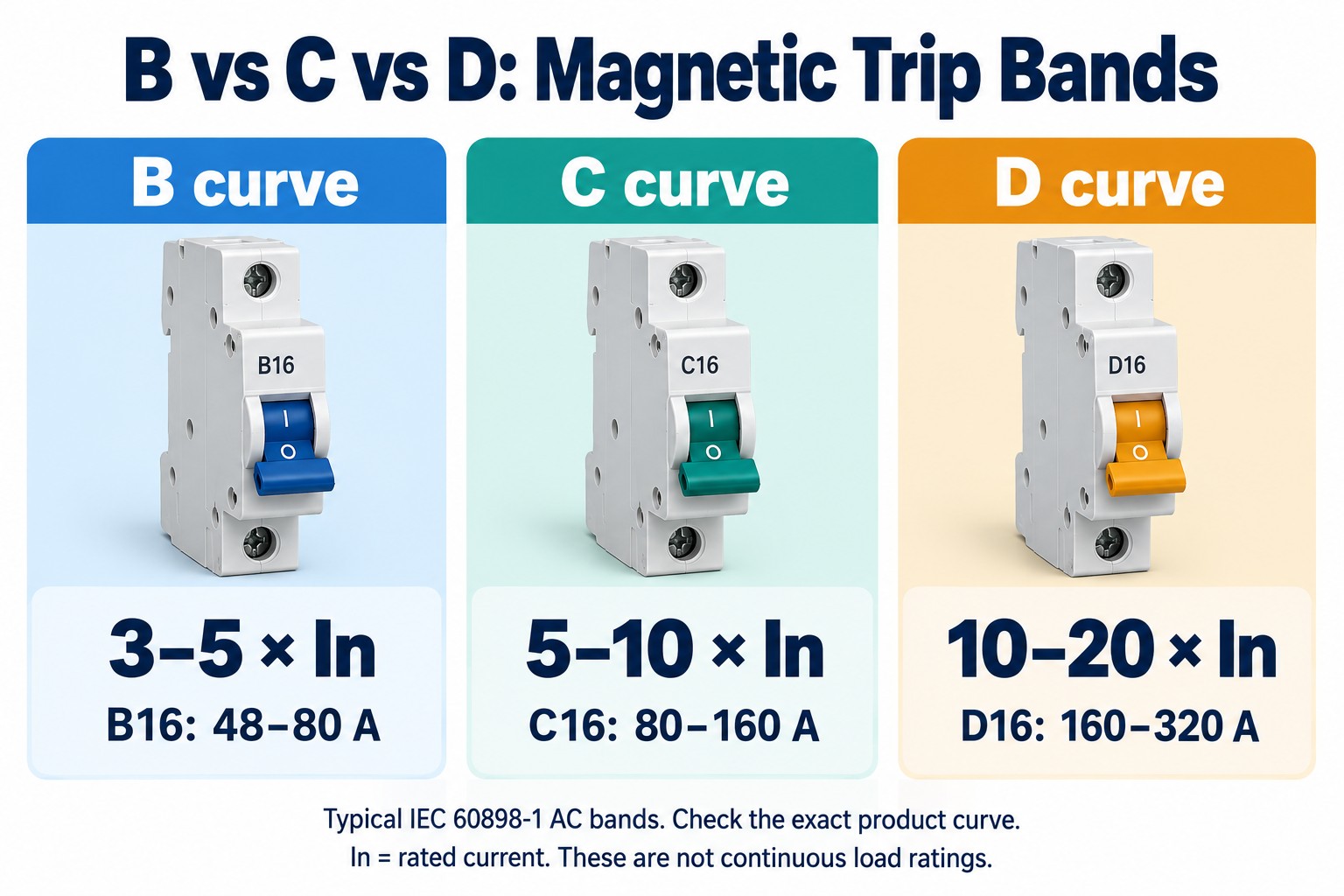
The letter identifies the trip characteristic and the number identifies rated current in amperes. Using the typical bands above, the arithmetic for a 16 A breaker is:
These calculated ranges do not mean that a C16 breaker can continuously supply 80 A, or that every B16 trips at exactly 48 A. They illustrate why the letter matters when a load starts. Duration, tolerances and the complete curve are essential to interpreting a particular event.
A separate marking such as 6000 A or 6 kA concerns short-circuit breaking capacity under its stated standard and voltage. It is neither the normal load rating nor the magnetic pickup current.
A thermal-magnetic breaker has an inverse-time overload region and a magnetic region for higher currents. Reading only the letter loses the time dimension: a current lasting milliseconds is a different duty from the same current lasting seconds.
Product data can also give tighter operating bands than the generic table. For example, Schneider Electric’s iC60 Acti9 curve explanation lists product-specific values. Use the data for the exact catalogue reference, standard and supply conditions; do not average different manufacturers’ figures into a new trip threshold.
Request the actual curve sheet with a quotation. A catalogue description saying “C curve” alone is not enough to verify an inrush profile or fault-clearing time.
Only after the circuit has been assessed. A higher magnetic threshold may accommodate a starting pulse, but it may also require more fault current for rapid magnetic operation. The relevant question is whether protection still works at the circuit’s lowest expected fault current.
Long cable runs and source impedance can limit fault current. Schneider Electric’s minimum short-circuit current guidance explains why the minimum fault level and conductor thermal limits must be checked together.
Illustrative check: suppose an assessment gives a minimum fault current of 120 A on a 16 A circuit. That is 7.5 × In. It lies inside the typical C magnetic band and below the typical D band. The generic table cannot establish guaranteed magnetic operation for either choice at that current. The designer must check the full curve against the required disconnection time and the circuit protection arrangement.
This example is not a replacement recommendation. Identify whether the original trip came from overload, short circuit, leakage or another protective function before changing equipment.
These checks follow the factors discussed in Schneider Electric’s circuit-breaker selection guide. For a broader purchasing introduction, see our AC MCB selection guide.
A B-curve MCB describes an overcurrent trip characteristic. A Type B RCD describes residual-current detection capabilities, including specified smooth DC residual currents. One label does not imply the other.
An RCBO combines overcurrent and residual-current protection, so its specification needs both classifications. For example, a B-curve overcurrent characteristic and Type A residual-current classification can appear on the same device. See Hager’s RCD type explanation and our RCCB vs RCBO comparison.
For an EV charging enquiry, write the MCB/RCBO curve and residual-current requirements in separate fields. If the problem is leakage-related tripping, our EV charger RCD troubleshooting guide addresses that different protection function.
Do not transfer an AC table directly to a DC application. Check the device’s DC voltage rating, approved pole arrangement, polarity restrictions, breaking capacity and DC trip data. Schneider Electric notes for its PowerPact B thermal-magnetic breakers that magnetic trip levels vary when those devices are applied on DC. That is a product-specific reminder to consult DC documentation, not a conversion factor for all breakers.
For PV and storage projects, also review our DC circuit breaker polarity checks. A curve letter alone does not establish suitability for a battery circuit or PV string.
Send Kuangya the application, destination market, supply details, design current, load starting profile, required poles and breaking capacity, installation temperature, and requested standard. If a curve is already specified, include the designer’s requirement and ask for the exact model’s time-current documentation.
Keep the approved catalogue reference, curve sheet and quotation together. If a supplier proposes an alternative model, compare those documents before accepting the substitution.
Neither is universally better. Choose the characteristic that fits the load and the verified fault-clearing requirements.
No. D16 and B16 are both marked 16 A. The letter changes the magnetic characteristic, not the number’s meaning.
Use the equipment’s starting-current data and the circuit assessment. Do not select D curve solely because the load is called a motor or transformer.
Not if the trip comes from residual-current detection. Establish which protective function operated before selecting a remedy.
No. It is a visual summary of typical magnetic bands. It cannot replace a manufacturer’s time-current curve, installation design or verification results.

