温州市岳陽工業区 325000
勤務時間
月曜日~金曜日:午前7時~午後7時
週末午前10時~午後5時
温州市岳陽工業区 325000
勤務時間
月曜日~金曜日:午前7時~午後7時
週末午前10時~午後5時

Understand DC circuit breaker polarity with seven practical checks. Compare reverse feeding and bidirectional current, review a battery example, and use a procurement checklist to verify the exact manufacturer documentation.
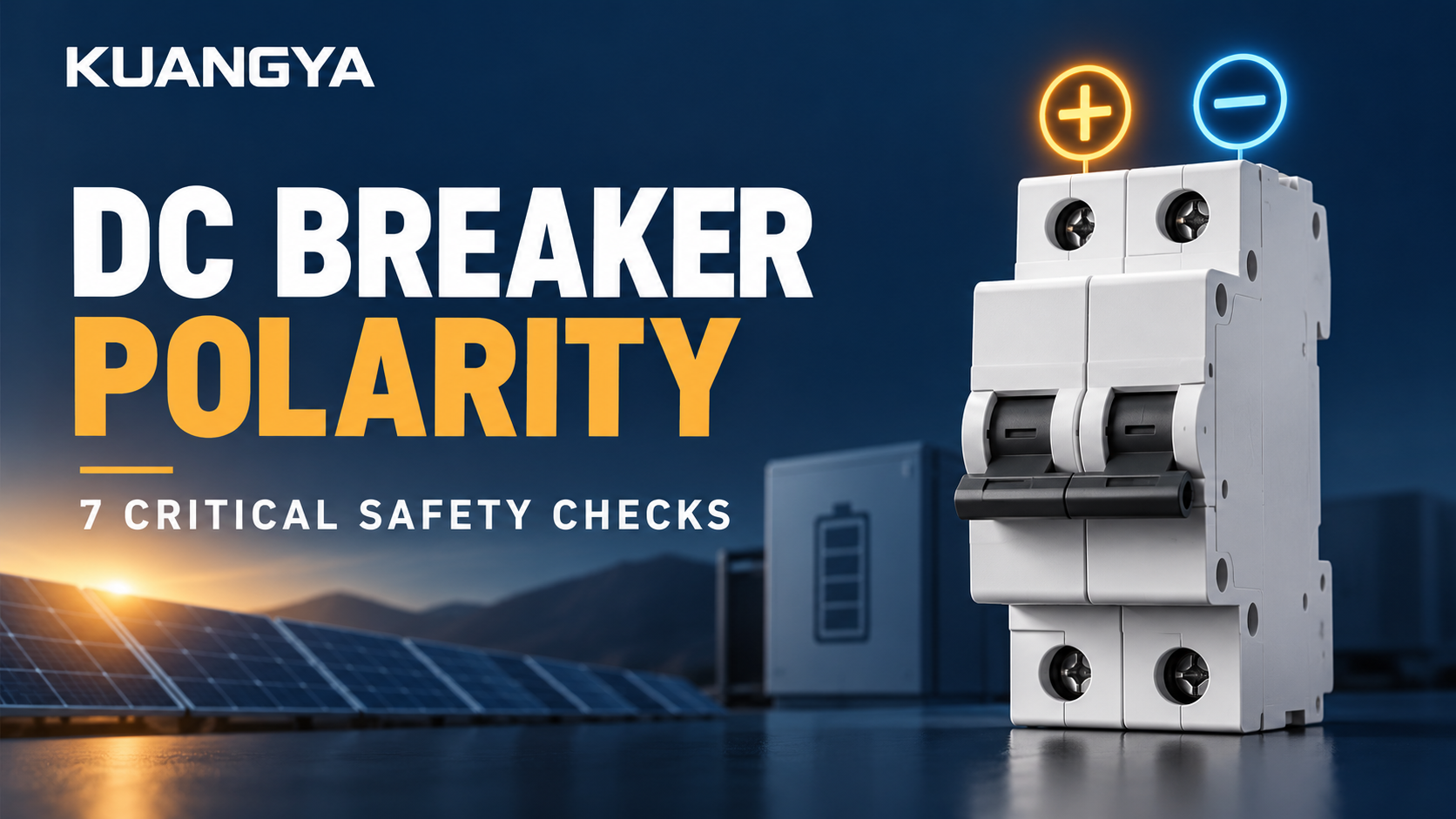
DC circuit breaker polarity matters whenever a breaker has directional limitations. A device can carry normal load current and still be unsuitable for interrupting a fault in the opposite direction. For solar PV and battery storage projects, a DC voltage rating alone does not answer the polarity question.
The practical rule is simple: select and connect the exact breaker according to its manufacturer’s approved DC diagram, current-direction limits and interrupting ratings. Do not infer safe wiring from the handle position, a generic online picture or the fact that the system appears to operate.
This guide explains seven checks for engineers, panel builders and buyers reviewing DC circuit breaker polarity. It separates three frequently confused issues: voltage polarity, permitted supply terminals and current reversal. It is a selection and documentation guide, not a live-work procedure or a substitute for a qualified electrical designer.
A polarized DC circuit breaker has a specified relationship between its terminals and the permitted current direction. A non-polarized designation may remove a particular directional restriction, but it does not remove voltage, fault-current, pole-connection or application limits. Always read what the manufacturer means for the exact model.
For example, Schneider Electric states that its C60H-DC is polarized, must follow its marked polarity, and must not be used where current direction can change even momentarily. This is a model-specific restriction, not proof that every DC breaker has the same restriction. See the manufacturer’s C60H-DC polarity guidance.
When reviewing DC circuit breaker polarity, start with the complete ordering reference and its current installation instructions. If the documents do not clearly cover your operating modes, obtain written confirmation before approving the device.
| 期間 | What it describes | What to verify |
|---|---|---|
| Voltage polarity | The positive and negative electrical potential of conductors or terminals | Actual conductor identification and the approved connection diagram |
| Reverse feeding | Supplying a device from the terminal side opposite to its usual or marked supply side | Whether the exact assembly permits that supply arrangement |
| Bidirectional current | Current flowing in either direction during different operating states | Whether protection and interruption are approved for both directions |
A battery can charge and discharge while its positive terminal remains positive relative to its negative terminal. The direction of energy transfer changes; the conductor labels do not simply exchange places. This distinction is central to DC circuit breaker polarity in storage applications.
Likewise, moving the supply cable from the upper terminals to the lower terminals is not automatically equivalent to approving charge and discharge duty. A product may have restrictions connected with internal protection, accessories or a particular wiring arrangement.
The first DC circuit breaker polarity check is identification. Record the manufacturer, full product reference, rated current, DC voltage marking and number of poles. Include suffixes for trip units, accessories and terminal arrangements. Similar-looking housings may contain different devices.
Use a clear photograph of the front and side markings alongside the installation sheet. Keep both in the project file. If the label is missing, damaged or inconsistent with the paperwork, quarantine the item for clarification instead of deciding its function by appearance.
A catalog family name is not sufficient evidence. One series can contain several ratings or configurations, and an online listing may combine photographs from multiple versions. Ask the supplier to identify exactly which document applies to the delivered reference.
For a procurement team, the output of this step should be a traceable link between the purchase order, sample label and approved drawing. That prevents a later substitution from silently changing the DC circuit breaker polarity assumptions used in the design.
Check every terminal shown in the manufacturer’s DC diagram. Look for positive and negative marks, line and load labels, current arrows, terminal numbers and required pole links. Do not interpret one isolated symbol without the rest of the drawing.
A multi-pole breaker may require a specific series connection to achieve a stated DC rating. The drawing, not the physical number of modules, determines how that configuration is used. Do not improvise bridges, parallel poles or alternative conductor routing.
DC circuit breaker polarity also cannot be established from a photograph of another customer’s cabinet. That cabinet may use a different product revision, grounding arrangement or supply topology. A neat installation is not evidence of a valid connection.
Where the drawing is ambiguous, send the manufacturer an annotated single-line diagram and request clarification. Ask which terminals connect to each source and which fault-current directions are covered. A written answer is more useful than a general assurance that the breaker is suitable for solar.
The third DC circuit breaker polarity check is a mode review. List normal operation, charging, discharging, standby, maintenance transfer and credible fault conditions. Identify which connected sources can feed current through the device in each state.
For a simple PV branch, normal power flows toward the conversion equipment. However, the designer still needs to assess the complete circuit rather than assuming that normal operating direction describes every fault. Parallel sources and other connected equipment can change the analysis.
In a battery circuit, charge and discharge are especially important. A breaker selected only from the discharge current may overlook a directional limitation during charging. The manufacturer’s application approval must cover the actual bidirectional duty, not just a matching ampere value.
Create a mode table with a separate row for each state. Where information is missing, mark it as unresolved. Do not turn an unknown direction into an assumed one merely to finish the purchase order.
| Operating state | Question for the designer | Required evidence |
|---|---|---|
| PV production | What source feeds the protected circuit? | Single-line diagram and approved breaker connection |
| Battery charging | Does current reverse relative to discharge? | Explicit suitability for the charging direction |
| Battery discharging | Which sources contribute to a fault? | Fault study and applicable DC interrupting rating |
| Alternative supply or transfer | Can another source energize the opposite terminal side? | Approved supply arrangement for that mode |
Do not use the phrase non-polarized as the complete answer to a reverse-feeding question. DC circuit breaker polarity, terminal-side supply and accessory limitations must all be checked together.
Schneider Electric’s reverse-feeding FAQ discusses marking-based restrictions and lists product exceptions. Its scope is the manufacturer’s listed products; it should not be used to approve an unidentified breaker from another supplier.
The useful purchasing question is precise: can this full ordering reference, including its accessories, be supplied from the proposed terminal side at the stated DC voltage and configuration? Ask for the relevant page of the instructions or an application confirmation.
If a technician needs to reroute the supply because of cabinet space, treat that as a design change. Cable convenience does not establish reverse-feed permission. Review the change before installation rather than modifying the connection and checking whether the load starts.
Correct DC circuit breaker polarity does not prove that a breaker can interrupt the available fault current. Voltage, prospective short-circuit current, circuit characteristics and the approved pole arrangement remain separate checks.
A current rating describes one part of selection; it is not a universal fault-interruption rating. Similarly, an AC breaking-capacity number should not be carried across to a DC application without explicit manufacturer data.
Ask for the DC interruption data at the actual system voltage and connection. Confirm the relevant test conditions and any limits identified in the documentation. The maximum system voltage may differ from the nominal battery or array voltage used in everyday conversation.
This article does not provide a universal sizing multiplier. Use the project requirements and equipment instructions. For related selection topics, see our guides to DC circuit breaker sizing for solar そして DC circuit breakers for ESS.
A DC circuit breaker polarity review should cover the completed panel. Compare the approved drawing with conductor labels, terminal identifiers, pole links and all connected sources. The person verifying the assembly needs the final revision, not an early quotation sketch.
Include mounting orientation, conductor preparation, permitted cable sizes and tightening requirements in the assembly inspection. These do not replace polarity verification, but an otherwise correct selection can still be undermined by installation errors.
Temperature is another independent constraint. A breaker installed beside heat-producing equipment may require a different thermal assessment from one evaluated in open air. Our DC circuit breaker derating guide explains why enclosure conditions deserve their own review.
Use an inspection record that identifies who checked the assembly and which drawing was used. When a replacement is fitted later, repeat the comparison. Matching the old device’s footprint does not establish equivalent DC circuit breaker polarity or application performance.
The final DC circuit breaker polarity check is not an improvised fault test. Commissioning should follow an approved procedure carried out by qualified personnel with the system safely isolated and all possible energy sources considered.
Never deliberately reverse a connection, create a short circuit or open a loaded circuit merely to see whether the breaker works. Normal switching, continuity or successful power-up cannot demonstrate the full rated interruption performance of a protective device.
Record the installed reference, relevant documents, inspection results and any manufacturer confirmations. Attach photographs that make the terminal markings and conductor identification readable without requiring future staff to dismantle an energized enclosure.
For change control, define which modifications trigger a new review: adding a battery, changing an inverter, introducing a second source, altering pole links or substituting a breaker. DC circuit breaker polarity should be revisited whenever the current paths or approved device configuration change.
Consider a hypothetical storage cabinet with a battery and a bidirectional converter. The same protected circuit carries charging current in one state and discharge current in another. The cabinet’s nominal voltage and cable current are known, but the selected breaker’s directional approval is not.
A weak review would stop after checking the voltage and ampere values. A stronger DC circuit breaker polarity review asks whether both current directions are permitted and whether the documented DC interruption performance covers the proposed application.
The designer first marks the current paths for charging and discharging on the single-line drawing. Next, the buyer requests the exact model’s connection instructions and a clear statement covering both modes. Finally, the panel builder confirms that the delivered device matches the approved reference.
If the instructions limit the device to one direction, the team must resolve the selection before energization. Reversing the breaker to favor the other operating mode does not solve a two-direction requirement. Nor does changing a label alter the product’s approval.
This example illustrates a decision process, not a recommended wiring arrangement. The appropriate device and system protection scheme depend on the full design, fault conditions and applicable requirements.
Use the following checklist when requesting a sample or quotation. It converts a vague request for a DC breaker into a reviewable specification. Keep answers tied to one exact reference rather than accepting a mixture of data from different products.
A useful DC circuit breaker polarity inquiry includes an annotated project diagram. It gives the supplier enough context to answer the actual application question and reduces the risk of a generic yes response being mistaken for engineering approval.
Normal operation is not a verification of rated protective performance. Ask whether the exact configuration is approved and documented. A breaker is chosen for abnormal conditions as well as routine current carrying.
That is too broad. Products differ. The DC circuit breaker polarity question must be answered from the specific device instructions, not from a blanket statement about the entire market.
Missing visible markings are not a substitute for documentation. A label may be on another face, a photograph may be incomplete, or the product may have other restrictions. Resolve identity and instructions before approving use.
Directional suitability does not establish voltage, fault interruption, coordination or thermal suitability. Verify the complete application. Use non-polarized as one characteristic to investigate, not a complete specification.
Two devices can share dimensions and current ratings while differing in DC limitations. Require a technical comparison before substitution. Update the drawing and inspection record when an approved change is made.
Yes, if the selected device has directional restrictions. A lower nominal voltage does not cancel its instructions, and the available fault current still requires assessment. The appropriate answer comes from the exact device and circuit, not voltage alone.
Only where the manufacturer explicitly approves the exact application and operating directions. Do not assume approval. A device restricted against current reversal is not made suitable simply by changing which terminals receive the cables.
No. Reverse feeding concerns the side from which the device is supplied. Reversing battery polarity changes the electrical polarity applied to the connected circuit and can endanger equipment. Neither should be attempted without an approved design.
An appropriate instrument and safe procedure can support conductor identification, but a field meter does not certify interruption performance or application approval. Qualified personnel should perform the required checks; do not treat a continuity result as proof of protective capability.
No generic diagram can establish suitability for every model. Use the manufacturer’s exact connection drawing and the approved project design. Illustrations in educational articles should not be treated as installation instructions.
Provide the intended use, maximum DC voltage, operating current, current-direction requirements, prospective fault-current information, enclosure conditions and a single-line diagram. Request model-specific documentation before ordering. Do not send only a photograph and an ampere value.
DC circuit breaker polarity is a documented application constraint, not a cosmetic marking. Verify the exact model, terminal diagram, operating directions, reverse-feed permission, interruption data, installed arrangement and commissioning record.
The best purchasing decision is the one that can be traced back to an approved design and the correct manufacturer instructions. For PV and storage projects, settle these questions before installation and repeat the review whenever the sources, operating modes or breaker reference change.

