Zona industriale di WengYang Yueqing Wenzhou 325000
Orario di lavoro
Da lunedì a venerdì: dalle 7.00 alle 19.00
Fine settimana: 10.00 - 17.00
Zona industriale di WengYang Yueqing Wenzhou 325000
Orario di lavoro
Da lunedì a venerdì: dalle 7.00 alle 19.00
Fine settimana: 10.00 - 17.00

Perché un RCCB o un RCBO scatta quando un ATS passa all'alimentazione del generatore? Confronta le disposizioni del neutro, la messa a terra e i percorsi di dispersione, quindi segui un elenco di controllo diagnostico sicuro supportato dalle indicazioni del produttore.
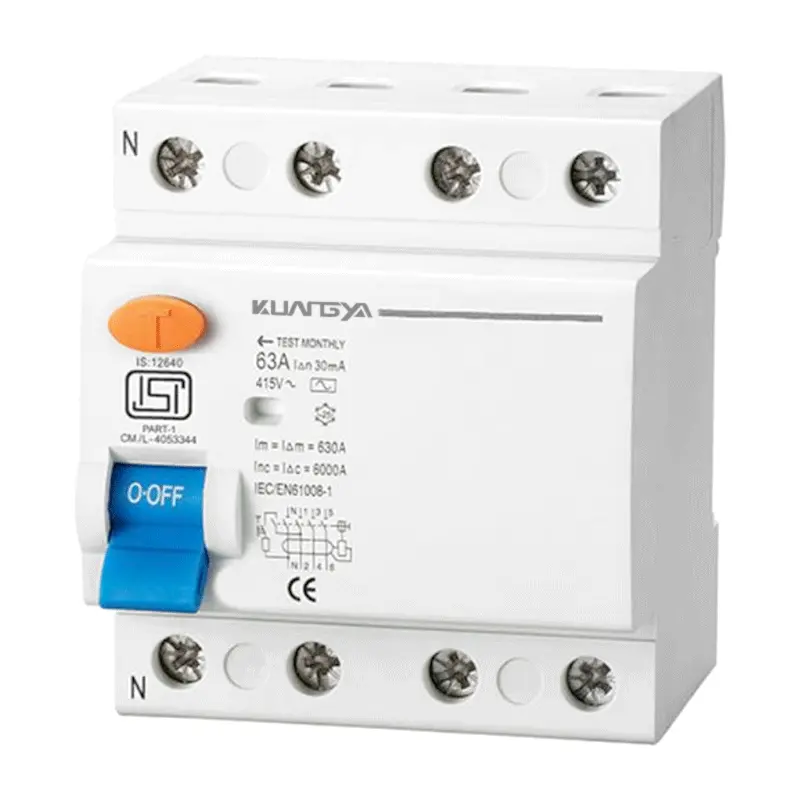
Risposta rapida: If an RCCB or RCBO trips when an automatic transfer switch (ATS) moves a load from utility power to a generator, do not simply fit a less sensitive device. The electrician should trace both source paths and check neutral switching, neutral-to-earth bonding, all conductors passing through the residual-current sensor, connected equipment leakage and the device’s exact operating conditions. A trip can indicate a real fault or an unintended return path; the symptom alone cannot identify which.
An RCD compares current flowing through all active conductors of the protected circuit, including the neutral where present. If some current returns by another path, the imbalance can cause a trip. Schneider Electric’s RCD explanation describes this sensing principle. During transfer, the source, neutral connection and earthing arrangement may change. Generator start-up can also bring loads back online together; a faulty appliance or cumulative leakage may appear at that moment. These are possibilities to test, not a diagnosis from the timing alone.
| Arrangement | What changes | Review before selecting the RCD |
|---|---|---|
| Solid neutral ATS | The load neutral remains connected to the normal-source neutral while phase conductors transfer. | Where is the intended neutral-to-earth bond? Is there another bond at the generator that creates parallel return paths? |
| Switched neutral ATS | The neutral is transferred with the phase conductors. | How is the generator source bonded when selected? Are earthing and protective conductors continuous as required? |
Neither option is automatically correct for every installation. The arrangement depends on the system earthing design, generator configuration, national rules and the transfer equipment. Schneider Electric’s generator grounding example explains how a solid neutral and a switched neutral lead to different source-grounding schemes. Its ASCO neutral-switching white paper documents the design choice. These are third-party application examples, not proof that one Kuangya model is approved for a specific ATS.
Victron Energy’s Wiring Unlimited guidance explains why a neutral-to-earth link and the source mode matter for RCD operation in generator or inverter systems. It also warns that a TEST button check is not a test of the complete installation. The exact bonding point and method must follow local wiring rules and the actual equipment design.
Un RCCB provides residual-current protection but needs appropriate overcurrent protection. An RCBO combines residual-current and overcurrent functions in one device. Neither fixes a neutral-bonding error. Larger systems may also use separate ground-fault sensing and protective coordination; do not treat a small final-circuit RCCB as interchangeable with that scheme. The Guida RCCB vs RCBO covers the functional difference, while our TEST-button guide explains the limits of that check.
Schneider Electric describes real transfer-switch design configurations with either a solid or switched neutral and relates them to generator grounding and ground-fault sensing. Victron documents the source-bonding issue in generator and inverter installations. Together, these published engineering examples show why a trip after transfer calls for a system review. We do not have a verified Kuangya customer installation, measured leakage record or before-and-after repair report for this exact symptom, so no such result is claimed here.
Send the single-line diagram, supply and generator voltage, earthing arrangement, ATS pole count and neutral configuration, generator bonding instructions, circuit loads, prospective fault current, required residual-current protection and the location of each proposed RCCB/RCBO. Ask for the exact product datasheet, wiring instructions and market-specific certification evidence. The SPD placement guide for generator and ATS systems covers the separate surge-protection question.
Non cambiare la sensibilità come scorciatoia. I requisiti di protezione dipendono dallo scopo del circuito e dalle normative locali. Prima localizza il guasto o il percorso di corrente non intenzionale; fai valutare qualsiasi modifica della protezione da un progettista qualificato.
No. Un neutro commutato può essere appropriato per un sistema derivato separatamente, ma deve essere coordinato con il legame del generatore e l'intero schema di messa a terra. Un guasto di un apparecchio non correlato o un neutro condiviso a valle possono comunque attivare un RCD.
No. Controlla parte del meccanismo del dispositivo nelle condizioni specificate. Non dimostra il percorso di guasto completo, l'arrangiamento di messa a terra, il tempo di funzionamento o la protezione di ogni circuito.
Responsabilità editoriale: elaine, Kuangya Electric. Questo articolo riassume le linee guida del produttore citato per la revisione ingegneristica. Non è un'istruzione di cablaggio specifica per il sito; l'isolamento, il test e la correzione dei circuiti di rete o del generatore spettano a personale elettrico qualificato.

