Zona industriale di WengYang Yueqing Wenzhou 325000
Orario di lavoro
Da lunedì a venerdì: dalle 7.00 alle 19.00
Fine settimana: 10.00 - 17.00
Zona industriale di WengYang Yueqing Wenzhou 325000
Orario di lavoro
Da lunedì a venerdì: dalle 7.00 alle 19.00
Fine settimana: 10.00 - 17.00

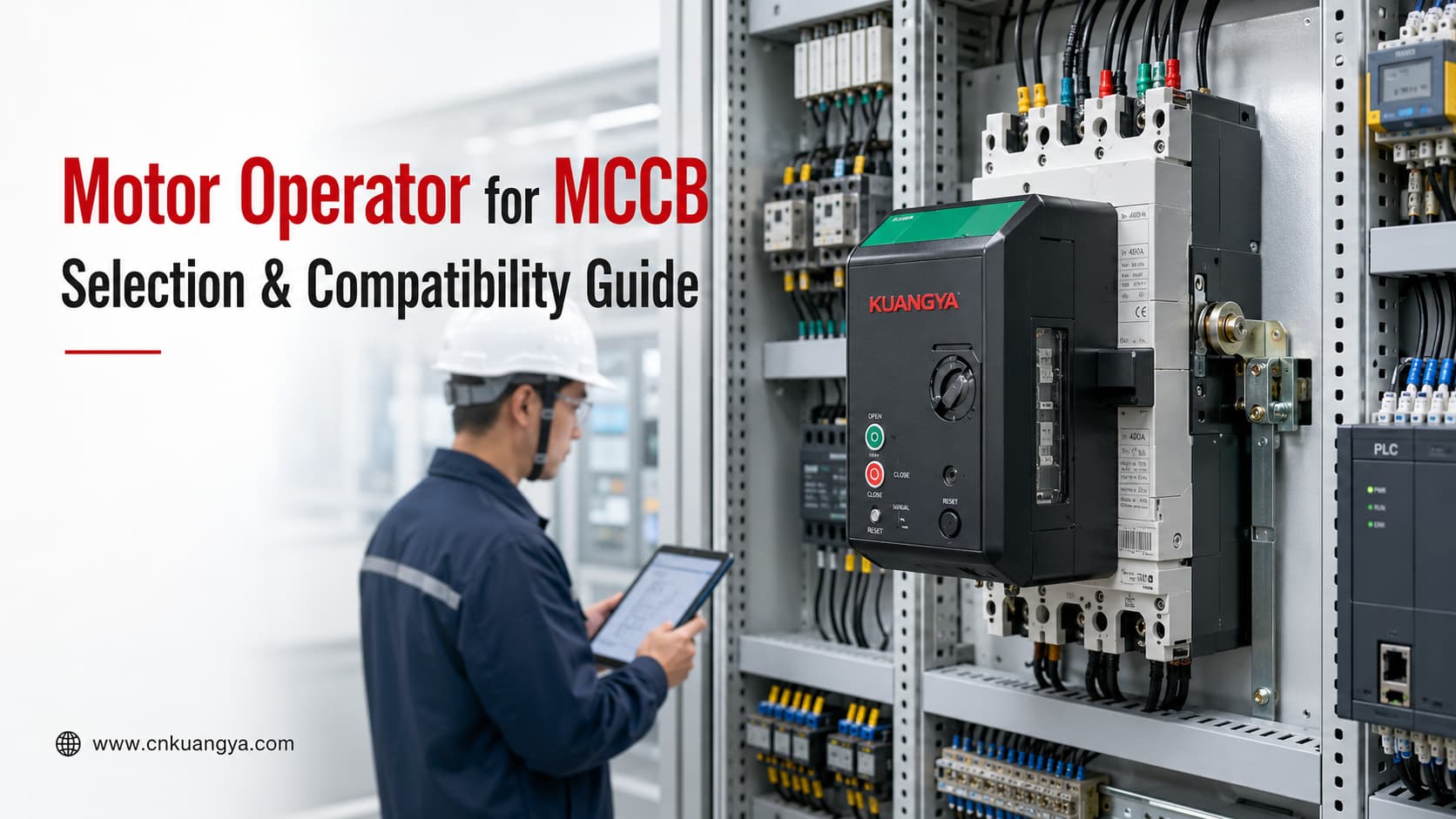
Selecting a motor operator for an MCCB is not as simple as choosing the correct voltage or rated current.
Two molded case circuit breakers may have the same current rating but completely different frame sizes, handle structures, mounting-hole positions and operating mechanisms. A motor operator that fits one MCCB series may not fit another series, even when both breakers are rated at 250 A or 400 A.
Choosing the wrong motor operator can lead to:
For this reason, the correct motor operator must be selected according to the complete breaker model, frame size, mechanical interface, control voltage, required functions and control method.
This guide explains how to select a compatible motor operator for MCCB applications and what information should be provided before requesting a quotation.
To select the correct motor operator for an MCCB, confirm the following information:
The circuit breaker model and installation photos should always be checked before the motor operator is ordered.
Need a compatibility check?
Send KUANGYA your MCCB model, nameplate photo, front photo, side photo, control voltage and required quantity. Our team can help review the mounting structure and recommend a suitable motor operator configuration.
A motor operator is an electrical operating mechanism installed on a molded case circuit breaker. It converts an electrical control signal into mechanical movement to operate the breaker handle.
Depending on the breaker and motor operator design, it may support:
A motor operator is commonly used when the circuit breaker cannot or should not be operated manually at the installation site.
Le applicazioni tipiche includono:
A motor operator does not normally provide overcurrent protection itself. The protection function remains inside the MCCB. The motor operator only provides the mechanical force required to operate the breaker.
For a detailed explanation of its structure, functions and operating process, read our guide to what a circuit breaker motor operator is and how it works.
For a basic explanation of the product and its operating principle, read our guide on what a circuit breaker motor operator does.
Motor operators are not automatically universal.
The mechanical design of an MCCB can vary significantly between different:
Even two MCCBs from the same manufacturer may require different motor operators if they belong to different product series.
A compatible motor operator must align correctly with the breaker handle and transfer enough mechanical force to move the breaker through its complete operating sequence.
The operator must also allow the breaker to reach the correct:
If the motor operator is not mechanically matched, several problems may occur.
The motor operator may move the handle but fail to push it completely into the ON position.
The breaker may not reach the full OFF position, creating uncertainty during maintenance or remote shutdown.
After a fault trip, many MCCBs must first be moved to the reset position before they can be closed again. An incompatible mechanism may not provide the required reset travel.
Incorrect handle alignment can place unnecessary force on the MCCB handle, motor gears, mounting plate or internal mechanism.
The operator may interfere with the panel door, terminal cover, busbars, cables or nearby components.
Therefore, selecting a motor operator for MCCB applications must begin with the breaker model and mechanical structure, not only the electrical rating.
The more complete the project information is, the faster the compatibility check can be completed.
The following table shows the information normally required before selection and quotation.
| Required Information | Perché è importante |
|---|---|
| Breaker manufacturer | Identifies the original MCCB structure |
| Complete breaker model | Confirms the exact product series |
| Breaker series | Helps identify compatible accessories |
| Dimensioni del telaio | Determines the main mechanical dimensions |
| Numero di pali | Helps confirm breaker width and configuration |
| Corrente nominale | Helps identify the breaker version |
| Capacità di rottura | Distinguishes different versions in some series |
| Front photo | Shows the handle and front-cover structure |
| Side photo | Shows depth and available mounting space |
| Nameplate photo | Confirms model, rating and manufacturer |
| Mounting dimensions | Confirms hole positions and installation alignment |
| Control voltage | Determines the motor power version |
| Required functions | Confirms ON, OFF, reset and manual requirements |
| Metodo di controllo | Confirms PLC, relay, ATS or switch control |
| Feedback requirements | Determines whether auxiliary contacts are needed |
| Quantità | Supports quotation and production planning |
| Destination country | Supports packaging, shipping and documentation planning |
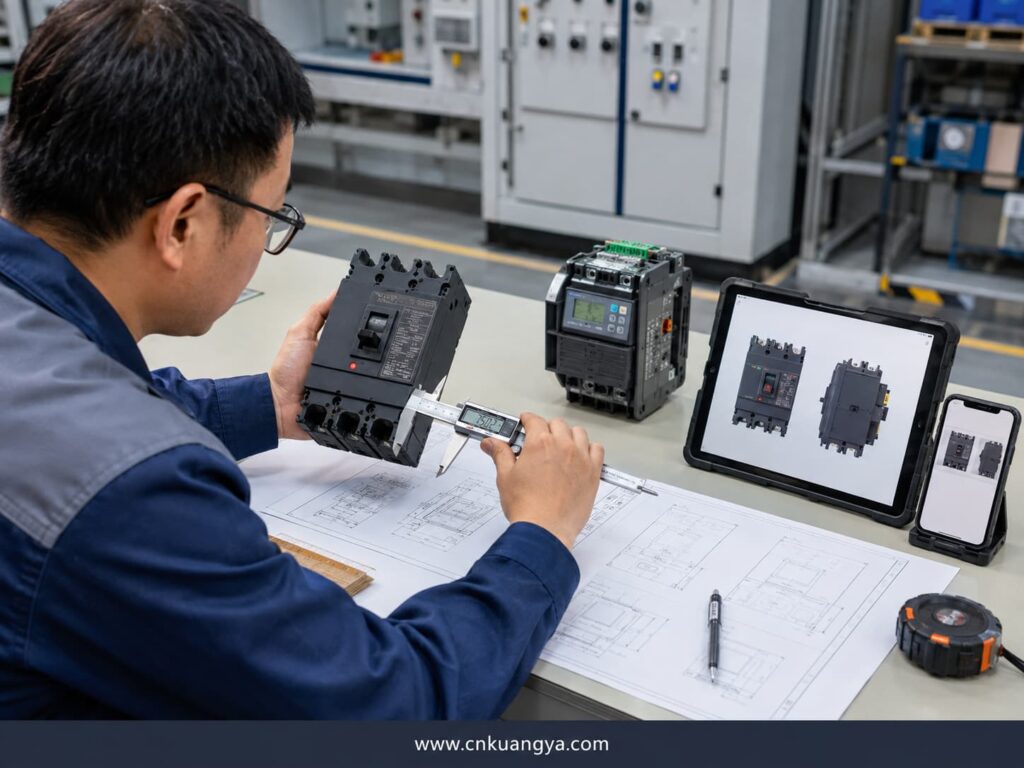
Customers should avoid providing only a general description such as:
“I need a motor operator for a 250 A MCCB.”
A 250 A current rating is not enough to confirm compatibility.
A more useful request would be:
“We need a motor operator for a three-pole 250 AF MCCB. The breaker model is XXX, the required control voltage is 24 VDC, and the operator will be controlled by a PLC. Front, side and nameplate photos are attached.”
This information allows the supplier to begin a real compatibility review.
Industrial low-voltage circuit breakers are generally evaluated under standards such as IEC 60947-2, while the motor operator must also be verified for compatibility with the selected breaker and control system.
The first step is to identify the complete MCCB model.
Do not rely only on:
The complete model normally appears on the breaker nameplate or front label.
Important information may include:
Different MCCB series can use different:
The same manufacturer may offer several MCCB families that cannot use the same accessories.
Therefore, the complete model should be photographed clearly.
Provide at least three images:
If possible, also provide:
Clear photos reduce repeated communication and improve selection accuracy.
The frame size is one of the most important parameters in motor operator selection.
MCCBs are commonly grouped by frame rating, such as:
However, frame-size terminology can vary between manufacturers.
The frame size affects:
A motor operator designed for a 125 AF breaker is unlikely to be suitable for a 630 AF MCCB because the mechanical dimensions and required operating force are different.
A breaker rated at 160 A may be installed in a 250 AF frame.
Ad esempio:
In this case, the motor operator is normally selected according to the breaker series and physical frame, not simply the 160 A current value.
This is why both frame size and rated current should be provided.
If you also need to confirm the breaker voltage, rated current, breaking capacity and frame size, refer to our complete DC MCCB selection guide.
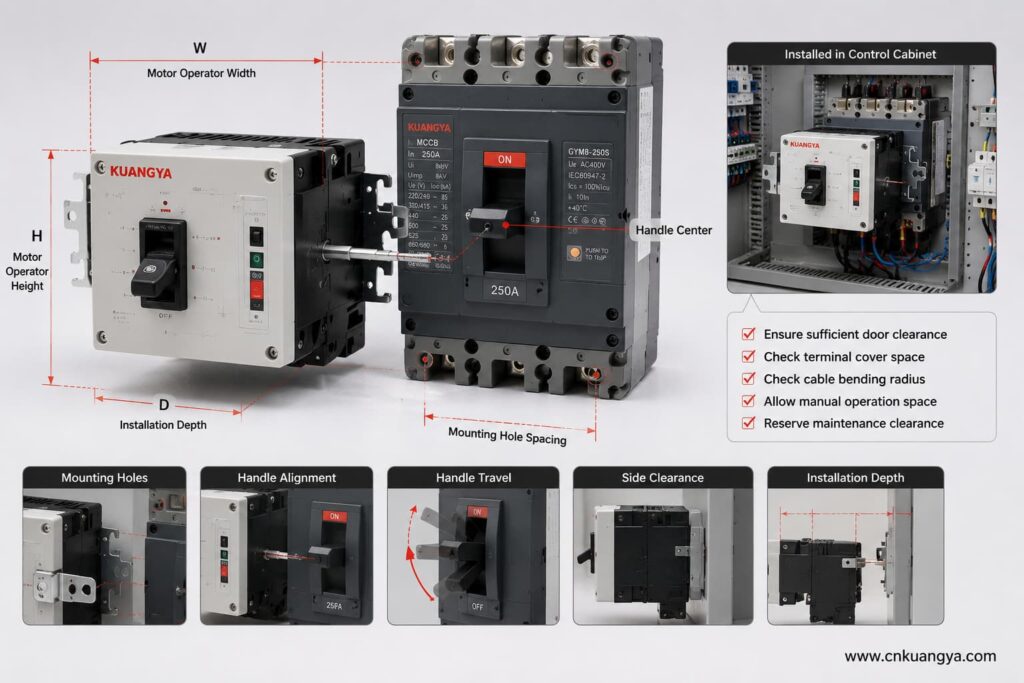
Mechanical compatibility is the most critical part of MCCB motor operator selection.
The motor operator must be correctly aligned with the breaker handle and securely attached to the breaker or mounting structure.
The following points should be checked.
Confirm:
The motor operator should not require unsafe drilling or modification of the breaker body.
Confirm:
The operator mechanism must engage the handle correctly throughout the complete operating cycle.
The mechanism must allow movement between:
Some breakers require the handle to move beyond the normal OFF position before resetting after a trip.
The selected motor operator must be capable of completing this movement where reset operation is required.
Larger MCCBs normally require more mechanical force than smaller breakers.
The motor and gearbox must provide enough torque without:
Check whether the operator is mounted:
The operator should not interfere with:
A dimension drawing is strongly recommended before bulk production.
Recommended action: Send the breaker dimensions and cabinet installation photo together. This allows the supplier to check both MCCB compatibility and available installation space.
After mechanical compatibility has been confirmed, the next step is selecting the correct control voltage.
The control voltage is the power supplied to the motor operator, not the main circuit voltage passing through the MCCB.
This distinction is very important.
For example, an MCCB may be installed in a 400 VAC distribution system, while its motor operator is controlled by:
The breaker main-circuit voltage and motor operator control voltage are separate specifications.
| Tensione di controllo | Applicazione tipica |
|---|---|
| 24 VDC | PLC systems and industrial automation |
| 48 VDC | DC control systems and communication power systems |
| 110–125 VAC | Armadi di controllo industriali |
| 110–125 VDC | DC protection and control systems |
| 220–250 VAC | Distribution systems and standard control panels |
| 220–250 VDC | Special industrial control systems |
| Other voltage | Project-specific applications |
Available voltage options depend on the motor operator model.
Do not assume every model supports every voltage.
The customer must confirm:
Ad esempio:
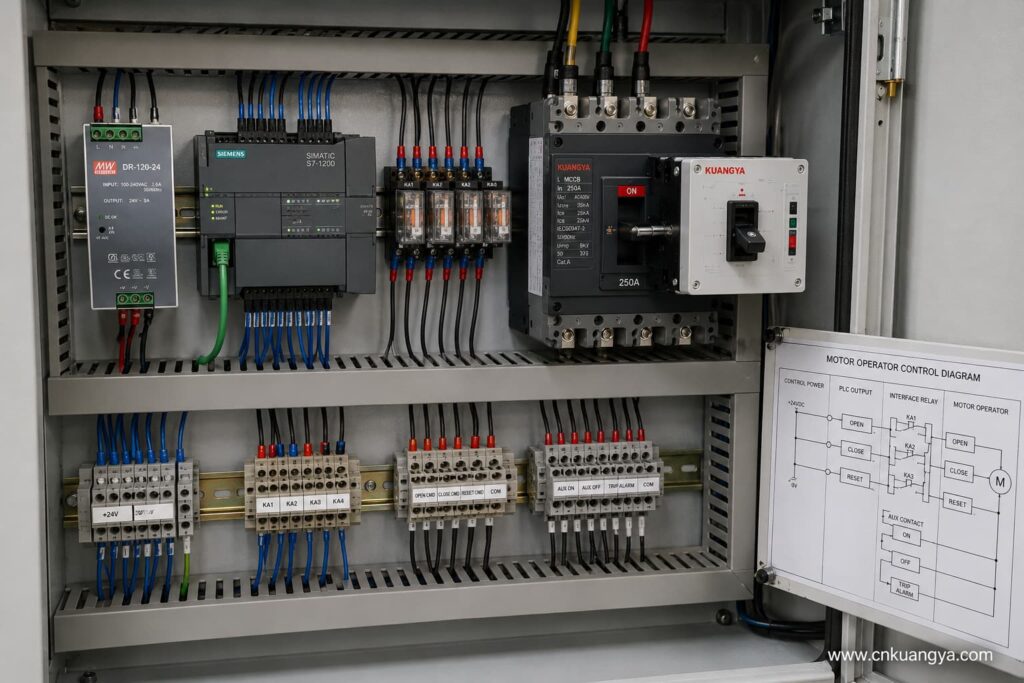
A PLC output should not automatically be connected directly to the motor operator.
Check:
In many systems, the PLC controls an intermediate relay, and the relay supplies the opening or closing command to the motor operator.
This protects the PLC output and provides electrical isolation.
An incorrect control voltage may cause:
Always confirm the control power before ordering.
Not every project requires the same functions.
Before selecting a motor operator, determine exactly what the control system must do.
Remote opening is used for:
Remote closing allows the breaker to be switched ON without manual operation at the panel.
It may be used in:
Remote closing should only be performed when the system conditions allow safe energization.
After an MCCB trips because of a fault, the handle may remain in an intermediate trip position.
Before reclosing, the mechanism may need to move the handle to the reset position.
Reset capability depends on:
A breaker should not be automatically reclosed after a fault without confirming that the fault condition has been evaluated or cleared.
Official motor mechanism guidance also distinguishes between opening, closing and resetting operations, with the permitted reset method depending on the breaker and control configuration.
Manual operation may still be required for:
Check whether the operator provides:
Some systems require a local/remote selector.
Local mode may be used during:
Remote mode may allow control by:
A motor operator provides movement, but it does not always provide all required status signals by itself.
For example, an official ABB motor operator instruction notes that remote opening, closing and resetting are provided by the operator, while fault-trip indication may require a separate alarm accessory.
Customers often need to monitor:
Depending on the breaker system, these signals may require additional accessories.
| Project Requirement | Possible Device or Function |
|---|---|
| Remote opening and closing | Motor operator |
| ON/OFF position feedback | Auxiliary contact |
| Fault-trip indication | Alarm contact or trip contact |
| Local/remote status | Selector-switch auxiliary contact |
| Communication feedback | Communication module |
| ATS sequence control | ATS controller and interlocking |
| PLC monitoring | Dry contacts or communication interface |
An auxiliary contact usually indicates whether the breaker is in the ON or OFF position.
It is often used for:
An alarm contact may indicate that the breaker has tripped because of a protection event.
This is different from normal OFF position feedback.
Some breaker systems can provide digital status and control through a communication interface.
The exact solution depends on:
Do not assume the motor operator alone provides all monitoring functions.
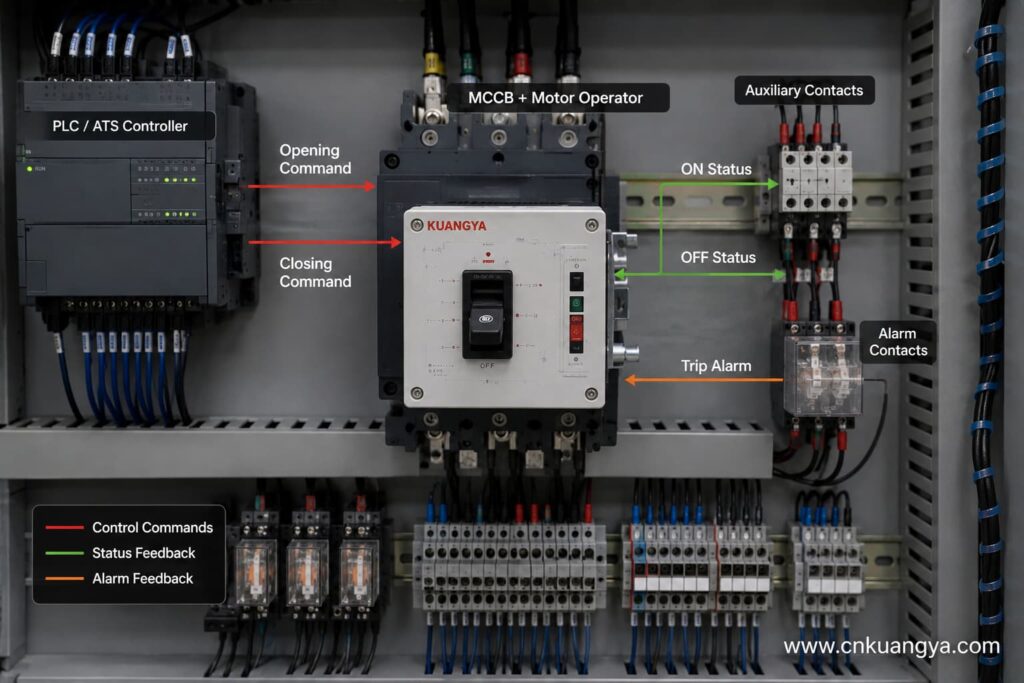
The control method determines how opening and closing commands are sent to the motor operator.
A simple control panel may use separate buttons for:
Confirm:
A relay can isolate the motor operator circuit from the controller.
Relay control is common when:
For PLC applications, confirm:
The PLC program should prevent conflicting opening and closing commands.
In an automatic transfer system, the motor operator may be controlled by an ATS controller.
The control design should consider:
A motor operator is only one part of the ATS system. The complete transfer logic and interlocking design must also be confirmed.
For remote supervisory systems, check whether the control system uses:
The motor operator may require an interface relay or communication module.
Motor operators may use different installation structures depending on the breaker and project.
A front-mounted operator is installed on the front of the MCCB.
Advantages may include:
Points to check:
Some breakers are supplied with a motorized mechanism integrated into the breaker assembly.
Advantages may include:
Points to check:
For special breakers or retrofit projects, a customized mounting plate or external operating mechanism may be considered.
This solution requires careful confirmation of:
Customizing a motor operator should not mean forcing an unsuitable mechanism onto an incompatible breaker.
The full mechanical design must be evaluated.
Motor operators are often confused with other circuit breaker accessories.
However, these devices perform different functions.
| Accessory | Funzione principale | Can Open Breaker? | Can Close Breaker? |
|---|---|---|---|
| Motor operator | Remote mechanical operation | Sì | Sì |
| Intervento in derivazione | Remote electrical trip | Sì | No |
| Undervoltage release | Opens or prevents closing when voltage is too low | Sì | No |
| Auxiliary contact | Reports breaker ON/OFF position | No | No |
| Alarm contact | Reports protection trip status | No | No |
| Closing release | Electrically initiates closing on compatible devices | No | Model-dependent |
| Communication module | Transfers status and control data | Indirectly | Indirectly |
Used when the breaker must be opened and closed remotely.
Used when the breaker needs to trip remotely.
A shunt trip does not normally close or reset the MCCB.
Used to open the breaker or prevent closing when the control voltage falls below a specified level.
Used to report breaker position.
Used to indicate a fault trip.
A complete remote-control solution may require several accessories working together.
Ad esempio:
Yes, a compatible MCCB motor operator can be integrated into a PLC-controlled system.
However, the interface must be designed correctly.
The PLC may control:
The PLC may receive:
Provide:
An interface relay may be needed when:
Some motor operators require a pulse command rather than a continuous control signal.
The control circuit should follow the operating instructions for the selected model.
Incorrect command duration may lead to:
The final wiring should be checked according to the actual motor operator diagram.
An industrial control-panel manufacturer needs to operate an MCCB remotely through a PLC.
The supplier should confirm:
Before production, the breaker sample or detailed drawing should be checked.
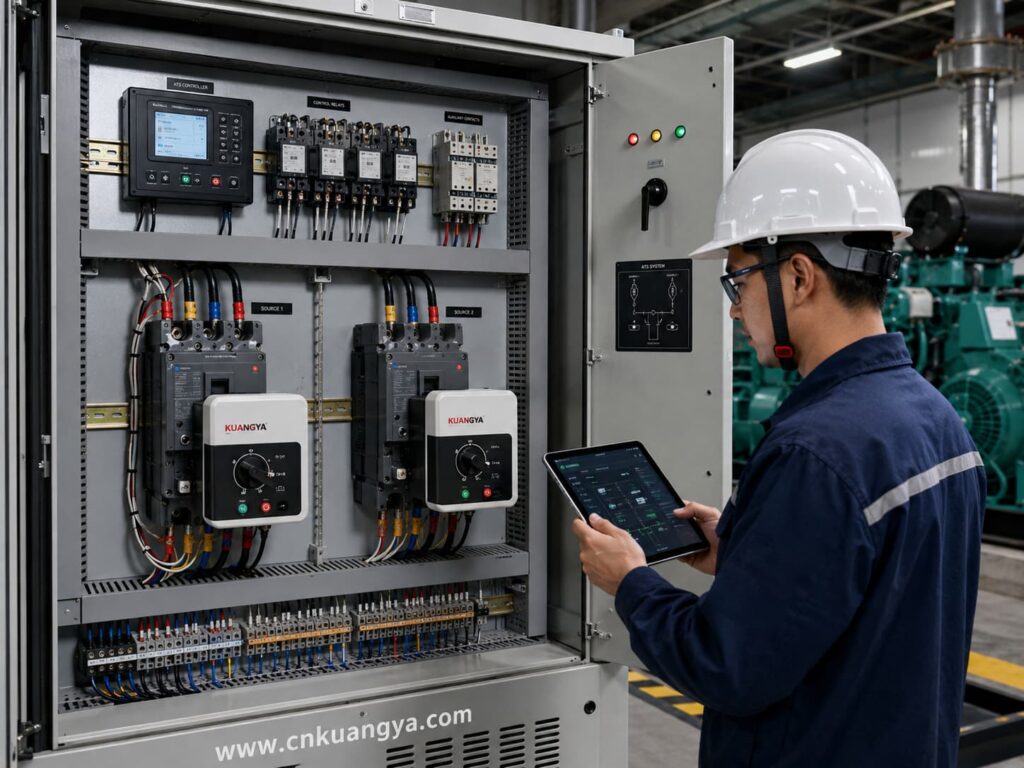
An ATS system uses two MCCBs to switch between utility power and generator power.
The project requires more than two motor operators.
The complete system may also need:
The motor operators must match both MCCBs and work with the ATS controller voltage.
The control system should prevent both breakers from closing at the same time unless the system is specifically designed for parallel operation.
A solar PV distribution cabinet is installed at a remote site.
The operator wants to open or close the MCCB without sending a technician to the site for every switching operation.
Confirm:
The motor operator should not be selected only because the breaker is used in a solar system.
The mechanical compatibility with the MCCB remains the first requirement.
For more application information, read our guide on motorized circuit breaker applications in solar PV systems.
For a complete explanation of remote breaker operation in photovoltaic systems, read our guide to motorized circuit breakers for solar PV applications.
A customer may request:
“Motor operator for 250 A MCCB.”
This is not enough.
Several MCCB models can have the same rated current but different mechanical structures.
Always provide the complete breaker model.
The rated current may be lower than the frame rating.
For example, a 160 A breaker may use a 250 AF frame.
The frame size has a direct effect on motor operator dimensions.
Some external operators can be adapted to several breaker structures, but this does not mean one model fits every MCCB.
The handle travel, operating force and mounting structure must still be checked.
A 400 VAC breaker does not necessarily require a 400 VAC motor operator.
The operator may use 24 VDC, 110 VAC or 220 VAC control power.
Voltage value alone is not enough.
The customer must specify:
A PLC output may not be able to supply the motor directly.
An interface relay may be required.
Remote operation without position feedback may leave the control system unable to confirm whether the breaker actually opened or closed.
The operator may fit the breaker but interfere with:
Reset function depends on the breaker and motor operator design.
It should be confirmed before ordering.
For a new breaker model or customized installation, sample confirmation is recommended before mass production.
Use the following checklist before requesting a quotation.
| Check Item | Customer Action | Confirmed |
|---|---|---|
| Breaker manufacturer | Record the complete manufacturer name | ☐ |
| Breaker model | Photograph the front nameplate | ☐ |
| Breaker series | Check catalogue or product label | ☐ |
| Dimensioni del telaio | Confirm AF rating | ☐ |
| Corrente nominale | Record the trip-unit current | ☐ |
| Pole number | Confirm 2P, 3P or 4P | ☐ |
| Capacità di rottura | Record if available | ☐ |
| Front photo | Provide a clear full view | ☐ |
| Side photo | Show breaker depth and cabinet space | ☐ |
| Mounting dimensions | Provide drawing or manual measurements | ☐ |
| Control voltage | Confirm voltage and AC/DC | ☐ |
| Metodo di controllo | Confirm PLC, relay, ATS or push button | ☐ |
| Required commands | Confirm open, close and reset | ☐ |
| Feedback signals | Confirm ON, OFF and TRIP requirements | ☐ |
| Funzionamento manuale | Confirm whether local operation is required | ☐ |
| Cabinet clearance | Provide available width, height and depth | ☐ |
| Quantità | Confirm sample or bulk order quantity | ☐ |
| Destination | Confirm country or port | ☐ |
| Certificazione | Confirm project requirements | ☐ |
| OEM requirements | Confirm logo, label, color and packaging | ☐ |
Completing this checklist can significantly reduce model-selection errors.
Customers can copy the following template and send it to KUANGYA.
Company name:
Contact name:
Email or WhatsApp:
Destination country:
Breaker manufacturer:
Complete breaker model:
Breaker series:
Frame size:
Corrente nominale:
Number of poles:
Capacità di rottura:
Motor operator control voltage:
AC or DC:
Required functions:
Control method:
PLC or ATS model:
Feedback requirements:
Local/manual operation required:
Applicazione:
Quantity:
OEM logo required:
Customized packaging required:
Breaker front photo attached: Sì / No
Breaker side photo attached: Sì / No
Nameplate photo attached: Sì / No
Dimension drawing attached: Sì / No
The clearer the information is, the faster the compatibility and quotation process can be completed.
Before bulk production, the following points should be confirmed.
The operator must align correctly with the breaker handle and mounting points.
Test:
Confirm the product operates correctly at the project control voltage.
Confirm:
Confirm the operator fits inside the final cabinet.
The wiring diagram should match the project control method.
Confirm:
For export and project supply, confirm:
A sample order or pre-production confirmation is recommended for a new MCCB model.
KUANGYA supports customers who need motor operator solutions for MCCB and circuit breaker applications.
Available support may include:
To improve selection accuracy, customers should send:
When a standard configuration cannot be confirmed directly, additional dimensions or a breaker sample may be required.
Per saperne di più KUANGYA’s manufacturing, product development and electrical protection capabilities.
A motor operator is an electrical mechanism that moves the MCCB handle to support remote opening, closing and, depending on the design, reset operation.
It allows the circuit breaker to be controlled by push buttons, relays, PLC systems, ATS controllers or remote monitoring systems.
Start by confirming the complete breaker manufacturer, model, series, frame size, pole number, handle structure, mounting dimensions, control voltage and required functions.
Do not select only according to rated current.
No.
Some MCCBs have manufacturer-specific motor operators, while others may support compatible external mechanisms.
The breaker model and mechanical interface must be checked before ordering.
A motor operator may fit several breakers only when their mechanical dimensions, handle travel, mounting points and operating force are compatible.
Compatibility should never be assumed only because the breakers have similar current ratings or appearances.
Not by itself.
Rated current helps identify the breaker, but the motor operator is mainly selected according to the breaker series, physical frame size and mechanical structure.
Choose the voltage that matches the available control power in the project.
Esempi comuni sono:
The available options depend on the motor operator model.
Yes, provided the control voltage, output type, output current and control logic are compatible.
An interface relay may be required between the PLC and motor operator.
Non sempre.
ON/OFF feedback may require an auxiliary contact, while fault-trip indication may require an alarm contact or trip contact.
A motor operator can remotely open and close a compatible breaker.
A shunt trip normally only opens the breaker when a control voltage is applied.
A shunt trip does not normally close or mechanically reset the breaker.
Some motor operator and breaker combinations support electrical reset.
The reset movement and control logic must be confirmed according to the actual breaker model.
Automatic reclosing should only be used when the system design allows safe fault evaluation and recovery.
Photos can help identify the breaker model, handle structure and available installation space.
For final confirmation, KUANGYA may also request:
Provide:
Provide:
Selezione del corretto motor operator for MCCB applications requires more than checking the breaker current or system voltage.
The motor operator must match the breaker’s:
The most common selection mistakes happen when customers provide only the rated current or assume that one universal motor operator can fit every MCCB.
Before ordering, confirm the complete breaker model and provide clear photos, control-voltage information and project requirements.
KUANGYA supports MCCB motor operator compatibility checking, different control-voltage configurations, PLC and ATS applications, OEM customization, sample evaluation and bulk project supply.
Send us your breaker model, nameplate photo, control voltage, required functions and quantity to request a compatible motor operator recommendation and quotation.

