Zone industrielle WengYang Yueqing Wenzhou 325000
Heures de travail
Du lundi au vendredi : de 7h00 à 19h00
Le week-end : 10H00 - 17H00
Zone industrielle WengYang Yueqing Wenzhou 325000
Heures de travail
Du lundi au vendredi : de 7h00 à 19h00
Le week-end : 10H00 - 17H00

An AC-side RCD trips as your solar inverter starts? Learn how to distinguish capacitive leakage from insulation or wiring faults, check RCD compatibility, and troubleshoot safely.
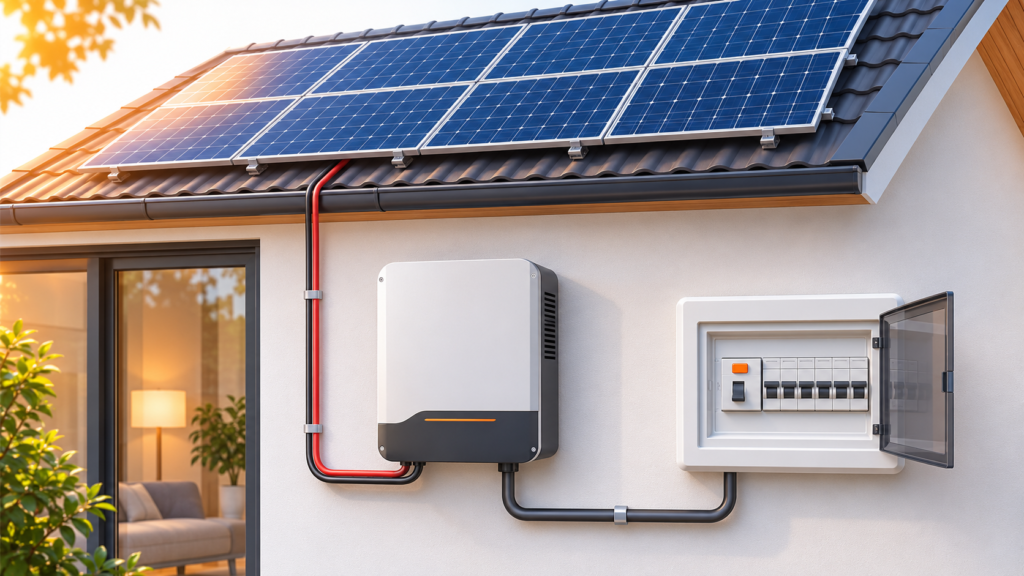
Réponse rapide : An AC-side residual current device (RCD) can trip as a solar inverter starts because its measured differential current exceeds the device’s operating threshold. That current may come from normal capacitive leakage, a real insulation or wiring fault, or leakage from other circuits sharing the RCD. The right diagnosis begins by identifying which device opened and checking the exact inverter manual. Never bypass an RCD or change its rating simply to keep the inverter running.
Look at the AC distribution board and the inverter display or event log. Did a physical RCD or RCBO move to the OFF position? Or did the inverter remain connected to the board but report an insulation, residual-current, or grid fault? These are different events. An RCD senses an imbalance in the conductors passing through it. An inverter can also have its own residual-current monitoring and fault detection. Record the device model, event code, weather and the point in the startup sequence before resetting anything.
If the AC breaker trips due to overcurrent rather than the RCD section of an RCBO, investigate that separately. Our RCCB versus RCBO guide explains which protection each device provides.
PV modules, cables and filters have capacitance to earth. With transformerless inverters, operating leakage current can flow as the system energizes. SMA’s technical note on leakage currents distinguishes this capacitive leakage from fault-related residual current and explains why the inverter measures their combined differential current. A trip coinciding with startup does not prove that the RCD is defective.
Damaged insulation, water ingress, a loose or incorrect connection, and a neutral-to-earth fault can also create a current path outside the intended conductors. A repeatable trip after rain deserves particular attention; see our guide to an RCD that trips in wet weather. If the inverter reports an insulation alarm, follow the separate PV insulation-fault troubleshooting guide and the inverter manufacturer’s procedure.
RCD type and rated residual operating current are not universal settings for every solar installation. In its RCD selection guidance, SMA says to use a device compatible with the particular inverter and to consult its operating manual. For one specified Sunny Boy series and firmware, the operating manual describes compatible external RCD types and an inverter setting relevant to 30 mA devices. Those details cannot be transferred to another model. Check local rules and the inverter’s current documentation before specifying a type or threshold. Our Type A versus Type B RCCB overview explains the different residual-current waveforms.
When an inverter and other circuits sit behind one RCD, their leakage currents can add. An electrician should confirm which conductors pass through the device, whether neutrals are shared across RCD-protected circuits, and whether the protective conductor is correctly arranged. Moving circuits or changing protection requires a design check, not trial-and-error rewiring.
Not as a quick fix. First determine why it trips and what protection the circuit requires. The inverter instructions and local rules govern the permissible device and setting.
It depends on the inverter design and local installation requirements. Internal monitoring and an external AC-side RCD can have different roles. Check the model-specific manual and the electrical design.
No universal answer applies. Isolation, built-in DC residual-current monitoring, manufacturer approval and local rules affect selection. Confirm the exact model before ordering protection equipment.
Need help specifying an AC protection device? Send the inverter model, installation country, circuit diagram and applicable requirement through La page de contact de KUANGYA. La compatibilité de l'appareil doit être confirmée pour le système réel.

