Zone industrielle WengYang Yueqing Wenzhou 325000
Heures de travail
Du lundi au vendredi : de 7h00 à 19h00
Le week-end : 10H00 - 17H00
Zone industrielle WengYang Yueqing Wenzhou 325000
Heures de travail
Du lundi au vendredi : de 7h00 à 19h00
Le week-end : 10H00 - 17H00

Pourquoi un DDR se déclenche-t-il au démarrage d’un variateur de fréquence ? Comparez les causes des courants de fuite et les types de DDR, puis suivez une procédure de diagnostic sûre conforme aux recommandations du fabricant du variateur.
Réponse rapide : If an RCD trips when a variable frequency drive (VFD) starts, first determine whether there is an actual insulation or wiring fault. A drive’s EMC filter, switching operation and motor cable can also contribute leakage current. The correct response is to measure and diagnose the installation, then select an RCD type and arrangement permitted by the drive manufacturer and local rules—not to bypass protection or increase the trip threshold by guesswork.
A residual current device compares current in the live conductors passing through its sensor. Current returning through another path creates an imbalance. Unlike a simple resistive load, a VFD contains rectification, electronic switching and often an EMC filter. Schneider Electric’s ATV12 guidance notes that filter and switching effects can create leakage and that several drives on one RCD can add their leakage currents. The result can be a genuine fault, normal operating leakage approaching the device threshold, or an unsuitable RCD for the possible fault-current waveform.
| Symptôme | Possible explanation | What a qualified person should verify |
|---|---|---|
| Trips immediately at energization | Filter charging or an existing fault | Drive manual, supply wiring, leakage at startup and insulation condition |
| Trips only when the motor runs | Motor or cable fault, cable capacitance or drive output effects | Motor and cable condition, length and routing, drive diagnostics |
| Trips after adding another drive | Cumulative leakage | Current contribution of each drive and the shared protection arrangement |
| Trips intermittently | Moisture, damaged insulation, changing load or interference | Event history and measured current under representative operating states |
Schneider’s drive tripping FAQ specifically identifies EMC filters and long motor cables as factors. Timing alone is not proof that a trip is harmless.
RCD type describes which residual-current waveforms the device is designed to detect. A single-phase converter may have different requirements from a three-phase drive; a type that tolerates interference is not automatically capable of detecting smooth DC residual current. Check the exact model’s installation manual, supply topology and national requirements. For a documented example, Schneider’s ATV320 installation manual specifies Type A or Type F for a single-phase device connected between phase and neutral, and Type B or an approved all-current-sensitive monitor for a three-phase device or a single-phase device not connected between phase and neutral. It also advises one residual-current device per drive when several drives are installed. This is guidance for that product, not a universal requirement for every VFD or approval of a Kuangya model.
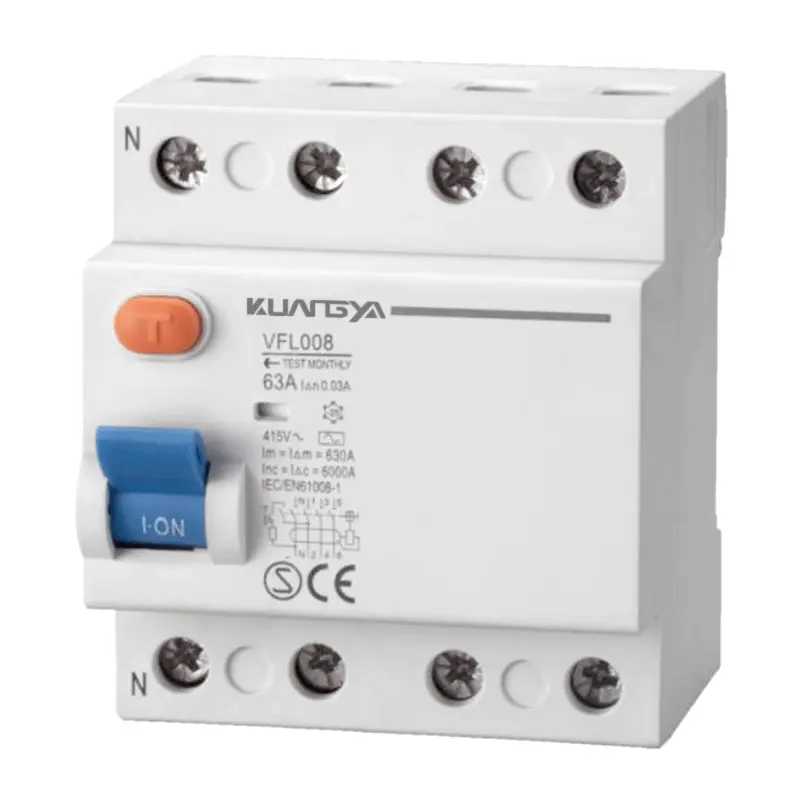
Review the Gamme d'ID Kuangya ou de disjoncteurs différentiels avec protection contre les surintensités (RCBO) only after the required type, rated current, sensitivity, poles, fault level and certification have been established. An RCCB needs suitable separate overcurrent protection; an RCBO combines those functions. The RCCB versus RCBO comparison explains that difference.
Opening a panel, disconnecting conductors and insulation testing can expose hazardous voltage or damage electronics if performed incorrectly. These tasks belong to qualified electrical personnel following isolation and the drive manufacturer’s instructions.
Schneider’s published ATV12 FAQ discusses multiple drives sharing an earth-leakage device and identifies cumulative leakage as a cause of unexpected operation. Its ATV320 manual gives model-specific protective-device requirements. These are manufacturer guidance documents, not a published field case or measured customer results from Kuangya. We have no verified Kuangya site report for a VFD trip and therefore do not claim a successful repair or a percentage reduction in nuisance trips.
No. Required sensitivity depends on the protection objective and local rules. A higher setting may remove required protection without fixing a fault.
No universal answer. Some specific three-phase drives require it, while other drive manuals describe different arrangements. Follow the exact manual and project rules.
It may be possible in a defined design, but leakage adds and selectivity matters. Check the drive manufacturer’s instructions and measured operating current.
Editorial responsibility: elaine, Kuangya Electric. This article summarizes cited manufacturer guidance for engineering review and is not a site-specific installation approval.

