Zone industrielle WengYang Yueqing Wenzhou 325000
Heures de travail
Du lundi au vendredi : de 7h00 à 19h00
Le week-end : 10H00 - 17H00
Zone industrielle WengYang Yueqing Wenzhou 325000
Heures de travail
Du lundi au vendredi : de 7h00 à 19h00
Le week-end : 10H00 - 17H00

An RCBO combines residual current protection with overload and short-circuit protection in one device. When correctly selected and installed, it can disconnect a faulty circuit when it detects excessive current or a residual-current imbalance among the live conductors passing through its sensing system.
However, an RCBO may sometimes trip repeatedly, refuse to reset, operate only when a particular appliance starts, or fail to trip when the TEST button is pressed. These symptoms may be caused by faulty equipment, damaged insulation, moisture, incorrect wiring, excessive leakage current, or an internal RCBO fault.
This RCBO troubleshooting guide explains what causes an RCBO to trip, how to reset an RCBO safely, how to identify common wiring problems, and what to do when the RCBO test button is not working.
For available ratings and product configurations, see the KUANGYA RCBO product range.
Electrical safety notice: An RCBO is connected to hazardous mains voltage. Homeowners and equipment users should limit troubleshooting to switching off loads, unplugging portable equipment, checking for visible damage, and performing a normal handle reset. Opening a distribution board, disconnecting conductors, tightening terminals, carrying out insulation tests, or replacing an RCBO should be performed by a qualified electrician.
If an RCBO ne cesse de se déclencher, the most common causes are earth leakage, overload, a short circuit, a faulty appliance, moisture ingress, damaged insulation, incorrect neutral wiring, or the combined leakage current of several electronic devices.
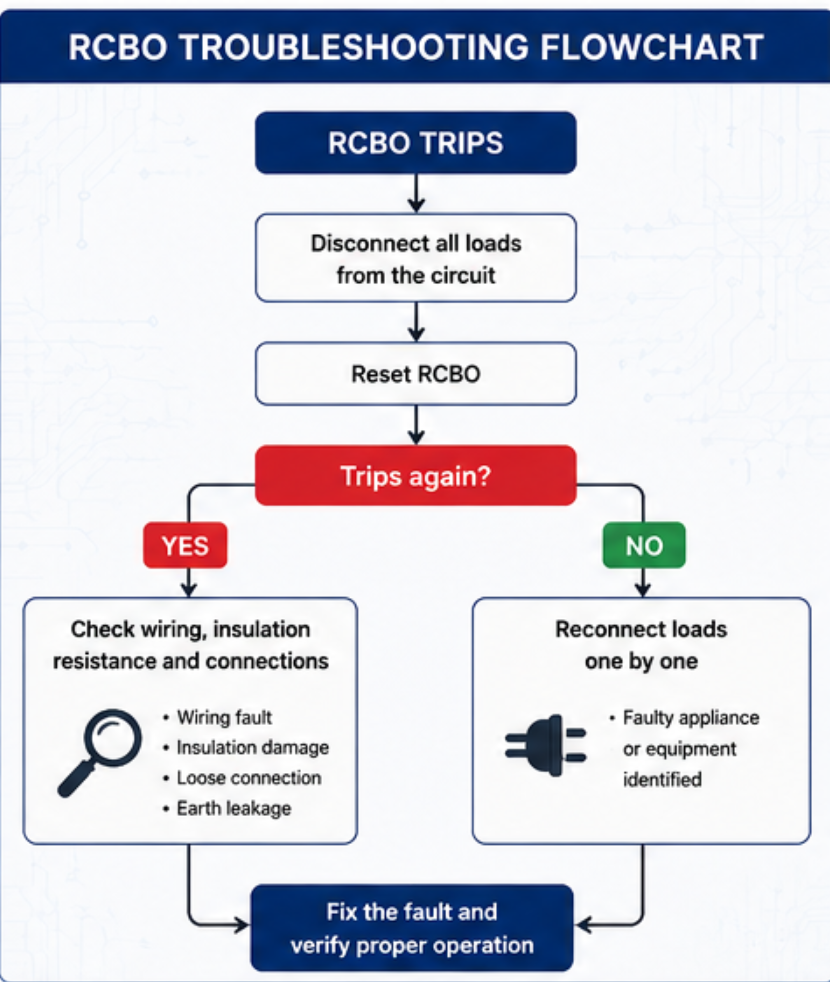
Switch off or unplug the connected loads, move the RCBO handle fully to the OFF position, and then reset it once. If it remains ON, reconnect the equipment one item at a time. If it trips again with all user-accessible loads disconnected, the fixed wiring, permanently connected equipment, or RCBO should be tested by a qualified electrician.
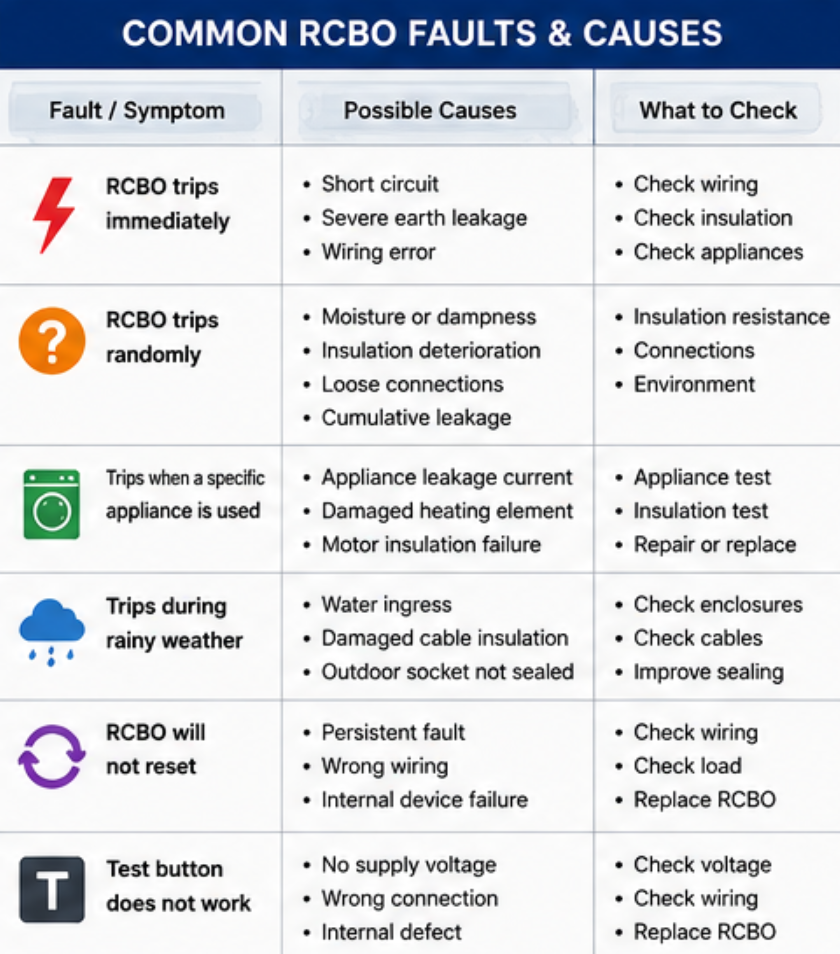
| Symptôme | Cause probable | Next Action |
|---|---|---|
| Trips immediately after reset | Short circuit, severe leakage, wiring fault, or damaged appliance | Disconnect accessible loads and arrange circuit testing if it still trips |
| Trips when one appliance starts | Faulty heating element, motor, cable, or appliance insulation | Disconnect the appliance and have it inspected |
| Trips randomly | Moisture, loose connection, deteriorated insulation, or cumulative leakage | Record when the trip occurs and arrange professional testing |
| Trips during rain | Water ingress or condensation | Inspect accessible outdoor equipment for visible moisture or damage |
| Will not reset | Persistent fault, incorrect neutral wiring, or damaged mechanism | Move fully to OFF once; if it still fails, stop and call an electrician |
| TEST button does not work | Supply condition, incorrect wiring, test-circuit failure, or internal fault | Verify the exact product supply and wiring requirements |
RCBO stands for Residual Current Circuit Breaker with Overcurrent Protection. It combines residual current protection and overcurrent protection in one device.
The overcurrent section protects circuit conductors and connected equipment against overloads and short circuits. In many conventional RCBO designs, overloads are detected by a thermal mechanism and short circuits by an electromagnetic mechanism. The exact internal design may vary between manufacturers and product types.
The residual current section monitors the vector sum of the currents flowing through all live conductors that pass through the device. During normal operation, the resulting sum should be approximately zero. If current flows through an unintended path, such as damaged insulation, moisture, an equipment enclosure, or earth, an imbalance can occur and cause the RCBO to disconnect the circuit.
Residual current protection provides additional protection against certain electric shock and fire risks. It does not replace correct insulation, protective earthing, bonding, circuit design, or safe working procedures.
An RCBO may trip because of an overcurrent fault, a residual current fault, an installation problem, or a problem inside the device itself.
An RCBO that trips immediately after being reset normally indicates that a fault is still present. Repeatedly forcing the handle back to ON does not solve the problem and may expose the installation to additional risk.
Les causes possibles sont les suivantes :
Safe user check: Switch off and unplug accessible equipment, move the RCBO handle fully to OFF, and attempt one reset. If the RCBO remains ON, reconnect the equipment one item at a time. Stop using any appliance that causes another trip.
Electrician-only checks: Isolating fixed equipment, disconnecting outgoing conductors, testing insulation resistance, locating neutral-to-earth faults, and verifying RCBO operation.
Intermittent tripping can be difficult to diagnose because the fault may only appear under certain conditions. Temperature, humidity, vibration, appliance operating cycles, and the number of devices operating together can all affect the result.
Common causes include moisture, deteriorated insulation, loose terminals, intermittent appliance leakage, cumulative leakage current, and a circuit operating close to its current limit.
Record when the trip occurs. Useful details include the weather, which appliances were operating, how long the circuit had been running, and whether a motor, heater, compressor, or inverter had just started.
A qualified electrician may use leakage-current measurement, insulation resistance testing, load-current measurement, and other circuit tests to locate the fault. Sensitive electronic equipment may need to be disconnected before some tests are performed.
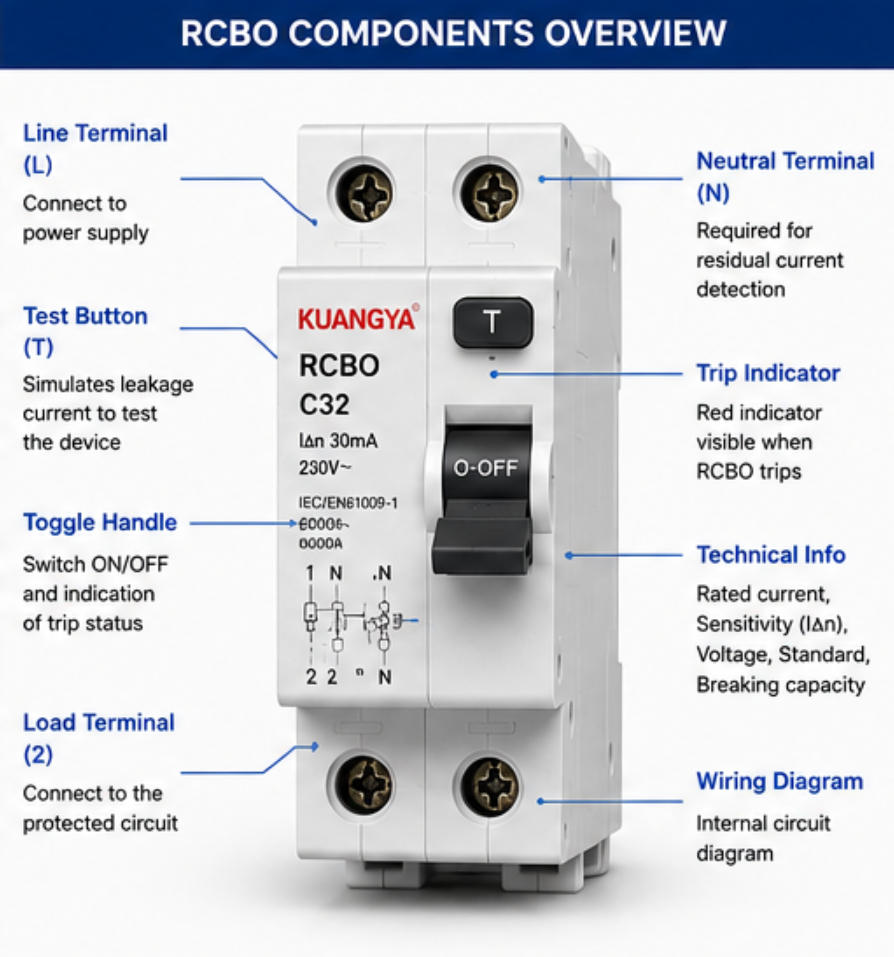
If the RCBO trips only when a particular appliance starts, the appliance or its supply cable may be faulty.
Les exemples les plus courants sont les suivants :
Heating elements and motor windings can deteriorate because of heat, age, vibration, moisture, and contamination. A damaged heating element may allow current to leak to a grounded metal casing. A motor or compressor may also develop an insulation fault that appears only during starting or operation.
Disconnect the suspected appliance and reset the RCBO once. If the circuit remains stable without the appliance, keep the appliance disconnected and arrange inspection or repair.
Rain-related tripping often points to moisture entering outdoor equipment or wiring accessories.
Check accessible outdoor equipment for:
Do not open wet electrical equipment while it is energized. The affected circuit should remain isolated until the water path and damaged components have been identified and repaired.
Electronic equipment such as computers, LED drivers, switch-mode power supplies, inverters, variable-frequency drives, and UPS systems may produce small amounts of normal leakage current through their filtering components.
When many devices are connected to one circuit, their combined leakage current may reduce the margin between normal operation and the RCBO trip threshold. A small additional leakage caused by humidity or one deteriorating device can then produce an intermittent trip.
The correct solution is not to increase the residual current rating without analysis. A qualified electrician should measure the actual leakage, identify abnormal equipment, and determine whether the loads should be divided across additional circuits.
Follow these steps only when there is no visible smoke, burning smell, water inside electrical equipment, damaged cable, abnormal heat, or other immediate danger.
Some circuit-breaker mechanisms will not reset unless the handle is first moved fully to OFF. If the RCBO trips again immediately, do not continue resetting it.
A successful reset does not always prove that the fault has disappeared. Moisture, deteriorated insulation, loose connections, and appliance faults may only appear under certain operating conditions.
An RCBO may refuse to reset because the protected circuit still contains a fault or because the device itself cannot latch correctly.
If the RCBO will not remain ON after accessible loads have been switched off or unplugged, leave the circuit off and arrange professional inspection.
The RCBO TEST button uses the device’s built-in test circuit to create a controlled imbalance under its specified supply and wiring conditions. Pressing the TEST button should normally cause a correctly supplied and correctly connected RCBO to trip.
The TEST button checks the built-in test and tripping mechanism. It does not replace professional verification of operating current, trip time, circuit wiring, insulation condition, protective earthing, or the complete electrical installation.
A failed TEST-button operation should be investigated promptly. A qualified electrician should verify the supply voltage, supply frequency, neutral connection, and terminal arrangement against the instructions for the exact RCBO model. If the required supply and wiring conditions are correct and the RCBO still fails its prescribed test, follow the manufacturer’s inspection or replacement procedure.
The TEST button should be operated at the interval stated by the RCBO manufacturer or required by applicable local maintenance rules. Avoid applying one universal test interval to every installation unless it matches the instructions printed on the product or supplied by the manufacturer.
Incorrect RCBO wiring can cause immediate tripping, random operation, TEST-button failure, or an RCBO that will not reset.
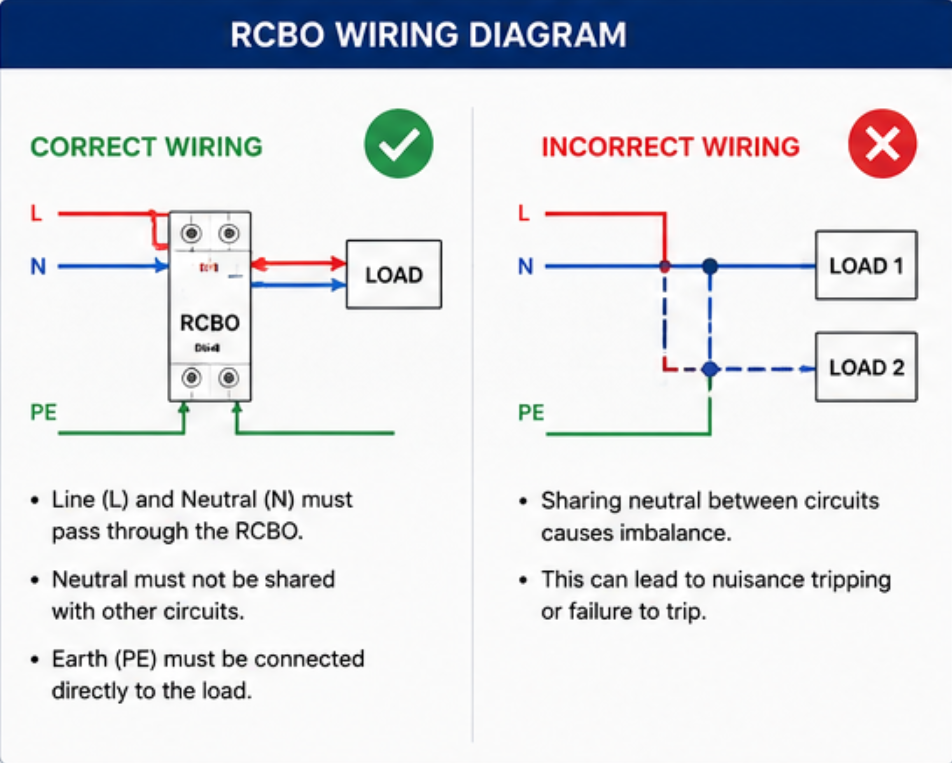
If current leaves through the live conductors associated with one RCBO but part of the return current follows another path, the RCBO detects an imbalance and may trip. This can occur when two protected circuits share a neutral or when conductors are connected to the wrong neutral bar.
An unintended neutral-to-earth connection downstream of the RCBO can allow part of the return current to bypass the intended sensing path. The RCBO may then trip immediately or only when the circuit is loaded.
Some RCBOs have defined incoming and outgoing terminals. Reversing them may affect the TEST circuit or normal operation. Installers should always follow the connection diagram for the exact RCBO model rather than assuming that all devices use the same terminal arrangement.
Loose terminals can produce heat, arcing, voltage instability, and insulation damage. Terminal inspection and tightening must be performed with the supply safely isolated and according to the manufacturer’s specified torque.
For detailed connection examples, see the RCBO wiring diagram guide.
An RCBO should not be replaced automatically simply because it trips. In many cases, the trip indicates that the device is responding to an external fault.
Le remplacement doit être envisagé dans les cas suivants
A replacement RCBO must meet the installation requirements, including rated current, residual operating current, voltage, breaking capacity, trip curve, number of poles, residual current type, terminal arrangement, and applicable certification.
An unsuitable RCBO type may contribute to unreliable protection or unwanted tripping when electronic, inverter-controlled, or variable-speed equipment is connected.
The choice between Type AC, Type A, Type F, and Type B should be based on the expected residual current waveform, equipment-manufacturer instructions, applicable product and installation standards, and local electrical regulations. This troubleshooting article should not be used as the only basis for selecting an RCBO type.
After identifying the likely cause of the fault, use the assistant below to organize the known circuit and equipment parameters.
The result supports preliminary specification and product enquiries only. Final RCBO selection must be verified against the equipment manual, circuit design, conductor capacity, prospective short-circuit current, product datasheet, coordination requirements, certification, and applicable local electrical rules.
How to use this RCBO selector: choose the known circuit and equipment conditions. The result organizes a preliminary specification and highlights information that still requires verification.
Preliminary selection only. This tool does not approve a circuit or replace the equipment manual, product datasheet, coordination study, qualified designer, or local rules.
The appropriate inspection and testing interval depends on the manufacturer, installation environment, local regulations, site risk, and previous fault history.
A fixed wiring fault, permanently connected appliance, outdoor circuit, shared neutral, moisture problem, or defective RCBO may still be present even when portable equipment has been unplugged.
Switch off the accessible loads, move the handle fully to OFF, and then move it to ON. Reconnect the loads individually. Do not repeatedly reset an RCBO that trips immediately.
The RCBO may not have the required supply voltage, or it may have incorrect wiring, a loose neutral connection, a damaged internal test circuit, or a failed mechanism. The exact product supply and terminal requirements should be checked before declaring the device defective.
Yes. Water entering outdoor sockets, lighting, junction boxes, pumps, cable joints, or enclosures can increase leakage current and cause the RCBO to operate.
Yes. A faulty LED driver or electronic power supply can cause leakage. A large number of devices may also create enough combined leakage current to reduce the circuit’s normal operating margin.
Not until the connected equipment and wiring have been checked. Repeated tripping often means the RCBO is responding to a real external fault. Replace it when inspection and testing confirm that the device itself is damaged or unreliable.
IEC 61009-1:2024 specifies general requirements and tests for RCBOs intended for household and similar uses within its defined voltage, frequency, rated-current, and short-circuit-capacity limits. Products intended for other applications may be subject to different or additional product standards.
Installation, selection, testing, fault finding, and maintenance must also comply with applicable national wiring regulations, equipment-manufacturer instructions, circuit-design requirements, and product-certification rules for the destination market.
Because RCBO designs and national requirements differ, terminal arrangements, test conditions, residual-current type, sensitivity, breaking capacity, coordination, and acceptable test results must be verified for the exact product and installation.
An RCBO protects against overcurrent and residual current faults, but it cannot identify the cause of a trip by itself. When an RCBO keeps tripping, the cause may be a faulty appliance, damaged insulation, moisture, incorrect wiring, excessive circuit loading, cumulative leakage current, or an internal device problem.
Start with safe checks: switch off accessible loads, inspect for visible damage, move the handle fully to OFF, reset it once, and reconnect equipment individually. Leave conductor disconnection, insulation testing, terminal work, internal distribution-board inspection, and RCBO replacement to a qualified electrician.
An RCBO that will not reset, repeatedly trips without an identifiable appliance, shows heat damage, or fails its prescribed TEST-button check should be investigated promptly. Correct installation, suitable product selection, regular testing, and timely maintenance are essential for reliable long-term protection.
Explorer KUANGYA RCBO solutions for residential, commercial, and suitable electrical protection applications.

