Zone industrielle WengYang Yueqing Wenzhou 325000
Heures de travail
Du lundi au vendredi : de 7h00 à 19h00
Le week-end : 10H00 - 17H00
Zone industrielle WengYang Yueqing Wenzhou 325000
Heures de travail
Du lundi au vendredi : de 7h00 à 19h00
Le week-end : 10H00 - 17H00

Where should an elevator SPD go? Review the lift AC supply, drive output and control lines separately, then use this practical selection checklist.
Réponse rapide : For an elevator installation, review the incoming AC supply, the drive and controller cabinet, and any exposed communication lines as separate surge paths. A power SPD at the lift distribution board can help limit transients arriving on the AC supply. It does not automatically protect the drive’s PWM motor output or every signal cable. Selection and placement must follow the elevator and drive manufacturers’ instructions, the earthing arrangement, and the project’s electrical design.
A modern lift can contain a controller, variable-frequency drive, safety circuits, door electronics, sensors and communications. These circuits do different jobs and have different electrical ratings. A single kA value on an SPD cannot tell an installer whether every interface is protected. Start by drawing the supply and signal paths, identifying which cables enter the control cabinet and where they originate.
This guide covers surge protection. It does not replace the elevator’s safety functions, overcurrent protection, inspection regime or manufacturer-approved wiring. A qualified elevator contractor and electrical designer should approve changes to an existing installation.
Identify the panel feeding the lift, its nominal voltage, phase and neutral arrangement, earthing system, available short-circuit current, upstream protective device and existing building SPDs. An appropriately rated AC SPD may be needed at the service entrance, at the dedicated elevator distribution board, or both, depending on the building’s lightning protection design and the distance between panels.
Compare the candidate SPD’s maximum continuous operating voltage (Uc), voltage protection level (Up), Type, discharge ratings and short-circuit rating with the actual installation. Check the manufacturer’s backup protection instructions and keep connection conductors short and direct. Do not select a device solely from its maximum discharge current (Imax).
IEC 61643-11:2025 specifies requirements and test methods for SPDs connected to AC low-voltage power systems. IEC 61643-12:2020 covers selection, location and coordination principles. These publications provide a framework; the project’s applicable code and equipment manuals determine the final design.
The incoming mains connection and the motor terminals of a variable-frequency drive are not equivalent. The motor output is a pulse-width-modulated waveform, not a conventional 50/60 Hz supply. Do not place a standard mains SPD across the drive’s motor output unless the drive and SPD manufacturers expressly approve that application. Motor-cable length, insulation and any output filter should be evaluated using the drive manual.
For more on this distinction, see our VFD input-side versus output-side surge protection guide. The same review is useful when an elevator controller includes a drive, but the lift manufacturer’s instructions take priority.
Power protection does not automatically cover low-voltage control or communication lines. Identify external copper cables, remote monitoring interfaces and connections between buildings or exposed locations. If a signal SPD is required, it must match the interface voltage, signal type, data rate, connector and grounding scheme. An incorrectly chosen signal protector can interfere with communications or safety monitoring.
Keep safety-critical elevator circuits under the control of the approved lift design. Do not add a component to a safety loop simply because it fits electrically; confirm compatibility and approval with the elevator manufacturer.
A building may already have a Type 1 or Type 1+2 SPD near the service entrance. A local Type 2 SPD at a downstream lift panel can be considered where the electrical design calls for another protection stage. Coordination depends on device characteristics, cable length, protective devices and installation layout. The label “Type 1+2” does not by itself prove a second device is unnecessary.
Notre guide des fusibles de protection pour parafoudres explains why upstream fault protection must be checked against the SPD datasheet. An SPD’s status window or remote contact should also be included in the maintenance plan, because a disconnected SPD may leave the circuit without its intended surge protection.
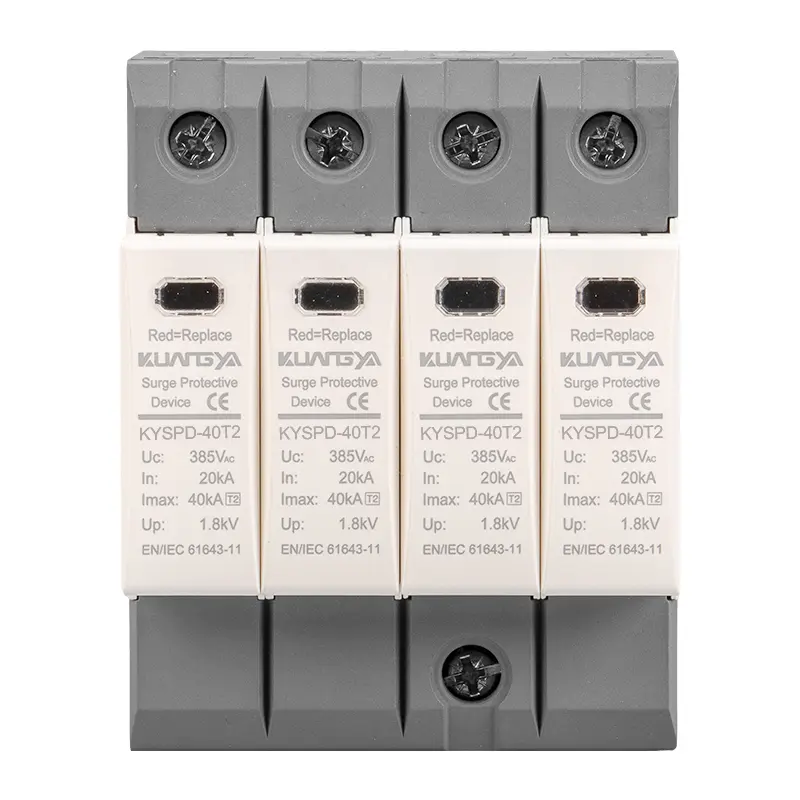
KUANGYA lists a Type 2 elevator AC SPD et a Type 1+2 elevator AC SPD. These product pages provide candidate configurations, not a universal selection for every lift. Verify the current model datasheet, voltage and earthing compatibility, short-circuit conditions, backup protection and the actual panel arrangement before ordering. Ask the supplier for model-specific documentation rather than assuming all versions share the same ratings.
It can help limit surges entering on the AC supply. It does not automatically solve repetitive voltage stress on the drive’s PWM motor output. Use the drive manufacturer’s cable and filter instructions for that output circuit.
No single SPD type is correct for every building. The choice depends on the lightning protection design, the point of installation and coordination with existing devices.
Do not assume so. Power and signal circuits have different ratings and may need separately specified protection.
Start with the actual elevator electrical diagram. Protect the AC supply where the building design requires it, assess exposed signal paths independently, and leave motor-output protection decisions to the drive manufacturer’s approved design. For a product review, provide the supply and earthing details, panel fault current, existing SPDs and the lift controller model.

