Zone industrielle WengYang Yueqing Wenzhou 325000
Heures de travail
Du lundi au vendredi : de 7h00 à 19h00
Le week-end : 10H00 - 17H00
Zone industrielle WengYang Yueqing Wenzhou 325000
Heures de travail
Du lundi au vendredi : de 7h00 à 19h00
Le week-end : 10H00 - 17H00

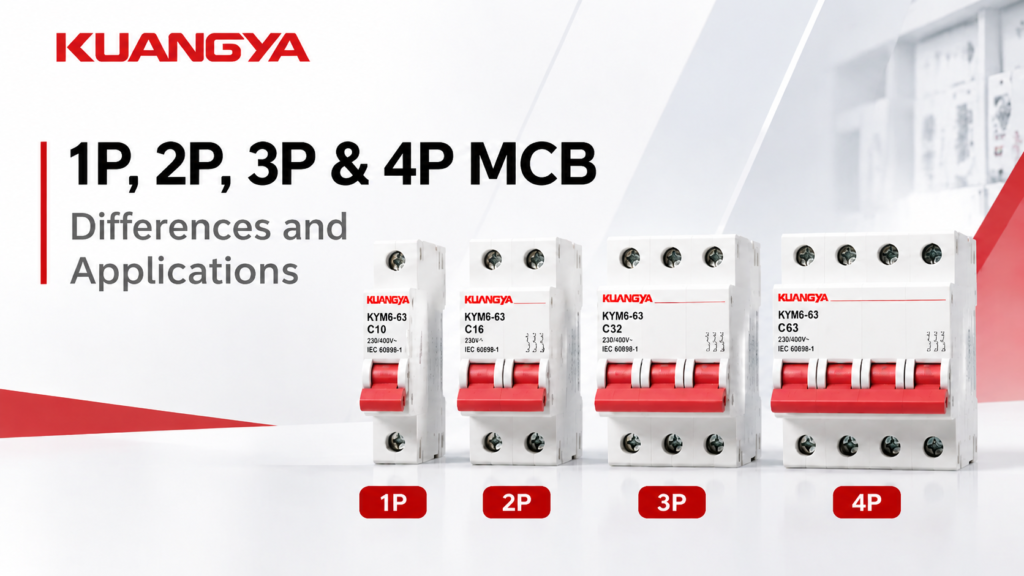
Les configurations de disjoncteurs miniatures 1P, 2P, 3P et 4P sont largement utilisées dans les systèmes de distribution électrique basse tension. Chaque type possède une configuration de pôles différente et répond à des applications électriques spécifiques. Comprendre les différences entre les disjoncteurs miniatures 1P, 2P, 3P et 4P aide les ingénieurs électriciens, les fabricants de tableaux électriques et les acheteurs à choisir des dispositifs de protection adaptés à leurs installations.
Vous pouvez souvent trouver des disjoncteurs miniatures 1P, 2P, 3P et 4P dans les catalogues de produits électriques. Bien qu’ils puissent sembler similaires, leurs configurations internes et leurs applications diffèrent.
Le choix du nombre de pôles approprié est important pour garantir une isolation sûre des circuits, une protection électrique fiable et la compatibilité avec le système de distribution.
Dans ce guide, nous expliquerons les différences entre les disjoncteurs miniatures 1P, 2P, 3P et 4P, les usages courants de chaque type et les points que les acheteurs doivent vérifier avant de passer commande.
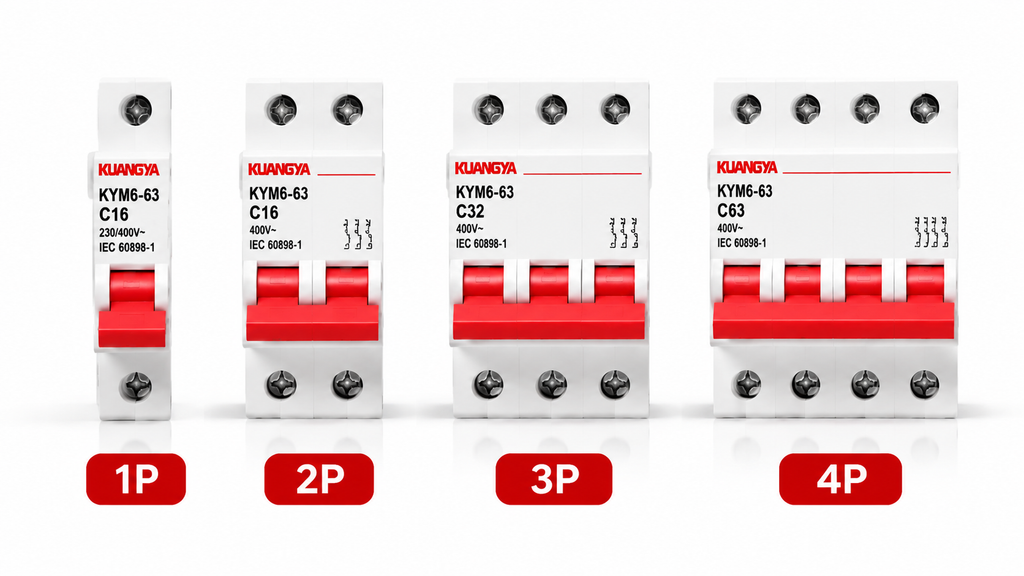
Le nombre de pôles d’un disjoncteur miniature désigne le nombre de conducteurs électriques que le disjoncteur peut couper simultanément.
Différents systèmes électriques nécessitent différentes configurations de commutation.
Lors de la comparaison des configurations de disjoncteurs miniatures 1P, 2P, 3P et 4P, il est important de tenir compte du nombre de conducteurs commutés, de la disposition de la protection contre les surintensités et des exigences du système électrique. Ces facteurs permettent de déterminer quel disjoncteur miniature convient à une installation monophasée ou triphasée.
Par exemple :
Il est important de comprendre que le nombre de pôles n’indique pas toujours le nombre de conducteurs protégés indépendamment. Certaines configurations commutent le conducteur neutre sans assurer de protection contre les surintensités sur ce pôle.
Consultez toujours les spécifications techniques du fabricant avant de choisir un disjoncteur miniature.
Un disjoncteur miniature 1P possède un pôle protégé et sectionné. Il est couramment utilisé dans les installations électriques monophasées pour protéger le conducteur de phase.
En cas de surcharge ou de court-circuit, le disjoncteur miniature déclenche et interrompt le circuit.
Un MCB 1P est souvent choisi lorsque le conducteur neutre ne doit pas être coupé par le disjoncteur du circuit de dérivation.
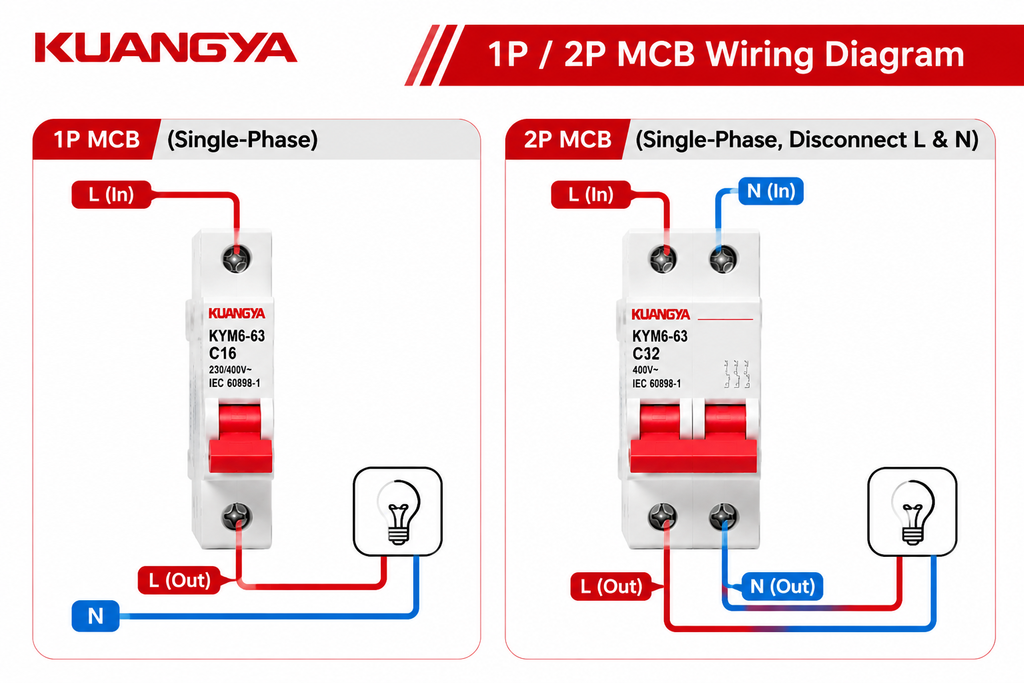
Un MCB 2P comporte deux pôles mécaniquement liés qui fonctionnent simultanément. Il est couramment utilisé dans les systèmes électriques monophasés où les conducteurs de phase et de neutre doivent tous deux être déconnectés.
Selon sa conception, un MCB 2P peut assurer une protection contre les surintensités sur les deux pôles ou utiliser une configuration spécifique avec un pôle protégé et un neutre coupé.
Pour les acheteurs, il est important de distinguer un véritable disjoncteur miniature 2P d’un disjoncteur miniature 1P+N. Leur apparence extérieure peut être similaire, mais leurs dispositifs internes de protection peuvent différer.
Un disjoncteur miniature 3P est conçu pour les systèmes électriques triphasés. Il comporte trois pôles mécaniquement liés, permettant de commuter simultanément les trois conducteurs de phase.
Il assure une protection contre les surcharges et les courts-circuits dans les circuits triphasés.
A 3P MCB is commonly selected for three-phase loads that do not require the neutral conductor to be switched by the circuit breaker.
The selection must also consider the motor starting characteristics, expected fault current and applicable protection requirements.
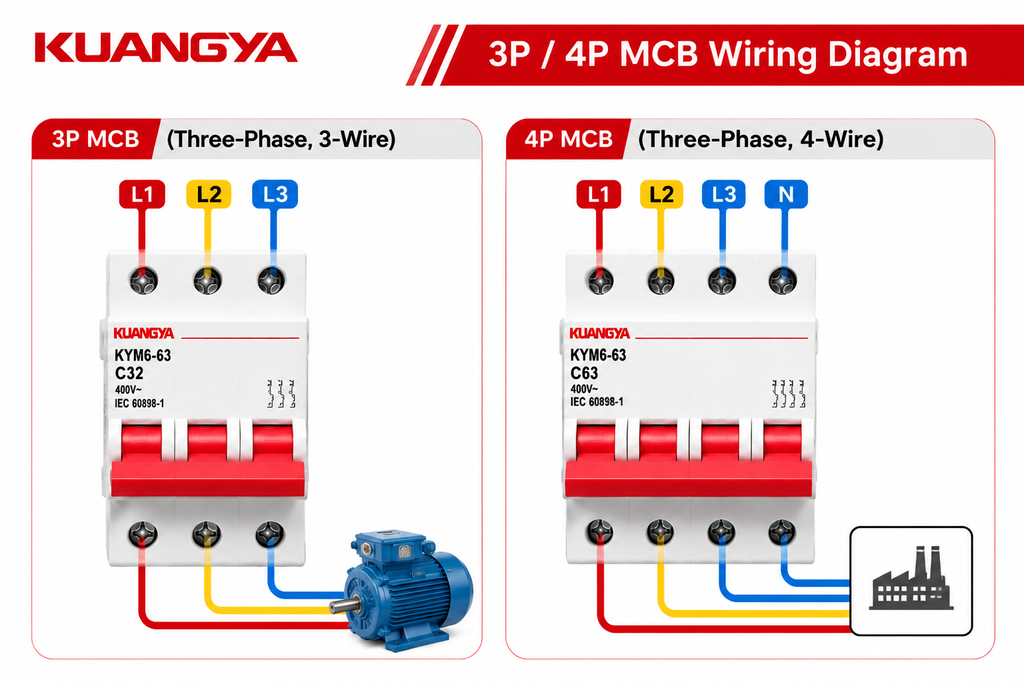
A 4P MCB has four mechanically linked poles, generally used for three-phase systems with a neutral conductor.
It allows the three phase conductors and the neutral conductor to be switched together.
When selecting a 4P MCB, buyers should confirm whether the neutral pole is protected, switched only, or designed with a specific neutral switching sequence.
This is particularly important in systems with nonlinear loads or significant neutral currents.
The following table summarizes the main differences between these four configurations.
| MCB Type | Nombre de pôles | Typical System | Application courante |
|---|---|---|---|
| 1P | 1 | Monophasé | Lighting and branch circuits |
| 2P | 2 | Monophasé | Equipment and circuits requiring two-pole isolation |
| 3P | 3 | Triphasé | Motors and industrial equipment |
| 4P | 4 | Three-phase, four-wire | Distribution boards and three-phase systems with neutral |
The following points should also be considered:
The selection of 1P, 2P, 3P and 4P MCB products depends on the electrical supply configuration and isolation requirements. While single-pole breakers are commonly used in individual single-phase circuits, double-pole, three-pole and four-pole configurations provide different switching arrangements for single-phase and three-phase systems. Always verify the manufacturer’s technical documentation before choosing an MCB.
Selecting an MCB should not be based on appearance alone. Buyers and electrical engineers should first understand the electrical system and the protection requirements.
For a more detailed selection process, read our guide on how to choose an AC MCB, including rated current, breaking capacity and trip curve considerations.
Here are four important factors to consider.
First, determine whether the installation uses a single-phase or three-phase power supply.
Par exemple :
Some electrical installations require the neutral conductor to be disconnected together with the phase conductors.
In these situations, a suitable 2P or 4P configuration may be required.
However, neutral switching requirements depend on the earthing system, installation design and applicable regulations.
The MCB’s rated current and voltage must be compatible with the electrical circuit.
Common rated currents include:
The correct rating should be determined according to conductor capacity, load characteristics and circuit design.
Breaking capacity indicates the maximum prospective short-circuit current that the MCB can safely interrupt under its specified conditions.
Common breaking capacity ratings include 4.5kA, 6kA and 10kA.
Trip curves such as B, C and D are also important when matching an MCB to different load characteristics.
The selected breaking capacity must not be lower than the prospective short-circuit current at the installation point.
For electrical wholesalers, distributors, importers and panel builders, checking the product specifications before ordering can help avoid unnecessary product mismatches.
We recommend confirming the following information with the manufacturer:
| Spécifications | What to Confirm |
|---|---|
| Nombre de pôles | 1P, 2P, 3P or 4P |
| Courant nominal | 6A, 10A, 16A, 32A, 40A, 63A, etc. |
| Tension nominale | According to the intended application |
| Capacité de rupture | 4.5kA, 6kA, 10kA or other available ratings |
| Courbe de déplacement | B, C or D |
| Standard | IEC/EN 60898-1, where applicable |
| Montage | Montage sur rail DIN |
| Certification | Relevant certificates and declarations |
| Personnalisation | Logo, packaging and product labeling |
For additional technical reference, electrical professionals can consult the official IEC 60898-1 standard, which covers circuit-breakers for overcurrent protection in household and similar installations.
Read the official IEC 60898-1 standard for further information about its scope and requirements.
For OEM projects, buyers should also discuss product dimensions, terminal structures, branding requirements and packaging specifications before mass production.
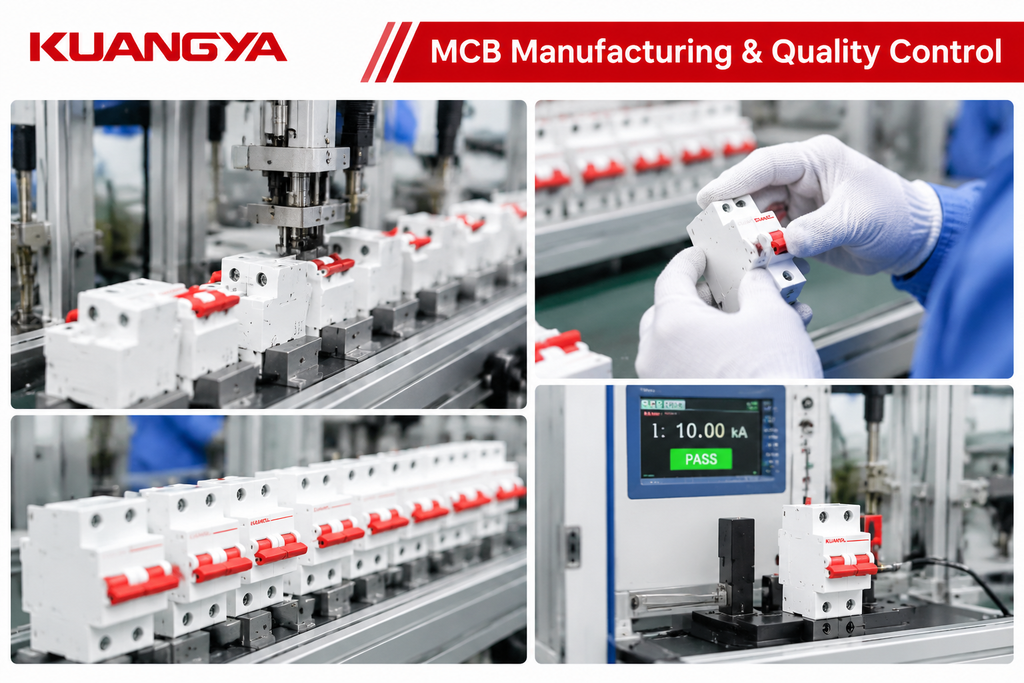
KUANGYA provides low-voltage electrical protection products for distributors, electrical wholesalers and industrial customers.
Our MCB product range includes different pole configurations to meet various electrical distribution requirements.
Available product configurations include:
We also support OEM requirements, including customized branding and product packaging, subject to product specifications and order quantities.
Whether you are sourcing MCBs for residential distribution boards, commercial electrical projects or industrial applications, our team can help you identify suitable product configurations.
Looking for a reliable MCB manufacturer?
Contact KUANGYA to discuss your required specifications, product configurations and OEM requirements.
Site web : https://www.cnkuangya.com/
A 1P MCB switches and protects one conductor, usually the live conductor. A 2P MCB switches two mechanically linked conductors, commonly live and neutral. Their overcurrent protection arrangements may differ depending on the product design.
A 2P MCB may be suitable in certain single-phase applications, but it should not be considered an automatic replacement. The circuit design, neutral switching requirements, protection arrangement and applicable regulations must be checked first.
A 3P MCB switches three phase conductors, while a 4P MCB switches three phase conductors and the neutral conductor. The appropriate choice depends on the electrical system and isolation requirements.
Not necessarily. Some 4P MCBs have a protected neutral pole, while others use a switched neutral pole without independent overcurrent protection. Always check the manufacturer’s technical documentation.
A 3P MCB is commonly used for three-phase motor circuits. However, motor protection must also consider starting current, overload protection, short-circuit protection and the motor manufacturer’s recommendations.
Yes. MCBs are available in various rated currents, breaking capacities and trip curves. Availability depends on the manufacturer’s product range.
Many MCB manufacturers offer OEM services, including customized logos, labels and packaging. Minimum order quantities and customization details should be confirmed with the manufacturer.
Understanding the differences between 1P, 2P, 3P and 4P MCBs is essential when selecting circuit protection devices for different electrical systems.
Each configuration serves a specific purpose, from single-phase branch circuits to three-phase distribution systems with neutral conductors.
Before purchasing, always verify the pole configuration, rated current, voltage, breaking capacity and relevant product standards.
If you are looking for MCB products or OEM manufacturing solutions, KUANGYA welcomes inquiries from distributors, wholesalers and electrical industry partners.

