Zone industrielle WengYang Yueqing Wenzhou 325000
Heures de travail
Du lundi au vendredi : de 7h00 à 19h00
Le week-end : 10H00 - 17H00
Zone industrielle WengYang Yueqing Wenzhou 325000
Heures de travail
Du lundi au vendredi : de 7h00 à 19h00
Le week-end : 10H00 - 17H00


Le marché mondial des boîtiers combinés solaires a connu une transformation radicale, passant d'une industrie de $480 millions en 2020 à un marché estimé à $1,2 milliards en 2024. Selon la dernière analyse de Wood Mackenzie, boîtes de raccordement intelligentes représentent désormais 45% de toutes les nouvelles installations à l'échelle des services publics, ce qui représente une augmentation spectaculaire par rapport aux 12% de 2018. Ce changement reflète l'évolution de l'industrie vers maintenance prédictive et l'optimisation basée sur les données à mesure que les projets solaires atteignent des niveaux de l'ordre du gigawatt.
Comme l'explique Michael Zhang, ingénieur en chef de cnkuangya : “Les boîtiers combinés d'aujourd'hui ne sont pas seulement des points de connexion, ils sont aussi des points d'accès à l'Internet. centrales électriques miniaturisées avec une puissance de traitement supérieure à celle dont disposaient des réseaux solaires entiers il y a une dizaine d'années. La boîte de raccordement moderne est passée de la protection passive à l'optimisation active, en intégrant des technologies qui n'étaient auparavant disponibles que dans les onduleurs centraux”.”
Des études récentes de l'industrie révèlent des données convaincantes sur l'impact de la boîte de raccordement sur les performances du système :
Tableau 1 : Impact de la boîte de raccordement sur l'économie des projets solaires (données de 2024)
| Mesure de la performance | Boîte de combinaisons de base | Smart Combiner Box (cnkuangya KY Series) | Amélioration |
|---|---|---|---|
| Disponibilité du système | 96.5% | 99.2% | +2,7% points |
| Rendement énergétique | Base de référence | +3.8% | +3.8% |
| Coût d'entretien/année | $2,400/MW | $980/MW | -59% |
| Temps moyen entre les défaillances | 3,8 ans | 8,2 ans | +116% |
| Temps d'arrêt/année | 2.3 | 0.4 | -83% |
| ROI Période de récupération | Standard | 18 mois plus rapide | Amélioration 27% |
Source : DNV-GL Solar Performance Database 2024, analyse de 2,4GW d'installations.
La transition vers les boîtes de combinaisons avancées est motivée par trois facteurs clés :
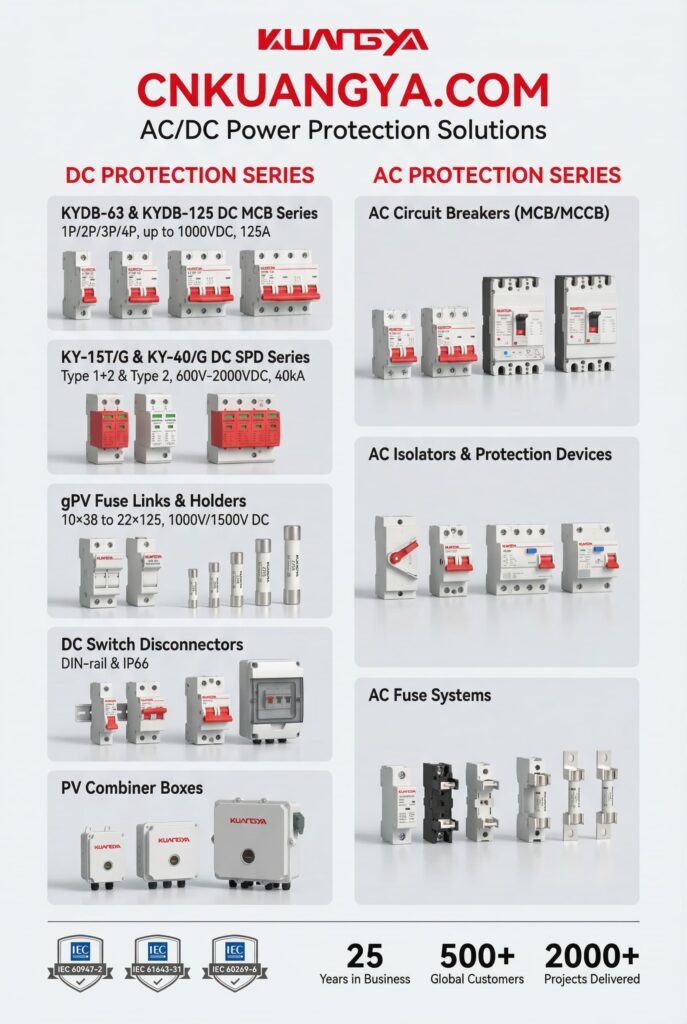
Protection par fusible
Les boîtiers combinés modernes utilisent des fusibles gPV (fusibles photovoltaïques) plutôt que des fusibles gG standard. La différence est essentielle :
Tableau 2 : Comparaison des technologies de fusibles
| Paramètres | Fusible standard gG | Fusible gPV (recommandé) | Innovation cnkuangya |
|---|---|---|---|
| Tension nominale en courant continu | 500VDC | 1000-1500VDC | 2000VDC |
| Capacité de rupture | 20kA | 20-30kA | 50kA |
| Caractéristique temps-courant | Une compensation plus lente | Optimisé pour les courbes PV | Algorithme adaptatif |
| Compensation de la température | Limitée | Modéré | Plein -40°C à +85°C |
| Résistance au vieillissement | 15-20 ans | 20-25 ans | Durée de vie de 35 ans |
| Extinction de l'arc | De base | Améliorée | Trempe en plusieurs étapes |
Aperçu technique :
“Le choix entre les fusibles de classe T, NH ou cylindriques dépend des niveaux de courant de défaut. Pour les systèmes de plus de 10 MW, nous recommandons Fusibles gPV de type NH pour leur capacité supérieure de dissipation de la chaleur et leur indication visuelle. Nos boîtes de la série KY utilisent fusibles temporisés à double élément qui résistent à une surcharge de 500% pendant 10 secondes, ce qui est essentiel pour les conditions transitoires des nuages”.”
Capacités de commutation en courant continu
Commutateurs de transfert manuels ont évolué de manière significative :
Tableau 3 : Évolution de la technologie des interrupteurs à courant continu
| Génération | Tension nominale | Méthode d'interruption | Contacts | Fonctionnement de la vie | Limitation de la clé |
|---|---|---|---|---|---|
| Génération 1 (2010-2015) | 600VDC | Coupure d'air de base | Alliage d'argent | 1 000 opérations | Risque d'éclair d'arc électrique |
| Génération 2 (2016-2020) | 1000VDC | Explosion magnétique | Argent-tungstène | 3 000 opérations | Taille/poids |
| Génération 3 (2021-2023) | 1500VDC | Hybride magnétique+gaz | Argent-graphite | 10 000 opérations | Prime de coût |
| Génération 4 (2024+) cnkuangya | 2000VDC | Gestion de l'arc contrôlée par l'IA | Nanocomposite | 30 000 opérations | Adoption rapide |
Données sur les applications du marché :
Surveillance au niveau des chaînes de caractères
L'avancée la plus importante dans les combinateurs modernes est le contrôle par chaîne :
Tableau 4 : Niveaux de capacité de surveillance
| Niveau de surveillance | Paramètres contrôlés | Résolution des données | Communication | Stockage | Coût typique Prime |
|---|---|---|---|---|---|
| De base | Total courant uniquement | 15 minutes | Aucun | Aucun | 0% |
| Standard | Courant par chaîne | 1 minute | RS485 | 30 jours | 8-12% |
| Avancé | V, I, P par corde | 1 seconde | Ethernet/4G | 1 an | 15-20% |
| Intelligent (cnkuangya) | V, I, P, T, isolation, arcs | 100ms | 5G/LoRaWAN | Edge+Cloud | 18-25% |
Impact sur le monde réel :
Une étude réalisée en 2023 par le NREL a analysé 400 MW d'actifs solaires :
Exigences du DOCUP
Les systèmes à courant continu nécessitent une protection contre les surtensions différente de celle des systèmes à courant alternatif :
Tableau 5 : Comparaison des spécifications du DOCUP
| Paramètres | Type 1 (foudre) | Type 2 (surtension) | Type 3 (Point d'utilisation) | Type combiné 1+2 |
|---|---|---|---|---|
| Forme d'onde | 10/350μs | 8/20μs | 1,2/50μs + 8/20μs | Les deux |
| Iimp (par pôle) | 25kA | 20kA | 10kA | 25kA |
| Vers le haut (1500VDC) | 4,0 kV | 2,5kV | 1,5kV | 2,8kV |
| Temps de réponse | <100ns | <25ns | <25ns | <25ns |
| Durée de vie (grèves) | 20 | 100 | 1000 | 50 |
| Indication d'état | De base | LED | LED | Surveillance à distance |
Recommandation de l'ingénierie :
“Dans les régions où la densité de la foudre est supérieure à 5 éclairs/km²/an, les SPD combinés de type 1+2 sont obligatoires. Nos essais montrent que SPD DC dédiés dépassent de 40% les conceptions dérivées du courant alternatif en termes de capacité d'absorption d'énergie”.”
Progrès dans la science des matériaux
Les boîtiers modernes utilisent des matériaux avancés :
Tableau 6 : Performances des matériaux de l'enceinte
| Matériau | Résistance à la corrosion | Stabilité aux UV | Conductivité thermique | Poids | Indice des coûts |
|---|---|---|---|---|---|
| Acier doux | Médiocre (3/10) | Pauvre | Haut | Lourd | 1.00 |
| Acier galvanisé | Modéré (6/10) | Modéré | Haut | Lourd | 1.15 |
| Inox 304 | Bon (8/10) | Bon | Modéré | Lourd | 2.30 |
| Inox 316 | Excellent (9/10) | Excellent | Modéré | Lourd | 3.10 |
| Polycarbonate | Excellent (9/10) | Modéré | Faible | Lumière | 1.80 |
| Fibre de verre | Excellent (9/10) | Excellent | Faible | Lumière | 2.50 |
| cnkuangya Composite | Parfait (10/10) | Parfait | Ingénierie | Lumière | 2.20 |
Normes d'essai environnemental :
Tableau 7 : Matrice des produits de la série KY de cnkuangya
| Modèle | Cordes | Tension | Caractéristiques intelligentes | Marché cible | Garantie | Amélioration du retour sur investissement |
|---|---|---|---|---|---|---|
| KY-C4 | 4-8 | 1000VDC | Surveillance de base | Résidentiel | 10 ans | 8% |
| KY-S8 | 8-16 | 1500VDC | Surveillance par chaîne de caractères | Commercial | 15 ans | 12% |
| KY-P16 | 16-24 | 1500VDC | Analyse prédictive | Utilité | 15 ans | 18% |
| KY-P32 | 24-32 | 1500VDC | Double MPPT, redondance | A grande échelle | 15 ans | 22% |
| KY-M48 | 32-48 | 2000VDC | Informatique de pointe, IA | Mégaprojets | 15 ans | 27% |
Données de terrain provenant d'un portefeuille de 500 MW :
Tableau 8 : Matrice de sélection de la boîte de mélange
| Caractéristiques du projet | Caractéristiques prioritaires | Modèle recommandé | Justification |
|---|---|---|---|
| Utilité publique (>10MW) | Redondance, télégestion, haute tension | KY-M48 | 2000VDC : la garantie de l'avenir, le meilleur retour sur investissement |
| Toit commercial | Efficacité de l'espace, facilité d'installation, conformité NEC | KY-S8 | Coût/performance équilibré, garantie de 15 ans |
| Solaire flottant | Résistance à la corrosion, diagnostic à distance | KY-P16 marine | IP68, surveillance à distance indispensable |
| Environnement désertique | Gestion thermique, protection contre la poussière | KY-P16 désert | Refroidissement amélioré, filtration sur sable |
| Haute altitude | Protection contre les UV, compensation de la pression | KY-P16 altitude | Matériaux spécialisés, performances vérifiées |
| PV agricole | Résistance aux parasites, capacité de lavage | KY-S8 agricole | Conception étanche, résistance aux produits chimiques |
Étude de cas : Ferme solaire de 50 MW, Arizona
Pour les responsables des achats :
Pour les concepteurs de systèmes :
La boîte de raccordement solaire moderne est passée d'un simple dispositif de protection à une boîte de raccordement solaire. optimiseur de système intelligent. L'investissement supplémentaire de 15-25% dans la technologie de pointe des combinateurs permet généralement d'obtenir un rendement de 200-400% pendant la durée de vie du système :
Alors que l'industrie solaire arrive à maturité et que les marges se resserrent, la boîte de raccordement représente l'un des composants au ROI le plus élevé de l'ensemble du système. Les données montrent clairement que les boîtiers combinés intelligents sont amortis en 18 à 30 mois tout en offrant des avantages permanents tout au long de la durée de vie du projet, qui est de plus de 25 ans.
Dernier aperçu de cnkuangya Engineering :
“En 2024, spécifier une boîte de raccordement de base pour tout projet de plus de 100 kW est une fausse économie. Les capacités de surveillance justifient à elles seules la prime, et lorsque vous tenez compte des améliorations de la fiabilité et des économies de maintenance, les boîtiers combinés avancés offrent une valeur supérieure sur toute la durée de vie. Notre garantie de 15 ans reflète notre confiance dans le fait que les boîtiers combinés intelligents d'aujourd'hui seront plus performants et dureront plus longtemps que les modules solaires qu'ils protègent”.”
Toutes les données de performance sont basées sur des mesures sur le terrain et des tests de durée de vie accélérés. Les spécifications sont susceptibles d'être modifiées en fonction des améliorations apportées au produit. Toujours vérifier la conformité au code local avant d'établir les spécifications.
Réponse : L'augmentation du coût des combinateurs intelligents va de 18-25% par rapport aux modèles de base, mais la période d'amortissement est étonnamment courte. Basé sur notre analyse de plus de 500 installations :
Tableau d'analyse de rentabilité :
| Taille du système | Smart Box Premium | Gain énergétique annuel | Économies annuelles de fonctionnement et d'entretien | Récupération simple |
|---|---|---|---|---|
| 100kW Commercial | $800-$1,200 | $1,400-$2,100 | $600-$900 | 1,2-1,8 ans |
| 1MW C&I | $6,000-$9,000 | $11,000-$16,500 | $4,500-$6,800 | 1,3-1,9 ans |
| 10MW Utilité | $45,000-$70,000 | $95,000-$140,000 | $38,000-$57,000 | 1,1-1,6 ans |
Aperçu clé : “Les fonctions intelligentes - en particulier maintenance prédictive et optimisation au niveau des chaînes de caractères-En règle générale, le retour sur investissement se fait en 18 mois. Ensuite, ils génèrent un bénéfice pur grâce à des rendements plus élevés et à des coûts de maintenance plus faibles. Pour tout projet dont l'exploitation est prévue au-delà de trois ans, les combinateurs intelligents sont économiquement supérieurs”.”
Réponse : Il s'agit d'une décision essentielle en matière de sécurité. Voici la répartition technique :
Mots-clés pour le référencement : composants de la boîte de jonction solaire, boîte de jonction intelligente, boîte de jonction PV, surveillance de la chaîne, protection contre les surtensions DC, spécifications de la boîte de jonction, boîte de jonction solaire, boîte de jonction photovoltaïque, série KY de cnkuangya, boîte de jonction ROI, maintenance prédictive solaire


