Dirección
304 North Cardinal
Dorchester Center, MA 02124
Horas de trabajo
De lunes a viernes: de 7.00 a 19.00 horas
Fin de semana: 10.00 A 17.00 HORAS
Dirección
304 North Cardinal
Dorchester Center, MA 02124
Horas de trabajo
De lunes a viernes: de 7.00 a 19.00 horas
Fin de semana: 10.00 A 17.00 HORAS



EV Charging Pile RCCB Selection: global electric vehicle revolution has fundamentally transformed the automotive industry, with annual EV sales projected to exceed 30 million units by 2030. This unprecedented growth has created massive demand for safe, reliable, and efficient charging infrastructure. At the heart of every EV charging installation lies a critical safety decision: selecting the appropriate residual current protection strategy.
Unlike traditional electrical loads, EV chargers present unique protection challenges due to their internal power conversion electronics. The onboard charger converts AC grid power to DC current for battery charging, creating potential fault conditions that include smooth DC residual currents—waveforms that conventional Type A RCCBs cannot detect. This limitation has driven the development of two primary protection strategies: standalone Type B RCCBs that detect all waveform types, and Type F RCCBs combined with external DC fault detection devices.
This comprehensive guide analyzes both approaches, examining technical specifications, regulatory compliance, cost considerations, and real-world performance to help you make informed decisions for your EV charging installations. Whether you’re designing a residential home charging point or a commercial charging hub with multiple high-power stations, understanding these protection options is essential for ensuring safety, reliability, and regulatory compliance.
Modern EV chargers are sophisticated power electronic systems that convert alternating current (AC) from the electrical grid into direct current (DC) suitable for charging vehicle batteries. This conversion process involves rectifiers and switching power supplies that can generate smooth DC fault currents under certain fault conditions—particularly insulation failures within the charger’s internal DC bus or charging cable.
The critical safety issue arises from the nature of these DC fault currents. Standard Type A RCCBs use toroidal transformers to detect imbalances between live and neutral conductors. However, DC currents can saturate the magnetic core of these transformers, effectively “blinding” the protection device and preventing it from detecting subsequent AC faults. This phenomenon, known as DC magnetic saturation, creates a dangerous false sense of security where the RCCB appears functional but fails to provide protection when needed most.
IEC 61851-1, the international standard governing electric vehicle conductive charging systems, recognizes this hazard explicitly. The standard requires protection against smooth DC residual currents for Mode 2 and Mode 3 charging systems, mandating either Type B residual current devices or alternative protection schemes incorporating DC fault detection functionality.
The regulatory landscape for EV charging protection varies across jurisdictions, but the trend globally is toward increasingly stringent requirements that acknowledge the unique hazards posed by EV charging equipment. Understanding these requirements is essential for ensuring compliance and avoiding costly retrofits or safety incidents.
European Requirements:\
In Europe, the 18th Edition of the IET Wiring Regulations (BS 7671:2018+A2:2022) mandates that each EV charging point must be individually protected by an RCD that disconnects all live conductors. For chargers without integrated DC fault detection (RDC-DD), Type B protection is required. Germany’s VDE standards and France’s NF C 15-100 regulations incorporate similar requirements, reflecting broad European consensus on the need for comprehensive DC fault protection.
UK Requirements:\
Following Brexit, the UK has maintained alignment with European safety standards through the 18th Edition Wiring Regulations. Amendment 2 specifically addresses EV charging protection, requiring Type B RCDs or Type A/F devices with appropriate DC fault detection measures. The UK Homecharge Scheme, which provides grants for residential charging installations, requires compliance with these protection standards as a condition of funding.
Asia-Pacific Requirements:\
Australia’s AS/NZS 3000 standard and New Zealand’s electrical codes have adopted similar requirements, recognizing the global nature of EV technology and the need for consistent safety standards. China’s GB/T standards for EV charging infrastructure specify DC fault protection requirements that align with international best practices.
North American Trends:\
While North American electrical codes have been slower to mandate Type B protection specifically, the trend is clearly moving in that direction. The National Electrical Code (NEC) requires GFCI protection for EV charging equipment, and industry best practice increasingly recommends Type B-level protection for maximum safety, particularly in commercial installations.
Type B RCCBs represent the most straightforward approach to EV charging protection, providing comprehensive detection of all residual current waveforms in a single device. These advanced protection devices can detect:
This universal detection capability eliminates the complexity of coordinating multiple protection devices and ensures comprehensive protection regardless of fault type. When a Type B RCCB is installed, it monitors continuously for all possible fault waveforms, providing a single point of verification for protection compliance.
Technical Advantages:\
The primary advantage of Type B RCCBs is their standalone nature. Installers need only select, install, and test a single device, simplifying procurement, installation, and ongoing maintenance. The integrated design ensures that all protection functions are coordinated by the manufacturer, eliminating compatibility concerns between separate devices.
Type B RCCBs also provide consistent sensitivity across all detectable waveform types. Unlike combination systems where different devices may have varying response characteristics, Type B devices maintain uniform trip thresholds and response times regardless of fault current waveform. This consistency simplifies system design and ensures predictable protection behavior.
Product Specifications (KUANGYA Type B Series):\
KUANGYA’s Type B RCCB product line offers current ratings from 16A to 100A, with standard 30mA sensitivity for personnel protection and higher sensitivities (100mA, 300mA) for fire protection applications. The devices comply with IEC 61008-1 and IEC 62423 standards, carrying CE marking and CB Scheme certification from TÜV Rheinland.
The alternative protection strategy combines a Type F RCCB with a separate DC fault detection device (typically designated RDC-DD per IEC 62955). This approach leverages the Type F RCCB’s ability to detect AC, pulsating DC, and high-frequency residual currents while relying on the external device for smooth DC detection.
How the Combination Works:\
In this configuration, the Type F RCCB provides primary protection against AC and pulsating DC faults, which represent the majority of earth leakage incidents. The DC fault detection device monitors specifically for smooth DC currents, which typically only occur during internal charger faults or insulation failures in the DC charging circuit. When the DC detection device senses a smooth DC fault exceeding its threshold (typically 6mA), it signals the RCCB to trip or triggers a separate contactor to disconnect the circuit.
Technical Considerations:\
The combination approach requires careful coordination between the Type F RCCB and the DC detection device. Both devices must be compatible in terms of voltage ratings, response characteristics, and fault-clearing capabilities. The DC detection device’s output signal must reliably trigger the RCCB trip mechanism or associated contactor, requiring proper wiring and verification during commissioning.
This coordination adds complexity to system design, installation, and testing. Installers must verify proper operation of both devices individually and in combination, ensuring that the DC detection device correctly signals the RCCB and that the RCCB responds appropriately to the external trip command.
When the Combination Approach May Be Appropriate:\
The Type F + DC detection strategy may be preferred in specific scenarios:
However, these advantages must be weighed against the added complexity and potential reliability concerns of multi-device protection schemes.
| Parámetro | Tipo B RCCB | Type F + DC Detection |
|---|---|---|
| AC Detection | ✓ (Full sensitivity) | ✓ (Full sensitivity) |
| Pulsating DC Detection | ✓ (Up to 6mA) | ✓ (Up to 6mA) |
| Detección suave de CC | ✓ (Integrated) | ✓ (Via external device) |
| Detección de alta frecuencia | ✓ (Up to 1kHz) | ✓ (Up to 1kHz) |
| Response Time (AC faults) | ≤40ms | ≤40ms (Type F) + signaling delay |
| Response Time (DC faults) | ≤40ms | Device-dependent + signaling delay |
| Trip Consistency | Single device, uniform response | Coordination-dependent |
| Fail-Safe Operation | Self-contained | Requires external device functionality |
| Temperature Stability | Integrated compensation | Coordination required |
| Long-Term Calibration | Single device drift | Multiple device drift factors |
Type B RCCB Installation:\
Installing a Type B RCCB follows standard procedures familiar to electrical contractors. The device mounts on standard 35mm DIN rail, connects to line, neutral, and earth conductors, and requires only basic electrical testing during commissioning. Verification involves standard RCCB test equipment that confirms trip sensitivity and response time at rated residual current.
The simplicity of Type B installation reduces labor costs and minimizes opportunities for wiring errors. Commissioning tests follow established protocols, with results easily documented for regulatory compliance and warranty purposes. Troubleshooting involves a single device, simplifying fault isolation and repair.
Type F + DC Detection Installation:\
The combination approach requires installing and wiring two separate devices, potentially from different manufacturers. The DC detection device requires additional connections for power supply, monitoring inputs, and trip signaling to the RCCB or contactor. These additional connections increase installation time and introduce potential points of failure.
Commissioning must verify proper operation of both devices individually and in combination. The DC detection device’s response to smooth DC test currents must be confirmed, along with its ability to reliably signal the RCCB. This testing requires specialized equipment and procedures that may not be familiar to all electrical contractors.
Initial Equipment Costs:\
Type B RCCBs command a premium over Type F devices due to their more sophisticated detection circuitry. However, when the cost of the separate DC detection device is included, the total initial investment for the combination approach often approaches or exceeds the cost of a standalone Type B RCCB.
For a typical 32A residential EV charging installation:
The combination approach may appear less expensive when low-cost components are selected, but premium DC detection devices with reliable signaling can eliminate this cost advantage.
Installation Labor Costs:\
The additional wiring and commissioning requirements of the combination approach typically add 30-60 minutes to installation time compared to a Type B RCCB. At typical electrician labor rates of $75-125 per hour, this adds $40-125 to installed cost, often negating any equipment cost savings.
Lifecycle and Maintenance Costs:\
Type B RCCBs require only standard periodic testing using built-in test buttons and occasional instrumented verification. The combination approach requires testing both devices, verifying their coordination, and ensuring that the DC detection device remains functional. Over a 15-year installation lifetime, these additional maintenance requirements can add significant cost.
More importantly, the combination approach introduces potential reliability concerns. If either device fails or their coordination degrades, protection may be compromised. Type B RCCBs, with their integrated design, eliminate this interdependency and associated risks.
From a regulatory perspective, both approaches can achieve compliance when properly implemented. However, the Type B RCCB provides a more straightforward compliance path with a single certified device that clearly meets IEC 62423 requirements for smooth DC detection.
In liability terms, using a single certified Type B device from a reputable manufacturer provides clear documentation of due diligence. The combination approach requires demonstrating that both devices are appropriate for the application, properly coordinated, and correctly installed—documentation that may be challenged in the event of an incident.
Aplicación: Homeowner installing Level 2 charging for daily EV charging\
Electrical Supply: 230V single-phase, 32A dedicated circuit\
Charger Type: Wall-mounted 7kW charger without integrated RDC-DD
Recommended Solution: Type B RCCB (32A, 30mA)
For residential applications, the simplicity and reliability of Type B protection outweigh any marginal cost differences. Homeowners expect trouble-free operation without nuisance tripping or complex protection systems. The Type B RCCB provides comprehensive protection in a single device that can be easily tested and maintained.
Installation involves a straightforward connection: supply line and neutral to RCCB input terminals, output terminals to charger line and neutral, and earth connection to the protective earth bus. The RCCB’s built-in test button enables monthly functional checks, while annual professional testing verifies continued compliance with protection standards.
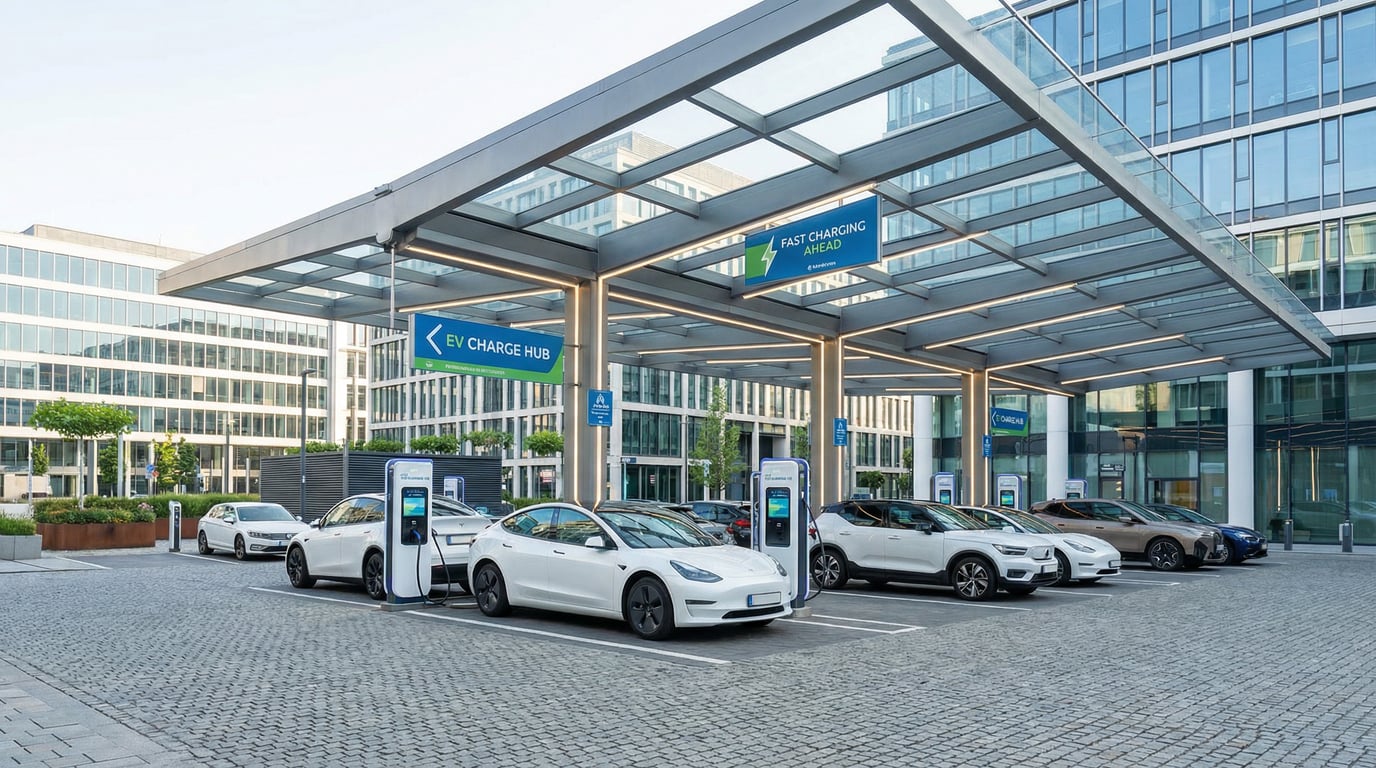
Modern EV charging infrastructure requires reliable Type B protection to ensure safety across multiple charging points.
Aplicación: Office building providing charging for employee and visitor vehicles\
Electrical Supply: 400V three-phase, multiple 16-32A circuits\
Charger Type: Multiple pedestal-mounted chargers, mix of single and three-phase
Recommended Solution: Type B RCCBs (individual per charger) or Type B RCBOs for selectivity
Commercial installations demand high availability and selective protection that isolates only the affected circuit during faults. Type B RCBOs (Residual Current Breaker with Overcurrent protection) provide both earth leakage and overcurrent protection in a single device, ensuring that a fault on one charging point does not affect others.
For a commercial hub with 10 charging points, individual Type B RCBOs provide superior selectivity compared to a shared RCCB protecting multiple circuits. While this approach requires more devices, the improved availability and simplified fault isolation justify the investment.
Aplicación: DC fast charging station requiring AC supply protection for auxiliary circuits\
Electrical Supply: 400V three-phase, high-current supply for charger power conversion\
Charger Type: DC fast charger (50-350kW) with integrated protection systems
Recommended Solution: Type B RCCB (100-300mA sensitivity) for fire protection
While the DC fast charger’s internal systems handle the high-power DC conversion, the AC supply circuits still require appropriate protection. Type B RCCBs with higher sensitivity settings (100-300mA) provide fire protection for the AC distribution while avoiding nuisance tripping from normal charger operation.
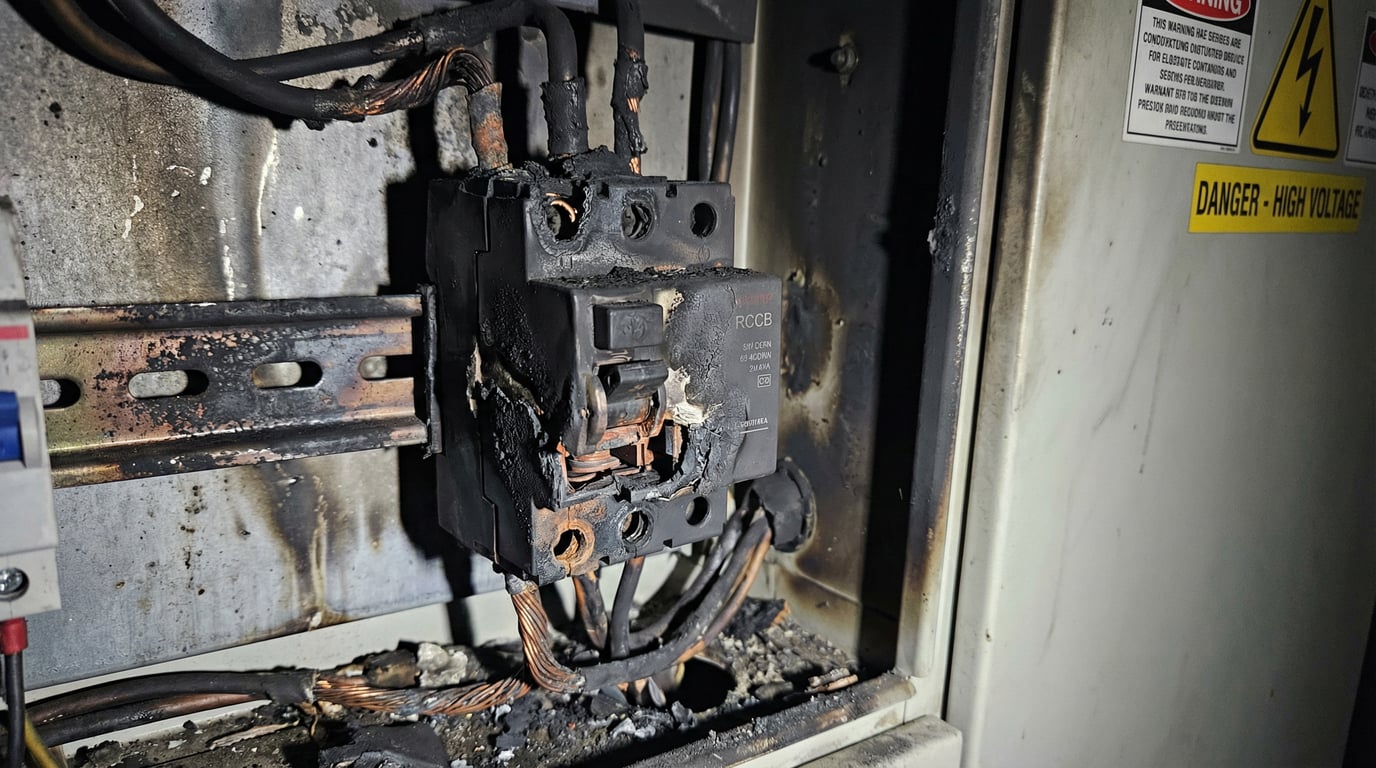
The devastating consequences of inadequate residual current protection: fire-damaged equipment resulting from substandard device selection.
The image above illustrates the severe consequences of inadequate residual current protection in an EV charging installation. This fire-damaged distribution board resulted from a smooth DC fault that went undetected due to improper protection selection. The installer had used a Type A RCCB, which was subsequently blinded by DC fault current, preventing it from tripping when an AC fault later developed.
Investigation revealed that the EV charger’s internal insulation had degraded, creating a smooth DC leakage path. The Type A RCCB did not detect this DC current, and its magnetic core became saturated. When a subsequent AC fault occurred due to cable damage, the already-saturated RCCB failed to respond, allowing fault current to flow for over 30 seconds before the upstream overcurrent protection finally operated.
During this extended fault duration, arcing created temperatures exceeding 1000°C, igniting cable insulation and surrounding materials. The resulting fire caused over €150,000 in property damage and rendered the charging facility inoperable for three months during repairs. The insurance investigation determined that inadequate protection selection contributed to the incident, resulting in increased premiums and loss of no-claims discounts for the facility operator.
This case underscores a critical principle: the incremental cost of proper Type B protection is negligible compared to the potential costs of inadequate protection. When evaluating protection strategies, the total cost of ownership—including liability exposure, insurance implications, and business continuity—must be considered alongside initial equipment costs.

KUANGYA’s industry-leading 8-year warranty reflects our confidence in product quality and long-term reliability.
KUANGYA Electrical Equipment has established itself as a leading manufacturer of residual current protection devices, with over 25 years of experience and more than 2,000 successful EV charging installations worldwide. Our comprehensive Type B RCCB product line offers solutions for every EV charging application, from residential home chargers to commercial charging hubs.
Standard Series (KYR2-B):
RCBO Series (KYR6-B):
While most manufacturers offer 12-24 month warranties, KUANGYA provides an unprecedented 8-year warranty on all Type B RCCB and RCBO products. This industry-leading warranty coverage includes:
Our warranty reflects confidence in our manufacturing processes, quality control systems, and the long-term reliability of our products. With mean time between failures (MTBF) exceeding 15 years and comprehensive type testing by independent laboratories, KUANGYA devices deliver the reliability that mission-critical EV charging installations demand.
Q1: Can I use a Type F RCCB with an external DC detection device instead of a Type B RCCB?
While the Type F + DC detection combination can provide equivalent protection when properly implemented, this approach introduces significant complexity. Both devices must be compatible, properly coordinated, and correctly wired to ensure reliable operation. The DC detection device must reliably signal the RCCB or associated contactor, and both devices require individual testing and maintenance.
For most installations, the standalone Type B RCCB provides superior reliability with simpler installation and maintenance. However, the combination approach may be appropriate for specific retrofit applications where Type F RCCBs are already installed, or where the EV charger includes integrated DC detection functionality. Always verify local code requirements, as some jurisdictions mandate Type B devices regardless of alternative protection schemes.
Q2: How do I size the RCCB for my EV charging installation?
Sizing an RCCB for EV charging involves several considerations:
Clasificación actual: Select a rated current equal to or greater than the charging circuit’s maximum continuous current. For a 7kW single-phase charger at 230V, maximum current is approximately 30.4A, so a 32A RCCB is appropriate. For 22kW three-phase chargers, 32A or 40A devices are typically required.
Sensitivity: 30mA sensitivity provides optimal personal protection and is recommended for most installations. Higher sensitivities (100mA, 300mA) may be used for fire protection in specific applications but do not provide adequate shock protection for accessible circuits.
Short-Circuit Capacity: The RCCB’s rated breaking capacity must exceed the maximum prospective fault current at the installation point. Most residential installations require 6kA capacity, while commercial installations may require 10kA or higher.
Type Selection: Type B is mandatory for chargers without integrated DC fault detection. Type A or F may be acceptable only when the charger includes compliant RDC-DD functionality and local codes permit their use.
Q3: What causes nuisance tripping in EV charging applications, and how can I prevent it?
Nuisance tripping can result from several factors:
Normal Leakage Currents: EV chargers and their associated cables generate small leakage currents during normal operation. If multiple chargers share a single RCCB, these currents can accumulate and approach the trip threshold. Solution: Install individual RCCB protection for each charging circuit.
Transient Inrush: Initial connection and power-up can create transient currents that trigger sensitive devices. Solution: Ensure proper cable sizing and consider C-curve trip characteristics for high-inrush applications.
Harmonic Distortion: Power electronics can generate harmonic currents that some RCCBs interpret as fault conditions. Solution: Type B and Type F RCCBs include filtering for high-frequency components, reducing nuisance tripping.
Cable Capacitance: Long cable runs increase capacitive leakage to earth. Solution: Follow maximum cable length recommendations and consider higher-rated devices for distant installations.
Proper installation practices—including dedicated circuits, appropriate cable sizing, and quality components—eliminate most nuisance tripping while maintaining full protection.
The selection between Type B RCCBs and Type F + DC detection combinations represents a critical decision that impacts safety, reliability, and lifecycle costs for EV charging installations. While both approaches can achieve regulatory compliance when properly implemented, the Type B RCCB offers distinct advantages in simplicity, reliability, and total cost of ownership.
For the vast majority of EV charging applications—from residential home chargers to commercial charging hubs—Type B RCCBs provide the optimal balance of comprehensive protection, ease of installation, and long-term reliability. The integrated design eliminates coordination concerns and provides consistent protection across all fault types.
KUANGYA’s industry-leading Type B RCCB product line, backed by our unprecedented 8-year warranty, delivers the quality and reliability that professional electrical installations demand. With comprehensive international certifications, advanced manufacturing capabilities, and global technical support, we stand ready to partner with you in building the safe, reliable charging infrastructure that will power the future of sustainable transportation.
Contact KUANGYA today to discuss your EV charging protection requirements and discover how our Type B RCCB solutions can enhance your installations.
KUANGYA Electrical Equipment – 25 Years of Protection Excellence | 8-Year Industry-Leading Warranty | Global Certifications | EV Charging Specialists

