Zona industrial de WengYang Yueqing Wenzhou 325000
Horas de trabajo
De lunes a viernes: de 7.00 a 19.00 horas
Fin de semana: 10.00 A 17.00 HORAS
Zona industrial de WengYang Yueqing Wenzhou 325000
Horas de trabajo
De lunes a viernes: de 7.00 a 19.00 horas
Fin de semana: 10.00 A 17.00 HORAS

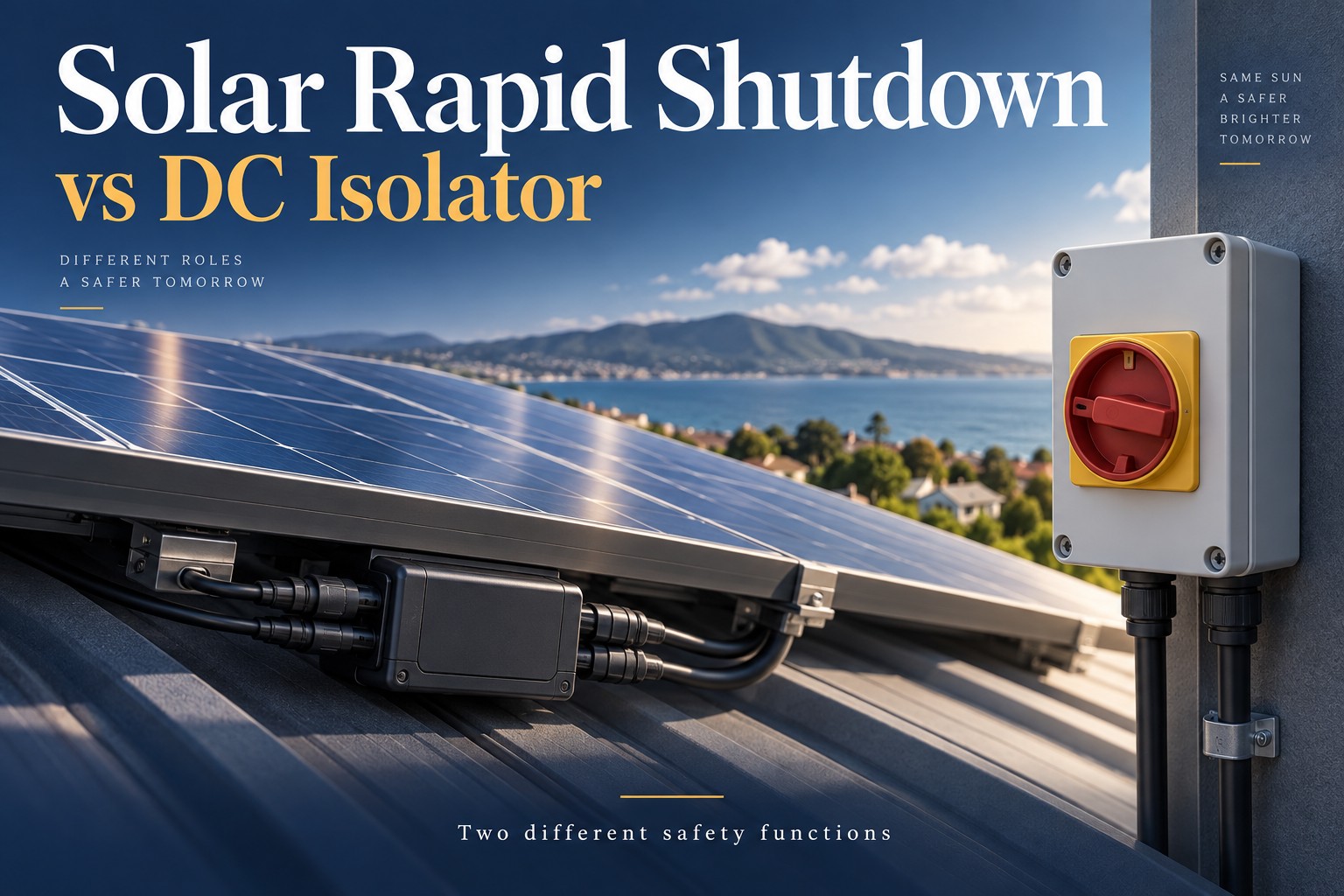
Turning a solar inverter off does not necessarily remove voltage from the rooftop wiring. That is why solar rapid shutdown and DC isolation need to be treated as separate design functions.
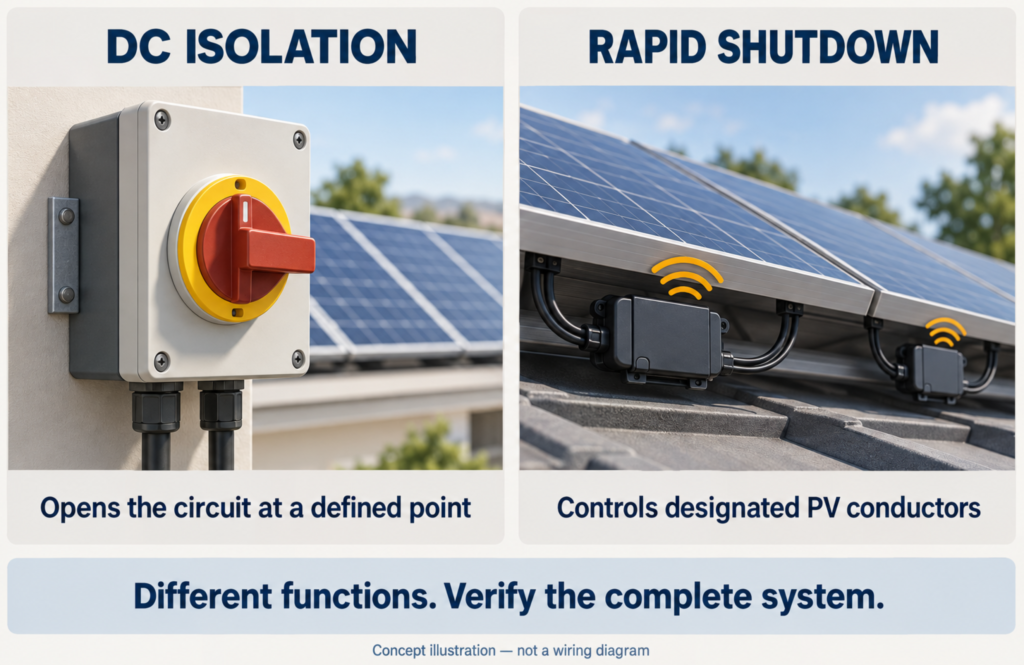
Respuesta rápida: A DC isolator opens a circuit at its installation point. A rapid shutdown system controls designated PV conductors after a shutdown signal, using an approved equipment arrangement. An ordinary DC isolator alone does not establish that a rooftop system meets rapid shutdown requirements.
This guide is for installers, distributors and project buyers comparing protection equipment. Electrical work and shutdown verification must be performed by qualified personnel using the applicable equipment instructions.
A correctly selected DC switch disconnector provides a defined isolation point between parts of the circuit. Its suitability depends on DC voltage, current, switching duty, pole arrangement and installation conditions.
Opening the switch does not stop sunlight from reaching the modules. Conductors on the source side can therefore remain energized. A handle in the OFF position is not proof that every cable on the roof is safe to touch.
For equipment options and model-specific information, see Kuangya DC switch disconnectors.
Rapid shutdown addresses the electrical hazard associated with designated PV conductors after initiation. In common module-level arrangements, compatible electronics change the output state when the shutdown signal is received or the required operating signal disappears.
The initiating device, transmitter, inverter and rooftop electronics must work together as specified. For example, Tigo documents different communications arrangements for different product families; a shutdown method should not be assumed to work identically across all models. See Tigo’s rapid shutdown overview.
| Pregunta | Ordinary DC isolator | Rapid shutdown system |
|---|---|---|
| Propósito principal | Provide circuit isolation at a defined location | Control specified PV conductor hazards after initiation |
| Does it stop a PV module generating voltage in sunlight? | No | No; controlled outputs and module internals are different things |
| Is one switch sufficient to prove rooftop compliance? | No | Compliance depends on the complete approved arrangement |
| What should a buyer check? | DC ratings, switching duty, pole wiring and enclosure | Compatible components, initiation method and system documentation |
This is a functional comparison, not a substitute for the installation design or equipment certification.
A July 2026 Tigo field notice illustrates the risk of assuming that one controller being off means the array is off. For specified TS4-X and TS4-A 725W configurations, another active transmitter can continue supplying an operating signal after the CCA is powered down. The notice is specific to the listed equipment combinations; it should not be generalized to every rapid shutdown product.
The practical lesson is to document all relevant signal sources and follow the manufacturer’s verification procedure. Read the original Tigo field notice.
Do not apply one universal answer. Requirements depend on the jurisdiction, adopted code edition, building arrangement and accepted compliance route.
SolarEdge’s technical note describes both code development and UL 3741-related system approaches. This is a reminder to evaluate the documented system configuration instead of assuming that a component label alone proves compliance. See the SolarEdge UL 3741 application note.
Ask the project designer or authority having jurisdiction to confirm the applicable requirements before ordering equipment.
Request these items together:
Put the responsibility for each document in the purchase specification. This makes missing interfaces easier to resolve before installation.
A Caja combinadora FV may bring together string connections and specified protection or isolation components. Its contents should be reviewed individually. The presence of a fuse, surge protective device or disconnect does not by itself demonstrate rapid shutdown performance.
For a project enquiry, send Kuangya the string configuration, maximum DC voltage, design current, installation environment and required isolation arrangement. Have the rapid shutdown system supplier confirm compatibility separately.
It opens the circuit at the switch. It does not stop illuminated modules from producing voltage, and source-side conductors may remain energized.
No. An operating-status indication is not verification of electrical isolation. Qualified personnel must follow the equipment-specific isolation and test procedure.
Remote operation alone does not prove compliance. The complete system must meet the applicable requirements and have supporting documentation.
Define the complete system architecture first. Specify the shutdown function and isolation points together, then select compatible equipment for each function.

