Zona industrial de WengYang Yueqing Wenzhou 325000
Horas de trabajo
De lunes a viernes: de 7.00 a 19.00 horas
Fin de semana: 10.00 A 17.00 HORAS
Zona industrial de WengYang Yueqing Wenzhou 325000
Horas de trabajo
De lunes a viernes: de 7.00 a 19.00 horas
Fin de semana: 10.00 A 17.00 HORAS

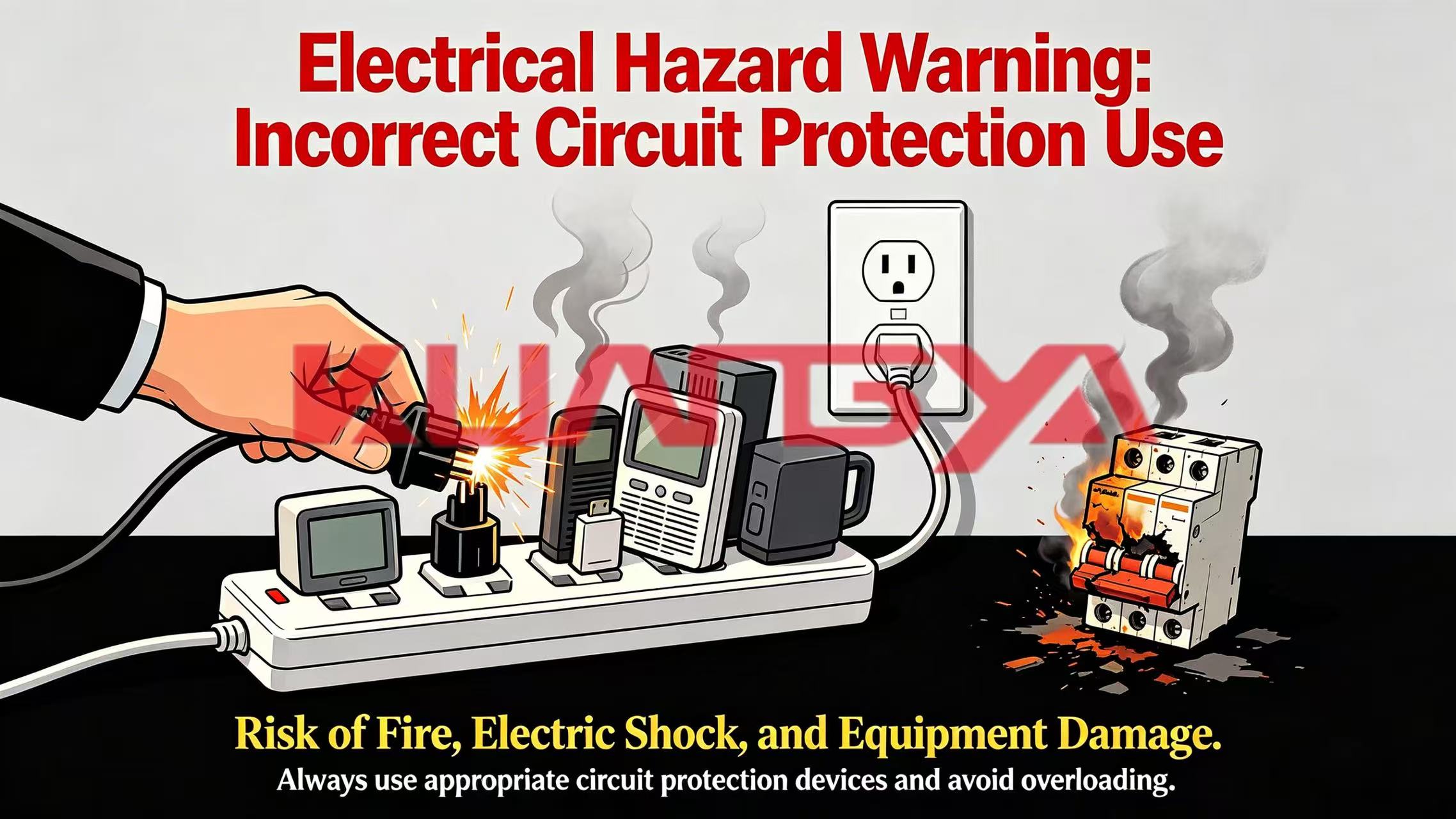
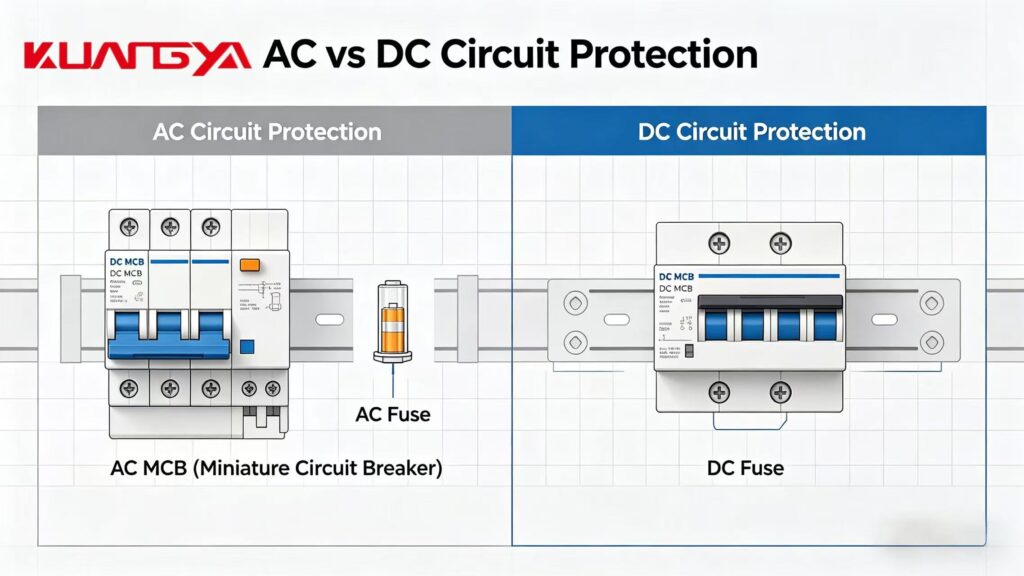
Antes de entrar en las principales diferencias entre la protección de circuitos de CA y CC, es esencial comprender los conceptos básicos: qué son la CA y la CC, cómo se comportan y por qué esas diferencias requieren dispositivos de protección distintos. Tanto la protección de circuitos de CA como la de CC están diseñadas para evitar tres tipos principales de fallos eléctricos: sobrecargas, cortocircuitos y fallos de arco. Pero su enfoque para detener estos fallos varía drásticamente porque la corriente alterna y la corriente continua fluyen de formas fundamentalmente diferentes. Comprender estas diferencias es clave para dominar la protección de circuitos de CA frente a CC para su hogar.
En primer lugar, aclaremos la diferencia entre corriente alterna (CA) y corriente continua (CC): esta es la base para entender por qué sus sistemas de protección son tan diferentes, y es una parte fundamental del conocimiento de la protección de circuitos de CA frente a CC.
La corriente alterna (CA) es la que sale de las tomas de corriente, los interruptores de la luz y la mayoría de los electrodomésticos. Su nombre se debe a que alterna su dirección: va y viene 50 veces por segundo (en Europa, Asia y la mayor parte del mundo) o 60 veces por segundo (en Norteamérica, Sudamérica y partes de Asia). Esta inversión constante crea puntos de “cruce por cero”, momentos en los que la corriente cae a cero antes de cambiar de dirección. Este cruce por cero es fundamental para el funcionamiento de la protección de los circuitos de CA, como explicaremos en breve. Para profundizar en los fundamentos de la corriente alterna, visite Guía de corriente alterna de Energy.gov.
La corriente continua fluye en una dirección constante, como la energía de una batería, un panel solar o un cargador USB. Es el tipo de corriente que se utiliza en la mayoría de aparatos electrónicos (teléfonos, portátiles, televisores) y es cada vez más común en sistemas domésticos como paneles solares, baterías de almacenamiento y cargadores de vehículos eléctricos. A diferencia de la CA, la CC nunca llega a un punto de cruce por cero: la corriente fluye constantemente en una dirección, lo que hace que los arcos eléctricos (un fallo común) sean mucho más difíciles de extinguir. Esta es una de las principales diferencias que hacen que la protección de circuitos de CA frente a CC sea tan importante.
Los dispositivos de protección de circuitos de CA -como los disyuntores estándar, las tomas GFCI (interruptor de circuito por fallo a tierra) y los disyuntores AFCI (interruptor de circuito por fallo de arco)- están diseñados para aprovechar el paso por cero natural de la CA. He aquí un desglose paso a paso de cómo funcionan, un componente clave para entender la protección de circuitos de CA frente a CC:
1. Detección: El dispositivo de protección (por ejemplo, un disyuntor) supervisa constantemente la corriente que circula por el circuito. Si detecta una sobrecarga (demasiada corriente) o un cortocircuito (corriente que fluye por una vía no prevista), activa una respuesta.
2. Interrupción: Cuando se detecta un fallo, el mecanismo interno del disyuntor (normalmente un electroimán o un elemento térmico) se dispara, abriendo el circuito para detener el flujo de corriente. Como la CA tiene puntos de cruce por cero, el disyuntor puede programar su disparo para que coincida con un cruce por cero, lo que reduce drásticamente la intensidad del arco eléctrico que se forma cuando se interrumpe el circuito.
3. Extinción de arcos: Incluso con cruce por cero, se forma un pequeño arco cuando se separan los contactos del interruptor. Los interruptores de CA utilizan sencillos conductos de arco (placas metálicas) para enfriar y extinguir este arco rápidamente, normalmente en una fracción de segundo. Esto es eficaz porque el arco se debilita de forma natural en cada paso por cero, lo que facilita su extinción.
Los dispositivos de protección de circuitos de CA más comunes que encontrará en su hogar incluyen: disyuntores termomagnéticos estándar para circuitos generales, tomas GFCI para baños, cocinas y zonas exteriores (que protegen contra fallos a tierra) y disyuntores AFCI para dormitorios y zonas de estar (que protegen contra fallos de arco de cableado dañado). Para saber cómo probar correctamente las tomas GFCI, consulte nuestro post interno Cómo comprobar los enchufes GFCI de su casa.
Los dispositivos de protección de circuitos de CC -como los disyuntores de CC, los interruptores de circuito de CC por fallo de arco (DC-AFCI) y los fusibles de CC- se enfrentan a un reto mayor: La corriente continua no tiene paso por cero, por lo que el arco eléctrico que se forma durante un fallo es mucho más caliente, persistente y difícil de extinguir. Para hacer frente a esta situación, los dispositivos de protección de CC se construyen con componentes especializados, una diferencia clave en la protección de circuitos de CA frente a CC:
1. Detección: Al igual que la protección de CA, los dispositivos de CC supervisan el flujo de corriente para detectar sobrecargas, cortocircuitos y fallos de arco. Sin embargo, los fallos de arco de CC son más difíciles de detectar porque no tienen las mismas fluctuaciones de tensión que los arcos de CA.
2. Interrupción: Los interruptores de CC utilizan un mecanismo más fuerte y robusto para disparar el circuito. A diferencia de los interruptores de CA, que se basan en el cruce por cero, los interruptores de CC deben forzar al arco a estirarse y enfriarse para extinguirlo. Esto suele implicar el uso de campos magnéticos para alejar el arco de los contactos y llevarlo a una serie de placas metálicas (conductos de arco) que disipan el calor.
3. Supresión de arcos: Los disyuntores de CC también pueden utilizar materiales especializados (como contactos de aleación de cobre o plata) que son más resistentes a los daños por arco. Algunos disyuntores de CC incluso utilizan cámaras llenas de gas para sofocar el arco, asegurando que no vuelva a encenderse después de interrumpir el circuito.
Los dispositivos de protección de circuitos de CC más comunes en los hogares son: Disyuntores de CC para sistemas de paneles solares y baterías domésticas, dispositivos DC-AFCI para cargadores de vehículos eléctricos y fusibles de CC de bajo voltaje para sistemas de iluminación LED. Para obtener más información sobre la protección de circuitos de CC para sistemas solares, consulte Directrices de seguridad de la Asociación de Industrias de la Energía Solar (SEIA).
Un punto clave que hay que recordar sobre la protección de circuitos de CA frente a CC: Los dispositivos de protección de CA y CC no son intercambiables. Si se utiliza un disyuntor de CA en un circuito de CC, no se extinguirá el arco, lo que provocará un sobrecalentamiento y un incendio. Utilizar un disyuntor de CC en un circuito de CA es exagerado (y más caro), pero no necesariamente peligroso, aunque sigue sin ser recomendable, ya que puede no dispararse correctamente en caso de fallos específicos de CA.
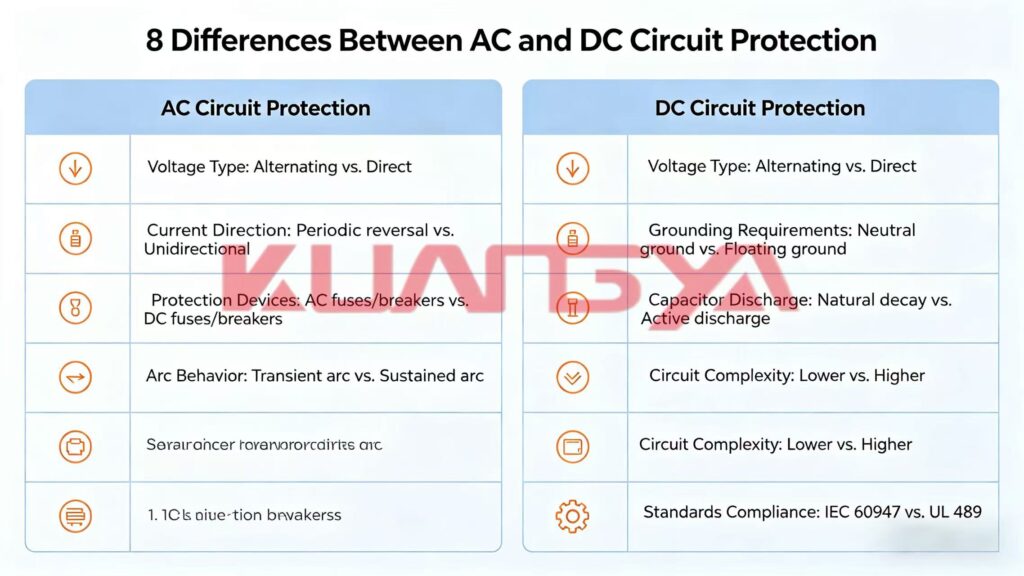
Ahora que ya sabemos cómo funcionan las protecciones de circuitos de CA y CC, vamos a desglosar las 8 diferencias clave que todo propietario debe conocer. Estas diferencias explican por qué no se pueden mezclar y combinar dispositivos de protección y por qué elegir la protección de circuitos de CA frente a CC adecuada es fundamental para la seguridad del hogar. La siguiente tabla resume estas diferencias con claridad, lo que facilita su consulta a la hora de evaluar el sistema eléctrico de su hogar.

| Característica | Protección de circuitos de CA | Protección de circuitos de CC |
| Comportamiento actual | Dirección alterna (50/60 Hz) con puntos de cruce por cero naturales en los que la corriente desciende a cero. Esto facilita la extinción del arco. | Flujos en una dirección constante sin cruce por cero. Los arcos son persistentes y más difíciles de extinguir. |
| Extinción de arcos | Se basa en el cruce por cero para debilitar los arcos. Utiliza conductos de arco simples para enfriar y extinguir los arcos rápidamente (normalmente <0,1 segundos). | Requiere supresión de arco especializada (campos magnéticos, cámaras de gas o conductos de arco avanzados) para estirar y enfriar los arcos persistentes. Tarda más en extinguirse (0,1-0,5 segundos). |
| Dispositivos comunes | Disyuntores termomagnéticos estándar, tomas GFCI, disyuntores AFCI, fusibles de enchufe y fusibles de cartucho. | Disyuntores de CC, dispositivos DC-AFCI, fusibles de CC, relés de protección específicos para energía solar e interruptores de desconexión de baterías. |
| Uso doméstico típico | Enchufes de pared, circuitos de iluminación, frigoríficos, microondas, lavadoras y la mayoría de electrodomésticos estándar. | Paneles solares, sistemas de almacenamiento de baterías domésticas, cargadores de vehículos eléctricos (cargadores rápidos de corriente continua), iluminación LED de bajo voltaje y concentradores domésticos inteligentes (algunos utilizan corriente continua). |
| Tensión nominal | Los circuitos residenciales de CA suelen ser de 120 V (monofásicos) o 240 V (bifásicos) en Norteamérica; de 230 V (monofásicos) en la mayor parte del mundo. | Los circuitos residenciales de CC van de 12 V (iluminación de bajo voltaje) a 48 V (baterías domésticas) y 600 V (paneles solares). La corriente continua de alto voltaje (HVDC) es poco frecuente en los hogares, pero se utiliza en grandes instalaciones solares. |
| Velocidad de viaje | Respuesta rápida (0,01-0,1 segundos) para fallos de CA, diseñada para aprovechar el cruce por cero para minimizar los daños por arco. | Respuesta más lenta pero más robusta (0,1-0,5 segundos) necesaria para manejar arcos persistentes. Algunos disyuntores de CC tienen velocidades de disparo ajustables para diferentes aplicaciones (por ejemplo, solar frente a baterías). |
| Coste | Más asequibles y ampliamente disponibles. Un disyuntor de CA estándar cuesta $5-$20; una toma GFCI cuesta $10-$30. | Más caros debido a los componentes especializados. Un disyuntor de corriente continua cuesta $20-$100; un dispositivo DC-AFCI cuesta $50-$150. La protección solar específica puede ser aún más costosa. |
| Compatibilidad | No puede utilizarse en circuitos de CC. No extinguirá los arcos, lo que provocará sobrecalentamiento, daños en los equipos y riesgo de incendio. | No puede utilizarse en circuitos de CA estándar. Está sobredimensionado para su uso en CA, puede que no se dispare correctamente en caso de fallos de CA y es una pérdida de dinero. |
Para poner estas diferencias en perspectiva, veamos un ejemplo real: Supongamos que tiene un sistema de paneles solares en casa y decide utilizar un disyuntor de CA estándar en el lado de CC del sistema (entre los paneles solares y el inversor). Cuando se produce un cortocircuito, el disyuntor de CA se dispara, pero el arco de CC sigue ardiendo porque no hay un cruce por cero que lo debilite. Este arco puede alcanzar temperaturas de más de 1.650 °C (3.000 °F), lo suficientemente caliente como para fundir el cableado de cobre, prender fuego al aislamiento e iniciar un incendio doméstico. Por el contrario, un disyuntor de CC extinguiría rápidamente el arco, deteniendo el fallo antes de que cause daños. Este ejemplo pone de manifiesto por qué es tan importante para la seguridad doméstica conocer la diferencia entre la protección de circuitos de CA y CC.
Comprender las diferencias entre la protección de circuitos de CA y CC es más valioso cuando se aplica a situaciones domésticas del mundo real. A continuación se presentan las tres situaciones más comunes en las que es fundamental elegir el dispositivo de protección adecuado, y en las que cometer un error puede tener graves consecuencias. Cada situación subraya por qué la protección de circuitos de CA frente a CC no puede pasarse por alto en los hogares modernos.
La mayor parte del sistema eléctrico de su hogar funciona con corriente alterna, por lo que aquí es donde encontrará la protección de circuitos de CA estándar. Vamos a desglosar lo que necesita para las diferentes áreas de su hogar, una parte clave de la aplicación de los conocimientos de protección de circuitos de CA frente a CC:
- Zonas comunes (dormitorios, salones, comedores): Estos circuitos utilizan disyuntores termomagnéticos de CA estándar (15 A o 20 A) para proteger contra sobrecargas y cortocircuitos. Además, el Código Eléctrico Nacional (NEC) exige disyuntores AFCI en estas zonas para proteger contra fallos de arco procedentes de cableado dañado (por ejemplo, un cable masticado o un cable deshilachado dentro de una pared). Para conocer los requisitos NEC más recientes sobre protección AFCI, visite Página de recursos NEC de la NFPA.
- Zonas húmedas (baños, cocinas, lavanderías, enchufes exteriores): Estas zonas requieren protección GFCI, que puede adoptar la forma de una toma GFCI o un disyuntor GFCI. Los dispositivos GFCI controlan la diferencia entre la corriente entrante y la saliente: si se produce una fuga de corriente, por pequeña que sea (por ejemplo, si se le cae un secador de pelo al agua), el GFCI se dispara en milisegundos, evitando así una descarga eléctrica. Más información sobre la seguridad de los GFCI en Guía GFCI de ESFI.
- Grandes electrodomésticos (frigoríficos, hornos, lavadoras): Estos aparatos consumen más corriente, por lo que suelen tener circuitos de CA específicos con disyuntores de mayor potencia (20A-30A). Por ejemplo, un horno eléctrico suele utilizar un circuito de 240 V CA con un disyuntor de 30 A. Nuestra guía interna Protección de circuitos para grandes electrodomésticos proporciona más detalles sobre el dimensionamiento de los disyuntores para estos dispositivos.
En todos estos casos, la protección de circuitos de CA es suficiente porque la corriente es alterna y los dispositivos están diseñados para manejar el paso por cero natural. La clave aquí es asegurarse de que los disyuntores están dimensionados para el amperaje correcto y que la protección GFCI/AFCI está instalada donde lo exige el código. Este es un aspecto fundamental de la protección de circuitos de CA frente a CC para uso doméstico estándar.
Los paneles solares y las baterías domésticas son las fuentes de alimentación de CC más comunes en los hogares, y requieren una protección de circuitos de CC especializada. Esto es lo que necesita saber, una aplicación crítica de la protección de circuitos de CA frente a CC para sistemas de energía renovable:
- Paneles solares: La energía producida por los paneles solares es CC, y el cableado entre los paneles (llamado “cadena”) es de alta tensión (a menudo 240 V-600 V CC). Este cableado necesita disyuntores o fusibles de CC para protegerlo contra cortocircuitos y sobrecargas. Además, muchos sistemas solares requieren dispositivos DC-AFCI para proteger contra fallos de arco en la cadena de paneles. Para obtener información detallada sobre la protección de circuitos de paneles solares, consulte Normas de seguridad para instalaciones solares de la SEIA.
- Baterías domésticas: Las baterías (por ejemplo, Tesla Powerwall, LG Chem RESU) almacenan energía de CC, por lo que el cableado entre la batería y el inversor necesita disyuntores de CC. También se necesita un interruptor de desconexión de la batería (que es un tipo de disyuntor de CC) para cortar de forma segura la alimentación de la batería para su mantenimiento o en caso de emergencia. Más información sobre la seguridad de las baterías domésticas enGuía de sistemas de baterías domésticas de Energy.gov.
- Inversores: El inversor convierte la corriente continua de los paneles solares/batería en corriente alterna para su hogar. Mientras que el lado de CA del inversor utiliza protección de CA estándar, el lado de CC requiere protección de CC. Es fundamental utilizar los disyuntores de CC recomendados por el fabricante del inversor, ya que el uso de un disyuntor incorrecto puede anular la garantía y crear un riesgo para la seguridad. Nuestro poste interno Cómo proteger su inversor solar con disyuntores de CC adecuados ofrece orientación paso a paso.
Un error común que cometen los propietarios de viviendas con sistemas solares es suponer que la protección integrada del inversor es suficiente. Aunque los inversores tienen cierta protección, el cableado de CC anterior al inversor (de los paneles al inversor) necesita su propia protección de CC específica. Por ejemplo, si el cableado de un panel solar se daña y provoca un cortocircuito, el disyuntor de CC se activará antes de que el fallo llegue al inversor, evitando daños a éste y reduciendo el riesgo de incendio. Este es un ejemplo clave de por qué la protección de circuitos de CA frente a CC no es negociable en los sistemas solares.
Los cargadores de vehículos eléctricos y la iluminación LED de bajo voltaje son otras dos fuentes habituales de corriente continua en los hogares modernos. Analicemos sus necesidades de protección, otra aplicación importante de la protección de circuitos de CA frente a CC:
- Cargadores de VE: La mayoría de los cargadores domésticos de vehículos eléctricos (cargadores de nivel 2) funcionan con corriente alterna y utilizan protección de circuito de corriente alterna estándar (240 V, disyuntores de 30 A-50 A). Sin embargo, los cargadores rápidos de CC (cargadores de nivel 3) utilizan alimentación de CC y requieren una protección de circuito de CC especializada. Además, algunos cargadores de vehículos eléctricos incorporan protección DC-AFCI para evitar fallos de arco en el cable de carga. Para más información sobre seguridad en la instalación de cargadores de vehículos eléctricos, visite Guía de seguridad para la recarga de vehículos eléctricos de EVgo.
Cuando instale un cargador para vehículos eléctricos, compruebe siempre las especificaciones del fabricante para ver si requiere protección de CA o CC. Si no está seguro, consulte a un electricista autorizado: instalar una protección incorrecta puede dañar el cargador o crear un riesgo de incendio. Nuestra guía interna Cómo elegir la protección de circuito adecuada para su cargador EV doméstico puede ayudarle a tomar la decisión correcta.
- Iluminación LED de bajo voltaje: Muchos sistemas modernos de iluminación LED utilizan corriente continua de bajo voltaje (12 V o 24 V). Estos sistemas suelen incluir un transformador que convierte la corriente alterna de la pared en corriente continua para los LED. El lado de CC del transformador necesita un fusible o disyuntor de CC de bajo voltaje para proteger contra sobrecargas (por ejemplo, si se conectan demasiados LED a un solo transformador).
Los circuitos de CC de bajo voltaje suelen considerarse “más seguros” que los circuitos de CA de alto voltaje, pero siguen suponiendo un riesgo si no se protegen adecuadamente. Un cortocircuito en un sistema de iluminación de CC de bajo voltaje puede hacer que el transformador se sobrecaliente y provocar un incendio. Por este motivo, incluso los sistemas de baja tensión requieren una protección adecuada de los circuitos de CC, un punto clave en la formación sobre protección de circuitos de CA frente a CC.
Existe mucha información errónea sobre la protección de circuitos de CA frente a CC, y estos mitos pueden llevar a los propietarios a cometer errores peligrosos. Vamos a desmentir los más comunes, asegurándonos de que tiene un conocimiento preciso sobre la protección de circuitos de CA frente a CC:
Este es el mito más peligroso sobre la protección de circuitos de CA frente a CC. Como ya hemos explicado, los interruptores de CA y CC están diseñados para manejar diferentes tipos de flujo de corriente. Los disyuntores de CA se basan en el cruce por cero para extinguir los arcos, mientras que los disyuntores de CC utilizan componentes especializados para manejar los arcos persistentes. El uso de un interruptor de CA en un circuito de CC no detendrá el arco, lo que provocará sobrecalentamiento, daños en el equipo e incendios. Utilizar un disyuntor de CC en un circuito de CA es innecesario y puede que no se dispare correctamente ante fallos específicos de CA.
Ejemplo: Un propietario sustituye un disyuntor de CC de su sistema solar por un disyuntor de CA más barato. Unos meses más tarde, se produce un cortocircuito en el cableado del panel solar. El disyuntor de CA se dispara, pero el arco de CC sigue ardiendo, inflamando el aislamiento alrededor del cableado y provocando un pequeño incendio. El incendio se apaga rápidamente, pero causa daños por valor de $5.000 en el sistema eléctrico de la casa. Este ejemplo subraya por qué no se pueden mezclar los dispositivos de protección de circuitos de CA con los de CC.
Aunque muchos circuitos de CC en los hogares son de baja tensión (12 V, 24 V, 48 V), esto no significa que sean más seguros que los de CA. De hecho, la corriente continua puede ser más peligrosa en algunos casos debido a sus arcos persistentes. Un arco de 48 V de CC puede alcanzar temperaturas lo suficientemente altas como para fundir el cableado de cobre e inflamar materiales inflamables, aunque el voltaje sea inferior al de la corriente alterna estándar (120 V/240 V). Esta es una distinción clave en la seguridad de la protección de circuitos de CA frente a CC.
Además, la corriente continua puede provocar una “descarga eléctrica” igual que la alterna. Aunque es más probable que la CA provoque contracciones musculares (lo que puede dificultar soltarse de un cable con corriente), la CC puede causar quemaduras y daños en los tejidos si se entra en contacto con cables con corriente. Lo más importante: Todos los circuitos eléctricos, tanto de CA como de CC, requieren una protección adecuada. Para más información sobre seguridad en caso de descarga eléctrica, visite Guía de prevención de descargas eléctricas de ESFI.
El inversor convierte la corriente continua de los paneles solares en corriente alterna para su hogar, pero no protege el lado de corriente continua del sistema. El cableado entre los paneles solares, el regulador de carga y el inversor sigue siendo de CC, y esta parte del sistema es vulnerable a cortocircuitos y fallos de arco. Sin protección de CC, un fallo en el cableado de CC puede dañar el inversor, provocar un incendio o incluso dañar los propios paneles solares. Se trata de un error común que ignora los fundamentos de la protección de circuitos de CA frente a CC para sistemas solares.
La mayoría de los instaladores solares incluirán protección de CC como parte de la instalación, pero es importante comprobarlo si compra un sistema usado o realiza una instalación por su cuenta. Compruebe siempre el manual del inversor para ver qué tipo de protección de CC se requiere. Nuestro puesto interno Lista de comprobación de la protección solar de CC puede ayudarte a verificar la protección de tu sistema.
Incluso los sistemas de CC pequeños, como un panel solar de 100 W para un cobertizo o un sistema de iluminación LED de bajo voltaje, requieren protección de circuito de CC. Un sistema de CC pequeño puede tener una tensión más baja, pero aún así puede sufrir cortocircuitos o sobrecargas. Por ejemplo, un cortocircuito en un sistema de iluminación LED de 12 V puede hacer que el transformador se sobrecaliente y se incendie si no hay un fusible de CC. Por este motivo, la protección de circuitos de CA frente a CC es importante para todos los sistemas de CC, independientemente de su tamaño.
Hemos cubierto mucho terreno, pero probablemente aún tenga preguntas. A continuación encontrará las preguntas más comunes que se hacen los propietarios de viviendas sobre la protección de circuitos de CA frente a CC, junto con respuestas claras y prácticas que le ayudarán a dominar la protección de circuitos de CA frente a CC para su hogar.
A: No, nunca debe utilizar un disyuntor de CA en un circuito de CC, ni siquiera en caso de apuro. Los disyuntores de CA no están diseñados para extinguir los arcos de CC, que seguirán ardiendo después de que se dispare el disyuntor. Esto supone un grave riesgo de incendio. Si no dispone de un disyuntor de CC, desconecte la alimentación del circuito y espere hasta que pueda conseguir el dispositivo de CC adecuado. No merece la pena arriesgar la seguridad de su hogar y su familia por una solución temporal. Esta es una regla innegociable de la protección de circuitos de CA frente a CC.
A: Si tiene alguna de las siguientes situaciones, es probable que tenga circuitos de CC en su hogar que necesitan protección de circuitos de CC, una parte clave de la concienciación sobre la protección de circuitos de CA frente a CC:
- Paneles solares en el tejado o en el suelo
- Sistemas domésticos de almacenamiento en baterías (por ejemplo, Tesla Powerwall, LG Chem RESU)
- Cargadores rápidos de CC para vehículos eléctricos
- Sistemas de iluminación LED de bajo voltaje (12 V o 24 V)
- Algunos dispositivos domésticos inteligentes (por ejemplo, determinadas cámaras de seguridad o termostatos inteligentes) que utilizan corriente continua.
Para confirmarlo, consulte el manual de instalación del dispositivo o sistema. Si dice “alimentación de CC” o “entrada/salida de CC”, es probable que necesite protección de circuito de CC. También puede consultar a un electricista autorizado para que inspeccione el sistema eléctrico de su casa e identifique cualquier circuito de CC. Si necesita ayuda para encontrar un electricista cualificado, visite Asociación Nacional de Inspectores Eléctricos Certificados (NACEI).
A: Sí, la protección de circuitos de CC es casi siempre más cara que la de CA. La razón principal es que los disyuntores y dispositivos de protección de CC requieren componentes especializados para manejar los arcos persistentes. Por ejemplo, los disyuntores de CC necesitan campos magnéticos más fuertes, conductos de arco más robustos y contactos de mayor calidad (como los de aleación de plata) para soportar el calor de los arcos de CC. Estos componentes aumentan el coste. Esta diferencia de coste es una consideración clave en la planificación de la protección de circuitos de CA frente a los de CC.
Aunque la protección de CC es más cara, es una inversión necesaria, especialmente para sistemas de gran valor como paneles solares o baterías domésticas. El coste de la protección de CC es mucho menor que el de reparar los daños causados por un incendio o sustituir un sistema solar dañado. Nuestra guía interna Comprender los costes de la protección de circuitos de CC desglosa los precios con más detalle.
A: La mayoría de los electricistas con licencia están capacitados para instalar protección básica de circuitos de CC para sistemas domésticos comunes como paneles solares, baterías domésticas y cargadores de vehículos eléctricos. Sin embargo, para sistemas de CC complejos, como instalaciones solares aisladas de la red, grandes bancos de baterías o matrices solares comerciales, es mejor trabajar con un electricista especializado en energías renovables o sistemas eléctricos de CC. Este es un punto importante para garantizar una correcta instalación de protección de circuitos de CA frente a CC.
Cuando contrate a un electricista, pregúntele si tiene experiencia con la protección de circuitos de CC y las instalaciones solares y de baterías. Un electricista cualificado sabrá seleccionar los dispositivos de protección de CC adecuados, instalarlos correctamente y asegurarse de que cumplen los códigos eléctricos locales. Para obtener consejos sobre la contratación de un electricista, visite Guía ESFI para la contratación de un electricista autorizado.
A: Se recomienda inspeccionar los dispositivos de protección de circuitos de su hogar al menos una vez al año. Esto es lo que hay que comprobar, una parte clave para mantener una protección eficaz de los circuitos de CA frente a CC:
- Protección CA: Pruebe los enchufes GFCI pulsando el botón de “prueba”; deberían dispararse y cortar la corriente. Compruebe si los disyuntores presentan signos de sobrecalentamiento (por ejemplo, decoloración, olor a quemado) o daños. Si un disyuntor se dispara con frecuencia, puede ser señal de sobrecarga o avería.
- Protección CC: Inspeccione los disyuntores y fusibles de CC en busca de signos de daños o sobrecalentamiento. Pruebe los dispositivos DC-AFCI (si los tiene) según las instrucciones del fabricante. En los sistemas solares, compruebe si el cableado entre los paneles y el inversor está dañado (por ejemplo, cables deshilachados, conexiones sueltas).
Además, si experimenta un apagón, un disyuntor disparado o un problema eléctrico, inspeccione inmediatamente los dispositivos de protección correspondientes. Nuestro puesto interno Lista de comprobación anual de protección de circuitos de CA frente a CC ofrece una guía detallada paso a paso.
A: Mezclar la protección de circuitos de CA y CC puede tener graves consecuencias, por eso es tan importante entender la protección de circuitos de CA frente a la de CC:
- Utilizar un disyuntor de CA en un circuito de CC: El disyuntor no extinguirá el arco, lo que provocará un sobrecalentamiento, daños en el equipo e incendios.
- Utilizar un disyuntor de CC en un circuito de CA: El disyuntor de CC está sobredimensionado para su uso en CA, por lo que puede no dispararse correctamente ante fallos de CA (por ejemplo, sobrecargas o fallos de arco). Esto puede provocar daños en el equipo o un incendio. Además, los disyuntores de CC son más caros, por lo que es una pérdida de dinero.
Para asegurarse de que está utilizando la protección de circuitos de CA frente a CC adecuada para su hogar, utilice esta práctica lista de comprobación. Repase cada uno de los puntos y compruebe que el sistema eléctrico de su hogar está correctamente protegido: esta lista de comprobación está diseñada para ayudarle a aplicar sus conocimientos sobre protección de circuitos de CA frente a CC:
1. Circuitos de CA estándar: Todos los enchufes de pared, circuitos de iluminación y electrodomésticos estándar utilizan disyuntores de CA. La protección GFCI está instalada en baños, cocinas, lavanderías y tomas exteriores. La protección AFCI está instalada en dormitorios, salones y comedores.
2. Sistemas de paneles solares: El lado de CC del sistema (entre los paneles, el regulador de carga y el inversor) tiene disyuntores o fusibles de CC. La protección DC-AFCI se instala si así lo requiere el fabricante o el código local.
3. Baterías domésticas: El cableado entre la batería y el inversor dispone de disyuntores de CC. Se ha instalado un interruptor de desconexión de la batería para el apagado de emergencia.
4. Cargadores de VE: Los cargadores de nivel 2 utilizan disyuntores de CA (30 A-50 A). Los cargadores rápidos de CC utilizan la protección de CC recomendada por el fabricante.
5. Iluminación LED de bajo voltaje: El lado de CC del transformador tiene un fusible o disyuntor de CC de bajo voltaje. El transformador está dimensionado para el número de LED conectados a él.
6. Inspección: Todos los dispositivos de protección (disyuntores, fusibles, GFCI/AFCI) están libres de daños, sobrecalentamiento o corrosión. Se comprueban con regularidad (al menos una vez al año).
7. Verificación profesional: Un electricista autorizado ha inspeccionado el sistema eléctrico de tu casa (especialmente los circuitos de CC) en los últimos 2-3 años, o después de cualquier instalación importante (por ejemplo, solar, cargador de VE).
Si encuentra algún problema durante esta lista de comprobación (por ejemplo, un disyuntor de CA en un circuito de CC, falta de protección GFCI o disyuntores dañados), resuélvalo inmediatamente. Póngase en contacto con un electricista autorizado para que realice las reparaciones o mejoras necesarias. Para más información, consulte Recursos de seguridad eléctrica doméstica de la NFPA.
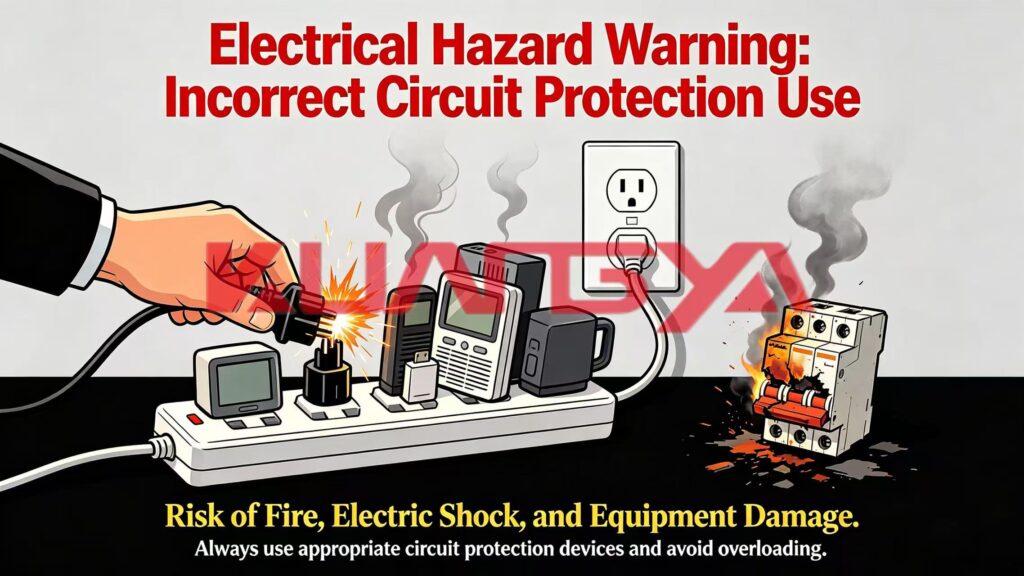
La protección de circuitos de CA frente a CC no es un tema que deba pasarse por alto, no cuando se trata de la seguridad de su hogar y su familia. A medida que aumenta el número de dispositivos y sistemas alimentados por CC que forman parte de la vida cotidiana en el hogar, comprender las diferencias entre la protección de CA y CC ya no es sólo cosa de electricistas, sino que es algo que todo propietario debe saber. Dominar la protección de circuitos de CA frente a CC le garantiza que podrá tomar decisiones seguras e informadas sobre el sistema eléctrico de su hogar.
Las principales conclusiones son sencillas: Los dispositivos de protección de circuitos de CA y CC no son intercambiables. La protección de CA se basa en el cruce por cero para extinguir los arcos, mientras que la protección de CC utiliza componentes especializados para manejar los arcos persistentes. Utilizar el dispositivo equivocado puede provocar incendios eléctricos, daños en los equipos y costosas reparaciones. Este es el principio básico de la protección de circuitos CA frente a CC.
Si conoce las 8 diferencias fundamentales entre la protección de circuitos de CA y de CC, entiende qué protección necesita para las distintas situaciones domésticas, desacredita los mitos más comunes y sigue nuestra lista de comprobación final, podrá asegurarse de que el sistema eléctrico de su hogar esté seguro y correctamente protegido. Recuerde que la protección de circuitos de CA frente a CC no es una solución universal: cada tipo de corriente requiere su propia protección especializada.
Recuerde: En caso de duda, consulte a un electricista autorizado. Ellos tienen los conocimientos y la experiencia para ayudarle a seleccionar los dispositivos de protección adecuados, instalarlos correctamente y mantener su hogar seguro. Invertir hoy en la protección adecuada de los circuitos de CA frente a CC le evitará problemas costosos y peligrosos el día de mañana. Para obtener consejos sobre seguridad eléctrica, suscríbase a nuestro blog o visite Portal de seguridad en el hogar de ESFI.

