WengYang Industriegebiet Yueqing Wenzhou 325000
Arbeitszeiten
Montag bis Freitag: 7AM - 7PM
Am Wochenende: 10AM - 5PM
WengYang Industriegebiet Yueqing Wenzhou 325000
Arbeitszeiten
Montag bis Freitag: 7AM - 7PM
Am Wochenende: 10AM - 5PM

Wo sollten Überspannungsschutzgeräte in einem System mit Generator und automatischer Netzumschaltung (ATS) installiert werden? Überprüfen Sie die Platzierung am Netzanschluss, am Generator, auf der Lastseite des ATS sowie in den Steuerstromkreisen und ermitteln Sie die für eine sichere Auswahl erforderlichen elektrischen Daten.
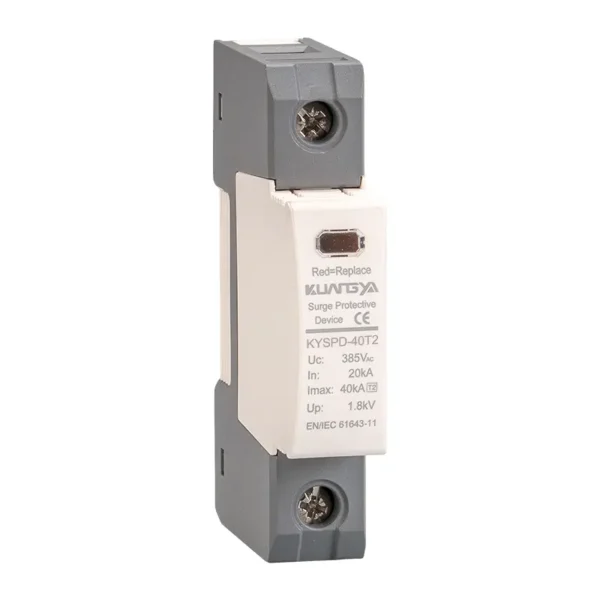
Kurze Antwort: An automatic transfer switch (ATS) does not make one upstream surge protective device (SPD) sufficient for both utility and generator operation. Review the utility entrance, generator-side distribution, ATS load side and vulnerable control or communication circuits as separate exposure points. The final locations and device ratings depend on the system grounding, voltage, fault level, local rules and equipment instructions.
Draw both operating states: utility feeding the load and generator feeding the load. Mark the service equipment, generator output, ATS, downstream distribution boards, sensitive loads, grounding/bonding points and control cables. A surge entering by one source can reach equipment through a different path than a surge entering by the other. Schneider Electric’s ATS application guidance illustrates SPDs on the load sides of the service entrance, generator and transfer switch. It also discusses protection for exposed data and control circuits.
This is a design example, not a universal wiring diagram. The Kuangya AC SPD range includes different types and pole arrangements, but no model should be specified without its exact datasheet and the site single-line diagram.
| Location to review | Zweck | Designfrage |
|---|---|---|
| Utility/service entrance | Limit surges entering from the supply side | What lightning exposure and upstream protection already exist? |
| Generator-side distribution | Address exposure associated with the generator supply path | How is the generator neutral bonded and switched? |
| ATS load side | Protect loads regardless of the selected source | Is the SPD connected at a suitable point with short, direct leads? |
| Control and data circuits | Protect ATS/generator controls and remote signals | Which signal protocol, voltage and cable route apply? |
Where a long outdoor control cable connects equipment at both ends, assess protection at each end using devices designed for that signal interface. An AC power SPD is not a substitute for a correctly specified signal-line SPD.
SPD type follows the installation point and expected surge duty under the applicable standard and local rules, not simply the fact that a panel contains an ATS. A service entrance with direct lightning-current exposure may call for a different device than a downstream distribution board. Compare the project requirements with the exact product classification, continuous operating voltage (Uc or MCOV), voltage protection level, nominal discharge rating, fault-current suitability and required backup protection. Review conductor arrangement and earthing system before choosing pole count or protection modes. Our 3+1 vs. 4+0 SPD-Leitfaden explains why wiring topology matters.
Do not copy a 480Y/277 V example rating into a 230/400 V or ungrounded installation. For example, the KYSPD-40T2-1P product page describes a Type 2 AC device; its published parameters are a starting point for a model-specific review, not approval for every ATS location.
Schneider Electric’s white paper on SPDs in automatic transfer switches and its ATS application FAQ provide the third-party placement example above. These documents are engineering guidance, not a claim that a specific Kuangya SPD has been tested in a named customer installation. Schneider’s generator SPD FAQ also distinguishes recommendations from requirements that depend on the jurisdiction and emergency-system classification. We do not have a verified Kuangya customer case for this exact arrangement and therefore do not present a fabricated one.
A qualified designer should also check coordination with other protection in the distribution system. For broader context see layered protection for critical power systems und die SPD document checklist.
Do not assume so. The generator supply path may bypass that point. Trace both source paths and review load-side protection.
Not unless its exact documentation specifies an integrated SPD and its ratings. Transfer switching and transient limitation are separate functions.
No universal answer applies. Check the jurisdiction, emergency-system classification and project specification. The cited Schneider guidance distinguishes common placements from code-triggered requirements.
Provide the single-line diagram, supply and generator voltages, earthing arrangement, neutral switching, fault level, proposed SPD locations, installation environment and any signal-line interfaces. Request model-specific datasheets and wiring instructions before approval.
Author: xuwenru. This article is based on cited public technical guidance and is not a site-specific engineering approval or an account of an unverified customer installation.

