WengYang Industriegebiet Yueqing Wenzhou 325000
Arbeitszeiten
Montag bis Freitag: 7AM - 7PM
Am Wochenende: 10AM - 5PM
WengYang Industriegebiet Yueqing Wenzhou 325000
Arbeitszeiten
Montag bis Freitag: 7AM - 7PM
Am Wochenende: 10AM - 5PM


As homeowners worldwide embrace solar energy systems to reduce electricity costs and achieve energy independence, understanding the critical components that ensure safe and efficient operation becomes increasingly important. The PV-Kombinationskasten stands as one of the most essential yet often overlooked elements in residential solar panel installations. This comprehensive guide explores everything you need to know about solar combiner boxes for home use, featuring real-world installation examples from Lebanon and Tunisia, complete technical specifications, and expert insights into optimizing your solar power system.
A residential PV combiner box, auch bekannt als solar array combiner box oder DC-Kombinatorkasten, serves as the central junction point where multiple solar panel strings converge before connecting to your inverter. Think of it as the electrical traffic director for your rooftop solar installation—it consolidates the direct current (DC) outputs from several solar panel strings into fewer, higher-capacity circuits, dramatically simplifying system wiring while enhancing overall safety and performance.
For homeowners installing residential solar panels, the combiner box becomes particularly valuable when your system includes three or more solar strings. While smaller installations with one or two strings can connect directly to the inverter, larger residential arrays benefit significantly from the organizational efficiency, protection features, and maintenance convenience that a quality combiner box provides. The device not only reduces the complexity of wiring running from your roof to your inverter but also creates a centralized point for monitoring, troubleshooting, and future system upgrades.
Modern solar combiner boxes for homes integrate multiple protective components including fuses, circuit breakers, surge protection devices, and disconnect switches—all housed within a weather-resistant enclosure designed to withstand decades of outdoor exposure. This consolidation of safety features makes the combiner box an indispensable component for any serious residential solar installation, particularly in regions with challenging weather conditions or unreliable grid power. Zitat Zitat
Understanding the internal architecture of your solar combiner box empowers you to make informed decisions during installation and maintenance. Each component plays a specific role in ensuring your home solar system operates safely and efficiently. Here’s a detailed breakdown of the critical electrical elements you’ll find inside a quality residential PV combiner box:
The first line of defense in your combiner box consists of DC-rated circuit breakers or string fuses, with each individual solar string connecting to its own dedicated protective device. These components typically range from 10A to 20A depending on your panel specifications and string configuration. DC circuit breakers offer significant advantages over traditional fuses for residential applications—they can be manually reset after tripping, provide visible indication of fault conditions, and eliminate the ongoing cost of fuse replacements. High-quality DC molded case circuit breakers (MCCB) are specifically engineered to safely interrupt DC current, which behaves differently than AC current and requires specialized breaking mechanisms to prevent dangerous arcing.
Busbars and terminal strips provide the physical connection points where individual string wires combine into common positive and negative conductors. Copper busbars offer superior conductivity and current-carrying capacity, making them the preferred choice for residential installations where reliability matters. These solid copper bars must be appropriately sized to handle the combined current from all connected strings without overheating or creating voltage drops that would reduce system efficiency. Terminal strips, constructed from ABS composite materials with metal contact points, serve similar functions in smaller residential systems and provide convenient connection points for wire management.
Lightning strikes and grid fluctuations pose serious threats to expensive solar equipment. Überspannungsschutzgeräte, also called surge arresters or lightning arresters, safeguard your investment by diverting dangerous voltage spikes safely to ground before they can damage your inverter, charge controller, or other sensitive electronics. Residential combiner boxes typically incorporate Type 2 SPDs rated for 20kA to 40kA surge current capacity, providing robust protection against both direct lightning strikes and induced surges from nearby electrical events. This component alone can save homeowners thousands of dollars in potential equipment replacement costs.
Safety regulations in most jurisdictions require a DC disconnect switch that allows technicians to completely isolate the combiner box from the rest of your solar system during maintenance or emergency situations. This manually operated switch must handle the full system voltage and current while providing a visible break in the circuit that ensures worker safety. The disconnect function becomes particularly important during roof repairs, system upgrades, or troubleshooting activities when you need to guarantee that no dangerous DC voltage remains present in the wiring.
Advanced residential combiner boxes increasingly incorporate monitoring capabilities that track individual string performance, detect potential issues before they become serious problems, and provide real-time data on your system’s energy production. Current sensors, voltage monitors, and communication modules can alert homeowners to underperforming strings caused by shading, soiling, or equipment failure, enabling proactive maintenance that maximizes your solar investment’s return.
The enclosure housing protects all internal components from environmental factors including rain, dust, UV radiation, and temperature extremes. Quality residential combiner boxes feature IP65 or IP66 rated enclosures constructed from corrosion-resistant materials such as powder-coated steel, stainless steel, or UV-stabilized polycarbonate plastic. Proper enclosure selection based on your local climate conditions ensures decades of reliable operation without degradation from environmental exposure. Zitat
Lebanon’s severe electricity crisis has transformed the country into an unexpected laboratory for residential solar innovation. With the state utility Électricité du Liban providing power for only a few hours daily—and sometimes experiencing complete blackouts—Lebanese homeowners have invested heavily in off-grid solar systems und hybrid solar installations that combine grid connection with substantial battery backup.
The Kanaan family residence in Beirut faced typical Lebanese energy challenges: daily power outages exceeding 20 hours, generator fuel costs approaching $500 monthly, and complete unpredictability in electricity availability. The family needed a comprehensive solution that could power essential appliances including refrigeration, lighting, water pumping, and home office equipment throughout the day and night, regardless of grid status.
Working with a certified solar installer, the family implemented a 6.5 kW residential solar system featuring 20 high-efficiency 325W monocrystalline panels arranged in four strings of five panels each. The installation incorporated a quality 4-string PV combiner box that consolidated the four separate DC outputs before connecting to a 6kW hybrid inverter and 15 kWh lithium battery bank.
The combiner box specification included:
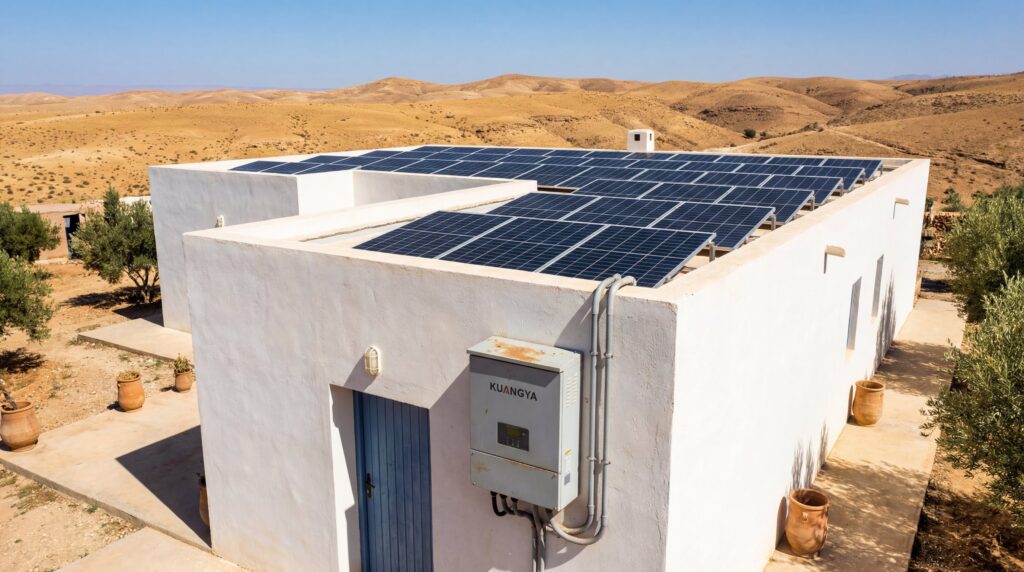
The solar panels were mounted on the flat concrete roof using ballasted racking systems that avoid roof penetrations—a common approach in Lebanese construction. The combiner box was strategically positioned on an exterior wall near the roof access point, minimizing the length of exposed DC wiring while maintaining easy accessibility for future maintenance. All wiring used UV-resistant solar cable rated for outdoor exposure, with proper conduit protection where cables transitioned from roof to combiner box.
Since installation in early 2023, the system has delivered remarkable results for the Kanaan family. During sunny conditions, the solar array generates sufficient power to run all household loads while simultaneously charging the battery bank to full capacity by early afternoon. The family now experiences zero power interruptions during daylight hours and maintains essential services throughout the night using stored battery power. Monthly electricity costs have dropped from $500 for generator fuel to approximately $50 for occasional grid power usage during extended cloudy periods.
The combiner box has proven its value during Lebanon’s intense summer heat and occasional winter storms. The surge protection device successfully diverted several lightning-induced voltage spikes during thunderstorms, while the circuit breakers provided convenient isolation of individual strings during a minor wiring issue that was quickly identified and resolved. The centralized design allowed the installer to complete troubleshooting in under 30 minutes—a task that would have required hours without the organized connection point the combiner box provides.
This installation represents one of approximately 1.5 gigawatts of residential solar capacity added in Lebanon between 2020 and 2024, demonstrating how quality components like properly specified combiner boxes enable reliable energy independence even in challenging circumstances.
Tunisia’s abundant sunshine—exceeding 3,000 hours annually with solar irradiation reaching 2,600 kWh/m² in southern regions—creates ideal conditions for residential photovoltaic installations. The country’s PROSOL ELEC program has supported thousands of homeowners in adopting grid-tied solar systems that reduce electricity bills while maintaining grid connection for reliability.
The Gharbi family home in Sfax, Tunisia’s second-largest city, presented a perfect opportunity for solar adoption. The two-story Mediterranean-style villa featured an unshaded south-facing roof with excellent solar exposure, while the family’s electricity consumption averaged 450 kWh monthly, primarily driven by air conditioning during hot summer months, water heating, and standard household appliances.
The installer designed a 5.2 kW grid-tied solar system optimized for the family’s consumption patterns and roof configuration. The installation utilized 16 high-efficiency 325W panels arranged in two strings of eight panels each, connected through a 2-string residential combiner box before feeding into a 5kW grid-tie inverter.
The combiner box featured:
The installation team mounted the panels using aluminum racking systems anchored to the concrete tile roof structure, maintaining proper tilt angle of 35 degrees to optimize year-round energy production. The combiner box was installed on the exterior wall immediately below the roof edge, providing weather protection under the roof overhang while maintaining accessibility. Special attention was paid to cable management and sealing, as Sfax’s proximity to the Mediterranean coast requires enhanced corrosion protection for all electrical components.
The system was connected to the grid through a bidirectional meter that tracks both consumption and any excess generation fed back to the utility. Under Tunisia’s net metering regulations, the family receives credit for surplus electricity production during peak solar hours, which offsets consumption during evening and nighttime periods.
The Sfax installation has exceeded performance expectations since commissioning in 2024. The system generates approximately 8,500 kWh annually, covering nearly 100% of the family’s electricity needs on an annual basis. During summer months, the array produces significant excess energy that earns grid credits, while winter production closely matches reduced consumption patterns.
Monthly electricity bills have dropped from approximately 120 Tunisian dinars ($40 USD) to less than 20 dinars ($7 USD), representing annual savings of over 1,200 dinars ($400 USD). At the installed cost of approximately $4,500 (supported by PROSOL ELEC subsidized financing), the system will achieve payback in approximately 11 years, with an expected operational lifetime exceeding 25 years.
The combiner box has performed flawlessly throughout the first year of operation, requiring no maintenance beyond a single visual inspection. The fiberglass enclosure has shown no signs of degradation despite exposure to salt air, intense UV radiation, and temperature variations from 5°C in winter to over 45°C during summer heat waves. The surge protection device successfully handled several grid voltage fluctuations common in the area, protecting the expensive inverter from potential damage.
This installation exemplifies Tunisia’s growing residential solar sector, which aims to add 2,000 MW of small to medium-scale solar capacity by 2030 as part of the national renewable energy strategy.
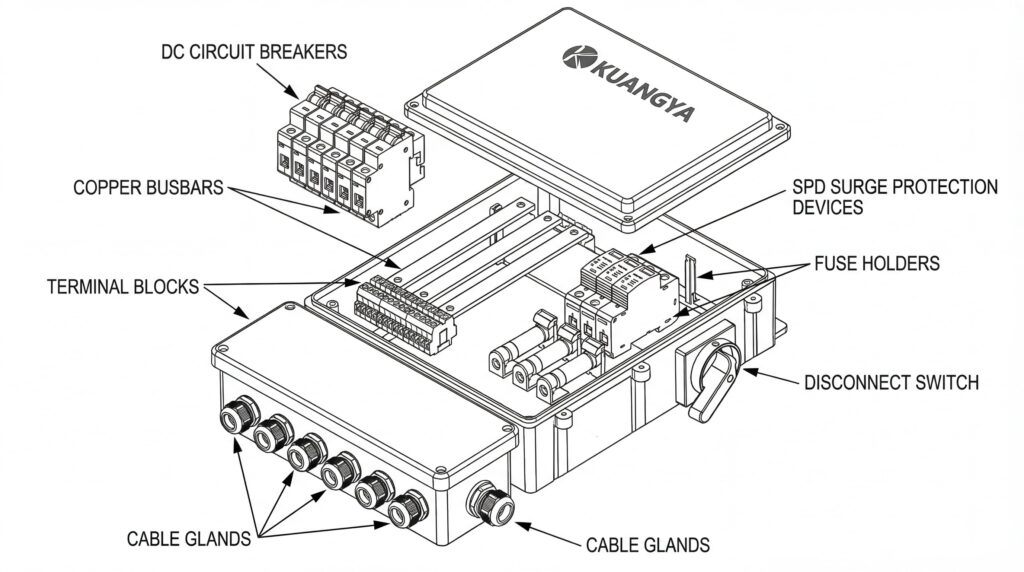
For homeowners, installers, and solar professionals planning residential installations, here’s a comprehensive component list for a typical residential solar combiner box:
| Komponente | Funktion | Typische Bewertung | Quantity |
|---|---|---|---|
| DC-Stromkreisunterbrecher | Overcurrent protection for individual strings | 10-20A, 600-1000V DC | 2-6 (one per string) |
| Copper Busbars | Main current consolidation conductors | 50-100A continuous rating | 2 (positive & negative) |
| Klemmenblöcke | Anschlusspunkte für Kabel | 20-30A per terminal | 4-12 positions |
| Überspannungsschutzgerät (SPD) | Lightning and voltage spike protection | 20-40kA, Type 2 | 1-2 units |
| DC Disconnect Switch | Manual isolation for safety | System voltage and current rating | 1 unit |
| Fuse Holders | Alternative to circuit breakers | 10-20A, 600-1000V DC | 2-6 (if using fuses) |
| String-Sicherungen | Overcurrent protection (alternative to breakers) | 10-20A, gPV rated | 2-6 (one per string) |
| Kabelverschraubungen | Weather-sealed cable entry points | PG13.5 to PG21 size | 4-8 units |
| Ground Bus Bar | Erdungsanschluss der Ausrüstung | 50A minimum | 1 unit |
| Monitoring Sensors | Current and voltage measurement (optional) | System-dependent | 2-4 units |
| Status Indicators | Visual fault indication (optional) | LED type | 2-6 units |
| Gehege | Weather protection housing | IP65/IP66 rated | 1 unit |
| Mounting Bracket | Wall or pole mounting hardware | Load-rated for enclosure weight | 1 set |
| Warning Labels | Safety and identification markings | UV-resistant material | Multiple |
This component list represents a standard residential configuration. Specific requirements vary based on system size, local electrical codes, and environmental conditions. Always consult with certified solar installers and ensure compliance with National Electrical Code (NEC) Article 690 or equivalent local regulations.
Investing in a quality PV-Kombinationskasten for your residential solar installation delivers multiple advantages that justify the additional upfront cost:
Simplified Wiring and Reduced Installation Costs: By consolidating multiple string outputs into a single connection point, combiner boxes dramatically reduce the amount of large-gauge cable required to run from your roof to your inverter. This simplification translates to lower material costs, faster installation time, and cleaner wire management that improves system aesthetics.
Enhanced Safety and Code Compliance: The integrated disconnect switch, circuit breakers, and surge protection create multiple layers of safety that protect both your equipment and installation personnel. Most jurisdictions require these protective features, and a properly specified combiner box ensures full code compliance while simplifying inspection and approval processes.
Easier Troubleshooting and Maintenance: When system performance issues arise, the combiner box provides a centralized testing point where technicians can quickly isolate problems to specific strings. This diagnostic capability can reduce troubleshooting time from hours to minutes, minimizing system downtime and service costs.
Future Expansion Capability: Quality combiner boxes often include spare circuit positions that accommodate additional solar strings if you decide to expand your array in the future. This forward-thinking design protects your initial investment while providing flexibility for system growth.
Equipment Protection and Longevity: The surge protection and overcurrent devices safeguard expensive inverters, charge controllers, and batteries from damage caused by lightning strikes, grid faults, or equipment malfunctions. This protection can prevent thousands of dollars in replacement costs over your system’s lifetime.
Improved System Monitoring: Modern combiner boxes with integrated monitoring capabilities provide valuable performance data that helps you optimize energy production, identify maintenance needs proactively, and verify that your solar investment delivers expected returns.
Choosing an appropriate Solarkombinationskasten requires careful consideration of several technical factors:
String Count and Current Rating: Determine how many solar strings your system includes and calculate the maximum current each string will produce. Select a combiner box with sufficient circuit breaker positions and busbar current capacity to handle your configuration with appropriate safety margin.
Nennspannung: Ensure the combiner box components are rated for your system’s maximum open-circuit voltage, typically 600V DC for residential installations but potentially 1000V DC for larger systems using high-voltage panels.
Schutz der Umwelt: Match the enclosure’s IP rating to your local climate conditions. Coastal installations require enhanced corrosion resistance, while desert environments demand superior UV protection and dust sealing.
Certification and Standards Compliance: Verify that the combiner box meets relevant safety standards such as UL 1741, IEC 61439, or equivalent certifications for your region. Certified products ensure reliable performance and facilitate inspection approval.
Quality and Warranty: Invest in combiner boxes from reputable manufacturers offering comprehensive warranties. The modest price difference between economy and premium products becomes insignificant compared to the cost of premature failure or safety issues.
For solar professionals and homeowners researching residential solar solutions, understanding trending search terms helps access the most relevant information:
These keywords reflect homeowner priorities around cost, quality, local availability, and system performance—all factors that influence combiner box selection and overall solar installation success.
While small systems with one or two solar strings can connect directly to the inverter without a combiner box, installations with three or more strings benefit significantly from this component. The combiner box provides essential safety features, simplifies wiring, enables easier troubleshooting, and ensures code compliance. Even for smaller systems, many homeowners choose to install combiner boxes for the organizational benefits and future expansion capability they provide. The relatively modest cost—typically $200-$600 for residential units—represents excellent value considering the protection, convenience, and professional appearance a quality combiner box delivers. If your installation includes battery backup, operates in areas with frequent lightning activity, or you plan potential future expansion, a combiner box becomes particularly valuable regardless of current system size.
One of the significant advantages of modern solar combiner boxes is their minimal maintenance requirements. Most residential installations need only an annual visual inspection to verify that all components remain secure, enclosure seals are intact, and no signs of corrosion, overheating, or physical damage are present. During this inspection, check that circuit breakers operate smoothly, connections remain tight, and monitoring indicators (if equipped) function correctly. The surge protection device (SPD) may require replacement after absorbing significant lightning strikes or voltage surges, though quality units typically provide visual indicators showing when replacement becomes necessary. In harsh coastal or industrial environments, more frequent inspections every six months help identify any accelerated corrosion or environmental degradation. Beyond these simple visual checks, combiner boxes require no routine maintenance, making them one of the most reliable components in your solar system. Professional solar technicians can perform comprehensive testing during periodic system performance evaluations, typically recommended every 3-5 years.
Die residential PV combiner box represents a critical yet often underappreciated component in home solar installations. As demonstrated by the successful implementations in Lebanon and Tunisia, quality combiner boxes enable reliable, safe, and efficient solar energy systems that deliver energy independence and substantial cost savings for homeowners worldwide.
Understanding the electrical components inside your combiner box—from DC circuit breakers and copper busbars to surge protection devices and disconnect switches—empowers you to make informed decisions during system design, installation, and maintenance. Whether you’re planning an off-grid solar system to achieve complete energy independence or a grid-tied installation to reduce electricity bills while maintaining utility connection, proper combiner box selection and installation ensures optimal performance and long-term reliability.
As global solar adoption accelerates and more homeowners embrace renewable energy, the importance of quality components and professional installation becomes increasingly clear. The modest investment in a properly specified combiner box pays dividends through enhanced safety, simplified maintenance, equipment protection, and peace of mind knowing your solar system incorporates best practices and code-compliant design.
For homeowners in regions facing electricity challenges similar to Lebanon or seeking to maximize solar potential like Tunisia, the combiner box stands as an essential element enabling the transition to clean, reliable, and cost-effective solar power. By following the guidance and real-world examples presented in this comprehensive guide, you can confidently plan and implement a residential solar installation that delivers decades of dependable performance and substantial energy savings.

