WengYang Industriegebiet Yueqing Wenzhou 325000
Arbeitszeiten
Montag bis Freitag: 7AM - 7PM
Am Wochenende: 10AM - 5PM
WengYang Industriegebiet Yueqing Wenzhou 325000
Arbeitszeiten
Montag bis Freitag: 7AM - 7PM
Am Wochenende: 10AM - 5PM

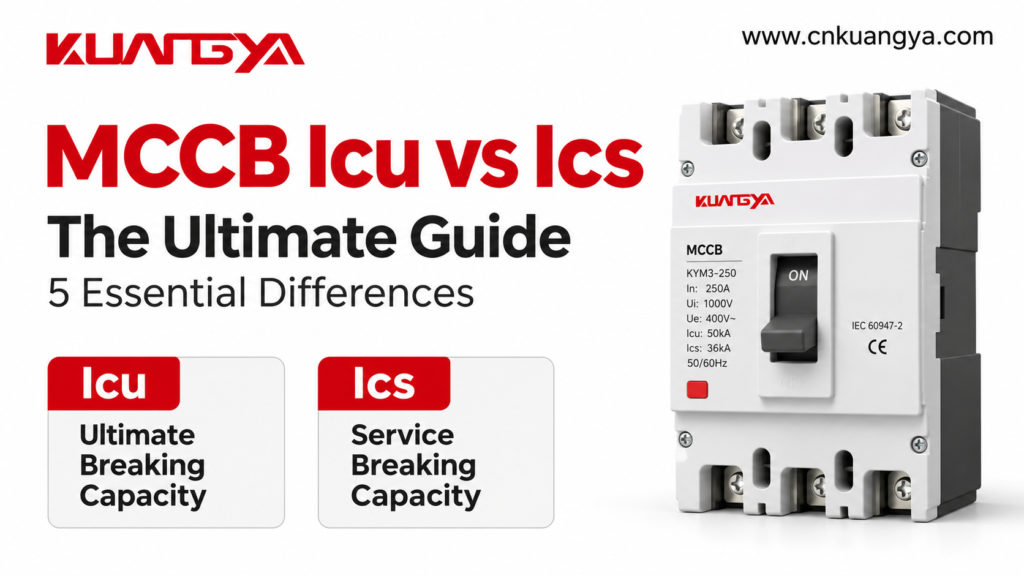
When selecting a Molded Case Circuit Breaker (MCCB), breaking capacity is one of the most important technical parameters to check. However, many buyers focus only on the rated current and Icu value while overlooking Ics.
Verstehen MCCB Icu vs Ics is essential when choosing a circuit breaker for industrial distribution panels, battery energy storage systems, and other electrical installations.
Both Icu and Ics describe the short-circuit breaking performance of an MCCB, but they represent different levels of performance under standardized test conditions.
In this guide, we explain what Icu and Ics mean, how they differ, how to calculate their relationship, and what buyers should consider when selecting an MCCB.
Understanding MCCB Icu vs Ics helps engineers evaluate both the ultimate and service short-circuit breaking capabilities of a circuit breaker.
Icu stands for Rated Ultimate Short-Circuit Breaking Capacity.
It represents the maximum prospective short-circuit current that an MCCB is assigned to interrupt under the specified test conditions at its rated operational voltage.
Icu is usually expressed in kiloamperes (kA).
For example, an MCCB with an Icu rating of 25kA is designed and tested to interrupt a prospective short-circuit current of up to 25,000 amperes under the specified conditions.
However, Icu does not mean that the circuit breaker is guaranteed to remain suitable for continued normal operation after interrupting a fault at this maximum level.
After an ultimate short-circuit test, the device is not required to meet the same subsequent service-performance requirements as a breaker tested at Ics.
Icu is important because it helps determine whether an MCCB can safely interrupt the maximum expected short-circuit current at its installation point.
When selecting an MCCB, engineers should compare its Icu rating with the calculated prospective short-circuit current of the electrical system.
If the available fault current exceeds the breaker’s rated breaking capacity, the device is not suitable for that installation unless an appropriately verified upstream protective arrangement is used.
Ics stands for Rated Service Short-Circuit Breaking Capacity.
It indicates the short-circuit current that an MCCB is assigned to interrupt under the service short-circuit test sequence specified by IEC 60947-2.
Unlike Icu, Ics also verifies the circuit breaker’s ability to meet the specified performance requirements following the test sequence.
Ics is generally expressed either directly in kA or as a percentage of Icu.
Common percentage values include:
The actual Ics value depends on the circuit breaker’s design, utilization category, and manufacturer’s declared specifications.
Ics is particularly important in electrical installations where maintaining reliable operation after a short-circuit event is a priority.
For example, in an industrial distribution system, an electrical fault may interrupt power to important equipment.
A breaker with a higher Ics rating provides a higher declared service short-circuit breaking capability, which can be valuable when evaluating the expected duty and continuity requirements of the installation.
However, Ics alone does not guarantee uninterrupted operation. The entire protection system, including selectivity and coordination, must also be considered.
Although both parameters describe short-circuit breaking capacity, their purposes are different.
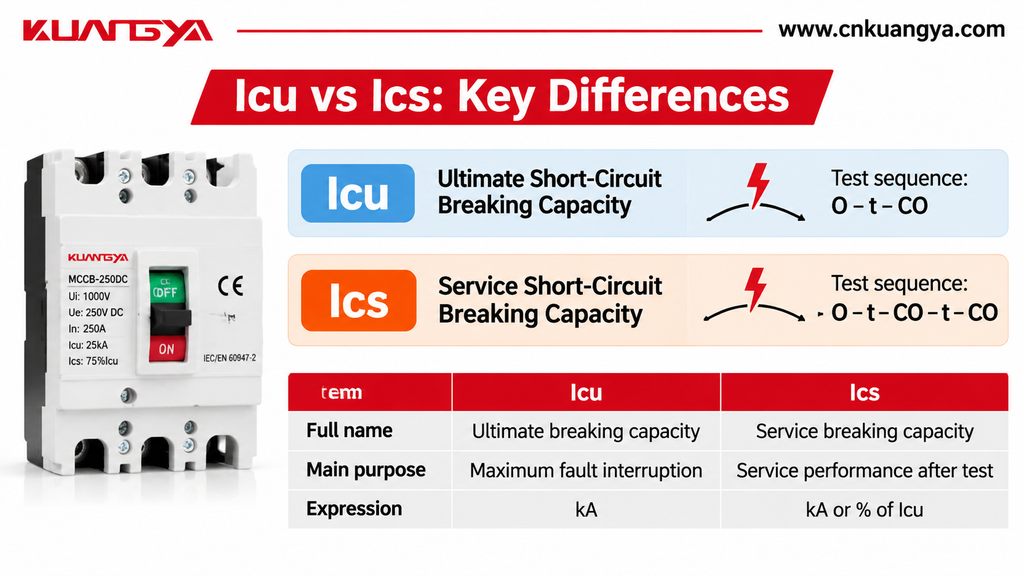
When comparing MCCB Icu vs Ics, buyers should consider both the maximum fault interruption capability and the required post-test performance.
| Vergleich | Icu | Ics |
|---|---|---|
| Full name | Ultimate Breaking Capacity | Service Breaking Capacity |
| Hauptzweck | Ultimate short-circuit interruption | Service-level short-circuit interruption |
| Test sequence | O – t – CO | O – t – CO – t – CO |
| Expression | kA | kA or % of Icu |
| Post-test requirement | Not required to meet the same service-performance requirements | Must meet the applicable post-test service requirements |
| Selection focus | Maximum fault interruption capability | Service performance after the specified fault test |
According to IEC 60947-2, the two ratings are verified using different short-circuit test sequences.
Icu Test: O – t – CO
Ics Test: O – t – CO – t – CO
The service test includes an additional closing and opening operation, followed by the applicable verification of performance.
These sequences help distinguish ultimate breaking performance from service breaking performance.
It is important to understand that these are standardized laboratory test sequences, not instructions for testing a circuit breaker in an operating electrical installation.
One of the easiest ways to understand the relationship between Icu and Ics is through a practical calculation.
Die Formel lautet:
Ics = Icu × Ics Percentage
For example, consider an MCCB with:
Kalkulation:
Ics = 25 × 75%
Ics = 18.75kA
This means the circuit breaker has:
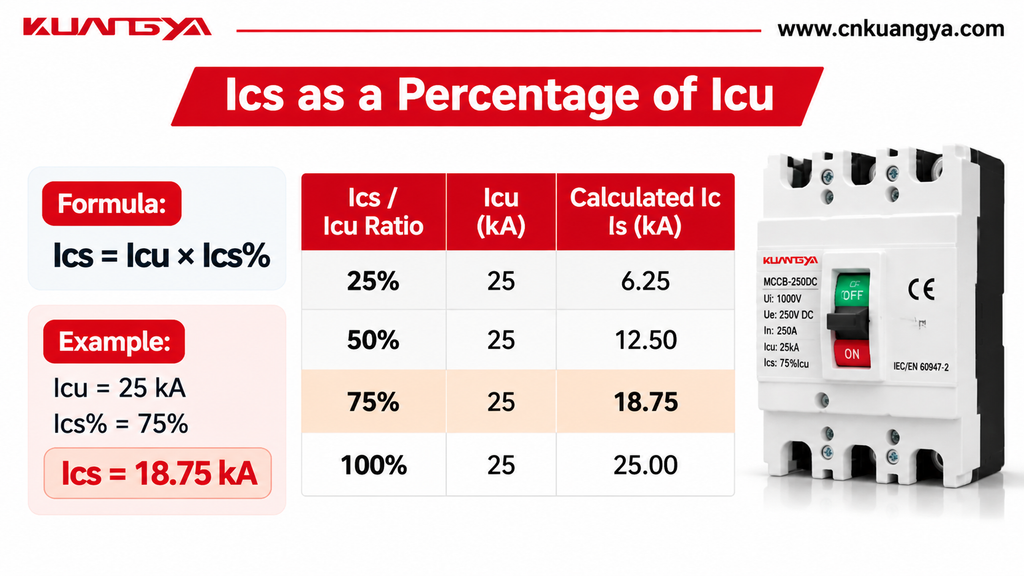
Assuming the same Icu rating of 25kA:
| Ics / Icu Ratio | Icu | Calculated Ics |
|---|---|---|
| 25% | 25kA | 6.25kA |
| 50% | 25kA | 12.5kA |
| 75% | 25kA | 18.75kA |
| 100% | 25kA | 25kA |
The table illustrates how the Ics percentage affects the declared service breaking capacity.
Wichtig: These are mathematical examples. Always check the manufacturer’s declared ratings and applicable standard requirements. Do not assume that every MCCB offers all four ratios.
A proper MCCB Icu vs Ics comparison should always be based on the prospective short-circuit current and the electrical system’s protection requirements.
Choosing an MCCB based only on its rated current or Icu value is not sufficient.
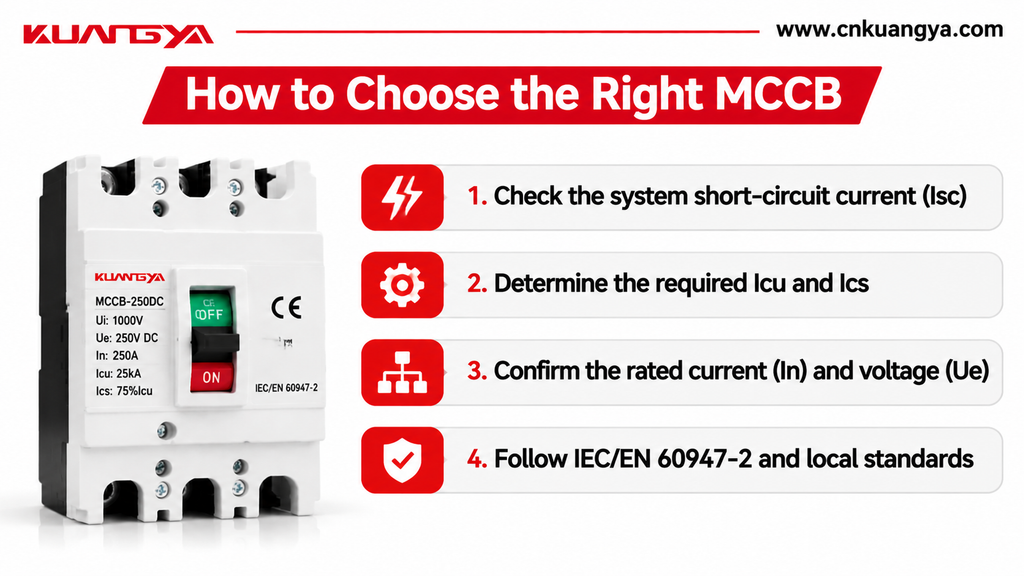
A proper selection should consider the actual electrical installation and its protection requirements.
The first step is to determine the maximum prospective short-circuit current at the intended installation point.
This calculation depends on factors such as:
The selected MCCB must have an appropriate breaking capacity for the calculated fault current at the corresponding rated operational voltage.
Once the prospective short-circuit current is known, check both ratings.
Icu must be sufficient to interrupt the required maximum fault current.
Ics should also be evaluated against the project’s service-continuity and post-fault performance requirements.
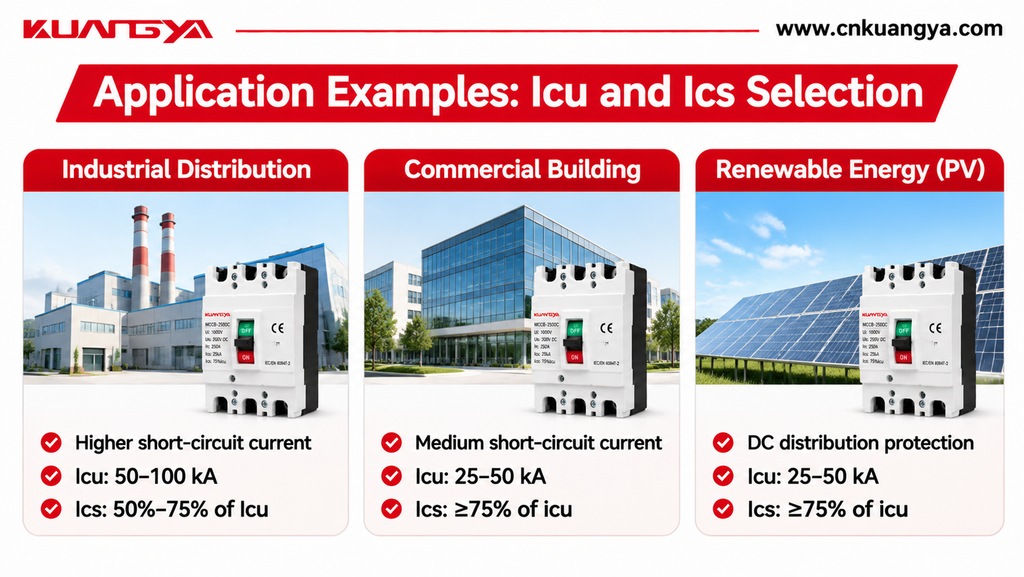
For critical industrial applications, a higher Ics relative to Icu may be desirable.
However, the correct choice depends on the system design rather than simply selecting the highest percentage.
Breaking capacity ratings are associated with specific rated operational voltages.
An MCCB may have different breaking capacity ratings at different AC or DC voltages.
For DC applications, also check the manufacturer’s specified pole arrangement and connection instructions.
Never assume that an AC breaking capacity rating automatically applies to DC circuits.
MCCBs are often installed in series with other protective devices.
Proper coordination helps ensure that the protective device closest to the fault operates as intended, reducing unnecessary interruptions to other parts of the electrical system.
Engineers should review:
A high Icu or Ics value alone does not establish selectivity between circuit breakers.
Before purchasing, verify the following parameters:
The complete datasheet should be reviewed rather than relying on a single breaking-capacity figure.
For further information about low-voltage circuit breaker requirements, refer to IEC 60947-2:2024 – Low-voltage switchgear and controlgear – Part 2: Circuit-breakers, published by the International Electrotechnical Commission (IEC).
Let’s look at an actual product specification to understand how these two parameters appear in a product datasheet.
The KUANGYA MCCB-250DC is a DC molded case circuit breaker with the following specifications:
| Parameter | Spezifikation |
|---|---|
| Modell | MCCB-250DC |
| Anzahl der Pole | 1P |
| Nennstrom | 250A |
| Rated Operational Voltage | 250V DC |
| Icu | 25kA |
| Ics | 75% of Icu |
Based on these specifications:
Icu = 25kA
Ics = 25 × 75% = 18.75kA
This example demonstrates why buyers should check both Icu and Ics when reviewing an MCCB datasheet.
The 25kA Icu rating indicates the ultimate short-circuit breaking capacity, while the 18.75kA Ics value indicates the declared service short-circuit breaking capacity.
The suitability of this MCCB must still be verified against the actual DC system voltage, prospective fault current, conductor capacity, pole arrangement, and installation requirements.
For detailed product information, visit the KUANGYA DC MCCB product page.
When comparing MCCBs from different manufacturers, buyers should avoid the following mistakes.
Two MCCBs may have the same Icu rating but different Ics values.
For example, two breakers may both have an Icu of 25kA, while their Ics ratings are 50% and 75% of Icu.
Their declared service breaking capacities are therefore different.
Not all MCCBs have an Ics rating equal to Icu.
The percentage must be confirmed from the manufacturer’s datasheet.
A breaking-capacity figure without its corresponding rated operational voltage can be misleading.
Always compare ratings at the actual system voltage and for the correct AC or DC application.
Rated current determines the normal current-carrying rating, but it does not independently establish short-circuit protection suitability.
The prospective fault current, breaking capacity, conductor protection, and coordination must also be checked.
A higher Ics rating can provide greater service short-circuit breaking capability.
However, the overall protection performance also depends on the protection settings, selectivity, installation conditions, and other system requirements.
Icu is the rated ultimate short-circuit breaking capacity, while Ics is the rated service short-circuit breaking capacity.
Icu verifies ultimate interruption performance, whereas Ics includes additional service-performance verification following the specified test sequence.
A higher Ics rating generally indicates greater declared service short-circuit breaking capability.
It can be advantageous in installations where post-fault service performance is important. However, the correct rating must be determined by the actual project requirements.
Yes. Some MCCBs have an Ics rating equal to 100% of Icu.
However, this is not universal. Always check the manufacturer’s technical documentation.
It means the rated service short-circuit breaking capacity is 75% of the rated ultimate short-circuit breaking capacity.
For an MCCB with an Icu of 25kA, an Ics of 75% equals 18.75kA.
IEC 60947-2 specifies requirements for low-voltage circuit breakers, including rated ultimate and rated service short-circuit breaking capacities.
The current sixth edition is IEC 60947-2:2024.
You should check both.
Icu must be suitable for the maximum prospective short-circuit current, while Ics should meet the project’s service-performance requirements.
Also verify rated voltage, current, poles, trip characteristics, and coordination.
Verstehen MCCB Icu vs Ics is essential when selecting a reliable circuit breaker for industrial and commercial electrical systems.
A clear understanding of MCCB Icu vs Ics also helps buyers compare technical datasheets from different circuit breaker manufacturers.
Icu defines the ultimate short-circuit breaking capability, while Ics indicates the service short-circuit breaking capability under the specified test conditions.
Neither parameter should be considered in isolation.
For a suitable MCCB selection, engineers and buyers should evaluate the system voltage, rated current, prospective short-circuit current, breaking capacity, and protection coordination together.
At KUANGYA, we provide AC and DC circuit protection solutions for different electrical applications.
If you are looking for an MCCB for your project or distribution system, contact our team with your technical requirements. We can help check the available specifications and discuss suitable product options.

