WengYang Industriegebiet Yueqing Wenzhou 325000
Arbeitszeiten
Montag bis Freitag: 7AM - 7PM
Am Wochenende: 10AM - 5PM
WengYang Industriegebiet Yueqing Wenzhou 325000
Arbeitszeiten
Montag bis Freitag: 7AM - 7PM
Am Wochenende: 10AM - 5PM

When an MCB trips only after the cabinet warms up, compare the load with the manufacturer’s permitted operating current at the temperature around the breaker. Check the effect of adjacent loaded devices and investigate abnormal heating before changing the breaker.
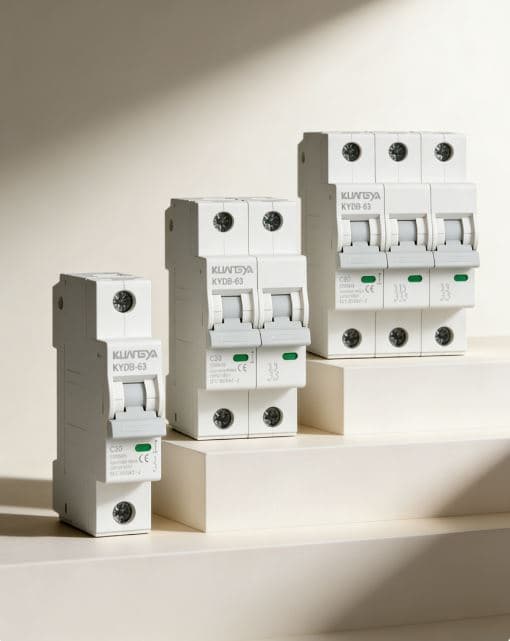
Use the ambient air temperature around the breaker inside the enclosure under the design load, according to the manufacturer’s method. Outdoor air temperature and a terminal surface temperature are different measurements. Once the cabinet warms up, neighboring loaded breakers and other equipment can raise the local ambient temperature.
Schneider Electric’s Acti9 ambient temperature table gives 29.9 A at 65°C for a single 32 A iC60 in the stated IEC 60947-2 example. For the table’s grouped installation, applying its 0.8 coefficient gives 23.92 A, shown rounded to 24 A. A hypothetical 26 A load is below the single-device value but above the grouped value. These are operating-current limits in the cited example. Actual tripping time depends on the device characteristic and conditions. Use the grouping method published for your exact model.
Changing the characteristic changes the magnetic trip response. Evaluate sustained overload and heat using the actual thermal characteristic and installation data. See the B and C curve selection guide for the separate short-circuit check.
Send the exact breaker part number, load current, maximum cabinet ambient temperature, mounting layout, neighboring loads and conductor details when reviewing KUANGYA MCB models or the broader AC circuit breaker range. Request model-specific derating data before final approval.

