WengYang Industriegebiet Yueqing Wenzhou 325000
Arbeitszeiten
Montag bis Freitag: 7AM - 7PM
Am Wochenende: 10AM - 5PM
WengYang Industriegebiet Yueqing Wenzhou 325000
Arbeitszeiten
Montag bis Freitag: 7AM - 7PM
Am Wochenende: 10AM - 5PM

DC-Überspannungsschutzgeräte (SPDs) werden auf der Gleichstromseite von Photovoltaikanlagen eingesetzt, um transiente Überspannungen zu begrenzen und Stoßströme abzuleiten, bevor diese Wechselrichter, Überwachungsgeräte, Anschlusskästen und andere empfindliche Komponenten beschädigen. Kennzeichnungen wie Klasse I, Klasse II, Unter, Imax, Nach oben und Iscpv werden jedoch häufig missverstanden.
Dieser Leitfaden erläutert die DC-SPD-Klassen – Klasse I, Klasse II und Klasse III – und zeigt, wie ein typisches Typenschild eines 1000-V-DC-Photovoltaik-SPD zu interpretieren ist.
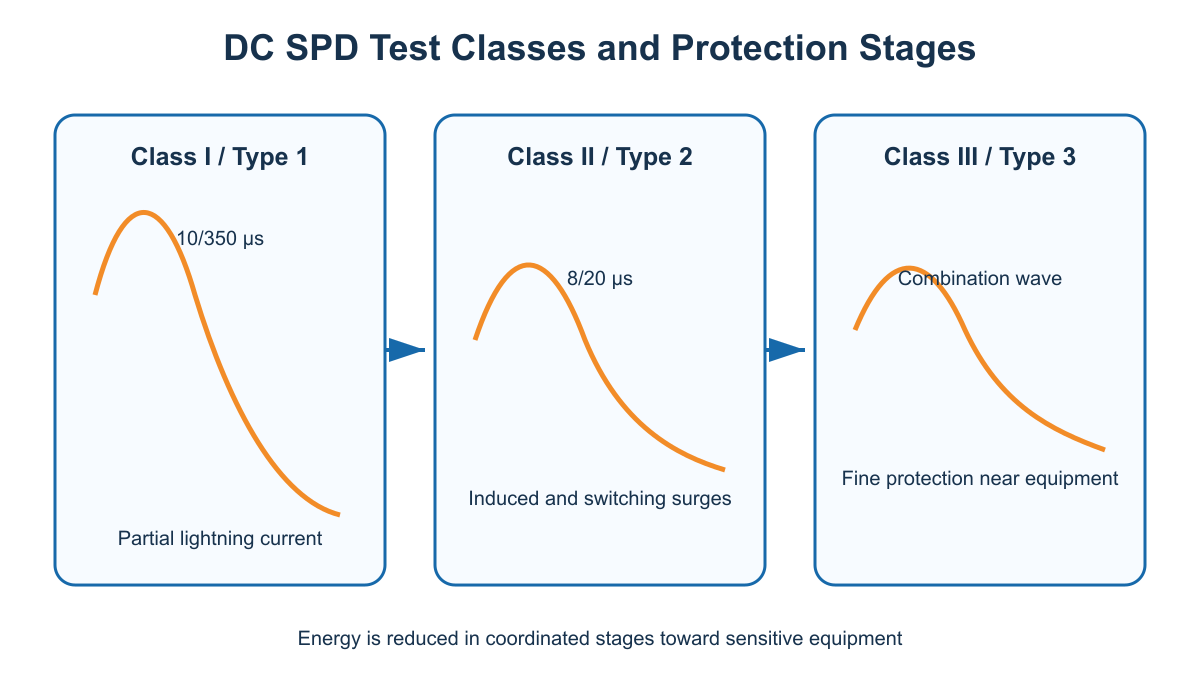
Das Wort Klasse auf einem SPD bezieht sich normalerweise auf eine Prüfklassifizierung. Es bedeutet nicht, dass Klasse I ein Premiumprodukt und Klasse II ein Produkt geringerer Qualität ist. Es beschreibt auch keine Isolationsklasse oder eine IP-Schutzart.
| Prüfklasse | Allgemeine Produktbezeichnung | Hauptprüfwellenform | Typische Rolle |
|---|---|---|---|
| Klasse I | Typ 1 | 10/350 μs Stromstoß | Teilblitzstromableitung |
| Klasse II | Typ 2 | 8/20 μs Stromstoß | Induzierte Blitz- und Schaltüberspannungen |
| Klasse III | Typ 3 | Kombinationswelle | Geräteschutz in der Nähe empfindlicher Betriebsmittel |
| Klasse I+II | Typ 1+2 | 10/350 μs und 8/20 μs | Kombinierter Blitzstrom- und Überspannungsschutz |
Diese SPD-Klassen dürfen nicht mit den Blitzschutzklassen LPS I, II, III und IV verwechselt werden. Beide Systeme verwenden ähnliche römische Ziffern, beschreiben jedoch unterschiedliche Sachverhalte.
Ein SPD der Klasse I bzw. Typ 1 ist für die Ableitung hochenergetischer Blitzstromkomponenten ausgelegt. Die maßgebliche Prüfwellenform ist typischerweise 10/350 μs: Der Strom steigt schnell an und klingt über einen vergleichsweise langen Zeitraum ab, wodurch der Impuls eine wesentlich höhere Energie aufweist als ein herkömmlicher 8/20 μs-Stoßstrom mit gleichem Spitzenwert.
Ein Schutz vom Typ 1 oder Typ 1+2 sollte in Betracht gezogen werden, wenn eine PV-Anlage über ein externes Blitzschutzsystem verfügt, der erforderliche Trennungsabstand nicht eingehalten werden kann oder wenn Blitzströme über die Grenze einer Blitzschutzzone in die elektrische Anlage eindringen können.
Der wichtigste Parameter für Typ 1 ist normalerweise Iimp. Ein hoher Imax-Wert allein belegt nicht, dass ein SPD für den Typ-1-Einsatz geeignet ist, da Imax normalerweise mit der 8/20 μs-Wellenform assoziiert wird.
Klasse II entspricht im Allgemeinen einem Typ 2 SPD, das mit einer 8/20 μs-Stromwellenform geprüft wurde. Es ist die am häufigsten verwendete Klasse für den Schutz gegen induzierte Blitzüberspannungen und Schalttransienten in PV-Kombinatorkästen, DC-Verteileranlagen und DC-Eingängen von Wechselrichtern.
Ein Typ 2 SPD kann als Teil eines koordinierten Schutzsystems auch nach einem Typ 1 SPD installiert werden. Es sollte nicht als Ableiter für direkte Blitzströme vermarktet werden, es sei denn, das Produkt ist zusätzlich als Typ 1 oder Typ 1+2 geprüft und deklariert.
Überspannungsschutzgeräte (SPD) der Klasse III bzw. Typ 3 bieten einen Feinschutz in unmittelbarer Nähe zu empfindlichen Geräten. Sie werden üblicherweise mit einem Kombinationswellengenerator geprüft, der eine Leerlaufspannungswellenform von 1,2/50 μs und eine Kurzschlussstromwellenform von 8/20 μs erzeugt.
Geräte vom Typ 3 arbeiten normalerweise in Verbindung mit vorgeschalteten Schutzgeräten vom Typ 1 oder Typ 2. Sie sind nicht dafür ausgelegt, die gesamte einlaufende Stoßenergie allein zu absorbieren.
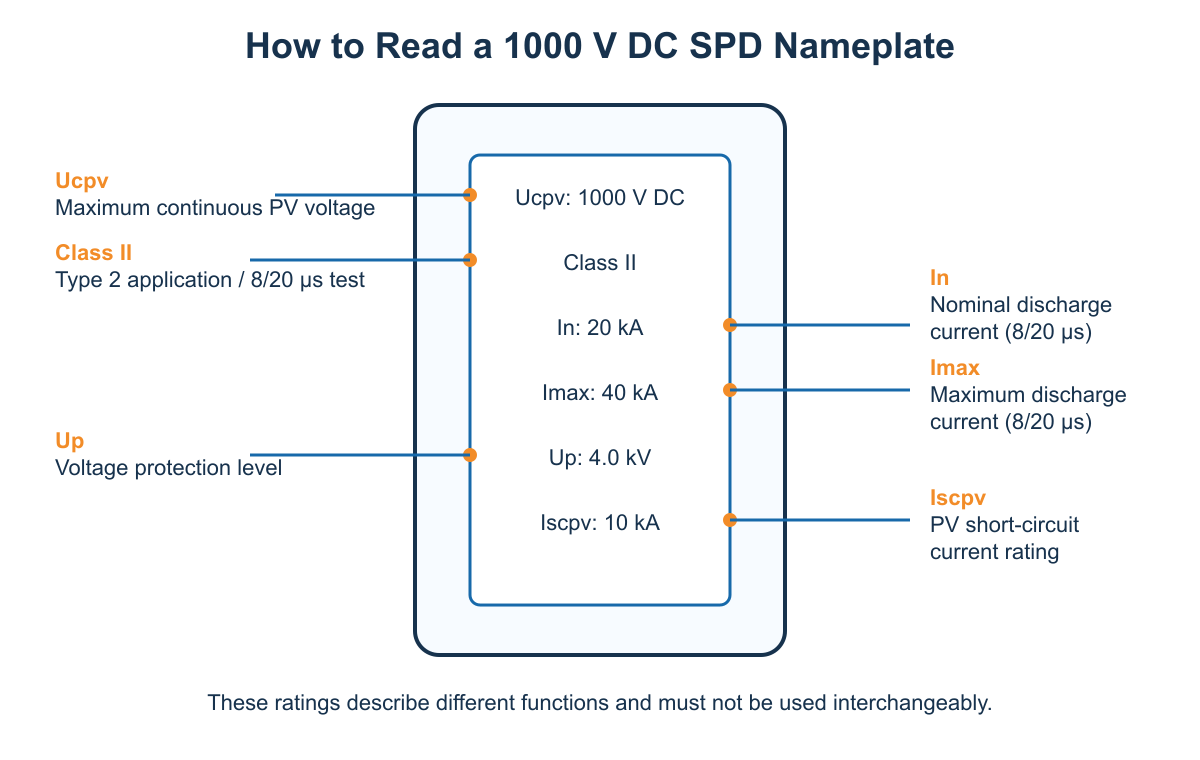
Ucpv ist die maximale Dauerspannung für ein Photovoltaik-SPD. Es ist die höchste Gleichspannung, die unter den vom Hersteller angegebenen Bedingungen dauerhaft an das SPD angelegt werden darf.
Der gewählte Ucpv-Wert darf nicht niedriger sein als die maximale Leerlaufspannung des PV-Generators nach Korrektur für die niedrigste zu erwartende Temperatur. Da die Leerlaufspannung (Voc) der Module bei sinkender Temperatur ansteigt, kann ein als “1000 V DC” beschriebenes System nicht automatisch ein SPD mit 1000 V Ucpv verwenden, ohne die maximale Spannung bei Kälte zu prüfen.
Diese Kennzeichnung weist auf eine Prüfung nach Klasse II und normalerweise auf eine Anwendung vom Typ 2 hin. Sie adressiert primär induzierte und schaltbedingte Überspannungen, die durch die 8/20-μs-Wellenform dargestellt werden. Sie beschreibt weder die Produktqualität noch das Kurzschlussausschaltvermögen.
Unter ist der Nennableitstoßstrom, der für einen Typ-2-Überspannungsschutz (SPD) normalerweise mit einer 8/20-μs-Wellenform spezifiziert wird. Er wird in der Standardprüfsequenz verwendet und ist ein wichtiger Indikator für die wiederholbare Stoßstrombelastbarkeit unter den angegebenen Prüfbedingungen.
Imax ist der maximale Ableitstoßstrom, der üblicherweise mit der 8/20 μs-Wellenform assoziiert wird. Es handelt sich um einen höheren, begrenzenden Ableitwert, der nicht als ein Strom interpretiert werden darf, den der SPD wiederholt führen kann.
In und Imax dürfen nicht direkt mit Iimp verglichen werden, sofern die zugehörigen Wellenformen nicht berücksichtigt werden. Ein 10/350 μs-Blitzstromimpuls enthält wesentlich mehr Energie als ein 8/20 μs-Impuls mit demselben Scheitelwert.
Nach oben ist der Schutzpegel. Er gibt den Wert an, auf den der SPD die Spannung unter den spezifizierten Testbedingungen begrenzt. Up sollte auf die Stoßspannungsfestigkeit der zu schützenden Betriebsmittel abgestimmt sein.
Ein niedrigerer Up kann den Schutzabstand verbessern, jedoch kann Up nicht isoliert bewertet werden. Ucpv muss für das PV-System hoch genug bleiben, und die Länge der Installationsleiter muss minimiert werden, da die Leiterinduktivität bei einem Stoßstrom die Spannung erhöht.
Iscpv ist der PV-Kurzschlussstrom-Bemessungswert des SPD. Dies ist kein Ableitvermögen für Stoßströme. Er beschreibt den prospektiven PV-Kurzschlussstrom, für den der SPD und seine Trennvorrichtung unter den vom Hersteller angegebenen Bedingungen geeignet sind.
Dieser Wert ist bei DC-Photovoltaikanlagen besonders wichtig, da ein defekter SPD sicher trennen muss, ohne einen gefährlichen DC-Lichtbogen aufrechtzuerhalten.
Dies beschreibt normalerweise den zulässigen Bereich der relativen Luftfeuchtigkeit. Das vollständige Datenblatt sollte auf Bedingungen wie nicht kondensierenden Betrieb, Korrosion, Vereisung und Höhenlage geprüft werden.
Dies ist der angegebene Temperaturbereich. Bei Geräten, die in externen Generatoranschlusskästen oder Gehäusen installiert sind, kann die interne Schaltschranktemperatur deutlich höher sein als die Umgebungstemperatur.
IP20 bietet einen grundlegenden Schutz gegen Fingerzugang und bestimmte feste Fremdkörper, aber die zweite Ziffer “0” bedeutet, dass kein Schutz gegen das Eindringen von Wasser deklariert ist. Ein IP20-SPD darf nicht direkt Regen ausgesetzt werden. Photovoltaik-Anwendungen im Außenbereich erfordern ein geeignetes, für die Umgebungsbedingungen ausgewähltes Gehäuse.
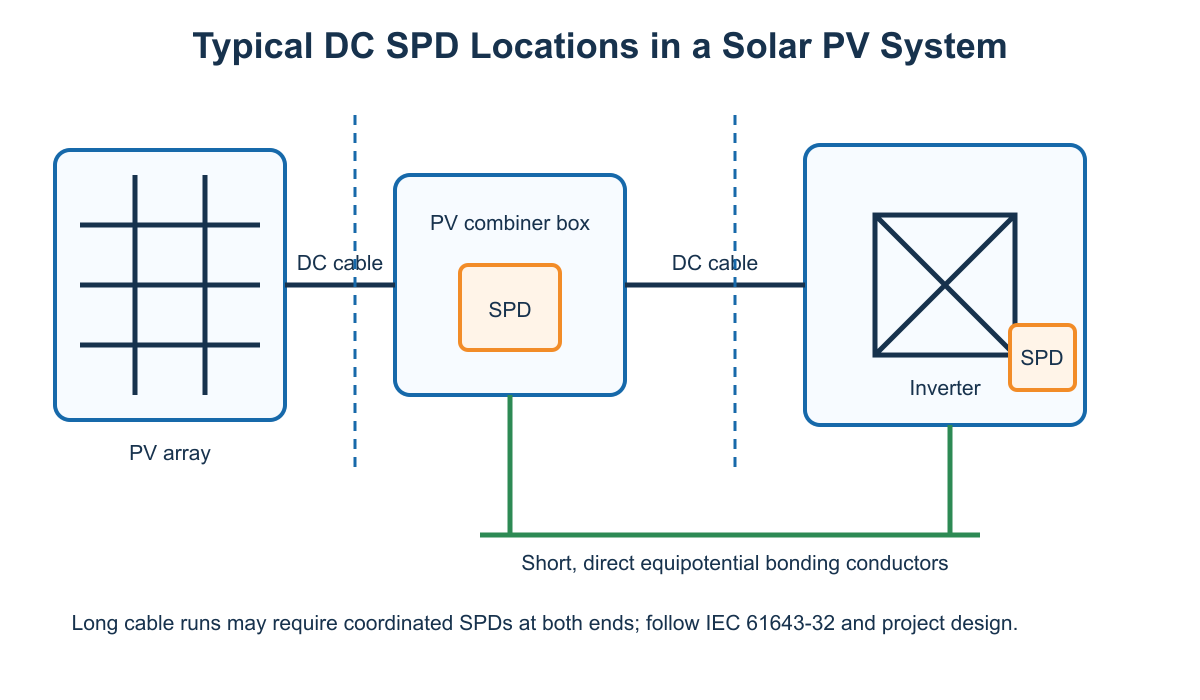
DC-Überspannungsschutzgeräte werden üblicherweise in PV-Generatoranschlusskästen und in der Nähe der DC-Eingänge von Wechselrichtern installiert. Die geeignete Anzahl und Platzierung hängt vom Systemlayout, der Leitungsführung, dem Blitzschutzkonzept, dem Erdungssystem und der Spannungsfestigkeit der Betriebsmittel ab.
Bei langen DC-Leitungen können koordinierte Überspannungsschutzgeräte an beiden Enden erforderlich sein. Die endgültige Platzierung und Koordination sollte gemäß der geltenden Installationsplanung und der Norm IEC 61643-32 erfolgen, anstatt einer universellen Ein-Geräte-Regel zu folgen.
Bei der endgültigen Auswahl müssen immer Ucpv, gegebenenfalls Iimp, In, Imax, Up, Iscpv, Schutzmodus, Erdungssystem, Vorsicherung und Zertifizierung berücksichtigt werden – nicht nur der höchste kA-Wert auf dem Etikett.
Die korrekte Auswahl eines DC-SPD ist eine koordinierte technische Entscheidung. Der SPD muss über eine geeignete Dauerspannung, die korrekte Prüfklasse, ein ausreichendes Ableitvermögen, einen angemessenen Schutzpegel und eine ausreichende PV-Kurzschlussfestigkeit verfügen.
Auf dem beispielhaften Typenschild steht Class II für eine Anwendung vom Typ 2; In 20 kA und Imax 40 kA beschreiben das Stoßstromvermögen bei 8/20 μs; Up 4,0 kV ist der Spannungsschutzpegel; und Iscpv 10 kA ist der PV-Kurzschlussstromwert. Keiner dieser Werte kann durch einen anderen ersetzt werden.
Benötigen Sie Hilfe bei der Auswahl eines DC-SPD für Ihre PV-Anlage? Senden Sie KUANGYA Ihre maximale Systemspannung, Modulstrangkonfiguration, minimale Standorttemperatur, Installationsposition, Erdungsanordnung und Blitzschutzbedingungen. Wir können ein geeignetes Typ 1, Typ 2 oder Typ 1+2 Modell für die Anwendung empfehlen.
Class I (Type 1) DC SPDs are tested with a 10/350 μs lightning-current impulse and are intended for installations where partial lightning current may enter the PV system. Class II (Type 2) DC SPDs are tested with an 8/20 μs waveform and mainly protect against induced lightning and switching surges.
A Type 2 SPD is not automatically suitable for direct-lightning-current duty. Where lightning current can enter the installation, use a properly tested Type 1 or Type 1+2 SPD as required by the lightning protection and risk assessment.
Choose a Ucpv rating that is not lower than the PV array maximum open-circuit voltage after correcting module Voc for the lowest expected site temperature. Also verify the inverter voltage limit and the manufacturer’s installation requirements.
Typical locations include PV combiner boxes and inverter DC inputs. Long cable routes or lightning protection zone boundaries may require coordinated SPDs at more than one location.

