WengYang Industriegebiet Yueqing Wenzhou 325000
Arbeitszeiten
Montag bis Freitag: 7AM - 7PM
Am Wochenende: 10AM - 5PM
WengYang Industriegebiet Yueqing Wenzhou 325000
Arbeitszeiten
Montag bis Freitag: 7AM - 7PM
Am Wochenende: 10AM - 5PM

Ein 5-poliges Relais ist eines der am häufigsten verwendeten elektrischen Schaltgeräte in Kraftfahrzeugsystemen, in der industriellen Automatisierung, in Anlagen für erneuerbare Energien und in elektronischen Steuerkreisen. elektromechanisches Relais zur sicheren Steuerung von elektrischen Lasten mit hohem Stromverbrauch durch Steuersignale mit niedrigem Stromverbrauch. Es ermöglicht die sichere Steuerung einer elektrischen Last mit hohen Strömen durch ein Niederstromsignal. Aufgrund seiner Flexibilität und Zuverlässigkeit ist das 5-Pin-Relais zu einem wesentlichen Bestandteil der modernen Elektrotechnik geworden.
Im Vergleich zu einem Standardschalter bietet ein Relais besseren Schutz, bessere Automatisierungsmöglichkeiten und eine bessere elektrische Isolierung. In vielen Systemen kann das direkte Schalten von Hochstromgeräten Schalter beschädigen, die Verdrahtung überhitzen oder die Sicherheit beeinträchtigen. Ein Relais löst diese Probleme durch die Verwendung elektromagnetischer Steuerung.
Das 5-Pin-Relais ist besonders beliebt, da es sowohl Schließer- als auch Öffnerkontakte enthält, was dem Benutzer mehr Flexibilität bei der Verdrahtung bietet. Es wird häufig in Autos, Solarsystemen, industriellen Schalttafeln, Sicherheitssystemen und Hausautomatisierungsprojekten eingesetzt.
In diesem Leitfaden werden das Funktionsprinzip, die Stiftkonfiguration, Verdrahtungsmethoden, Anwendungen, Prüfverfahren, Fehlerbehebungstechniken und häufig gestellte Fragen im Zusammenhang mit 5-poligen Relais erläutert.
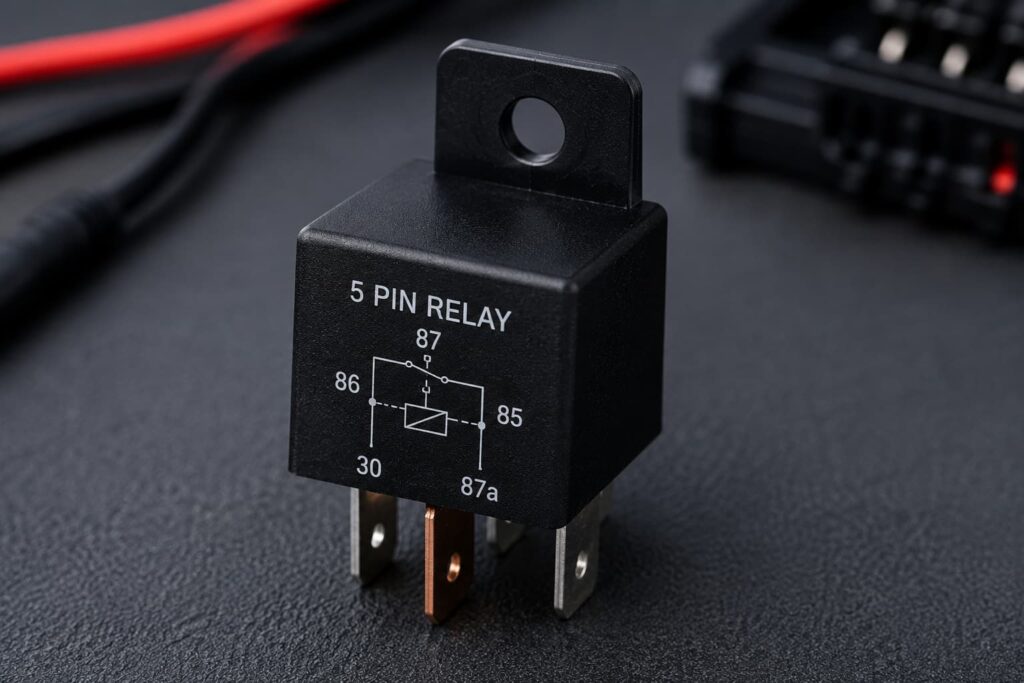
Ein 5-poliges Relais ist ein elektromechanischer Schalter, der elektromagnetische Kraft zum Öffnen oder Schließen elektrischer Kontakte nutzt. Es enthält fünf Anschlüsse, mit denen das Relais Stromkreise steuern kann.
Zu den fünf Terminals gehören:
Wenn eine Spannung an die Relaisspule angelegt wird, entsteht im Inneren des Relais ein Magnetfeld. Dieses Magnetfeld bewegt einen internen Anker, der die Verbindung zwischen den Kontakten ändert.
Der Hauptzweck eines Relais besteht darin, dass ein kleines elektrisches Signal eine größere elektrische Last sicher steuern kann.
Das Verständnis der Relaisstruktur hilft dem Benutzer, das Gerät richtig zu verdrahten und Fehler zu beheben.
Die Spule erzeugt bei Erregung ein Magnetfeld. Relaissteuerungen sind in der industriellen Automatisierungstechnik und in intelligenten elektrischen Anwendungen weit verbreitet.
Die Armatur ist ein bewegliches Metallteil, das die Kontakte schaltet.
Die Feder bringt den Anker in seine ursprüngliche Position zurück, wenn die Spule an Strom verliert.
Die Kontakte öffnen oder schließen den Stromkreis.
Das Außengehäuse schützt das Relais vor Staub, Vibrationen und Feuchtigkeit.
Die meisten Relais folgen einem Standard-Klemmennummerierungssystem.
| Pin-Nummer | Funktion | Beschreibung |
|---|---|---|
| 85 | Spulenanschluss | Normalerweise mit Masse verbunden |
| 86 | Spulenanschluss | Angeschlossen an die Triggerspannung |
| 30 | Gemeinsames Terminal | Hauptstromeingang |
| 87 | Normalerweise offen (NO) | Angeschlossen, wenn das Relais eingeschaltet ist |
| 87a | Normalerweise geschlossen (NC) | Verbunden, wenn das Relais AUS ist |
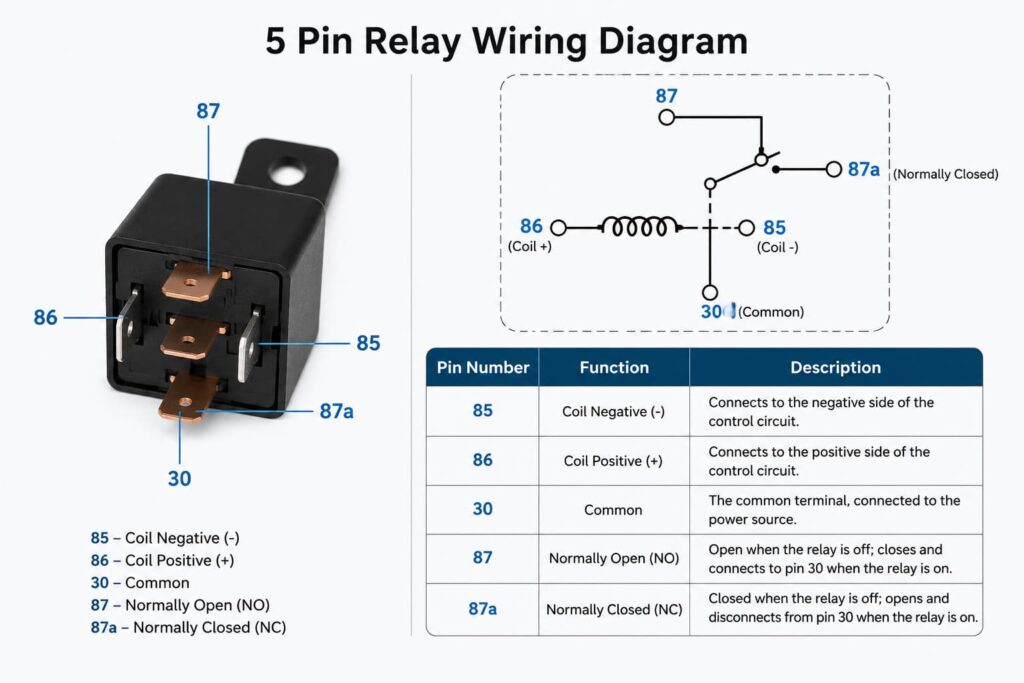
Diese beiden Stifte steuern die Relaisspule. Durch das Anlegen einer Spannung an ihnen wird das Relais aktiviert.
Pin 30 ist der gemeinsame Anschluss und erhält normalerweise die eingehende Stromversorgung.
Pin 87 wird mit Pin 30 verbunden, wenn das Relais erregt ist.
Pin 87a bleibt mit Pin 30 verbunden, wenn das Relais nicht erregt ist.
Das Relais arbeitet nach elektromagnetischen Prinzipien.
Wenn die Spule nicht mit Strom versorgt wird:
Wenn Spannung an die Spule angelegt wird:
| Relaiszustand | Aktive Verbindung | Ergebnis |
|---|---|---|
| Spule AUS | 30 → 87a | Normalerweise geschlossen aktiv |
| Spule EIN | 30 → 87 | Normalerweise offen aktiv |
Viele Menschen verwechseln diese beiden Relaistypen.
| Merkmal | 4-Pin-Relais | 5-Pin-Relais |
|---|---|---|
| Ausgangskontakte | Eine | Zwei |
| NC-Kontakt | Nein | Ja |
| Flexibilität | Grundlegend | Fortgeschrittene |
| Verdrahtungsoptionen | Begrenzt | Mehr Flexibilität |
Der zusätzliche Öffneranschluss verleiht dem 5-poligen Relais zusätzliche Steuerungsmöglichkeiten.
Am häufigsten werden 5-Pin-Relais in der Automobilindustrie eingesetzt, wo sie in vielen Fällen auch zuverlässig arbeiten müssen. Stromkreisschutzlösungen um eine stabile elektrische Leistung zu gewährleisten.
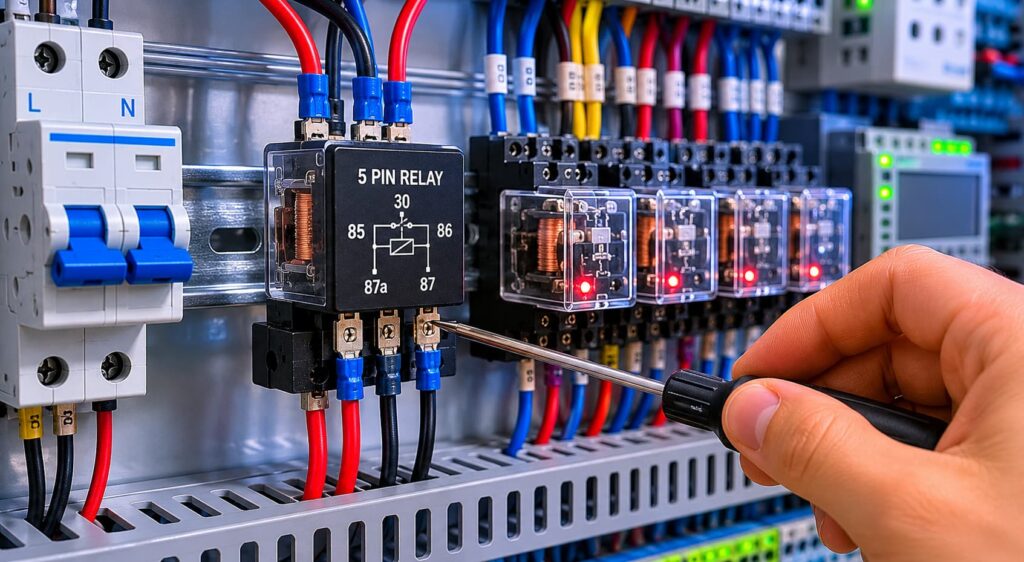
Relais sind in industriellen Steuerungssystemen weit verbreitet.Industrielle Relaisanwendungen spielen weiterhin eine wichtige Rolle in modernen Automatisierungs-, Fertigungs- und elektrischen Sicherheitssystemen.
Die Anwendungen umfassen:
Solar- und Energiespeichersysteme verwenden Relais für:
Intelligente Häuser verwenden Relais für:
Der Steuerkreis bleibt vom Lastkreis getrennt.
Kleine Schalter können große elektrische Lasten sicher steuern.
Die NO- und NC-Klemmen bieten vielfältige Steuerungsmöglichkeiten.
Relais verhindern Überhitzung und Schäden am Schalter.
Relais ermöglichen den Fern- und Automatikbetrieb.
Obwohl Relais nützlich sind, haben sie auch einige Einschränkungen.
Bewegliche Teile verschleißen mit der Zeit.
Die meisten Relais erzeugen ein Klickgeräusch.
Mechanische Relais sind langsamer als elektronische Schalter.
Elektrische Lichtbögen können beim Schalten die Kontakte beschädigen.
Das 12-Volt-Relais mit 5 Pins ist der beliebteste Typ in Kraftfahrzeugsystemen.
| Parameter | Typischer Wert |
|---|---|
| Spulenspannung | 12 V GLEICHSTROM |
| Kontakt Bewertung | 30A-40A |
| Umschaltzeit | 5-15 ms |
| Betriebstemperatur | -40°C bis +85°C |
Eine korrekte Verdrahtung ist für die Sicherheit und Leistung von entscheidender Bedeutung.
| Relais-Stift | Verbindung |
|---|---|
| 85 | Boden |
| 86 | Auslöseschalter |
| 30 | Leistungsaufnahme |
| 87 | Ausgangslast |
| 87a | NC-Ausgabe |
In einem Fahrzeug:
Wenn der Schalter das Relais aktiviert, fließt Strom zu den Nebelscheinwerfern.
Die Prüfung von Relais ist bei der Wartung wichtig.
Lokalisieren Sie alle fünf Klemmen.
Widerstand zwischen den Pins 85 und 86 prüfen.
Legen Sie die Nennspannung an die Spule an.
Sie sollten ein Klickgeräusch hören.
Verwenden Sie zur Überprüfung ein Multimeter:
| Test | Erwartetes Ergebnis |
|---|---|
| Widerstand der Spule | Stabiles Lesen |
| Relais-Klick | Hörbares Geräusch |
| Kein Kontakt | Kontinuität bei ON |
| Öffner | Kontinuität bei OFF |
Ein zu hoher Strom kann die Kontakte beschädigen.
Die Relaisspule kann durchbrennen.
Schlechte Verbindungen können zu intermittierendem Betrieb führen.
Feuchtigkeit kann die Relaisanschlüsse korrodieren.
Die Kontakte können aufgrund von Lichtbögen zusammenschweißen.
| Problem | Mögliche Ursache | Lösung |
|---|---|---|
| Relais klickt nicht | Keine Spulenspannung | Stromversorgung prüfen |
| Laden funktioniert nicht | Beschädigte Kontakte | Relais austauschen |
| Überhitzung des Relais | Überschüssiger Strom | Höherwertiges Relais verwenden |
| Relaisklappern | Niederspannung | Stromquelle stabilisieren |
Eine Diode schützt den Stromkreis vor Spannungsspitzen, die von der Spule erzeugt werden.
Sicherungen schützen vor Überstrom.
Eine gute Kühlung verhindert Überhitzung.
Überspannungsschutzgeräte helfen, Schäden durch transiente Spannungen zu reduzieren. Überspannungsschutzgeräte werden in der Regel zusammen mit Relaissystemen installiert, um die elektrische Sicherheit und die Zuverlässigkeit der Geräte zu verbessern.
Schalten Sie vor der Verkabelung immer den Strom ab.
Unterdimensionierte Drähte können überhitzen.
Überschreiten Sie niemals die Spezifikationen des Relais.
Die stabile Befestigung verhindert Vibrationsschäden.
Feuchtigkeit kann die internen Kontakte beschädigen.
Ein 5-poliges Relais ermöglicht das Schalten einer elektrischen Last mit hohem Strom durch ein Steuersignal mit niedrigem Strom.
Pin 87 ist normalerweise offen, während Pin 87a normalerweise geschlossen ist.
Ja, lassen Sie einfach Pin 87a unbenutzt.
Dies deutet in der Regel auf eine instabile Spannung oder eine unzureichende Stromversorgung hin.
Die Lebensdauer der Relais hängt vom Laststrom, der Schaltfrequenz und den Betriebsbedingungen ab.
Elektromechanische Standardrelais sind in der Regel nicht polaritätsempfindlich, es sei denn, sie enthalten eine interne Diode.
| Relaistyp | Hauptverwendung | Vorteile | Benachteiligungen |
|---|---|---|---|
| 4-Pin-Relais | Grundlegendes Schalten | Einfache Verdrahtung | Weniger flexibel |
| 5-Pin-Relais | Erweiterte Kontrolle | Schließer und Öffner | Komplexer |
| Halbleiterrelais | Schnelles Umschalten | Geräuschloser Betrieb | Höhere Kosten |
| Kfz-Relais | Fahrzeugsysteme | Dauerhaft | Spannungsspezifisch |
| Industrierelais | Automatisierungssysteme | Hohe Zuverlässigkeit | Größeres Format |
Auch mit der Entwicklung der modernen Elektronik sind Relais nach wie vor äußerst wichtig, da sie eine wichtige Rolle spielen:
In Automobilsystemen, Industriemaschinen, Anlagen für erneuerbare Energien und intelligenten Automatisierungssystemen spielen Relais weiterhin eine entscheidende Rolle.
Das 5-polige Relais ist eines der vielseitigsten und am weitesten verbreiteten elektrischen Schaltgeräte in modernen elektrischen Systemen. Seine Fähigkeit, Hochstromgeräte mit Niederstromsignalen sicher zu steuern, macht es zu einem unverzichtbaren Bestandteil der Automobilelektronik, der industriellen Automatisierung, der Solarsysteme und der Hausautomatisierungsprojekte.
Das Verständnis der Relais-Stiftkonfiguration, des Funktionsprinzips, der Verdrahtungsmethoden, des Prüfverfahrens und der Fehlerbehebungstechniken hilft Ingenieuren, Elektrikern und Technikern, sicherere und zuverlässigere elektrische Systeme zu bauen.
Im Vergleich zu einem einfachen 4-Pin-Relais bietet das 5-Pin-Relais mehr Flexibilität, da es sowohl Schließer- als auch Öffnerkontakte enthält. Dies ermöglicht fortschrittlichere Steuerkreisdesigns.
Ganz gleich, ob Sie an der Verkabelung von Fahrzeugen, an industriellen Schalttafeln, an Systemen für erneuerbare Energien oder an elektronischen Heimwerkerprojekten arbeiten, die Wahl des richtigen Relais und dessen ordnungsgemäße Installation kann die Sicherheit und Leistung des Systems erheblich verbessern. elektrische Schutzprodukte dazu beitragen, die langfristige Zuverlässigkeit von industriellen und erneuerbaren Energiesystemen zu gewährleisten.
Während sich die Elektrotechnik weiter entwickelt, bleibt das 5-polige Relais eine zuverlässige und kostengünstige Lösung für moderne Schaltanwendungen.

