WengYang Industrial Zone Yueqing Wenzhou 325000
Work Hours
Monday to Friday: 7AM - 7PM
Weekend: 10AM - 5PM
WengYang Industrial Zone Yueqing Wenzhou 325000
Work Hours
Monday to Friday: 7AM - 7PM
Weekend: 10AM - 5PM

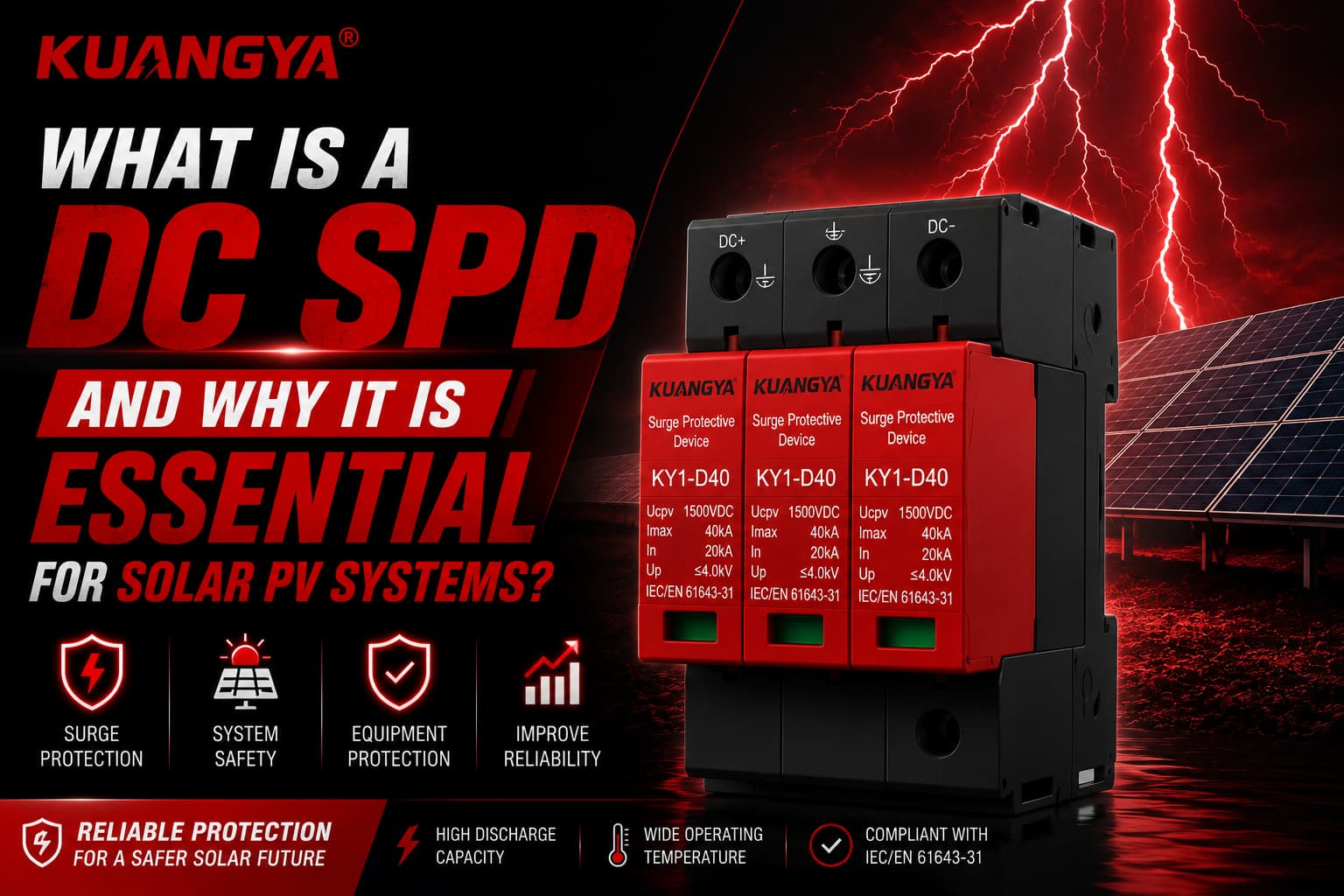
Solar photovoltaic (PV) systems are widely considered one of the most reliable renewable energy solutions. However, behind their stable energy output lies a serious and often underestimated threat—electrical surges.
These surges are caused by lightning, grid switching, or internal electrical disturbances, and they can destroy expensive solar equipment within milliseconds.
┃ Even a small surge event can lead to inverter failure, system downtime, or permanent damage to PV components.
This is why surge protection is not optional in solar energy systems—it is essential. Understanding modern solar surge protection requirements is critical for protecting expensive PV equipment and ensuring long-term system reliability.
At the center of this protection strategy is the DC SPD (Direct Current Surge Protective Device).
A DC SPD (What Is DC SPD) is a protective electrical device designed to limit transient overvoltage in direct current (DC) circuits, especially in solar PV systems.
Its main function is to detect dangerous voltage spikes and safely redirect surge energy to the grounding system before it reaches sensitive equipment.
Typical protected equipment includes:
┃ A DC SPD does not stop surges from happening—it safely diverts them away from critical equipment.
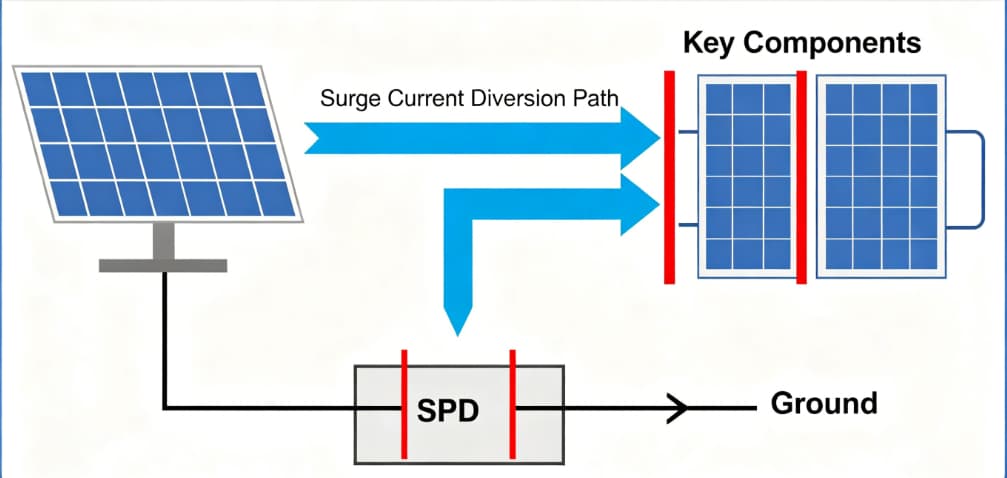
A DC SPD operates in real time, reacting within nanoseconds when a surge occurs.
┃ Typical response time is less than 25 nanoseconds.
This extremely fast reaction is what prevents catastrophic damage in solar systems.
Solar PV systems are particularly vulnerable because they are:
┃ 1. Direct lightning strikes (rare but destructive)
┃ 2. Indirect lightning induction (most common)
┃ 3. Grid switching surges
┃ 4. Ground potential differences
Without protection, even indirect lightning can induce thousands of volts into PV strings.
This makes Solar SPD (DC SPD) a critical requirement in all installations.
Most people assume lightning strikes are the biggest threat to solar PV systems.
However, the real danger is surge energy traveling inside the system itself.
Once a surge enters the system, it can spread through cables and affect multiple devices, causing cascading failures across the entire installation.
Watch this explanation:
👇
┃ Key Insight: Solar protection is not about protecting one device — it is about protecting the entire system.
Although both devices protect against surges, their applications are different.
| Feature | DC SPD | AC SPD |
|---|---|---|
| Current type | Direct Current | Alternating Current |
| Application | Solar PV systems | Grid power systems |
| Arc behavior | Hard to extinguish | Naturally zero-crossing |
| Risk level | Higher | Lower |
┃ DC systems are more dangerous during surge events because DC arcs do not naturally extinguish.
DC SPDs are generally categorized into three types:
Used in areas with direct lightning exposure
Used for standard solar protection (most common Solar SPD type)
Used for protecting sensitive downstream electronics
┃ In most solar PV systems, Type 2 Solar SPD is the standard choice.
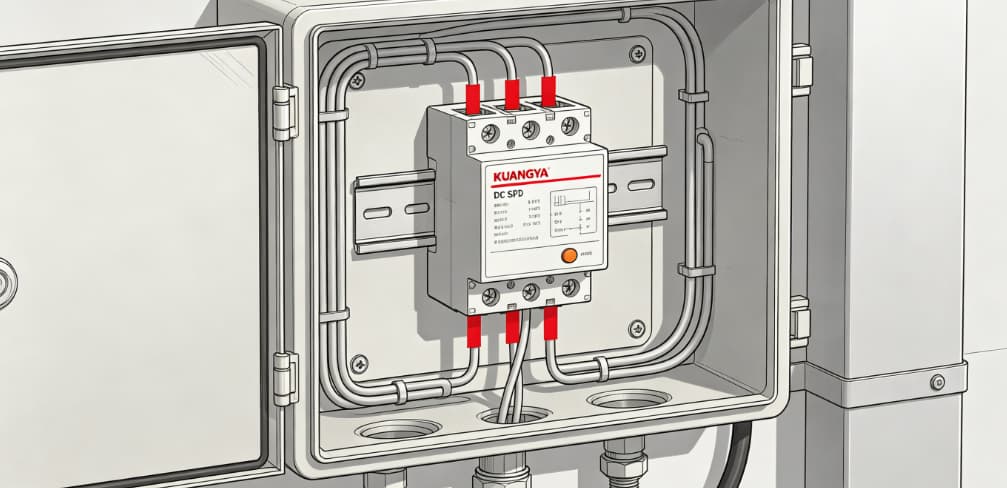
Correct installation location determines protection effectiveness.
Common installation points include:
┃ The closer the SPD is to the equipment, the higher the protection efficiency.
Incorrect placement can significantly reduce protection performance.
To understand What Is DC SPD, we must understand surge behavior.
A surge is not a steady flow of electricity—it is a high-energy transient wave.
┃ Reflection – energy bounces between components
┃ Amplification – long cables increase voltage peaks
┃ Induction – electromagnetic coupling from lightning
Even indirect lightning can generate dangerous voltage spikes.
A commercial rooftop system in Southeast Asia experienced indirect lightning. Without DC SPD installed, 4 inverters were damaged, costing the owner over $25,000 in replacement and downtime.
A 10 MW solar farm in the Middle East had Type 2 Solar SPD installed in all combiner boxes. A nearby lightning strike caused a surge of 7 kV, but all inverters and monitoring systems remained fully operational, saving the company hundreds of thousands in potential losses.
┃ These examples demonstrate the tangible ROI of DC SPD investment.
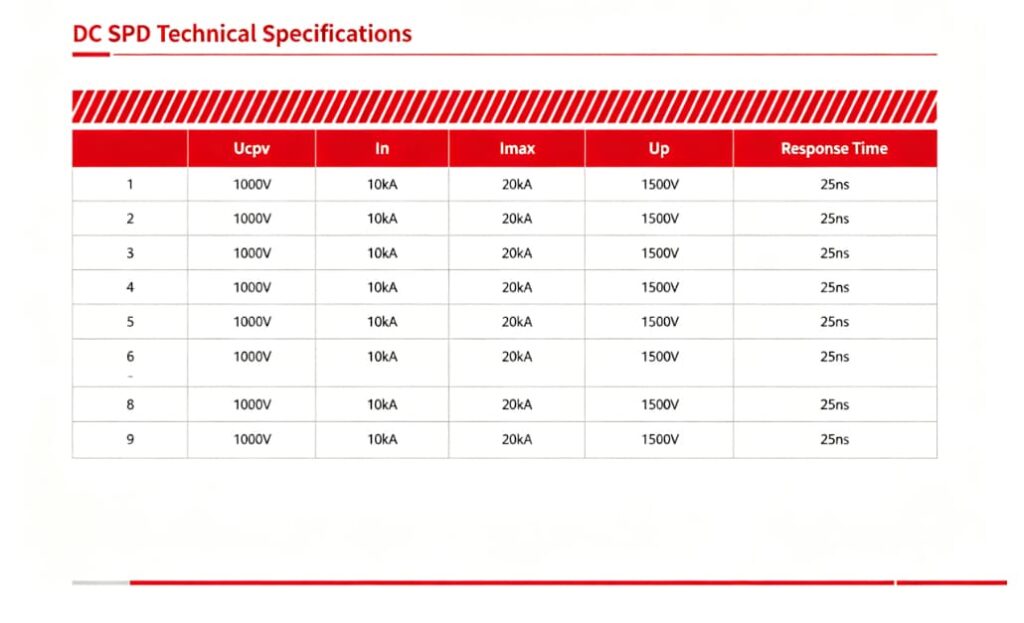
A reliable DC SPD is defined by several key parameters:
Understanding these specifications is only the first step. Proper installation also requires knowing how to size a DC SPD for a solar PV array based on system voltage, cable length, and surge exposure level.
| Parameter | Meaning | Importance |
|---|---|---|
| Ucpv | Max operating voltage | Must match PV system voltage |
| In | Nominal surge current | Normal surge handling |
| Imax | Maximum surge capacity | Extreme event protection |
| Up | Residual voltage level | Lower = better protection |
| Response time | Reaction speed | Critical for safety |
Installing DC SPD is a small fraction of total PV system cost but prevents catastrophic financial loss.
| Item | Cost | Risk Without SPD |
|---|---|---|
| Single inverter replacement | $6,000 | High (possible failure) |
| DC SPD unit | $200–$500 | Low |
| Downtime per day | $1,500/day | Can be 10+ days without SPD |
┃ ROI for DC SPD can be realized within the first surge event avoided.
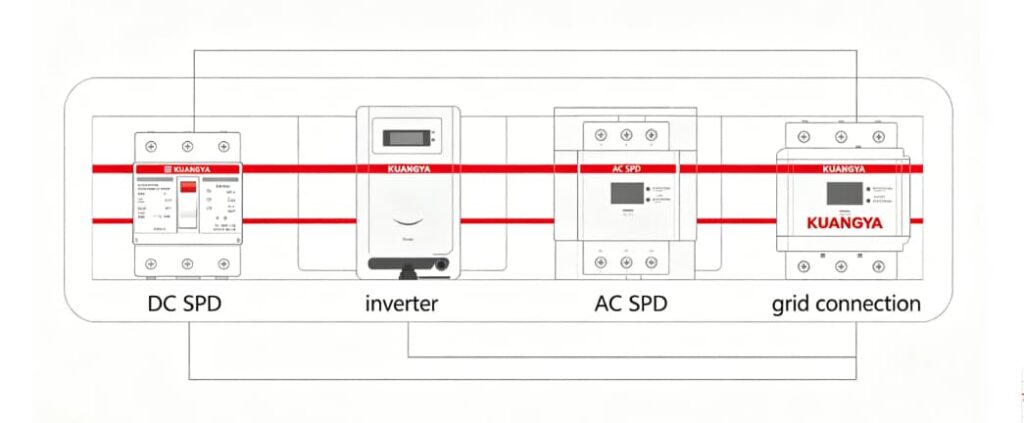
A complete solar protection system includes multiple layers:
┃ DC SPD acts as the first line of defense before energy reaches the inverter.
PV Array → Combiner Box (DC SPD installed) → Inverter → AC SPD → Grid Connection
┃ If this sequence is broken, surge energy may bypass protection layers.
┃ Keep SPD leads as short as possible
┃ Ensure low-impedance grounding
┃ Install as close to protected equipment as possible
┃ Avoid sharp cable bends and physical stress
┃ A failed or poorly installed SPD provides zero protection.
┃ Leads to premature SPD failure
┃ Cannot handle real surge events
┃ Reduces protection efficiency
┃ Increases residual voltage exposure
┃ High humidity, temperature, and dust accelerate degradation
External conditions significantly affect SPD lifespan:
┃ Even without surge events, environmental stress can shorten SPD lifespan.
DC SPD technology is evolving alongside solar energy systems.
┃ Future Solar SPD systems will act as intelligent protection networks.
A device that protects solar systems from dangerous voltage surges.
Yes, even small systems can be damaged by lightning-induced surges.
Typically 5–10 years depending on surge exposure and environment.
It significantly reduces risk but cannot stop direct lightning strikes completely.
Only if the indicator shows normal status; otherwise, replacement is mandatory.
Compliance with IEC 61643-31, UL 1449, and IEC 62561

