Address
304 North Cardinal
St. Dorchester Center, MA 02124
Work Hours
Monday to Friday: 7AM - 7PM
Weekend: 10AM - 5PM
Address
304 North Cardinal
St. Dorchester Center, MA 02124
Work Hours
Monday to Friday: 7AM - 7PM
Weekend: 10AM - 5PM

Type B RCCBs: EV Safety Essential: global transition toward electric mobility is accelerating at an unprecedented pace. With millions of electric vehicles (EVs) now on roads worldwide and charging infrastructure expanding rapidly across urban centers, highways, and residential communities, the importance of electrical safety in these installations cannot be overstated. At the heart of this safety ecosystem lies a critical but often overlooked component: the Residual Current Circuit Breaker (RCCB), specifically Type B variants designed to handle the unique electrical challenges posed by modern EV charging systems.
As EV adoption continues to surge, with projections indicating that electric vehicles will account for over 50% of new car sales in many markets by 2030, the demand for reliable and safe charging infrastructure has become paramount. Charging stations, whether installed in homes, workplaces, or public locations, represent complex electrical installations that must protect both users and equipment from potentially lethal electrical faults. The selection of appropriate protective devices, particularly rccb for ev charging station applications, has emerged as a fundamental consideration for installers, facility managers, and electrical engineers.
The evolution of EV charging technology has introduced new electrical phenomena that traditional protection devices were not designed to address. Modern EV chargers, particularly those utilizing DC fast charging capabilities or incorporating vehicle-to-grid (V2G) functionality, generate residual currents with complex waveforms that include DC components and high-frequency harmonics. These characteristics render conventional Type AC and Type A RCCBs inadequate, necessitating the deployment of Type B RCCBs capable of detecting and responding to the full spectrum of fault currents encountered in EV charging applications.
Residual Current Circuit Breakers represent a cornerstone of modern electrical safety systems, designed to protect against electric shock and prevent electrical fires caused by earth fault currents. Unlike conventional circuit breakers that respond to overcurrent conditions, RCCBs continuously monitor the balance of current flowing through the live and neutral conductors of an electrical circuit. Under normal operating conditions, the currents in these conductors are equal and opposite, resulting in zero net magnetic flux in the device’s toroidal transformer core. When an earth fault occurs, creating an alternative path for current to flow through a person or equipment chassis to ground, this balance is disrupted.
The resulting differential current induces a magnetic flux in the transformer’s core, which the RCCB’s detection circuit recognizes as a fault condition. When this residual current exceeds the device’s rated sensitivity threshold, typically 30mA for personnel protection or 300mA for fire protection, the RCCB’s trip mechanism activates within milliseconds, disconnecting the power supply and eliminating the shock hazard. This fundamental operating principle has proven remarkably effective in protecting human life across countless residential, commercial, and industrial applications for decades.
The development of RCCB technology has progressed through several generations, each designed to address specific categories of electrical faults. Type AC RCCBs, the earliest and most basic variant, detect only sinusoidal alternating residual currents at the fundamental supply frequency of 50 or 60 Hz. While adequate for simple resistive and inductive loads common in traditional electrical installations, Type AC devices cannot reliably detect DC fault currents or high-frequency pulsating currents generated by modern power electronic equipment.
Type A RCCBs expanded protection capabilities to include pulsating DC residual currents superimposed on AC, making them suitable for loads such as washing machines and certain types of power supplies. However, Type A devices still have significant limitations regarding pure DC fault detection and high-frequency components. Type F RCCBs were developed specifically for single-phase variable speed drives and similar equipment, offering enhanced immunity to transient disturbances while maintaining sensitivity to the fault current types detected by Type A devices.
Type B RCCBs represent the current state-of-the-art in residual current protection, capable of detecting smooth DC residual currents, AC currents at frequencies up to 1kHz or 2kHz (depending on certification standards), and pulsating DC currents with or without superimposed DC components. This comprehensive detection capability makes Type B RCCBs mandatory for applications involving power conversion equipment, battery charging systems, and increasingly, for rccb for solar system installations where DC-to-AC inverters generate complex residual current signatures.
International standards governing RCCB performance and application have evolved in response to technological developments in electrical equipment. IEC 61008 and IEC 61009 series standards define the requirements for residual current operated circuit-breakers without and with integral overcurrent protection, respectively. Amendment 2 to IEC 61008-1 and IEC 61009-1 introduced specific requirements for Type B RCCBs, establishing test protocols for DC detection capability and high-frequency response.
IEC 60364-7-722, the international standard for electrical installations of charging points for electric vehicles, explicitly mandates the use of Type B RCCBs for EV charging equipment in certain configurations, particularly where DC fault currents may be present. Similarly, IEC 60364-7-712, addressing photovoltaic power supply systems, specifies protection requirements that increasingly favor Type B devices for rccb for solar system applications. National wiring regulations, including BS 7671 in the United Kingdom and NF C 15-100 in France, have incorporated these international standards, making Type B RCCB requirements legally binding in many jurisdictions.
Modern EV charging systems comprise sophisticated power electronics that convert grid-supplied AC power into the DC power required to charge vehicle battery packs. The charging process involves multiple stages of power conversion, typically beginning with AC-to-DC rectification followed by DC voltage regulation and current control. This conversion process inherently generates residual currents with characteristics that differ fundamentally from those produced by conventional linear loads.
AC Level 1 and Level 2 chargers, commonly used for home and workplace charging, utilize onboard vehicle chargers to perform the final DC conversion. While these systems present relatively straightforward electrical protection challenges, they still generate high-frequency harmonic currents due to the switching operations within their rectifier circuits. DC fast chargers, increasingly deployed for public charging infrastructure, perform high-power DC conversion external to the vehicle, introducing additional complexity to the electrical protection scheme. These chargers can deliver 50kW to 350kW or more of DC power, utilizing sophisticated power factor correction (PFC) circuits and DC-DC converters that generate complex current waveforms.
The most significant electrical safety challenge in EV charging installations involves the risk of DC fault currents. Under certain fault conditions, including insulation breakdown within the charger, vehicle, or charging cable, DC current can flow into the protective earth conductor. This DC component may originate from the vehicle’s battery pack or from the charging station’s internal DC bus, presenting several serious concerns for electrical safety.
First, DC fault currents do not provide the same physiological effects as AC currents. The human body’s response to DC shock differs significantly from AC exposure, with DC currents potentially causing sustained muscle contraction that prevents a person from releasing an energized conductor. More critically for protection device performance, the presence of DC fault currents can cause core saturation in standard RCCB transformers, effectively “blinding” Type AC and Type A devices so they cannot respond to subsequent AC fault currents. This blinding effect creates a dangerous situation where an RCCB may fail to trip during a life-threatening fault condition.
Type B RCCBs incorporate specialized magnetic core materials and detection circuitry specifically designed to identify and respond to smooth DC residual currents. The ability to detect DC fault currents up to specified levels while maintaining sensitivity to AC faults makes Type B devices essential for rccb for ev charging station installations where DC components may be present. The comprehensive protection offered by Type B devices ensures that all fault current types, whether AC, pulsating DC, or smooth DC, trigger appropriate protective action.
The switching frequencies employed in modern EV charger power electronics typically range from several kilohertz to over 100kHz, generating harmonic currents that propagate throughout the electrical installation. While the fundamental frequency of these switching operations is well above the range that RCCBs are required to detect, the harmonic content can create cumulative effects that influence overall system safety.
Capacitive leakage currents represent another important consideration in EV charging installations. The EMC filters incorporated into EV chargers to suppress electromagnetic interference contain capacitors connected between line conductors and earth. These capacitors conduct small but measurable currents to ground during normal operation, contributing to the steady-state residual current that flows even when no fault exists. In installations with multiple EV chargers or long cable runs, these capacitive currents can accumulate to levels that approach or exceed the rated sensitivity of protection devices, potentially causing nuisance tripping or compromising safety margins.
The majority of EV charging occurs at residential locations, where home charging stations provide convenient overnight charging capabilities. These installations typically utilize AC Level 1 (120V) or Level 2 (240V) chargers with power ratings ranging from 1.4kW to 19kW. While seemingly straightforward, residential EV charging installations present specific protection requirements that demand careful consideration of RCCB selection.
Modern residential EV chargers often feature advanced capabilities including Wi-Fi connectivity, load management systems, and integration with home energy management platforms. These features require sophisticated internal power supplies that generate the complex residual current signatures previously described. Additionally, the increasing prevalence of bidirectional charging capabilities, enabling vehicle-to-home (V2H) and vehicle-to-load (V2L) functionality, introduces additional electrical complexity that reinforces the need for Type B protection.
Workplace charging installations face similar considerations while typically serving larger numbers of vehicles and operating at higher power levels. Commercial installations must also account for the cumulative effects of multiple chargers operating simultaneously, with capacitive leakage currents from EMC filters potentially combining to create significant residual currents during normal operation. Type B RCCBs selected for these applications must provide adequate sensitivity for personnel protection while maintaining immunity to nuisance tripping caused by normal operating characteristics.
Public EV charging stations represent the most demanding application environment for residual current protection devices. These installations must operate reliably under widely varying conditions, including extreme temperatures, high humidity, and exposure to mechanical stress from vehicles and users. The high utilization rates and commercial importance of public charging infrastructure demand protection devices with exceptional reliability and longevity.
DC fast charging stations, delivering 50kW to 350kW of charging power, present the most stringent protection requirements. These installations feature complex power conversion systems with multiple stages of AC-DC and DC-DC conversion, generating fault currents across the full spectrum of waveforms and frequencies that Type B devices are designed to detect. The high current levels involved in fast charging, potentially exceeding 500A at the DC output, underscore the critical importance of reliable earth fault protection to prevent catastrophic failures and ensure user safety.
The selection of rccb for ev charging station applications in public infrastructure must consider not only technical performance requirements but also operational factors including maintenance accessibility, environmental protection ratings, and compatibility with monitoring and control systems. Many public charging networks now incorporate remote monitoring capabilities that require RCCBs with auxiliary contacts or communication interfaces for integration with building management systems.
The convergence of EV charging infrastructure with distributed energy resources, particularly photovoltaic (PV) solar systems, creates additional electrical protection considerations. Many modern EV charging installations incorporate on-site solar generation, with chargers configured to utilize renewable energy when available and draw from the grid when solar production is insufficient. This integration requires protection schemes that account for the unique characteristics of solar inverter systems.
Solar PV inverters generate residual currents with characteristics similar to those of EV chargers, including DC components and high-frequency harmonics. Installations combining both solar generation and EV charging therefore benefit from Type B RCCB protection that addresses the full range of fault currents potentially present. The growing adoption of integrated solar-plus-storage-plus-charging systems, where battery energy storage systems (BESS) are combined with solar PV and EV charging, further reinforces the importance of comprehensive residual current protection.
The application of rccb for solar system installations follows similar principles to those governing EV charging protection. Solar inverters, particularly transformerless designs common in modern residential and commercial installations, can conduct DC fault currents under certain failure modes. International standards increasingly mandate Type B protection for solar PV systems above specified power ratings, recognizing the inadequacy of Type A devices for these applications. The synergistic protection requirements of combined solar-plus-charging installations make Type B RCCBs the logical and often mandatory choice for these integrated energy systems.
Type B RCCBs demonstrate comprehensive detection capabilities that distinguish them from lower-type protection devices. These devices respond to sinusoidal AC residual currents at frequencies from 50/60 Hz up to 1,000 Hz or 2,000 Hz, depending on certification to specific standards. This high-frequency detection capability ensures protection against faults generated by modern power electronic equipment operating at elevated frequencies.
The DC detection capability of Type B RCCBs represents their most significant advancement over Type A devices. Type B devices detect smooth DC residual currents up to specified thresholds, typically 6mA or higher, ensuring that dangerous DC fault currents cannot persist undetected. This capability directly addresses the core safety concern of DC blinding that affects conventional RCCBs. Additionally, Type B devices respond to pulsating DC currents with or without superimposed DC components, covering the intermediate fault categories between pure AC and pure DC.
The trip characteristics of Type B RCCBs follow standardized patterns defined in IEC 61008 and IEC 61009. Instantaneous tripping occurs when residual currents exceed rated sensitivity thresholds, with trip times typically under 40ms for 30mA devices at rated fault current. Time-delayed variants (Type S or selective) incorporate intentional delays to enable coordination with downstream protection devices, maintaining selectivity in branched electrical installations.
| RCCB Type | AC Detection (50/60 Hz) | Pulsating DC | Smooth DC | High Frequency (>1kHz) | Typical Applications |
|---|---|---|---|---|---|
| Type AC | Yes | No | No | No | Basic resistive loads, legacy installations |
| Type A | Yes | Yes | No | Limited | Household appliances, standard EV chargers (AC only) |
| Type F | Yes | Yes | No | Yes (up to 1kHz) | Single-phase drives, some EV applications |
| Type B | Yes | Yes | Yes (up to 6mA+) | Yes (up to 1-2kHz) | EV charging stations, solar inverters, industrial drives, medical equipment |
Table 1: Comparison of RCCB Types and Detection Capabilities
The selection of appropriate Type B RCCBs for specific applications requires careful consideration of multiple electrical parameters. Rated current ratings typically range from 25A to 125A or higher for industrial applications, with the selected rating exceeding the maximum continuous load current by appropriate safety margins. Rated residual operating current (IΔn) values commonly include 10mA, 30mA, 100mA, and 300mA, with 30mA representing the standard for personnel protection and 300mA typical for fire protection applications.
The rated voltage and frequency must match the installation parameters, with most Type B RCCBs designed for 230/400V 50/60Hz systems common in international markets. Breaking capacity ratings indicate the maximum fault current the device can safely interrupt without damage, with typical values of 6kA, 10kA, or higher depending on the prospective short-circuit current at the installation location.
Environmental ratings including IP (Ingress Protection) and IK (Impact Protection) codes guide selection for challenging installation conditions. Outdoor EV charging stations require RCCBs with appropriate weatherproof ratings, often achieved through installation within protected enclosures rather than intrinsic device ratings. Temperature derating may be necessary for installations in extreme climate conditions, with standard devices typically rated for -25°C to +40°C ambient operation.
| Parameter | Residential EV Charging | Commercial EV Charging | DC Fast Charging | Solar PV Integration |
|---|---|---|---|---|
| Rated Current | 25A – 40A | 40A – 63A | 63A – 125A+ | 40A – 100A |
| Rated Sensitivity (IΔn) | 30mA | 30mA / 100mA | 100mA – 300mA | 30mA – 300mA |
| Poles | 2P or 4P | 4P | 4P | 2P or 4P |
| Type | Type B | Type B | Type B | Type B |
| Environmental Rating | IP2X minimum | IP4X minimum | IP65 | IP4X minimum |
| Special Features | Standard | Selective/delayed | Selective/delayed, aux contacts | DC monitoring, surge protection |
Table 2: Type B RCCB Selection Guidelines by Application
Electrical installations incorporating EV charging equipment must comply with applicable national wiring regulations, which increasingly reference international standards regarding residual current protection. In the European Union, the Low Voltage Directive mandates compliance with harmonized standards, effectively making Type B RCCB requirements mandatory for covered installations. Similar regulatory frameworks in North America, Asia-Pacific, and other regions are progressively adopting comparable requirements as EV charging infrastructure expands globally.
Installation standards specifically addressing EV charging include IEC 60364-7-722 (Electrical installations of buildings – Requirements for special installations or locations – Electric vehicle charging), which provides detailed guidance on protection, isolation, and switching requirements. This standard explicitly identifies circumstances requiring Type B RCCBs, particularly for conductive connection to the vehicle or where DC fault currents may occur. Compliance with these standards is essential for installation certification, insurance coverage, and operational safety.
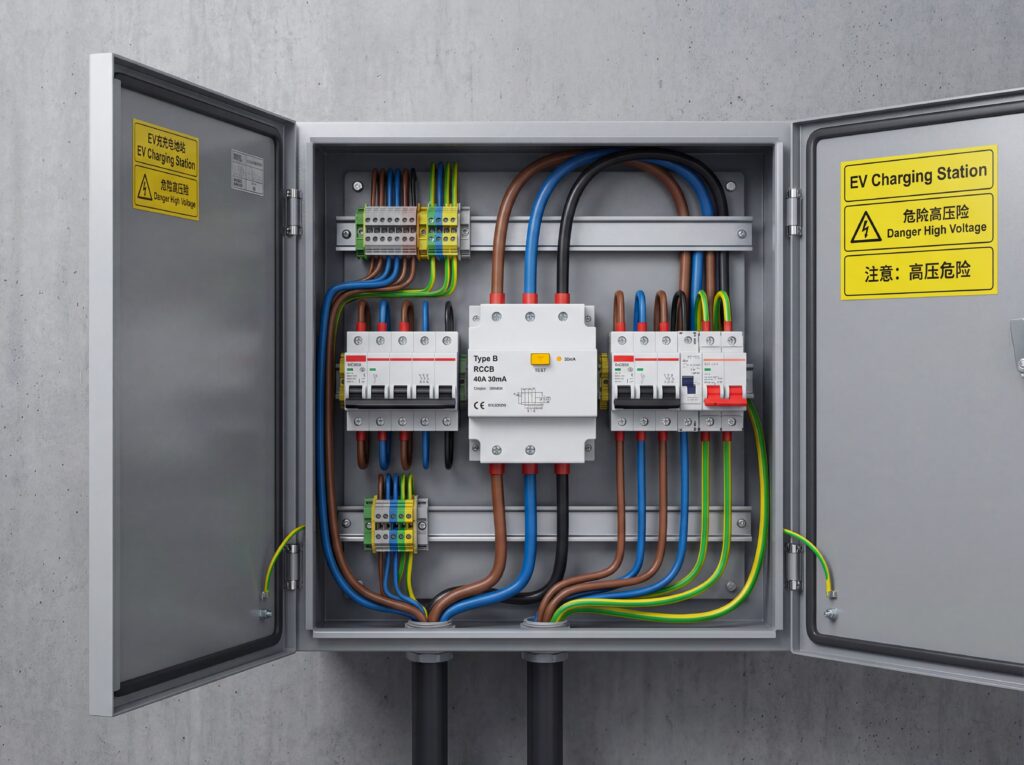
The physical location of RCCBs within EV charging installations affects both safety performance and operational reliability. Type B RCCBs should be installed upstream of the EV charging equipment, typically within the distribution board or dedicated enclosure serving the charging circuit. This location ensures protection of the entire circuit including any connection equipment while enabling convenient access for testing and maintenance.
Where multiple EV chargers are installed, individual RCCBs for each circuit provide the highest level of protection and operational flexibility, enabling isolation of individual chargers for maintenance without affecting others. Alternatively, a single RCCB serving multiple chargers may be appropriate in smaller installations, though careful load calculation and selectivity analysis is required. The use of time-delayed (selective) Type B RCCBs upstream with instantaneous devices downstream maintains coordination during fault conditions.
Surge protection devices (SPDs) should be coordinated with RCCB installations, with SPDs typically installed downstream of RCCBs to prevent damage from transient overvoltages. The connection between RCCBs and earth must follow standard practices ensuring low impedance paths for fault currents, with bonding conductors appropriately sized for the prospective fault currents.
Regular testing of Type B RCCBs is essential to ensure continued protection effectiveness. All RCCBs incorporate test buttons that simulate fault conditions, enabling users to verify trip functionality. Monthly testing by pressing the test button confirms basic operational capability, while annual or periodic inspection and testing by qualified personnel verifies trip times and sensitivity against manufacturer specifications.
Type B RCCBs require the same testing protocols as other RCCB types, with no special procedures needed for the DC detection capability. However, installation testing should include verification that the selected device provides appropriate protection for the connected loads, with particular attention to installations combining EV charging with other power electronic equipment. Record-keeping of test results supports predictive maintenance and demonstrates regulatory compliance.
Type B RCCBs command higher purchase prices than Type AC or Type A alternatives, reflecting their more sophisticated detection circuitry and comprehensive protection capabilities. This cost differential, typically 3-5 times the price of basic RCCBs, represents a significant consideration for large-scale installations. However, the total cost of ownership analysis must account for the complete economic picture including safety benefits, regulatory compliance, and operational reliability.
The consequences of inadequate protection in EV charging installations can be severe, ranging from equipment damage and installation downtime to personal injury or fatalities. Type B RCCBs eliminate the risk of protection failure due to DC blinding, ensuring that installations maintain safety integrity throughout their operational life. For commercial and public charging operators, the reliability of protection systems directly impacts customer satisfaction and revenue generation.
Regulatory compliance represents another economic consideration, as installations failing to meet current standards may require costly retrofitting to achieve certification or insurance coverage. The incremental cost of Type B RCCBs at initial installation is substantially lower than the cost of replacing inadequate protection devices following regulatory enforcement or incident investigation.
The Type B RCCB market is experiencing rapid growth driven by EV charging infrastructure expansion and regulatory mandate expansion. Major manufacturers have significantly expanded their Type B product ranges, with devices now available across the full spectrum of ratings and configurations required for residential through industrial applications. Competition among manufacturers is progressively reducing price premiums relative to Type A devices, improving the economic case for Type B adoption.
Technology development continues to enhance Type B RCCB capabilities, with improvements in detection accuracy, immunity to nuisance tripping, and integration with smart building systems. Emerging features include built-in monitoring and communication capabilities that enable remote status verification and predictive maintenance, supporting the digitalization of electrical infrastructure management. These developments align with broader trends in smart grid integration and energy management system sophistication.
The essential nature of Type B RCCBs for EV charging infrastructure safety emerges from the fundamental mismatch between the electrical characteristics of modern power electronic equipment and the detection capabilities of conventional protection devices. As the transportation sector continues its transformation toward electric mobility, the installations enabling this transition must incorporate protection systems capable of addressing the full spectrum of electrical fault hazards.
Type B RCCBs provide comprehensive protection against AC, pulsating DC, and smooth DC residual currents, eliminating the DC blinding risk that compromises the effectiveness of Type AC and Type A devices in EV charging applications. Regulatory standards have progressively recognized this requirement, mandating Type B protection for EV charging installations in jurisdictions worldwide. The application of Type B RCCBs extends beyond EV charging to encompass rccb for solar system installations and other power electronic applications generating complex residual current signatures.
The economic case for Type B RCCBs, while initially presenting higher acquisition costs, is strengthened by total cost of ownership considerations, regulatory compliance requirements, and the paramount importance of safety in electrical installations. As EV adoption accelerates and charging infrastructure scales to meet growing demand, the deployment of Type B RCCBs will remain an essential element of safe, reliable, and compliant electrical installations supporting the electric mobility revolution.
The convergence of EV charging with distributed energy resources, smart grid technologies, and building energy management systems further reinforces the importance of robust residual current protection. Installations incorporating both EV charging and solar PV generation benefit from the comprehensive protection provided by Type B devices, simplifying system design and ensuring safety integrity across all operating modes. The continued evolution of Type B RCCB technology, with enhanced features and improved economics, supports the scalable deployment of charging infrastructure necessary for global transportation electrification goals.
In summary, Type B RCCBs are not merely an enhanced protection option for EV charging installations—they represent an essential safety component mandated by standards and validated by the electrical characteristics of modern charging equipment. Stakeholders across the EV charging ecosystem, from residential installers to commercial operators and infrastructure developers, must prioritize Type B protection to ensure the safe, reliable, and sustainable growth of electric mobility infrastructure worldwide.
FAQ:
1.What’s the difference between Type A and Type AC RCCB?
The primary difference between a Type AC and a Type A Residual Current Circuit Breaker (RCCB) lies in the types of electrical faults they can detect. While a Type AC can only detect AC faults, a Type A can detect both AC and specific DC faults, making it the safer and more versatile choice for modern homes and businesses .
Here is a detailed comparison to help you understand the differences and choose the right one.
2.Do I need Type B RCCB for EV charging?
For EV charging, you generally need protection against smooth DC fault currents. While a Type B RCCB is one way to achieve this, you might also have a second option depending on your charging equipment.
Based on electrical standards like BS (IEC) EN 61851-1, all EV charging points must have RCD protection with an AC rating not exceeding 30mA. Crucially, they also require protection against smooth DC currents . Here is how the two compliant solutions compare:
This is the most straightforward and commonly recommended solution.
This is an alternative, cost-effective solution that meets the same safety standards.
You should not use a standard Type AC RCCB for EV charging. It cannot handle the high-frequency harmonics and DC components produced by modern EV chargers, which can cause the device to overheat and fail, posing a serious safety risk .
I hope this clarifies the requirements for your EV charging setup. Are you installing a specific model of charger? If you can share the make and model, I can help you check the manufacturer’s recommendation.

