WengYang Industrial Zone Yueqing Wenzhou 325000
Work Hours
Monday to Friday: 7AM - 7PM
Weekend: 10AM - 5PM
WengYang Industrial Zone Yueqing Wenzhou 325000
Work Hours
Monday to Friday: 7AM - 7PM
Weekend: 10AM - 5PM

Learn how to plan surge protection for LED street lights, including feeder, pole and luminaire SPD placement, selection, bonding and maintenance.
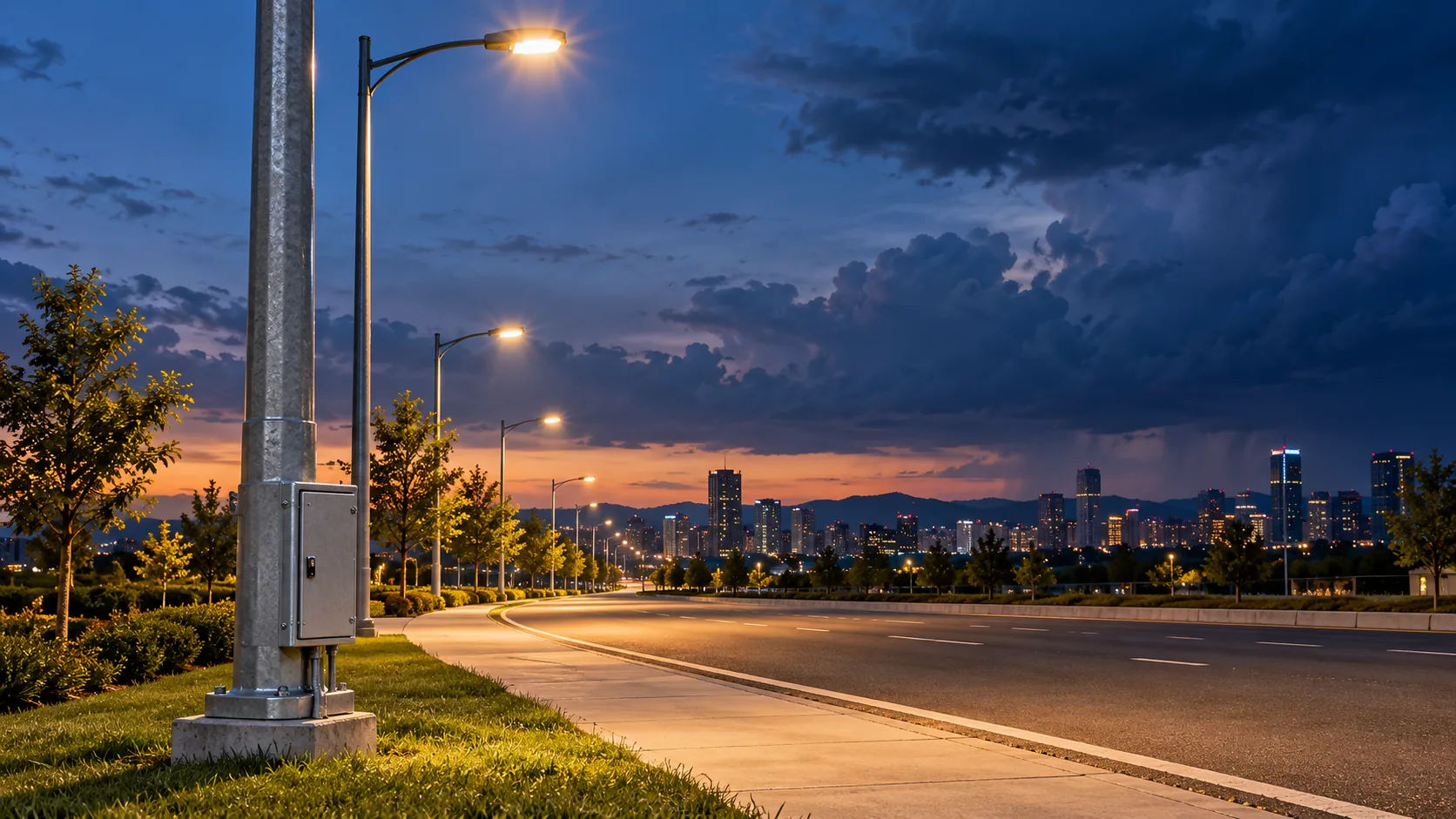
LED street lights are exposed to long outdoor cable runs, switching events and lightning-induced transients. The LED driver is often the most vulnerable and expensive part of a luminaire to replace. A surge protective device (SPD) can reduce transient stress, but its location and the complete installation matter more than a large kA number on a product label.
This guide explains a practical three-location approach: assess the feeder cabinet, the pole access compartment and the luminaire. The right arrangement depends on the supply network, cable lengths, local lightning exposure and the luminaire manufacturer's instructions.
| Location | What it helps protect | Design question |
|---|---|---|
| Lighting distribution cabinet | Multiple outgoing lighting circuits | Is an upstream SPD required at the supply entry, and which Type is appropriate? |
| Pole access compartment | Conductors and equipment at an individual pole | Is there a suitable enclosure, bonding path and replaceable SPD arrangement? |
| Luminaire or driver compartment | The LED driver and controls | Is an integrated or external SPD approved by the luminaire manufacturer? |
These locations are options, not a rule that every pole needs three SPDs. An electrical designer should coordinate them for the actual project. IEC 61643-12:2020 covers principles for selecting, locating and coordinating AC power SPDs; IEC 61643-11:2025 addresses requirements and tests for AC low-voltage SPDs. IEC 61643-12:2020 · IEC 61643-11:2025
An LED driver converts the incoming AC supply into controlled power for the LEDs. Outdoor lighting adds exposure that an indoor panel may not face: long cable runs, poles and other conductive structures, moisture, and accessible control equipment. A transient can reach a luminaire through the supply conductors or associated control wiring. The SPD must be selected for the relevant circuit and protection modes; it cannot compensate for a missing protective-earth connection or poor bonding.
Public-lighting guidance from Signify discusses surge protection as part of the overall lighting installation. A manufacturer's built-in surge claim should be checked against the actual project requirement rather than treated as a substitute for a coordinated design.
Document the nominal supply voltage, earthing arrangement, available fault current and the cabinet's existing protective devices. Check whether the installation calls for a Type 1, Type 2 or coordinated arrangement based on lightning exposure and the project's applicable rules. Select the AC SPD's continuous operating voltage (Uc), voltage protection level (Up), discharge ratings, short-circuit rating and backup protection from its datasheet.
Do not copy an SPD fuse rating from another model. The existing upstream device may already satisfy the manufacturer's conditions, or a dedicated backup device may be needed. Our SPD backup fuse guide explains the F1/F2 check in more detail.
A pole-mounted SPD may offer a serviceable protection point closer to the luminaire, especially where the feeder-to-luminaire cable is long. It must fit the pole's electrical compartment and environmental conditions. Verify the enclosure rating, terminal capacity, conductor routing, earthing and bonding, and how a technician will identify a failed cartridge during maintenance.
Keep the SPD leads short and direct according to the manufacturer's instructions. A long, looped connection can increase the voltage that reaches the LED driver during a fast transient. Never assume that a green status window proves the whole pole installation is correctly protected; it usually reports only the monitored state of the device. See our SPD indicator guide.
Ask the luminaire supplier whether surge protection is built into the driver, supplied as a separate replaceable module, or required externally. Confirm the declared test conditions and protection modes. If an external SPD is proposed, check physical space, temperature, wiring and warranty conditions before installation. Some lighting products allow different behavior when a series or parallel SPD fails; this should be chosen deliberately for maintenance and availability needs, as illustrated in Philips/Signify's LED electronics catalogue.
If the lighting system has networked controls, review the signal and communication paths too. An AC power SPD does not automatically protect every control port. IEC 61643-21:2025 addresses SPDs for telecommunications and signalling networks, including lines that may also carry power. IEC 61643-21:2025
Before requesting a quote, collect:
An SPD is not a voltage stabilizer and will not correct prolonged overvoltage or a sustained supply fault. Our SPD vs voltage stabilizer guide explains that distinction.
Not necessarily. The decision depends on the feeder architecture, exposure, luminaire protection, cable lengths and local requirements. A coordinated cabinet-and-pole strategy may differ from a compact installation with integrated luminaire protection.
No. Check the product's approved application, enclosure and environmental ratings, available space, wiring and maintenance access. A panel SPD's electrical ratings alone do not prove it is suitable for a pole compartment.
No. Surge protection reduces specified transient stresses; it does not guarantee survival of every event. Effective protection depends on the full installation, including bonding, conductor routing and coordination with other protection measures.
For a lighting project, start with the electrical drawings and luminaire datasheet, then select the SPD locations and models. Kuangya AC SPD products can be reviewed against the required ratings and installation conditions. If you need help matching an SPD to a feeder cabinet or pole design, contact Kuangya with the checklist above.

