WengYang Industrial Zone Yueqing Wenzhou 325000
Work Hours
Monday to Friday: 7AM - 7PM
Weekend: 10AM - 5PM
WengYang Industrial Zone Yueqing Wenzhou 325000
Work Hours
Monday to Friday: 7AM - 7PM
Weekend: 10AM - 5PM

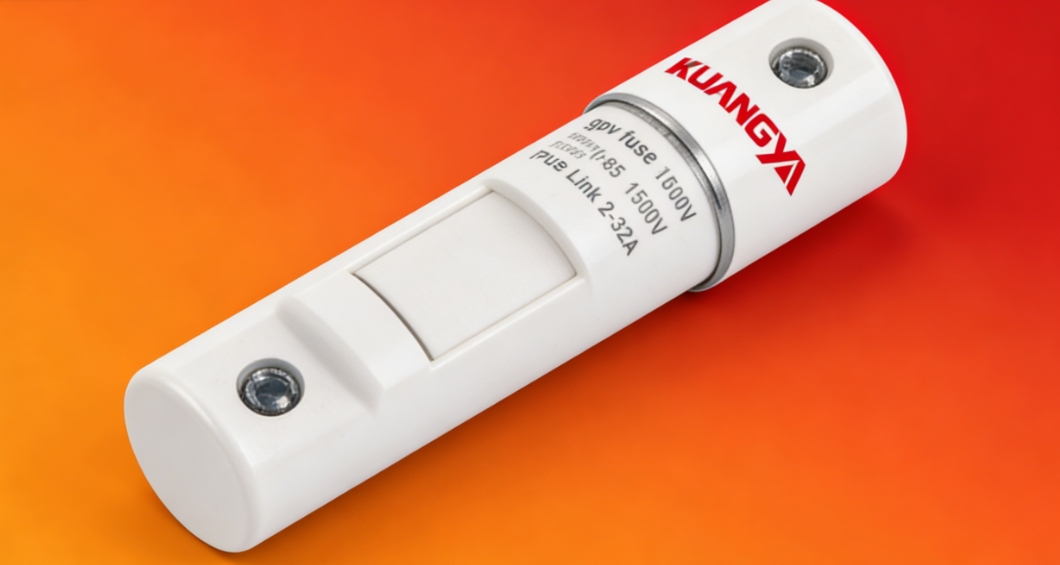
A gPV fuse is a DC-rated fuse-link intended to protect photovoltaic (PV) strings and arrays against specified overcurrent faults. The gPV marking belongs to the PV fuse standard IEC 60269-6. It does not, by itself, establish suitability for a battery rack or an energy-storage DC bus. This guide explains when PV string fusing is needed, what ratings to check and where battery protection differs.
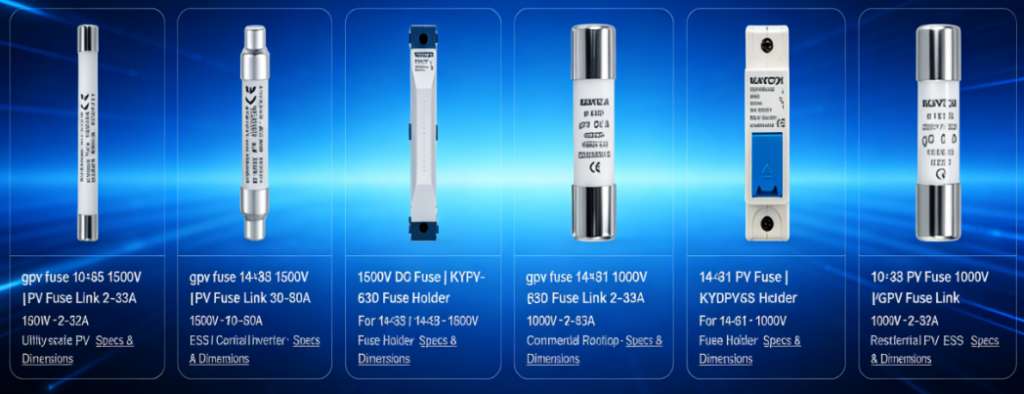
The IEC 60269-6 PV fuse standard gives supplementary requirements for fuse-links protecting PV strings and arrays in circuits of nominal voltage up to 1,500 V DC. A fuse must be matched to its holder, installation conditions and the maximum voltage and fault current at its location. A gPV fuse clears an overcurrent within its specified time-current and breaking-capacity limits; it does not detect every arc fault or guarantee that equipment will escape damage.
String fusing is often used where parallel strings can feed reverse current into a faulted string. Whether fuses are required depends on the number of parallel strings, module maximum series fuse rating, prospective reverse current, conductor ratings and the applicable installation rules. A single string is not automatically required to have a string fuse. Use the array design and the module manufacturer’s instructions rather than a blanket rule for every PV system. IEC 62548-1 addresses PV array design, including wiring and electrical protection devices.
A PV string and a battery can have very different source behavior and available fault currents. IEC 60269-7 gives supplementary requirements for fuse-links protecting batteries and battery systems up to 1,500 V DC. Do not describe a gPV-marked fuse as a battery protection device solely because both circuits are DC. For an energy storage system, follow the battery integrator’s protective-device specification and request evidence for the exact fuse and application.
Use an appropriately rated holder and enclosure, follow the manufacturer’s terminal-torque and mounting instructions, and isolate the PV circuit using the required procedure before handling fuse-links. Inspect the holder for heat damage or loose connections at the intervals specified by the site maintenance plan. After a fuse operates, find and correct the fault before fitting a replacement with the approved specification. Never bypass a fuse or increase its rating merely to stop repeat operation.
No. The requirement depends on array configuration, possible reverse current, module limits and local rules. Confirm it in the project design.
Do not assume so. Battery protection has a separate IEC 60269-7 standard and different fault-current conditions. Check the exact device declaration and the battery system design.
The breaking capacity must cover the calculated prospective fault current, but it does not replace correct voltage, current, holder and coordination checks.
Specify PV fuses from the actual array design, not from a fixed kA value or a universal current multiplier. Explore KUANGYA DC fuse products, and request the exact gPV model datasheet before ordering. For the rest of the PV DC protection scheme, see our solar PV electrical protection guide and solar inverter protection guide.

