Address
304 North Cardinal
St. Dorchester Center, MA 02124
Work Hours
Monday to Friday: 7AM - 7PM
Weekend: 10AM - 5PM
Address
304 North Cardinal
St. Dorchester Center, MA 02124
Work Hours
Monday to Friday: 7AM - 7PM
Weekend: 10AM - 5PM



With the comprehensive revision of Spanish electrical regulations, all circuits requiring RCD protection must adopt Type A RCD residual current devices. This change is not only a compliance requirement but also an inevitable choice for modern distribution systems to address the challenges of non-linear loads. This article provides an in-depth analysis of Type A RCD from the perspectives of technical principles, application scenarios, and selection logic, and offers a one-stop solution for industry clients combined with KUANGYA’s extensive product portfolio.
一、Why can traditional AC-type RCDs not meet modern power distribution requirements?
Prior to the update of Spanish regulations, Type AC RCDs were widely used due to their cost advantages. However, with the popularization of non-linear loads such as electronic devices, chargers, and LED lighting, the form of residual current in circuits has fundamentally changed: from pure sine waves to complex waveforms containing half-wave rectification and DC components.
1.Core Limitations of AC Type Residual Current Operated Devices
AC Type residual current operated devices can only reliably break pure sinusoidal AC residual currents, presenting obvious defects in modern load scenarios
2. Technical Breakthroughs of Type A RCD
Type A RCD is an upgraded product designed to address the characteristics of modern loads, with its core advantage lying in precise detection of complex residual currents:
II. Type A RCD Application Scenarios and Selection Logic: Which Scenarios Must Be Upgraded?
According to the new Spanish regulations and IEC standards, Type A RCDs have become the core protection equipment for residential, commercial, and industrial power distribution. We use typical scenario examples and data comparisons to help clients clearly understand the selection logic.
| Application Scenario | Typical Loads | Risk Points | Recommended Selection | Key Advantages |
| Residential Power Sockets | Mobile phone/computer chargers, small household appliances | Half-wave rectified currents generated by chargers may cause Type AC RCD refusal to operate | KUANGYA VKL001 (25A/63A) | 30mA high sensitivity, cuts off leakage within 0.1s |
| Lighting Circuits | LED lights, dimmers, incandescent lamps | LED drive circuits contain DC components, which may reduce the sensitivity of Type AC RCDs | KUANGYA VFL001 (63A/80A) | Compatible with 50/60Hz wide frequency, anti-electromagnetic interference |
| Consumer Electronics | TVs, hair dryers, tablets | Class II consumer electronics have internal rectifier circuits generating complex residual currents | KUANGYA VKL17 (100A) | Type A certified, 100mA leakage protection threshold suitable for high-current circuits |
| HVAC Equipment | Electric heaters, water heaters | High-power loads tend to generate DC components, affecting protection reliability | KUANGYA VFL001 (80A) | High-current carrying design, excellent high-temperature resistance |
| New Energy Scenarios | Single-phase PV, EV charging (DC component ≤6mA) | PV inverters contain DC components, requiring precise residual current detection | KUANGYA VKL001/VFL001 | Meets the tolerance requirement for ≤6mA DC components |
Type A RCDs are not universal. For the following scenarios, a higher-level Type A-SI (Super-immunized) RCD should be selected:
Type A-SI RCD adds super-immunized (SI) characteristics on the basis of Type A, which can effectively avoid nuisance tripping caused by electromagnetic interference, making it the optimal solution for high-reliability scenarios.
Answer: With the popularization of non-linear loads, Type AC RCDs can no longer cover the residual current types of modern circuits, posing serious safety hazards. Mandating Type A RCDs aims to:
Answer: In terms of single-device cost, Type A RCDs are about 15%-25% more expensive than Type AC RCDs. However, from a life-cycle cost perspective, the upgrade benefits are significant:
Taking residential distribution as an example, a 63A Type A RCD costs an additional ~€20, but provides comprehensive electrical safety protection for the entire household, offering excellent cost performance.
Answer: You can quickly judge by the device marking:
Answer: The core difference lies in electromagnetic interference immunity:
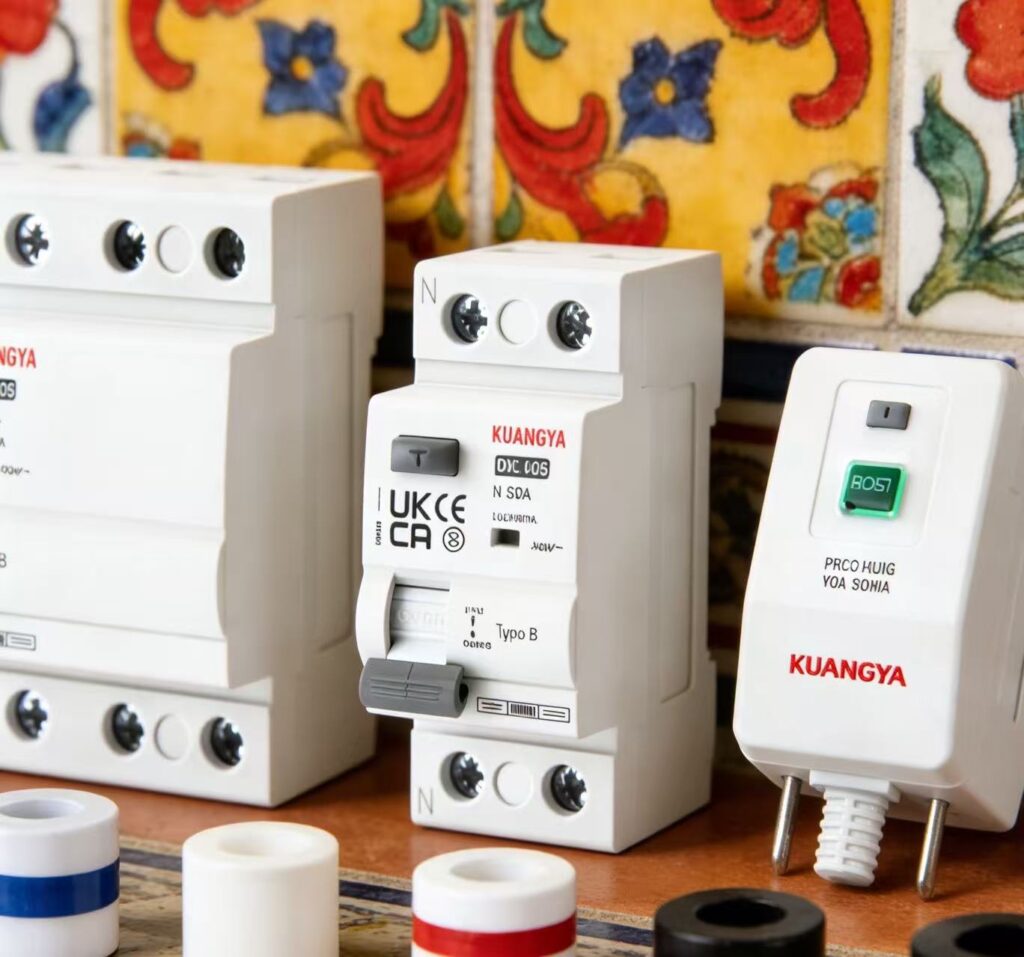
Based on rich technical accumulation and market insights, KUANGYA has launched the following core RCD product categories:
[Insert Image: KUANGYA VFL001 Series Product (with KUANGYA logo)]
| Model | Poles | Rated Current (A) | Leakage Protection Sensitivity (mA) | Rated Voltage (V) | Breaking Capacity (A) | Certifications | Application Scenarios |
| VKL001 | 2P | 25 / 63 | 30 | 230 / 415 | 3000 / 6000 | CE | Residential distribution, small commercial |
| VFL001 | 2P/4P | 63 / 80 | 30 | 230 / 415 | 630 / 6000 | CE | Large commercial, industrial distribution, new energy access |
| VKL17 | 2P | 100 | 100 | 240 | — | UKCA/CE/Type A | Main circuits of large commercial buildings, industrial equipment protection |
V. Conclusion: Embrace Regulatory Changes and Choose KUANGYA to Safeguard Electrical Safety
The update of Spanish electrical regulations is essentially a response to the safety needs of modern power distribution – from “being able to protect” to “precise and reliable protection”. Type A RCDs are not only an inevitable choice for compliance but also a core investment to improve the safety of distribution systems, extend equipment life, and avoid electrical accidents.
With 25 years of experience in electrical equipment manufacturing, KUANGYA relies on profound technical accumulation and a complete product portfolio to provide clients with comprehensive RCD solutions covering TYPE A, TYPE AC, TYPE ASI, TYPE B, TYPE EV, and other categories, fully meeting the new Spanish regulatory requirements and adapting to global markets.

Whether you are a residential user, distribution contractor, or industrial enterprise, you can find a suitable option in KUANGYA’s product system. For more product details and selection solutions, please visit the official website cnkuangya.com to obtain professional technical support and customized services.

