WengYang Industrial Zone Yueqing Wenzhou 325000
Work Hours
Monday to Friday: 7AM - 7PM
Weekend: 10AM - 5PM
WengYang Industrial Zone Yueqing Wenzhou 325000
Work Hours
Monday to Friday: 7AM - 7PM
Weekend: 10AM - 5PM

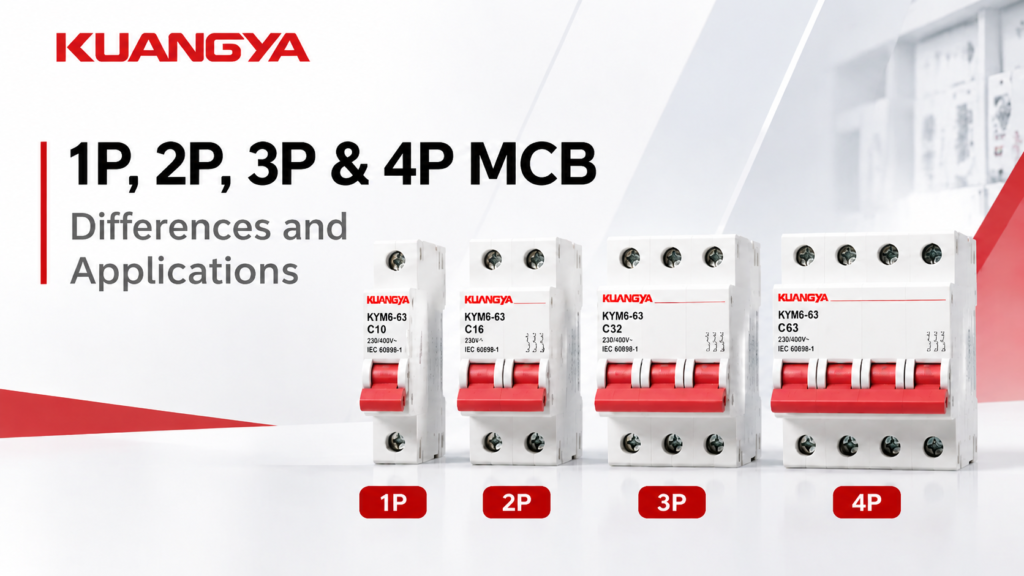
1P 2P 3P 4P MCB configurations are widely used in low-voltage electrical distribution systems. Each type has a different pole arrangement and serves specific electrical applications. Understanding the differences between 1P, 2P, 3P and 4P MCBs helps electrical engineers, panel builders and buyers select suitable circuit protection devices for their installations.
You may often see 1P, 2P, 3P and 4P MCBs in electrical product catalogs. Although they may look similar in appearance, their internal configurations and applications are different.
Choosing the correct number of poles is important for safe circuit isolation, reliable electrical protection and compatibility with the distribution system.
In this guide, we will explain the differences between 1P, 2P, 3P and 4P MCBs, where each type is commonly used, and what buyers should check before placing an order.
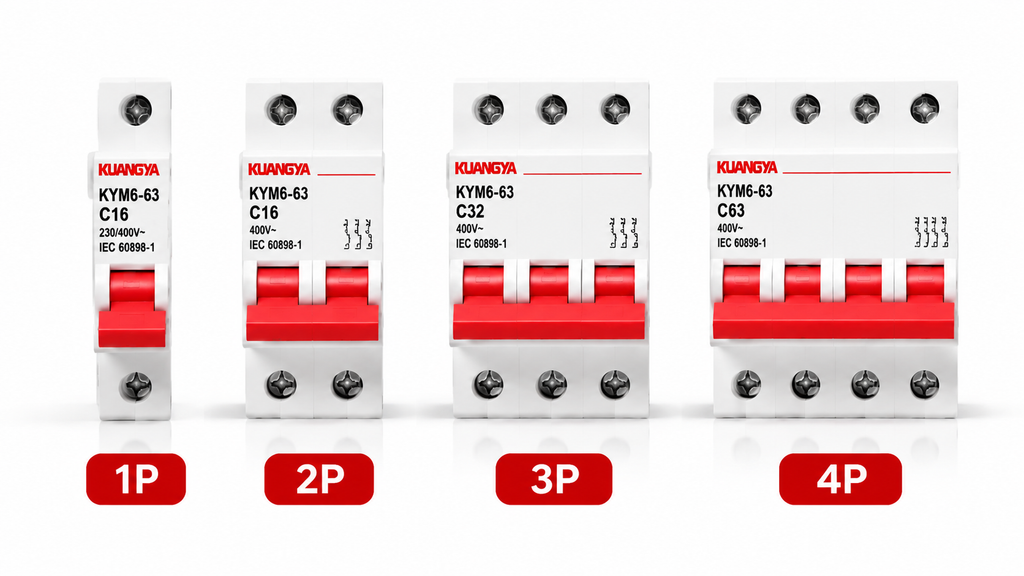
The pole number of an MCB refers to the number of electrical conductors that the circuit breaker can switch simultaneously.
Different electrical systems require different switching configurations.
When comparing 1P 2P 3P 4P MCB configurations, it is important to consider the number of switched conductors, the overcurrent protection arrangement and the electrical system requirements. These factors help determine which miniature circuit breaker is suitable for a single-phase or three-phase installation.
For example:
It is important to understand that the number of poles does not always indicate the number of independently protected conductors. Some configurations switch the neutral conductor without providing overcurrent protection on that pole.
Always check the manufacturer’s technical specifications before selecting an MCB.
A 1P MCB has one protected and switched pole. It is commonly used in single-phase electrical installations to protect the live conductor.
When an overload or short circuit occurs, the MCB trips and interrupts the circuit.
A 1P MCB is often selected when the neutral conductor does not need to be switched by the branch circuit breaker.
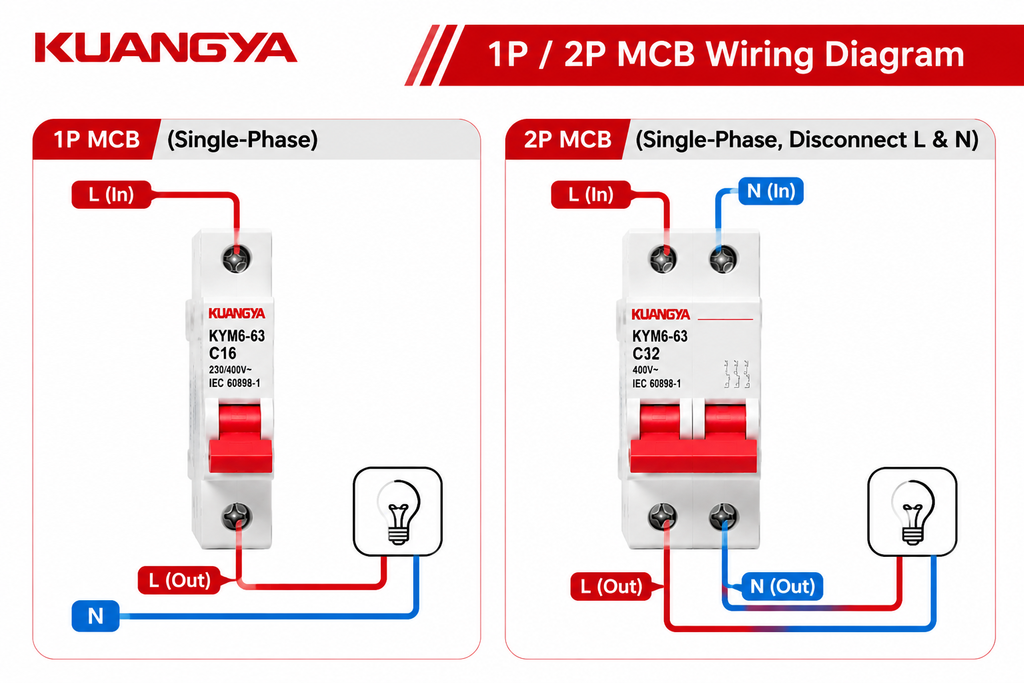
A 2P MCB has two mechanically linked poles that operate together. It is commonly used in single-phase electrical systems where both live and neutral conductors need to be disconnected.
Depending on its design, a 2P MCB may provide overcurrent protection on both poles or use a specific protected-pole and switched-neutral configuration.
For buyers, it is important to distinguish between a true 2P MCB and a 1P+N MCB. They may have similar external appearances, but their internal protection arrangements can be different.
A 3P MCB is designed for three-phase electrical systems. It has three mechanically linked poles, allowing all three phase conductors to be switched together.
It provides protection against overloads and short circuits in three-phase circuits.
A 3P MCB is commonly selected for three-phase loads that do not require the neutral conductor to be switched by the circuit breaker.
The selection must also consider the motor starting characteristics, expected fault current and applicable protection requirements.
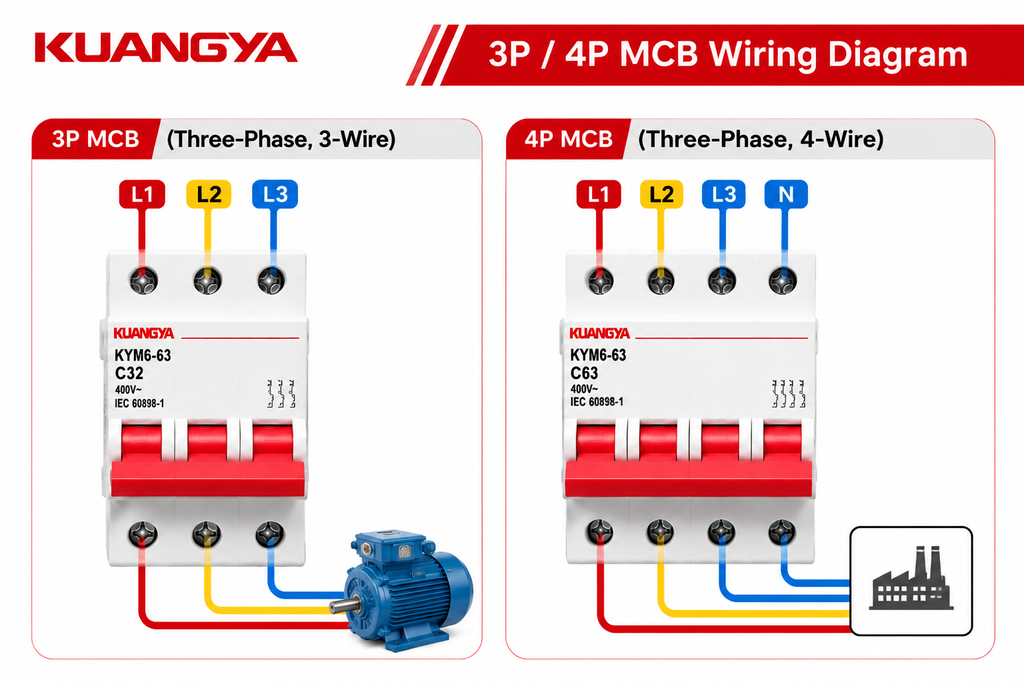
A 4P MCB has four mechanically linked poles, generally used for three-phase systems with a neutral conductor.
It allows the three phase conductors and the neutral conductor to be switched together.
When selecting a 4P MCB, buyers should confirm whether the neutral pole is protected, switched only, or designed with a specific neutral switching sequence.
This is particularly important in systems with nonlinear loads or significant neutral currents.
The following table summarizes the main differences between these four configurations.
| MCB Type | Number of Poles | Typical System | Common Application |
|---|---|---|---|
| 1P | 1 | Single-phase | Lighting and branch circuits |
| 2P | 2 | Single-phase | Equipment and circuits requiring two-pole isolation |
| 3P | 3 | Three-phase | Motors and industrial equipment |
| 4P | 4 | Three-phase, four-wire | Distribution boards and three-phase systems with neutral |
The following points should also be considered:
The selection of 1P, 2P, 3P and 4P MCB products depends on the electrical supply configuration and isolation requirements. While single-pole breakers are commonly used in individual single-phase circuits, double-pole, three-pole and four-pole configurations provide different switching arrangements for single-phase and three-phase systems. Always verify the manufacturer’s technical documentation before choosing an MCB.
Selecting an MCB should not be based on appearance alone. Buyers and electrical engineers should first understand the electrical system and the protection requirements.
For a more detailed selection process, read our guide on how to choose an AC MCB, including rated current, breaking capacity and trip curve considerations.
Here are four important factors to consider.
First, determine whether the installation uses a single-phase or three-phase power supply.
For example:
Some electrical installations require the neutral conductor to be disconnected together with the phase conductors.
In these situations, a suitable 2P or 4P configuration may be required.
However, neutral switching requirements depend on the earthing system, installation design and applicable regulations.
The MCB’s rated current and voltage must be compatible with the electrical circuit.
Common rated currents include:
The correct rating should be determined according to conductor capacity, load characteristics and circuit design.
Breaking capacity indicates the maximum prospective short-circuit current that the MCB can safely interrupt under its specified conditions.
Common breaking capacity ratings include 4.5kA, 6kA and 10kA.
Trip curves such as B, C and D are also important when matching an MCB to different load characteristics.
The selected breaking capacity must not be lower than the prospective short-circuit current at the installation point.
For electrical wholesalers, distributors, importers and panel builders, checking the product specifications before ordering can help avoid unnecessary product mismatches.
We recommend confirming the following information with the manufacturer:
| Specification | What to Confirm |
|---|---|
| Number of Poles | 1P, 2P, 3P or 4P |
| Rated Current | 6A, 10A, 16A, 32A, 40A, 63A, etc. |
| Rated Voltage | According to the intended application |
| Breaking Capacity | 4.5kA, 6kA, 10kA or other available ratings |
| Trip Curve | B, C or D |
| Standard | IEC/EN 60898-1, where applicable |
| Mounting | DIN rail mounting |
| Certification | Relevant certificates and declarations |
| Customization | Logo, packaging and product labeling |
For additional technical reference, electrical professionals can consult the official IEC 60898-1 standard, which covers circuit-breakers for overcurrent protection in household and similar installations.
Read the official IEC 60898-1 standard for further information about its scope and requirements.
For OEM projects, buyers should also discuss product dimensions, terminal structures, branding requirements and packaging specifications before mass production.
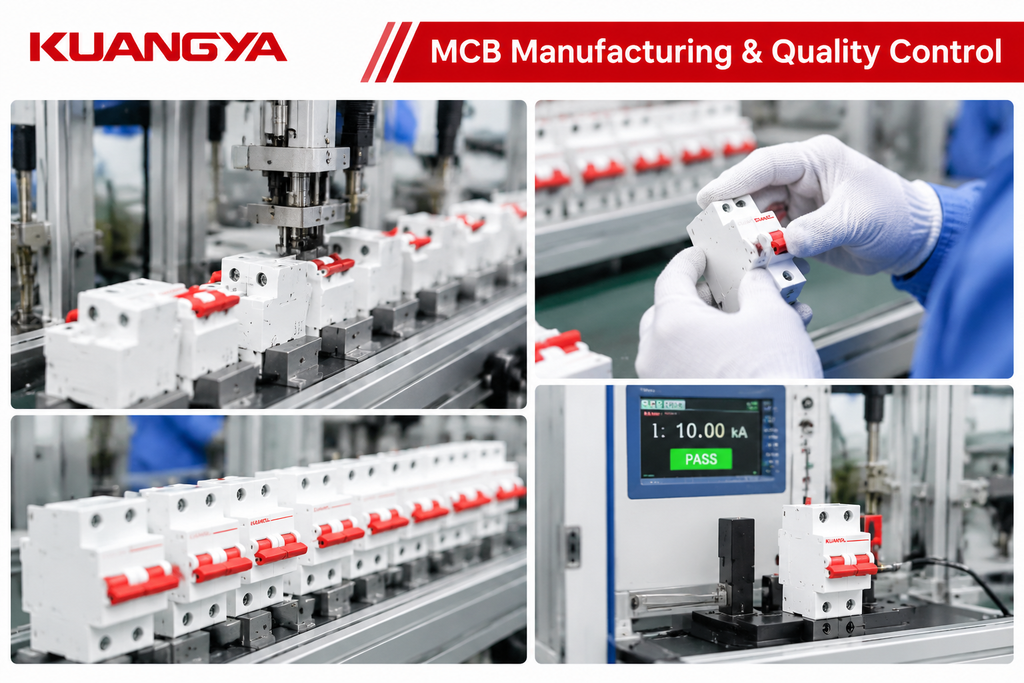
KUANGYA provides low-voltage electrical protection products for distributors, electrical wholesalers and industrial customers.
Our MCB product range includes different pole configurations to meet various electrical distribution requirements.
Available product configurations include:
We also support OEM requirements, including customized branding and product packaging, subject to product specifications and order quantities.
Whether you are sourcing MCBs for residential distribution boards, commercial electrical projects or industrial applications, our team can help you identify suitable product configurations.
Looking for a reliable MCB manufacturer?
Contact KUANGYA to discuss your required specifications, product configurations and OEM requirements.
Website: https://www.cnkuangya.com/
A 1P MCB switches and protects one conductor, usually the live conductor. A 2P MCB switches two mechanically linked conductors, commonly live and neutral. Their overcurrent protection arrangements may differ depending on the product design.
A 2P MCB may be suitable in certain single-phase applications, but it should not be considered an automatic replacement. The circuit design, neutral switching requirements, protection arrangement and applicable regulations must be checked first.
A 3P MCB switches three phase conductors, while a 4P MCB switches three phase conductors and the neutral conductor. The appropriate choice depends on the electrical system and isolation requirements.
Not necessarily. Some 4P MCBs have a protected neutral pole, while others use a switched neutral pole without independent overcurrent protection. Always check the manufacturer’s technical documentation.
A 3P MCB is commonly used for three-phase motor circuits. However, motor protection must also consider starting current, overload protection, short-circuit protection and the motor manufacturer’s recommendations.
Yes. MCBs are available in various rated currents, breaking capacities and trip curves. Availability depends on the manufacturer’s product range.
Many MCB manufacturers offer OEM services, including customized logos, labels and packaging. Minimum order quantities and customization details should be confirmed with the manufacturer.
Understanding the differences between 1P, 2P, 3P and 4P MCBs is essential when selecting circuit protection devices for different electrical systems.
Each configuration serves a specific purpose, from single-phase branch circuits to three-phase distribution systems with neutral conductors.
Before purchasing, always verify the pole configuration, rated current, voltage, breaking capacity and relevant product standards.
If you are looking for MCB products or OEM manufacturing solutions, KUANGYA welcomes inquiries from distributors, wholesalers and electrical industry partners.

