WengYang Industrial Zone Yueqing Wenzhou 325000
Work Hours
Monday to Friday: 7AM - 7PM
Weekend: 10AM - 5PM
WengYang Industrial Zone Yueqing Wenzhou 325000
Work Hours
Monday to Friday: 7AM - 7PM
Weekend: 10AM - 5PM

Rain-related RCD or RCCB trips often point to moisture in outdoor sockets, lights, cable joints or pumps. Learn safe first checks, electrician-only tests and why raising the trip rating is not a repair.
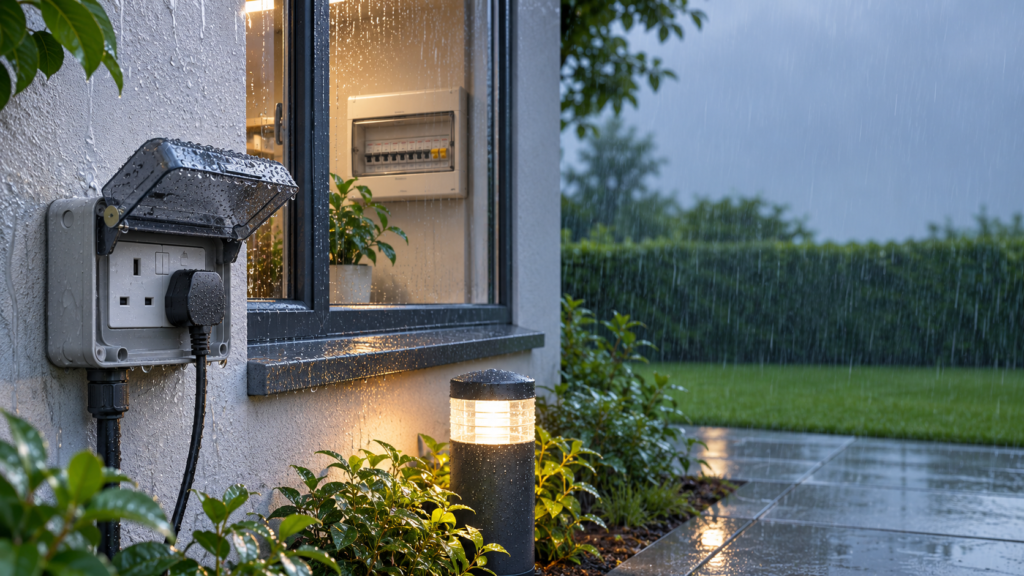
Quick answer: If an RCD or RCCB trips mainly during rain, moisture may be entering an outdoor socket, light fitting, cable joint, pump, or other connected equipment. A damaged cable or wet wall can also increase leakage current. The timing is a clue, not a diagnosis: a qualified electrician must identify the actual fault before the circuit is put back into regular service.
Safety first: Do not touch wet outlets, open enclosures, or work inside a distribution board. If there is standing water, visible damage, a burning smell, or repeated immediate tripping, leave the affected circuit off and call a qualified electrician. Never bypass an RCD or substitute a less sensitive device to hide a fault.
An RCD compares current flowing out through the live conductors with current returning through them. A difference can indicate current taking another path, including a path to earth. Water does not automatically mean the device is faulty. Rain can expose damaged insulation, failed seals, or a wet connection that allows leakage. Doepke’s RCCB fault checklist specifically identifies damp walls, damaged cables, and flooded outdoor lighting after heavy rain.
One shared RCCB may protect several circuits, so the trip can remove power from rooms that appear dry. An RCBO protects an individual circuit against residual current and overcurrent; its trip can make the affected circuit easier to identify. See our RCCB vs RCBO guide for the functional difference.
The BEAMA RCD Handbook lists moisture ingress, wet plaster, condensation, neutral-to-earth faults, and accumulated leakage among possible causes of unwanted trips. A rain correlation does not prove which of these is responsible.
BEAMA’s user troubleshooting flow uses the same basic sequence of unplugging loads and identifying the circuit, while directing unresolved circuit faults to an expert. Our broader RCBO troubleshooting guide covers trips at other times as well.
A professional can isolate the affected circuit, inspect weather-exposed fittings and cable entries, test insulation resistance with sensitive equipment disconnected as required, measure leakage current, and check neutral-to-earth faults and the protective device itself. The test plan depends on the installation and local rules. Finding a wet fitting is only the start: the entry path, damaged part, and any affected cable must be repaired before the circuit is returned to service.
Usually the source of leakage must be repaired first. Replacing an RCCB that is operating correctly will not seal a wet junction box. Changing a 30 mA device to a higher residual-current setting can remove required additional shock protection, so selection must follow the applicable installation rules and a qualified assessment. The ampere rating and the residual-current setting answer different questions; our RCCB rating chart explains the distinction.
For a new outdoor circuit or replacement device, choose the RCD/RCCB or RCBO type and rating for the load, supply, and local code, then specify suitable outdoor accessories and installation details. Browse KUANGYA RCCB options or RCBO products only after the fault has been diagnosed. Product selection is not a substitute for repairing water ingress.
Yes. Moisture can remain inside an enclosure, cable joint, or wall after the surface looks dry. The delay helps describe the fault pattern but does not identify the component.
A single RCCB may protect several downstream circuits. A leakage fault on one circuit can trip that shared device. The distribution-board layout determines what loses power.
No. Repeated trips can signal an unresolved electrical fault. Leave the circuit off after another trip and arrange inspection.
No. The rating applies to the enclosure under specified conditions. Damaged seals, poorly fitted glands, cable routing, aging, or installation defects can still allow water ingress.
This guide draws on the Doepke RCCB checklist, the BEAMA RCD Handbook, and Electrical Safety First’s outdoor electrical guidance. It is general fault-finding information, not an inspection of a particular installation. Local wiring rules and the installed device’s instructions take precedence.

