WengYang Industrial Zone Yueqing Wenzhou 325000
Work Hours
Monday to Friday: 7AM - 7PM
Weekend: 10AM - 5PM
WengYang Industrial Zone Yueqing Wenzhou 325000
Work Hours
Monday to Friday: 7AM - 7PM
Weekend: 10AM - 5PM

RCCB rating chart: compare 40A vs 63A current ratings and 30mA vs 100mA residual current settings. Learn selection and overcurrent protection checks.
Quick answer: On an RCCB, 40 A or 63 A is the rated current (In) that its contacts are designed to carry under specified conditions. 30 mA or 100 mA is the rated residual operating current (IΔn). These values describe different functions. An RCCB detects residual current; it does not provide integral overload or short-circuit protection. Select it together with a suitable upstream or downstream overcurrent protective device, the circuit design and the exact manufacturer’s instructions.
| Marking | Meaning | What it does not mean |
|---|---|---|
| 40 A or 63 A (In) | Rated current-carrying capacity of the RCCB | The current at which it trips for overload |
| 30 mA or 100 mA (IΔn) | Rated residual operating current | The normal load current of the circuit |
| Type AC, A, F or B | Residual-current waveform capability | Overcurrent trip curve B or C |
| 2P or 4P | Number of poles | Proof that the device suits every earthing system |
| Conditional short-circuit rating | Rating under stated coordination with an upstream protective device | Standalone short-circuit interruption by the RCCB |
For example, a 63 A, 30 mA Type A RCCB is rated to carry 63 A under its specified conditions and to respond to the residual-current waveforms covered by Type A at its declared sensitivity. It is not a 63 A miniature circuit breaker.
The 63 A version has a higher current-carrying rating. It does not provide stronger electric-shock protection when both devices have the same 30 mA sensitivity and the same residual-current type. It also does not allow an undersized cable or an incorrectly selected upstream breaker.
Check the maximum sustained current through the RCCB, the rating and characteristic of the protective fuse or breaker, cable ampacity, enclosure temperature, grouping, busbar and terminal ratings, and the manufacturer’s coordination data. The sum of all downstream breaker nameplate ratings is not automatically the actual simultaneous load; equally, assuming that loads never run together can understate the thermal duty.
Practical example: If a distribution board can carry more than 40 A through its RCCB under normal operation, a 40 A device should not be chosen simply because its leakage sensitivity is 30 mA. A 63 A device may be appropriate, but its upstream overcurrent protection and conductor sizing still need verification. Conversely, installing a 63 A RCCB where the circuit is limited to a lower current does not make its residual-current protection less sensitive.
Eaton’s RCD application guide explains that a fuse or breaker can carry more than its nameplate current before tripping. For that reason, RCCB contact protection must follow the particular manufacturer’s coordination table rather than a universal “same ampere rating” rule.
| RCCB marking | Typical design role | Important check |
|---|---|---|
| 30 mA | Additional protection against electric shock where required | Applicable wiring rules, load leakage and RCD type |
| 100 mA | Application-specific or upstream residual-current protection | Earthing arrangement and coordination with downstream devices |
| 300 mA | Certain upstream or fire-risk-related applications | Local rules, selectivity and equipment instructions |
A 100 mA or 300 mA RCCB is not a drop-in substitute for a required 30 mA device on a final circuit. Whether a delayed or selective upstream RCD is suitable depends on the installation and tested coordination. The residual-current type matters as well: electronic loads can produce waveforms that a Type AC device is not designed to detect. Follow the equipment manual and local rules when choosing Type A, F or B.
No. An RCCB without integral overcurrent protection monitors the imbalance between current leaving and returning through its protected conductors. A line-to-neutral overload can occur without the residual current needed to operate the RCCB. A separate fuse or circuit breaker must provide the required overcurrent and short-circuit protection. If one device must combine both functions, review an RCBO instead.
CHINT’s NL1 product documentation explicitly describes an RCCB as residual-current protection without overcurrent protection. The declared conditional short-circuit rating is valid only with its specified upstream short-circuit protective device.
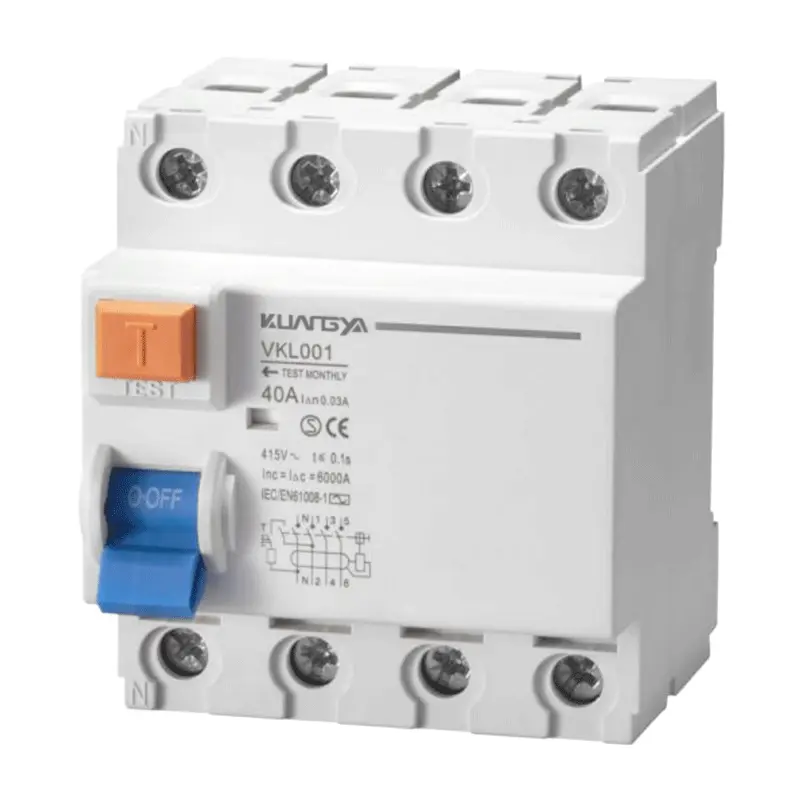
For an example of available ratings, KUANGYA’s VKL001 RCCB lists 2P and 4P options, 40 A and 63 A among its current ratings, and 30 mA, 100 mA and 300 mA sensitivities. Confirm the exact variant and certificates before specifying it. Our RCCB vs RCBO comparison explains when an integrated overcurrent device may be preferable.
No. The 40 A label is a rated current-carrying value, not an overload trip setting. The separate overcurrent protective device must be selected to protect the RCCB and conductors.
Both have the same declared residual-current sensitivity if they are otherwise the same type. The 63 A version has a higher rated current-carrying capacity. Safety depends on correct selection and coordination for the whole circuit.
Do not change sensitivity merely to hide repeated trips. First investigate leakage, moisture, wiring and load characteristics. A circuit that requires 30 mA additional protection must retain a compliant protective arrangement.
Send KUANGYA the supply voltage, phases, earthing arrangement, expected load current, prospective fault current, upstream protective device, desired IΔn, residual-current type and destination market. We can then identify a suitable RCCB variant for engineering review. Contact KUANGYA.

