WengYang Industrial Zone Yueqing Wenzhou 325000
Work Hours
Monday to Friday: 7AM - 7PM
Weekend: 10AM - 5PM
WengYang Industrial Zone Yueqing Wenzhou 325000
Work Hours
Monday to Friday: 7AM - 7PM
Weekend: 10AM - 5PM

Do heat pumps need surge protection? Compare panel and local SPDs, learn what each can and cannot protect, and check the key data before specifying an AC SPD.
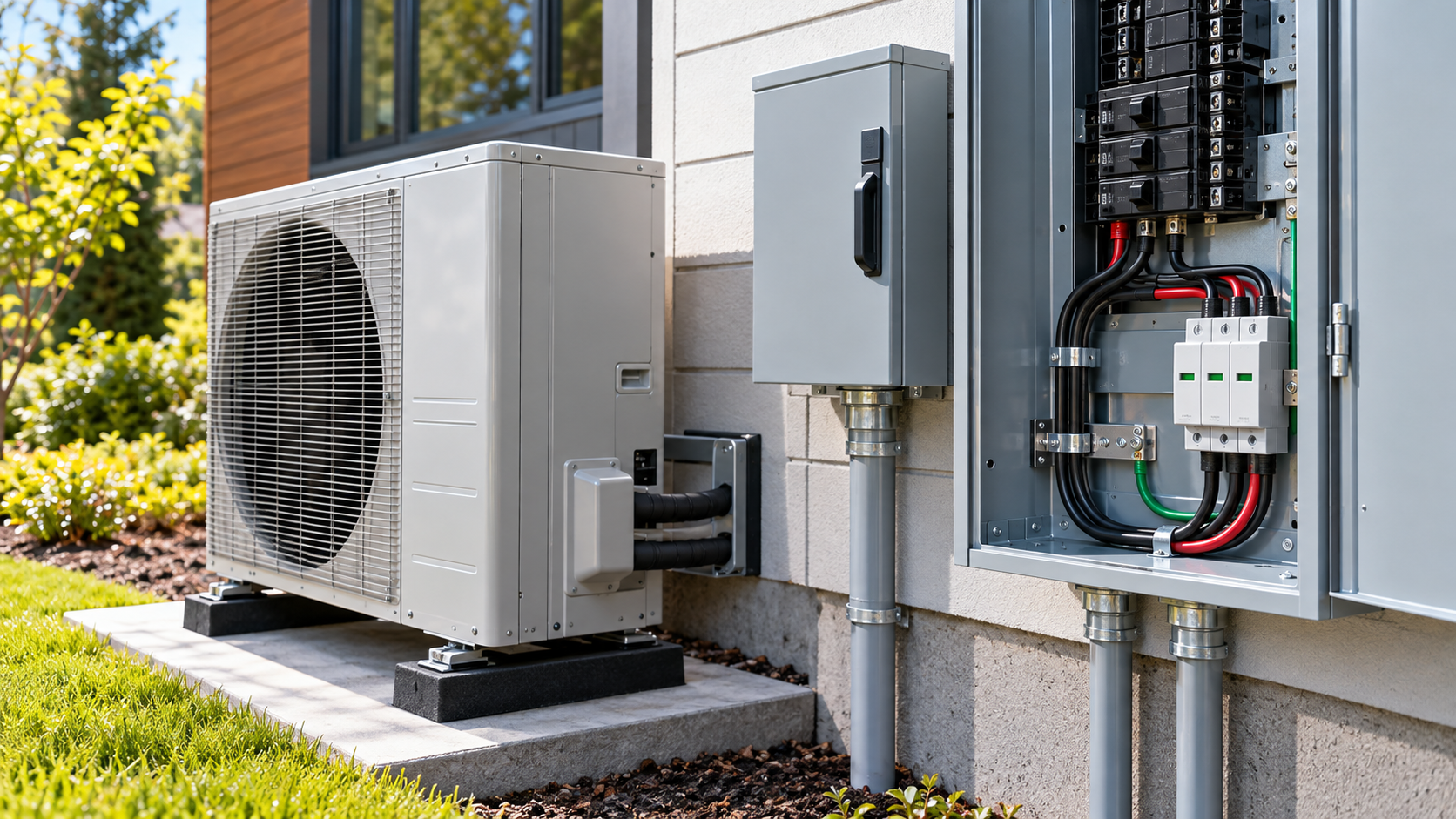
Do heat pumps need surge protection? A heat pump is usually hardwired, so a plug-in surge strip cannot protect the complete unit. A correctly selected surge protective device (SPD) at the electrical panel can help limit transient overvoltage reaching its supply circuit. Depending on the installation, an electrician may also consider protection closer to the outdoor unit. Neither location guarantees that every fault or lightning event is harmless.
A heat pump may include an outdoor compressor, inverter drive, electronic controls, indoor unit and communication wiring. The electrical arrangement varies by model. A surge on the supply can reach equipment on a dedicated circuit, while a strip in a nearby room protects only devices connected to that strip. Schneider Electric identifies HVAC equipment among hardwired loads that can benefit from panel-level surge protection. Its guidance does not replace the heat pump manufacturer’s instructions for any particular unit.
For the broader comparison, see our whole-house SPD vs power strip guide.
Start with the building’s electrical design. A suitable SPD at the service equipment or distribution panel provides an upstream layer for circuits served by that panel. A second SPD near a remote subpanel or heat-pump disconnect may be useful when cable routes and exposure justify it, but the need and coordination must be assessed for the actual installation. Schneider Electric notes that loads on additional panels can be exposed to switching transients that arise downstream of the main panel.
Keep this separate from the SPD’s own connection-lead length. Even a device mounted physically close to a heat pump can perform poorly if its conductors are unnecessarily long or looped. The SPD manufacturer’s wiring instructions, bonding arrangement and applicable code determine the installation.
For AC distribution-board products, review the KUANGYA AC SPD range. Select a specific model only after matching its datasheet and installation instructions to the supply system. Do not choose solely by a headline kA rating.
An SPD limits specified transient surges; it is not a voltage regulator, backup power source, replacement for an overcurrent protective device or repair for a loose neutral. Eaton distinguishes brief surges from longer-duration swells or temporary overvoltage. If the heat pump repeatedly shuts down, loses power or shows abnormal supply voltage, diagnose the underlying problem rather than assuming a larger SPD will solve it. Our surge vs temporary-overvoltage guide explains the distinction.
It can provide an upstream layer, but sufficiency depends on panel layout, cable routing, surge exposure, equipment withstand and local requirements. Ask a qualified electrician to assess whether an additional downstream device is warranted.
A hardwired heat pump cannot be protected by an ordinary plug-in strip. Do not alter the manufacturer-approved supply connection to accommodate one.
Do not assume so. Internal protective components and a building SPD may serve different purposes. Check the exact model documentation and ask the manufacturer or installer how the complete system should be protected.
Send your supply voltage, phase arrangement, earthing system, panel location, heat-pump model and cable-route details to KUANGYA. We can identify a suitable AC SPD candidate and provide the relevant datasheet for review by your electrician or project engineer.

