As electric vehicle adoption accelerates globally, installers face a critical decision that directly impacts both project profitability and safety compliance: choosing between Type A+ (Type A with RDC-DD) and Type B RCCB protection for EV charging installations. This choice can mean the difference between a $300-400 cost saving or an over-engineered solution that eats into your margins. The confusion stems from evolving IEC 61851-1 standards and regional variations in electrical codes. Many installers default to expensive Type B RCCBs without understanding when a more cost-effective Type A+ solution is perfectly compliant. This guide will equip you with the technical knowledge and selection framework to quote the right protection device for each job, maximizing your competitive edge while maintaining full safety compliance.
Understanding RCD and RCCB Technology for EV Applications
What Makes EV Charging Different?
Residual Current Devices (RCDs) and Residual Current Circuit Breakers (RCCBs) serve as the frontline defense against electric shock and fire hazards by detecting leakage currents. However, EV charging introduces a unique challenge that standard residential protection cannot handle: smooth DC leakage current. When an electric vehicle charges, its onboard charger converts AC grid power into DC current for battery storage. Under certain fault conditions—particularly in the vehicle’s power electronics or charging cable—this conversion process can cause smooth DC current to leak back into the AC circuit. This DC contamination poses two critical risks:
RCD Blinding: Even small amounts of DC current (above 6mA) can saturate the magnetic core of a standard Type A RCD, rendering it unable to detect dangerous AC leakage currents. The device remains closed while thinking everything is normal, leaving users exposed to electric shock hazards.
Fire Risk: Undetected leakage currents can cause localized heating in wiring, insulation breakdown, and potential fire ignition points. Traditional Type A RCDs, commonly found in residential installations, can detect AC sinusoidal currents and pulsating DC currents but fail when confronted with smooth DC leakage—the exact type generated by EV charger power electronics.
Type A RCCB: The Standard Baseline
Type A RCCBs represent the baseline protection level found in most modern residential and light commercial installations. These devices can reliably detect:
AC sinusoidal residual currents: Standard 50/60Hz leakage from damaged insulation, moisture ingress, or ground faults
Pulsating DC residual currents: Half-wave rectified currents with a DC component superimposed on AC Type A protection works flawlessly for conventional appliances, lighting circuits, and basic power tools. However, its Achilles heel is smooth DC current. When exposed to DC leakage exceeding approximately 6mA, the magnetic detection coil begins to saturate, progressively losing sensitivity to AC faults. Above this threshold, the device may fail to trip even during a life-threatening shock scenario. Key Specifications:
Rated residual operating current: Typically 30mA for shock protection
Type B RCCBs represent the gold standard in residual current protection, capable of detecting all fault current types that Type A handles, plus:
Smooth DC residual currents: Pure DC leakage from power electronic converters
High-frequency AC residual currents: Up to 1kHz, relevant for variable frequency drives and advanced power electronics The Type B device achieves this through sophisticated detection circuitry that monitors both AC and DC components independently, preventing magnetic saturation regardless of DC contamination levels. This makes it immune to the “blinding” effect that compromises Type A devices in EV charging applications. Key Specifications:
Rated residual operating current: 30mA (standard for EV applications)
Detection capability: AC + pulsating DC + smooth DC + high-frequency AC
Frequency response: 50Hz to 1kHz
Cost position: Premium (typically $300-400 more than Type A) When Type B is Mandatory:
Older EV chargers (pre-2020) without integrated DC fault detection
Installations where charger specifications explicitly require Type B
Applications with three-phase power electronics
Type A+ (Type A with RDC-DD): The Cost-Optimized Solution
The Type A+ configuration represents the modern, cost-effective approach to EV charging protection. It combines:
Type A RCCB: Standard AC and pulsating DC detection at the distribution board
RDC-DD (Residual Direct Current Detecting Device): A monitoring device integrated into the EV charger that continuously measures DC leakage current The RDC-DD acts as a specialized guardian, monitoring for smooth DC leakage at the charger itself. When DC current exceeds 6mA—the threshold where Type A RCDs begin to lose effectiveness—the RDC-DD immediately disconnects the charging circuit. This prevents DC contamination from ever reaching the upstream Type A RCCB, maintaining its full sensitivity to AC faults. How RDC-DD Works:\ The device uses a Hall-effect sensor or similar DC-sensitive technology to measure the differential current between live conductors and the protective earth. Unlike RCCBs that rely on magnetic flux balance, RDC-DD employs electronic sensing that remains unaffected by DC saturation. When the threshold is exceeded, it triggers a contactor or relay within the charger to isolate the circuit, typically within 100-300 milliseconds. Key Specifications:
Type A RCCB: Standard 30mA, AC + pulsating DC detection
RDC-DD: 6mA DC detection threshold (per IEC 62955)
Combined protection: Equivalent to Type B for EV-specific faults
Cost position: Mid-range (Type A price + integrated charger feature) Compliance Standards:\ The Type A + RDC-DD combination meets IEC 61851-1 requirements (updated 2017) for Mode 3 EV charging, which specifies: “RCD Type A, combined with appropriate equipment to disconnect the supply in case of DC fault currents exceeding 6mA.” Most modern Level 2 charging stations manufactured after 2020 include integrated RDC-DD compliant with IEC 62955, making Type A+ the preferred specification for residential and light commercial installations in markets like the UK, Nordic countries, and China.
Type A+ vs. Type B: Comprehensive Comparison
Technical Performance Comparison
Protection Aspect
Type A + RDC-DD (Type A+)
Type B RCCB
AC Residual Current Detection
✓ Full protection (30mA)
✓ Full protection (30mA)
Pulsating DC Detection
✓ Full protection
✓ Full protection
Smooth DC Detection
✓ Via RDC-DD (6mA threshold)
✓ Via RCCB core technology
High-Frequency AC (>60Hz)
✗ Limited (depends on charger)
✓ Up to 1kHz
Detection Location
Distributed (RCCB at board + RDC-DD at charger)
Centralized (at distribution board)
Response Time
100-300ms (RDC-DD) + <30ms (RCCB)
<30ms (single device)
Immunity to DC Blinding
✓ RDC-DD prevents DC reaching RCCB
✓ Inherent immunity
Protection During Cable Damage
✓ RCCB protects supply cable
✓ RCCB protects supply cable
Charger Dependency
✓ Requires RDC-DD in charger
✗ Independent of charger features
Cost-Benefit Analysis
Factor
Type A + RDC-DD (Type A+)
Type B RCCB
RCCB/RCBO Cost
$50-80 (Type A)
$350-480 (Type B)
Installation Labor
Standard (same as Type A)
Standard (same as Type A)
Charger Requirement
Must have IEC 62955 RDC-DD
Any charger compatible
Total Cost Difference
Baseline
+$300-400
Future-Proofing
Tied to charger technology
Universal compatibility
Maintenance
Charger RDC-DD must remain functional
Single device to maintain
Competitive Advantage
Lower quote price
Premium positioning
Advantages and Disadvantages
Type A+ (Type A with RDC-DD) Advantages:
Cost Efficiency: Saves $300-400 per installation compared to Type B, allowing more competitive quotes while maintaining full margins
Regulatory Compliance: Fully meets IEC 61851-1 requirements for Mode 3 charging when RDC-DD is IEC 62955 certified
Optimal for Modern Chargers: Leverages built-in safety features of contemporary EV charging equipment
Space Saving: Type A RCBOs are more compact, valuable in crowded distribution boards
Market Alignment: Preferred solution in UK, Nordic, and Chinese markets where most chargers include RDC-DD Type A+ Disadvantages:
Charger Dependency: Protection relies on RDC-DD remaining functional; charger failure or replacement requires verification
Verification Required: Installer must confirm RDC-DD presence and IEC 62955 compliance in charger documentation
Limited High-Frequency Protection: May not detect high-frequency AC faults above 400Hz (rarely an issue in residential EV charging)
Customer Education: May need to explain why “cheaper” protection is equally safe Type B RCCB Advantages:
Universal Compatibility: Works with any EV charger regardless of built-in protection features
Single-Point Protection: All fault detection in one device, simplifying troubleshooting
Future-Proof: No dependency on charger technology evolution or replacement
Comprehensive Detection: Handles all fault types including high-frequency AC from advanced power electronics
Mandatory Scenarios: Required for commercial installations, fast chargers >7kW, and older equipment Type B Disadvantages:
Premium Cost: $300-400 higher material cost reduces competitiveness or profit margin
Larger Footprint: Type B RCBOs occupy more space in distribution boards
Potential Over-Engineering: Provides capabilities beyond what modern residential chargers require
Market Mismatch: May be unnecessary in regions where Type A+ is standard practice
Declaration of Conformity (DoC) or Supplier’s Declaration of Conformity (SDoC)
Manufacturer’s website technical specifications
Step 2: Apply the Decision Matrix
Use this flowchart logic to determine the correct protection type: START HERE: Question 1: Does the charger explicitly require Type B in its installation manual?
YES → Specify Type B RCCB (no further analysis needed)
NO or UNCLEAR → Continue to Question 2 Question 2: Does the charger include RDC-DD compliant with IEC 62955?
YES (confirmed in documentation) → Continue to Question 3
NO or CANNOT VERIFY → Specify Type B RCCB Question 3: What is the installation type?
Residential/Light Commercial, ≤7kW, single-phase → Specify Type A + verify RDC-DD (Type A+ solution)
Commercial, >7kW, or three-phase → Specify Type B RCCB Question 4: What is the charger age/generation?
Post-2020 modern charger → Type A+ is optimal
Pre-2020 or budget EVSE → Specify Type B RCCB
Step 3: Regional Compliance Check
Different markets have varying preferences and requirements: Type A+ Preferred Markets:
United Kingdom (with RDC-DD verification)
Nordic countries (Sweden, Norway, Denmark)
China
Australia (with AS/NZS 3000 compliance) Type B Common Markets:
Germany (conservative approach)
France (commercial installations)
Austria (OVE E8601 standard)
Italy (three-phase installations)
United States (NEC requirements for >3.7kW)
Step 4: Document Your Selection
For every installation quote, include: Type A+ Specification:
“40A Type A RCBO (or 2-pole Type A RCCB + MCB)”
“EV charger model: [specify] with IEC 62955 RDC-DD”
“Complies with IEC 61851-1 Mode 3 requirements” Type B Specification:
“40A Type B RCBO (or 2-pole Type B RCCB + MCB)”
“Universal protection for all EV charger types”
“Complies with IEC 61851-1 and IEC 62423 standards”
DIN rail mounting: 4 modules wide Installation Accessories:
CNK-MCB-C40: 40A Type C MCB (for use with standalone RCCB)
CNK-SPD-275: Surge protection device (recommended for all EV installations)
CNK-ISO-63: Isolator switch for maintenance access
Application Scenarios with Visual Guides
Scenario 1: Residential Single-Phase Installation (7kW) – Type A+ Solution
Typical Setup:
Grid Supply → Main Distribution Board → Type A RCBO (40A) → Dedicated EV Circuit → Modern EV Charger (with RDC-DD) → Vehicle
Installation Context:
Single-family home
Garage or driveway installation
Modern EV charger (Tesla Wall Connector Gen 3, Wallbox Pulsar Plus, Zappi V2, etc.)
7kW charging power (32A at 230V)
Charger manufactured after 2020 with IEC 62955 RDC-DD Protection Configuration:
Upstream: 40A Type A RCBO at main distribution board
Charger: Integrated RDC-DD monitors DC leakage
Cable: 6mm² or 10mm² copper (depending on run length)
Additional: Surge protection device (SPD) recommended Visual Representation:
┌─────────────────────────────────────────────────────────────┐
│                    MAIN DISTRIBUTION BOARD                   │
│  ┌────────────┐                                              │
│  │  Type A    │  40A, 30mA                                   │
│  │   RCBO     │  AC + Pulsating DC Detection                │
│  │ CNK-RCBO-A40│                                             │
│  └─────┬──────┘                                              │
└────────┼─────────────────────────────────────────────────────┘
         │
         │ 6-10mm² Cable Run
         │
         ▼
┌─────────────────────────────────────────────────────────────┐
│              MODERN EV CHARGER (Post-2020)                   │
│  ┌──────────────────────────────────────────────────────┐   │
│  │  Integrated RDC-DD (IEC 62955)                       │   │
│  │  • Monitors DC leakage continuously                  │   │
│  │  • Trips at 6mA DC threshold                         │   │
│  │  • Prevents DC reaching Type A RCBO                  │   │
│  └──────────────────────────────────────────────────────┘   │
│                                                              │
│  [Charging Cable] ──────────► Vehicle                       │
└─────────────────────────────────────────────────────────────┘
PROTECTION LAYERS:
✓ Type A RCBO: AC faults, pulsating DC, cable damage
✓ RDC-DD: Smooth DC leakage from vehicle electronics
✓ Combined: Equivalent to Type B protection
Cost Breakdown:
Type A RCBO: $60-80
Installation labor: $150-200
Cable and accessories: $100-150
Total protection cost: $310-430 When to Use This Scenario:
Homeowner wants cost-effective solution
Charger documentation confirms IEC 62955 RDC-DD
Residential application with modern equipment
Competitive quote required
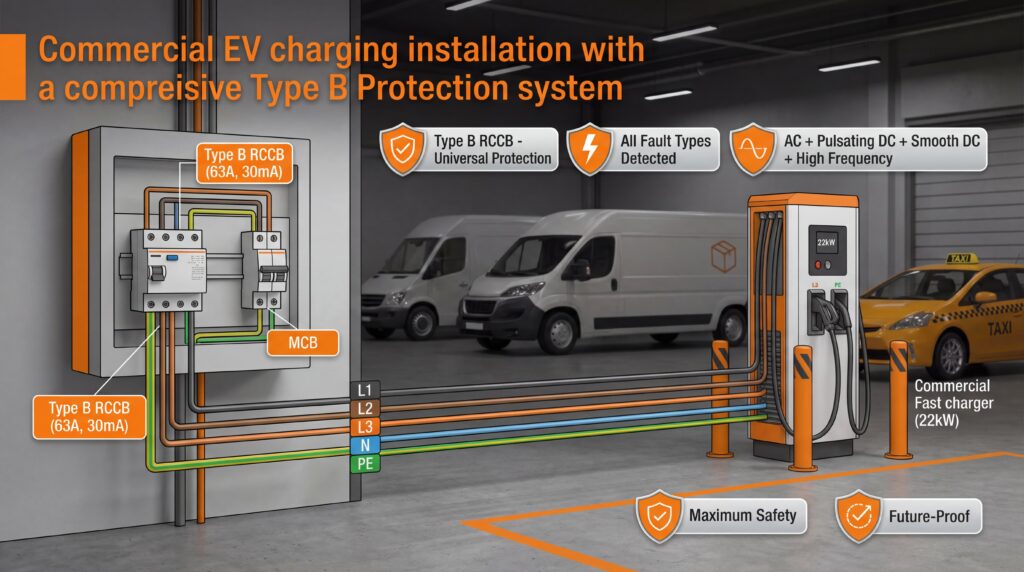
Scenario 2: Commercial Three-Phase Installation (22kW) – Type B Solution
Typical Setup:
Grid Supply → Commercial Distribution Board → Type B RCCB (63A) + MCB (63A) → Dedicated EV Circuit → Commercial Fast Charger → Vehicle
Installation Context:
Commercial parking facility, workplace charging, or public charging station
Three-phase power supply (400V)
22kW fast charging capability
Multiple vehicles per day usage
May include older or budget chargers without guaranteed RDC-DD Protection Configuration:
Upstream: 63A Type B RCCB + 63A Type C MCB at distribution board
Charger: May or may not have RDC-DD (Type B provides independent protection)
Cable: 10mm² or 16mm² copper three-phase + neutral + earth
Additional: Surge protection device (SPD) mandatory, isolation switch for maintenance Visual Representation:
┌─────────────────────────────────────────────────────────────┐
│              COMMERCIAL DISTRIBUTION BOARD                   │
│  ┌────────────┐  ┌────────────┐                             │
│  │  Type B    │  │  Type C    │  63A                        │
│  │   RCCB     │  │    MCB     │  Three-Phase                │
│  │ CNK-RCCB-B63│  │ CNK-MCB-C63│                            │
│  │ 30mA       │  │            │                             │
│  └─────┬──────┘  └─────┬──────┘                             │
└────────┼───────────────┼─────────────────────────────────────┘
         │               │
         │ L1, L2, L3, N, PE (10-16mm²)
         │
         ▼
┌─────────────────────────────────────────────────────────────┐
│           COMMERCIAL FAST CHARGER (22kW)                     │
│  ┌──────────────────────────────────────────────────────┐   │
│  │  Type B RCCB Provides:                               │   │
│  │  ✓ AC residual current detection                     │   │
│  │  ✓ Pulsating DC detection                            │   │
│  │  ✓ Smooth DC detection (independent of charger)      │   │
│  │  ✓ High-frequency AC detection (up to 1kHz)          │   │
│  └──────────────────────────────────────────────────────┘   │
│                                                              │
│  [Charging Cable] ──────────► Commercial Vehicle            │
│                                (Fleet, Taxi, Public)         │
└─────────────────────────────────────────────────────────────┘
PROTECTION LAYERS:
✓ Type B RCCB: All fault types including smooth DC
✓ MCB: Overload and short-circuit protection
✓ Independent: No reliance on charger features
✓ Universal: Compatible with any charger type
Cost Breakdown:
Type B RCCB: $350-450
Type C MCB: $40-60
Installation labor: $250-350
Cable and accessories: $200-300
Isolation switch: $80-120
Total protection cost: $920-1,280 When to Use This Scenario:
Commercial or public charging application
Three-phase high-power installation (>7kW)
Multiple chargers or unknown future charger models
Maximum safety and compliance required
Budget allows for premium protection
Frequently Asked Questions (FAQs)
FAQ 1: Can I use a Type A RCBO if the customer later replaces their EV charger with a different model?
Answer: This is a critical consideration that many installers overlook. If you install a Type A RCBO based on the original charger having RDC-DD, and the customer later replaces it with a charger that lacks this feature, the installation will no longer meet IEC 61851-1 safety requirements. Best Practice Recommendations:
Document the Dependency: In your installation certificate and handover documentation, clearly state: “Type A protection is compliant only when used with EV charger model [specify] or equivalent with IEC 62955 RDC-DD. Replacement chargers must maintain this specification.”
Educate the Customer: Explain that the Type A RCBO is part of a protection system that includes the charger’s RDC-DD. If they upgrade or replace the charger, they must verify the new unit has equivalent DC fault detection.
Consider Future-Proofing: For customers who express uncertainty about long-term charger choice, recommend Type B RCBO despite the higher cost. Frame it as “investment protection” that eliminates future compatibility concerns.
Offer Upgrade Path: Quote both options—Type A+ for current setup and Type B for future-proof protection—letting the customer decide based on their anticipated usage and budget. Real-World Scenario: A homeowner installs a Tesla Wall Connector Gen 3 (which has RDC-DD) with Type A protection. Three years later, they sell the house. The new owner wants to install a different charger brand that lacks RDC-DD. The electrician must either verify the new charger has RDC-DD or upgrade the RCBO to Type B—an unexpected cost that creates customer dissatisfaction. Installer Protection: Some installers include a clause in their contract: “Electrical protection is designed for specified EV charger model. Charger replacement or modification may require protection device upgrade at additional cost.” This manages expectations and protects against liability.
FAQ 2: What should I do if the charger documentation doesn’t clearly state whether it has RDC-DD?
Answer: Ambiguous or incomplete documentation is frustratingly common, especially with budget chargers or international brands. Never assume a charger has RDC-DD if it’s not explicitly stated—the safety and legal liability risks are too high. Step-by-Step Verification Process: Step 1: Check Multiple Documentation Sources
Product datasheet (look for “IEC 62955,” “RDC-DD,” “6mA DC detection,” or “DC fault current monitoring”)
Supplier’s Declaration of Conformity (SDoC) or CE Declaration
Manufacturer’s website technical specifications Step 2: Contact the Manufacturer or Supplier\ If documentation is unclear, email or call the technical support team with this specific question: “Does [model number] include an integrated Residual Direct Current Detecting Device (RDC-DD) compliant with IEC 62955? Can you provide written confirmation?” Request a written response (email is sufficient) that you can keep with your installation records. This protects you if there’s ever a compliance audit or incident investigation. Step 3: Check for Physical Indicators\ Some chargers have a test button labeled “DC Test” or “RDC-DD Test” separate from the main RCD test button. This physical presence suggests RDC-DD integration, though it’s not definitive proof of IEC 62955 compliance. Step 4: Default to Type B if Uncertain\ When you cannot obtain clear confirmation within a reasonable timeframe (48-72 hours), the safe and compliant approach is to specify Type B RCCB. Document your decision: “Type B specified due to inability to verify RDC-DD compliance in charger model [X].” Cost Management: If the customer balks at the Type B cost, explain: “We can only use the more economical Type A protection when the charger manufacturer confirms it has the required DC detection feature. Without that confirmation, regulations require Type B for your safety.” Red Flags Suggesting No RDC-DD:
Charger manufactured before 2018
Extremely low price point (<$300 for 7kW unit)
No mention of IEC 62955 anywhere in documentation
Generic or white-label branding with minimal technical specs
Manufacturer website lacks detailed technical information Alternative Approach: Some installers maintain a “verified chargers list” of models they’ve confirmed have RDC-DD, streamlining future quotes. Popular verified models include Tesla Wall Connector Gen 3, Wallbox Pulsar Plus/Max, Zappi V2, Easee One, and Ohme Home Pro.
Conclusion: Making the Right Choice for Profit and Safety
The decision between Type A+ and Type B RCCB protection is not merely technical—it’s a strategic business choice that impacts your competitiveness, profitability, and professional reputation. By understanding the distinct capabilities of each protection type and applying the systematic selection framework from cnkuangya.com, you can confidently quote the optimal solution for every EV charging installation. Key Takeaways for Installers:
Type A+ is your competitive advantage for residential installations with modern chargers—saving $300-400 per job while maintaining full compliance and safety.
Type B is your liability shield for commercial applications, high-power installations, and scenarios where charger specifications are uncertain.
Always verify RDC-DD before specifying Type A—documentation is your protection against future liability and compliance issues.
Educate your customers on the protection system as a whole, not just individual components, building trust and justifying your recommendations.
Regional standards matter—align your specifications with local market practices and regulatory expectations. The EV charging market will only grow in the coming years, and installers who master these technical nuances will capture more projects, maintain healthier margins, and build reputations as knowledgeable professionals. Whether you choose Type A+ for cost optimization or Type B for universal compatibility, the critical factor is making an informed, documented decision based on the specific installation requirements.
For more technical guidance, product specifications, and installation support, visit cnkuangya.com or contact our technical team for project-specific consultation.
About CNKuangya: Leading manufacturer of electrical protection devices for EV charging infrastructure, offering comprehensive Type A and Type B RCCB/RCBO solutions with full IEC compliance and technical support for installers worldwide.
elaine
Head of Marketing at Kuangya, focused on the global promotion of electrical protection and power distribution solutions.● Core Areas: Brand building in the PV, energy storage, and industrial power markets. ● Professional Products: Fuses, Surge Protective Devices (SPD), Miniature Circuit Breakers (MCB), and transfer switches. ● Value Proposition: Serving the global renewable energy market with "Safety, Reliability, and Innovation" as our cornerstones.Welcome to connect and collaborate to jointly advance the progress of intelligent power distribution technology.