WengYang Industrial Zone Yueqing Wenzhou 325000
Work Hours
Monday to Friday: 7AM - 7PM
Weekend: 10AM - 5PM
WengYang Industrial Zone Yueqing Wenzhou 325000
Work Hours
Monday to Friday: 7AM - 7PM
Weekend: 10AM - 5PM


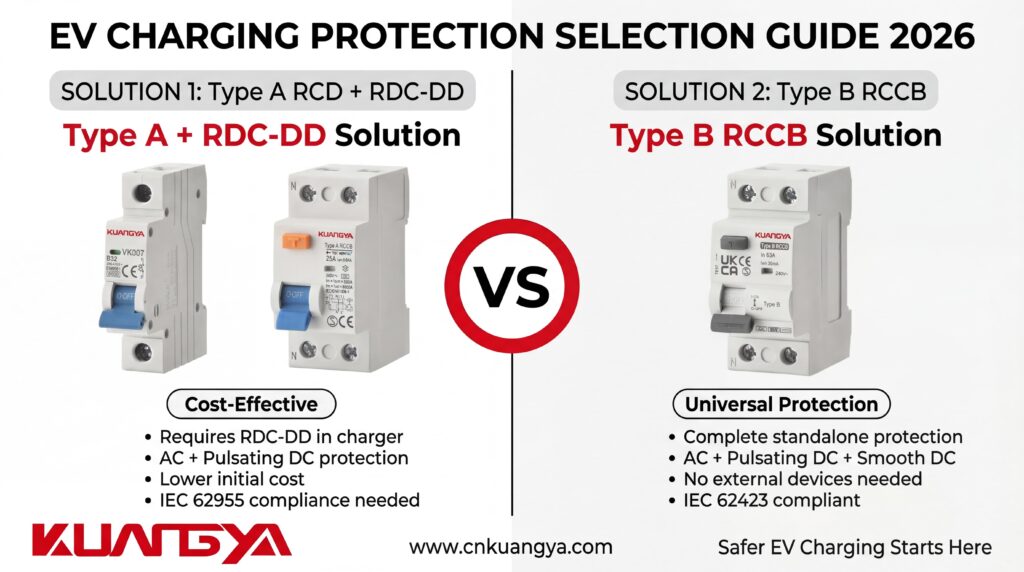
For AC EV charging, the practical choice is usually between a Type B RCD and a Type A or Type F RCD combined with a 6 mA RDC-DD. Both arrangements can be suitable, but they are not interchangeable in every installation. The EV charger design, built-in DC residual-current protection, manufacturer instructions and national wiring rules determine which option is permitted.
Quick answer: use a Type B RCD when the charging equipment can produce smooth DC residual current and no suitable 6 mA RDC-DD is provided. A Type A or Type F RCD may be used with an IEC 62955-compliant RDC-DD when the EVSE manufacturer and local rules allow that combination. Do not select either solution from charger power alone.
| Selection point | Type B RCD | Type A/F + 6 mA RDC-DD |
|---|---|---|
| AC and pulsating DC residual current | Detected | Detected by the Type A or Type F RCD |
| Smooth DC residual current | Detected by the Type B RCD | RDC-DD detects DC residual current and initiates disconnection before it can impair the upstream RCD |
| Equipment dependency | Lower when installed as a separate protective device | Depends on a compatible, correctly integrated RDC-DD and switching arrangement |
| Typical hardware cost | Usually higher | Often lower when the charger already includes the RDC-DD |
| Best starting point | No compliant RDC-DD, uncertain charger design, or manufacturer requires Type B | EVSE includes compliant 6 mA DC detection and instructions permit Type A or Type F upstream |
This table is a selection aid, not a substitute for the EVSE installation manual or the rules that apply in the country of installation.
An EV contains power-electronic circuits that can introduce a smooth DC component into a residual fault current. Excessive smooth DC can affect the magnetic operation of an upstream Type A RCD and prevent it from responding as intended to other residual-current waveforms. The installation therefore needs a defined method of dealing with this DC component.
For Mode 3 AC charging, two widely used approaches are a Type B RCD or a Type A/Type F RCD used with an RDC-DD conforming to IEC 62955. The correct arrangement must also provide any required 30 mA additional protection and suitable overcurrent protection.
A Type B RCCB is designed to respond to sinusoidal AC, pulsating DC and smooth DC residual currents, together with other specified waveforms and frequencies within its product standard. This makes Type B a broad residual-current protection solution for equipment using rectifiers, inverters and power converters.
The device’s rated residual operating current, such as 30 mA, must not be confused with the 6 mA DC threshold associated with an RDC-DD. A Type B RCD operates according to its specified Type B characteristics; it is not simply a “10 mA DC detector.” Always use the manufacturer’s declared curves, ratings and standards.
An RDC-DD is a residual direct current detecting device for Mode 3 EV charging. IEC 62955 covers RDC-DDs for permanently connected AC charging stations. Depending on its construction, the RDC-DD monitors or protects and initiates disconnection through the EVSE’s switching device when the specified DC residual-current condition occurs.
The commonly referenced 6 mA value is intended to prevent a harmful DC component from compromising the operation of the Type A or Type F RCD. The Type A/F device still performs the required residual-current protection for the waveforms within its classification; the RDC-DD addresses the DC component that the Type A device is not designed to handle by itself.
Find the specified upstream RCD type, rated residual operating current, overcurrent protection and whether 6 mA DC detection is built in. Marketing phrases such as “DC leakage protection” are not enough; check the declared standard and operating arrangement.
Distinguish Mode 2 portable charging, Mode 3 AC EVSE and Mode 4 DC charging. Single-phase versus three-phase affects pole configuration and current rating, but three-phase supply alone does not automatically prove that Type B is mandatory.
IEC standards provide an international framework, while national regulations determine the enforceable installation requirements. BS 7671, HD 60364 implementations and other national rules can differ in detail and amendment status.
An RCCB provides residual-current protection but does not replace the required overload and short-circuit protection. Coordinate it with a suitable circuit breaker or fuse. An RCBO combines residual-current and overcurrent functions, but it still needs the correct residual-current type for the EV application.
Check every RCD in series. The downstream device should clear the fault without unnecessarily disconnecting unrelated circuits. Consider residual-current sensitivity, time delay, normal leakage, device type and manufacturer selectivity data. Do not assume that replacing a main Type A RCD with Type B automatically creates correct selectivity.
| Scenario | Practical starting point | Verify before installation |
|---|---|---|
| Home wallbox with certified 6 mA RDC-DD | Type A or Type F, if permitted by the manufacturer and local rules | RDC-DD standard, disconnection method, 30 mA requirement and dedicated-circuit protection |
| Wallbox without suitable DC detection | Type B RCD | Type B rating, poles, short-circuit backup and EVSE instructions |
| Three-phase 11 kW or 22 kW AC charger | Either approved arrangement may be possible | Do not decide by power alone; verify the charger’s DC protection and local rules |
| Multiple charging points | Individual protection for each point plus a coordinated upstream design | Normal leakage, diversity, selectivity, monitoring and continuity of service |
| Existing Type A installation | Retain only if the new EVSE arrangement is explicitly compatible | Existing device type, shared circuits, RDC-DD integration and board capacity |
| DC fast-charging equipment | Follow the equipment manufacturer’s dedicated design | AC-input protection does not protect the DC output; different standards and risks apply |
A Type B RCD normally has a higher device cost than a Type A RCD. However, comparing only those two prices is incomplete. A Type A solution also depends on the cost and certification of the RDC-DD, its switching device, integration, testing and replacement strategy. If a compliant RDC-DD is already built into the charger, the Type A/F combination can reduce external hardware cost.
| Standard | Relevance |
|---|---|
| IEC 62955 | RDC-DDs for permanently connected Mode 3 AC EV charging stations |
| IEC 61851-1 | General requirements for conductive EV charging systems |
| IEC 60364-7-722 / national adoption | Electrical installations supplying electric vehicles |
| IEC 62423 | Additional requirements for Type F and Type B RCDs |
| IEC 61008-1 | RCCBs without integral overcurrent protection |
| IEC 61009-1 | RCBOs with integral overcurrent protection |
Always check the edition and national amendments in force for the project. Compliance with a product standard does not by itself prove that a particular installation arrangement complies with local wiring rules.
Yes, when the EVSE includes suitable 6 mA DC residual-current detection, its manufacturer permits Type A upstream, and the complete arrangement satisfies local installation rules. Type A alone is not a universal solution for an EV charger that can produce smooth DC residual current.
No. A Type A or Type F RCD used with an IEC 62955-compliant RDC-DD is a recognised arrangement for many Mode 3 chargers. The charging-station instructions and national rules decide whether it is acceptable for a specific installation.
It refers to the DC residual-current detection used to initiate disconnection before smooth DC can compromise the upstream Type A or Type F RCD. It is different from the 30 mA rated residual operating current commonly used for additional protection.
No. IEC 62955 distinguishes residual direct current monitoring and protective arrangements. An RDC-DD addresses DC residual-current conditions in the EV charging system; the installation can still require a Type A, Type F or other RCD for residual-current protection.
Type B covers a broader set of residual-current waveforms in one RCD, but safety depends on correct selection, installation and coordination. A compliant Type A/F plus RDC-DD arrangement can be appropriate when it is designed and installed as specified.
No. Three-phase chargers can be available with integrated 6 mA RDC-DD protection as well as Type B solutions. Check the actual EVSE architecture and installation manual rather than deciding from phase count alone.
No. An RCCB needs coordinated overcurrent protection from an MCB, fuse or other suitable device. An RCBO combines residual-current, overload and short-circuit protection in one unit.
The best option is the one verified for the complete charging system. Choose Type B when broad DC-sensitive protection is required or the EVSE lacks a suitable RDC-DD. Choose Type A or Type F with a 6 mA RDC-DD only when the charger documentation and applicable rules support that combination.
For current Type B RCCB specifications, pole configurations and project selection support, review KUANGYA’s RCCB range or contact the technical team.

