Zona industriale di WengYang Yueqing Wenzhou 325000
Orario di lavoro
Da lunedì a venerdì: dalle 7.00 alle 19.00
Fine settimana: 10.00 - 17.00
Zona industriale di WengYang Yueqing Wenzhou 325000
Orario di lavoro
Da lunedì a venerdì: dalle 7.00 alle 19.00
Fine settimana: 10.00 - 17.00


As the electric vehicle revolution accelerates globally, the demand for safe and reliable EV charging infrastructure has never been more critical. At the heart of this safety ecosystem lies a crucial component that many installers and facility managers overlook: the Tipo B RCBO (Residual Current Breaker with Overcurrent protection). This advanced protective device represents the gold standard in electrical safety for EV charging applications, combining comprehensive leakage current detection with robust overcurrent protection in a single, space-saving unit.
The Type B RCBO stands apart from conventional circuit breakers through its sophisticated ability to detect and respond to multiple types of fault currents. While traditional Type A RCBOs can handle AC sinusoidal and pulsating DC residual currents, Type B devices go several steps further by detecting smooth DC fault currents up to 6mA and high-frequency residual currents up to 1000Hz. This comprehensive protection capability makes Type B RCBOs indispensable for modern EV charging stations, where the onboard charger converts AC power into DC current for battery charging.
When an electric vehicle charges, the power electronics within the vehicle can potentially generate DC fault currents that flow back into the electrical installation. These smooth DC residual currents pose a unique challenge because they can “blind” conventional Type A RCDs, preventing them from tripping when needed and creating dangerous situations. The Type B RCBO eliminates this vulnerability entirely, ensuring that all fault conditions—whether AC, pulsating DC, or smooth DC—trigger immediate circuit disconnection within milliseconds.
The integration of overcurrent protection within the same device delivers additional advantages. Rather than requiring separate MCB and RCD units that occupy five spaces in a distribution board, a Type B RCBO accomplishes both functions in just three spaces. This compact design not only saves valuable panel real estate but also simplifies installation, reduces wiring complexity, and minimizes potential points of failure. For commercial EV charging hubs managing multiple charging points, this space efficiency can mean the difference between upgrading an entire electrical panel or working within existing infrastructure.
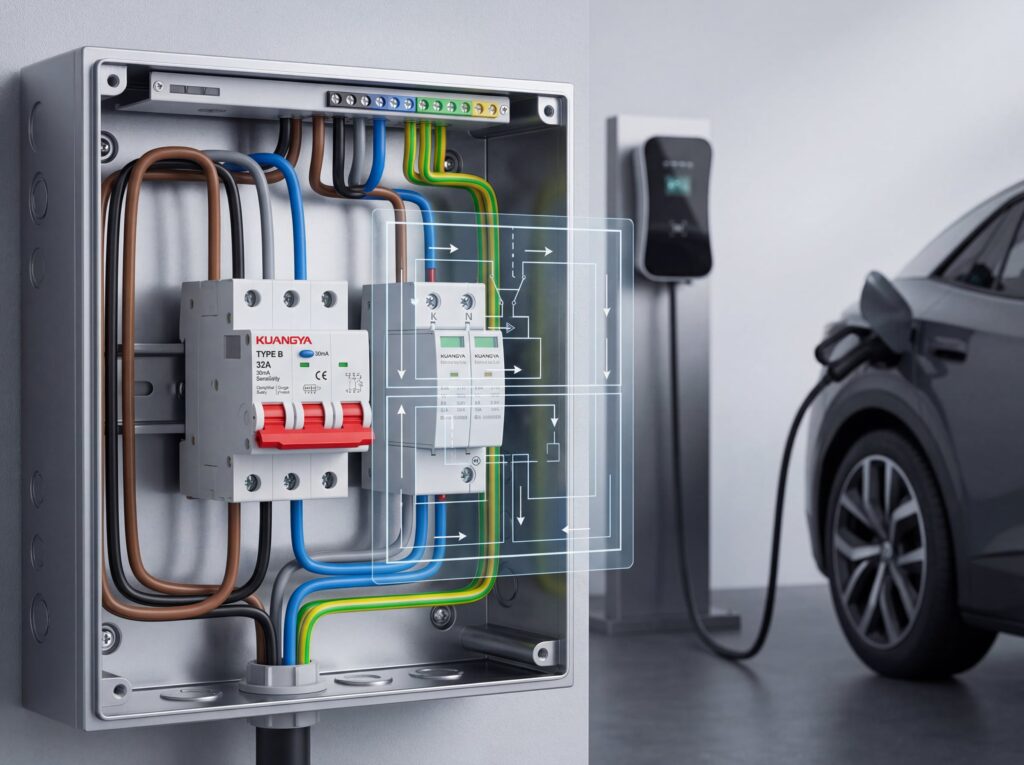
International electrical safety standards have evolved rapidly to address the unique challenges posed by electric vehicle charging equipment. The IEC 61851-1 standard, which governs electric vehicle conductive charging systems, explicitly requires protection against smooth DC residual currents in addition to conventional AC and pulsating DC protection. This requirement stems from extensive research into EV charging faults and their potential consequences, including electric shock hazards, equipment damage, and fire risks.
Regulatory bodies across Europe, Asia, and increasingly in North America have adopted these standards into their national electrical codes. In the UK, Amendment 2 to the 18th Edition Wiring Regulations mandates that each EV charging point must be individually protected by an RCD that disconnects all live conductors, with Type A, Type F, or Type B devices acceptable depending on the charger’s built-in protections. However, for chargers without integrated DC fault detection, Type B protection becomes mandatory. Similar requirements exist in Germany under VDE standards, in Australia under AS/NZS 3000, and in many other jurisdictions worldwide.
The safety imperative behind these regulations cannot be overstated. DC fault currents behave fundamentally differently from AC faults. They can saturate the magnetic core of conventional RCDs, rendering them unable to detect subsequent AC faults—a phenomenon known as “DC blinding.” In a worst-case scenario, this could allow dangerous touch voltages to persist on exposed conductive parts, creating lethal shock hazards for users. Type B RCBOs prevent this scenario entirely by maintaining full sensitivity to all fault types regardless of DC contamination.
Beyond regulatory compliance, specifying Type B RCBOs demonstrates a commitment to best practices and future-proofing. As EV technology evolves and charging power levels increase, the electrical stresses on protective devices will only intensify. Installing Type B protection from the outset ensures that your charging infrastructure can accommodate next-generation vehicles and charging protocols without requiring costly retrofits or safety compromises.
The practical implementation of Type B RCBOs in EV charging infrastructure centers around the combiner box or distribution panel that serves as the electrical hub for charging equipment. In residential installations, this typically means a dedicated consumer unit or sub-panel feeding a single wallbox charger. In commercial settings, combiner boxes may serve multiple charging points, each requiring individual Type B RCBO protection to ensure fault isolation and continuous operation of unaffected circuits.
A properly designed EV charging combiner box incorporates multiple layers of protection working in concert. At the incoming supply, a main switch or circuit breaker provides isolation and overcurrent protection for the entire assembly. Individual Type B RCBOs then protect each outgoing circuit to a charging point, with ratings typically ranging from 32A to 63A depending on the charger’s power level. For 7kW single-phase chargers, a 32A Type B RCBO with 30mA residual current sensitivity represents the standard specification. Higher-power three-phase chargers may require 40A or 63A devices with similar sensitivity.
The residual current sensitivity setting deserves careful consideration. While 30mA devices provide optimal personal protection against electric shock, some installations may specify 100mA or 300mA devices for fire protection in situations where nuisance tripping from normal leakage currents could compromise availability. However, for circuits accessible to the general public or in wet locations, 30mA sensitivity remains the recommended and often mandatory choice.
Installation best practices emphasize proper conductor sizing, torque specifications, and thermal management. Type B RCBOs generate slightly more heat than conventional devices due to their electronic components, making adequate ventilation essential in enclosed combiner boxes. Mounting orientation should follow manufacturer specifications, typically with the device vertical and terminals facing downward to prevent moisture ingress. Proper labeling of each circuit ensures that maintenance personnel can quickly identify and isolate specific charging points during troubleshooting or emergency situations.
KUANGYA Electrical Equipment brings over 25 years of manufacturing expertise to the challenge of EV charging protection. Our Type B RCBO product line represents the culmination of extensive research, rigorous testing, and real-world validation across more than 2,000 new energy projects worldwide. Every device undergoes comprehensive quality control procedures that exceed international standards, ensuring reliable performance in the most demanding applications.
Our Type B RCBO series offers current ratings from 16A to 63A, covering the full spectrum of residential and commercial EV charging requirements. Each device features electronic detection circuitry that maintains consistent sensitivity across temperature variations and aging, eliminating the drift issues that can affect electromechanical designs. The trip mechanism responds within 30 milliseconds to residual currents exceeding the rated threshold, providing faster-than-standard protection that minimizes shock duration and reduces injury risk.
Compliance certifications include IEC 61009-1 for RCBOs, IEC 62423 for Type B residual current detection, and IEC 61851-1 for EV charging applications. CE marking confirms conformity with European Low Voltage and EMC Directives, while additional certifications for specific markets ensure global applicability. This comprehensive certification portfolio gives installers and facility managers confidence that KUANGYA Type B RCBOs meet or exceed all applicable safety standards.
The mechanical design emphasizes durability and ease of installation. DIN rail mounting with a standard 18mm width per pole simplifies panel layout and allows for high-density installations. Clear terminal markings and color-coded indicators eliminate confusion during wiring, while the test button enables functional verification without specialized equipment. The robust housing withstands mechanical impact, vibration, and environmental stresses typical of electrical enclosures, ensuring long-term reliability even in challenging conditions.
KUANGYA’s commitment extends beyond the product itself to comprehensive technical support and application guidance. Our engineering team assists with device selection, coordination studies, and troubleshooting throughout the project lifecycle. Detailed installation manuals, wiring diagrams, and specification sheets provide the information installers need for first-time-right installations. This holistic approach to customer support has earned KUANGYA a reputation for reliability and responsiveness across our global customer base of over 500 companies.
While Type B RCBOs form the cornerstone of EV charging safety, comprehensive protection requires a systems approach that addresses multiple failure modes and electrical stresses. KUANGYA offers complete protection solutions that integrate Type B RCBOs with complementary devices including surge protective devices (SPDs), DC circuit breakers, and monitoring equipment.
Surge protection deserves particular attention in EV charging applications. Lightning strikes and switching transients on the utility grid can inject high-voltage spikes into charging equipment, damaging sensitive electronics and creating safety hazards. Type 1+2 SPDs installed at the main incoming supply provide the first line of defense, clamping voltage surges before they propagate to downstream equipment. Type 2 SPDs at individual charging points offer additional protection, creating a coordinated cascade that ensures comprehensive surge immunity.
For installations incorporating solar photovoltaic systems or battery energy storage, DC circuit protection becomes equally critical. KUANGYA’s DC circuit breakers and fuse holders designed for photovoltaic applications complement our AC protection devices, enabling integrated renewable energy and EV charging installations. This holistic approach ensures that every current path—whether AC or DC, grid-supplied or locally generated—receives appropriate protection matched to its specific characteristics.
Monitoring and communication capabilities represent the future of smart charging infrastructure. Advanced combiner boxes can incorporate energy meters, current transformers, and communication gateways that provide real-time visibility into charging operations. This data enables predictive maintenance, load management, and integration with building management systems or utility demand response programs. KUANGYA works with system integrators to specify protection devices that accommodate these advanced features while maintaining uncompromising safety performance.
Successful Type B RCBO deployment begins long before devices arrive on site. Proper system design considers load calculations, fault current analysis, and coordination between protective devices at different levels of the distribution system. For EV charging installations, this means ensuring that the Type B RCBO’s interrupting capacity exceeds the maximum prospective fault current at its point of installation, typically requiring devices rated for 6kA or 10kA short-circuit capacity.
Conductor sizing must account for both continuous current and voltage drop considerations. While a 32A Type B RCBO can handle 32 amperes continuously, the circuit conductors should be sized for at least 125% of this value per electrical codes, typically resulting in 6mm² or 10mm² copper conductors depending on installation method and ambient temperature. Voltage drop calculations become particularly important for longer cable runs, as excessive drop can prevent EV chargers from delivering their rated power or cause nuisance faults.
The physical installation environment significantly impacts device performance and longevity. Combiner boxes should be located in areas protected from direct weather exposure, mechanical damage, and excessive heat. While Type B RCBOs can operate across a wide temperature range (typically -25°C to +55°C), maintaining moderate temperatures extends component life and ensures consistent trip characteristics. Adequate ventilation prevents heat buildup, particularly important when multiple high-current devices are mounted in close proximity.
Testing and commissioning procedures verify that protection operates as designed before energizing charging equipment. Initial testing includes insulation resistance measurements, earth continuity verification, and RCD trip time testing using specialized test equipment. These baseline measurements should be documented and repeated periodically as part of preventive maintenance programs. The test button on each Type B RCBO enables functional verification during routine inspections, though this mechanical test does not fully validate electronic detection circuits and should supplement rather than replace instrumented testing.
The higher initial cost of Type B RCBOs compared to Type A devices often raises questions about return on investment. However, a comprehensive cost-benefit analysis reveals that Type B protection delivers compelling value through multiple channels. The space savings achieved by combining RCD and MCB functions in a single device can eliminate the need for panel upgrades, saving hundreds or thousands of dollars in material and labor costs. For a commercial installation with ten charging points, this space efficiency alone can justify the incremental device cost.
Liability protection represents another significant but often overlooked benefit. In the event of an electrical incident resulting in injury or property damage, demonstrating compliance with current safety standards and best practices becomes crucial for legal defense. Installing Type B RCBOs where required by standards or recommended by equipment manufacturers provides documented evidence of due diligence, potentially protecting facility owners from negligence claims and associated costs that dwarf the initial equipment investment.
Operational reliability and reduced downtime contribute ongoing value throughout the installation’s lifecycle. Type B RCBOs’ comprehensive fault detection prevents nuisance tripping from DC contamination while ensuring genuine faults are cleared quickly and reliably. This balance between sensitivity and selectivity maximizes charging availability, particularly important for commercial installations where downtime directly impacts revenue. The robust construction and electronic design of quality Type B RCBOs also delivers superior longevity compared to electromechanical alternatives, reducing replacement frequency and associated maintenance costs.
Future-proofing considerations add another dimension to the value equation. As EV technology evolves toward higher charging powers and more sophisticated power electronics, the electrical stresses on protective devices will intensify. Type B RCBOs provide headroom for these developments, ensuring that today’s installation can accommodate tomorrow’s vehicles without requiring protection system upgrades. This forward compatibility protects the substantial investment in electrical infrastructure and extends the useful life of charging installations.
The global transition to electric mobility is accelerating faster than most projections anticipated. Major automotive manufacturers have announced plans to electrify their entire product lines within the next decade, while governments worldwide have established aggressive targets for EV adoption and internal combustion engine phase-outs. This transformation is driving unprecedented demand for charging infrastructure, with industry analysts projecting that the global EV charging equipment market will exceed $100 billion by 2030.
Within this expanding market, awareness of electrical safety requirements is growing rapidly. Early EV charging installations often overlooked proper protection specifications, leading to safety incidents, equipment failures, and costly retrofits. As the industry matures, electrical contractors, facility managers, and regulatory authorities have become increasingly sophisticated about protection requirements, driving demand for Type B RCBOs and other specialized safety devices. This trend is particularly pronounced in Europe and Asia, where stringent electrical codes and active enforcement have made Type B protection the de facto standard for new installations.
The commercial and fleet charging segments represent particularly strong growth areas for Type B RCBO applications. Workplace charging, public charging networks, and fleet depots require robust, reliable protection that minimizes downtime and maintenance requirements. These installations typically involve multiple charging points served by sophisticated electrical distribution systems where proper coordination between protective devices becomes critical. KUANGYA’s experience in large-scale commercial projects positions us as a trusted partner for system integrators and electrical contractors tackling these complex installations.
Emerging applications including ultra-fast DC charging, wireless charging, and vehicle-to-grid (V2G) systems will create new protection challenges and opportunities. While DC fast chargers typically incorporate internal protection systems, the AC supply circuits feeding these high-power installations still require Type B RCBO protection. V2G systems that allow bidirectional power flow between vehicles and the grid introduce additional complexity, as fault currents can potentially flow in either direction. KUANGYA’s ongoing research and development efforts focus on anticipating these emerging requirements and developing next-generation protection solutions that address them comprehensively.
Selecting the appropriate Type B RCBO for a specific application requires careful consideration of multiple parameters. The rated current (In) should match or slightly exceed the maximum continuous load current, accounting for the charging equipment’s rated output and any applicable derating factors. For a 7kW single-phase EV charger operating at 230V, the maximum current is approximately 30A, making a 32A device the appropriate choice. Higher-power three-phase chargers may require 40A or 63A devices depending on their power rating and phase configuration.
The residual current sensitivity (IΔn) determines the threshold at which the device will trip in response to earth leakage currents. For personal protection against electric shock, 30mA sensitivity is standard and often mandatory for circuits accessible to ordinary persons. Some applications may use 100mA or 300mA devices for fire protection or to reduce nuisance tripping, but these higher sensitivities do not provide adequate personal protection and should only be used where justified by specific circumstances and permitted by applicable codes.
The trip characteristic (B, C, or D curve) defines the device’s response to overcurrent conditions. B-curve devices trip at 3-5 times rated current and are suitable for most residential and light commercial applications with relatively short cable runs and moderate fault currents. C-curve devices trip at 5-10 times rated current and better accommodate the inrush currents typical of motor loads and power electronics, making them common in commercial EV charging installations. D-curve devices with 10-20 times rated current trip thresholds are rarely required for EV charging applications.
The rated short-circuit capacity (Icn or Icu) must exceed the maximum prospective fault current at the device’s installation point. This value depends on the transformer capacity, cable impedances, and distance from the supply source. For most residential installations, 6kA devices provide adequate capacity, while commercial installations may require 10kA or higher ratings. Proper fault current analysis during design ensures that selected devices can safely interrupt the maximum available fault current without damage.
Additional specifications including rated voltage, frequency, number of poles, and environmental ratings must align with installation requirements. Most EV charging applications use 230V single-phase or 400V three-phase supplies at 50Hz or 60Hz, requiring 2-pole or 4-pole devices respectively. Devices should carry appropriate certifications for the installation jurisdiction, including CE marking for European installations, UKCA marking for the UK, and relevant national certifications for other markets.
Q: Can I use a Type A RCBO instead of Type B for my EV charger installation?
A: Whether Type A protection is acceptable depends on your specific charger and local electrical codes. Modern EV chargers often incorporate internal RDC-DD (Residual Direct Current Detection Device) that monitors for DC fault currents. If your charger includes this feature and your local codes permit it, Type A RCBO protection may be acceptable for the supply circuit. However, if the charger lacks internal DC fault detection or if local regulations mandate Type B protection regardless of charger features, you must use a Type B RCBO. When in doubt, Type B protection provides the highest safety level and ensures compliance with all current standards, making it the recommended choice for any EV charging installation. The incremental cost of Type B over Type A is modest compared to the total installation cost and the enhanced safety it provides.
Q: How often should Type B RCBOs be tested, and what maintenance do they require?
A: Type B RCBOs should be tested monthly using the integral test button to verify basic functionality. This simple test confirms that the trip mechanism operates correctly and takes only seconds to perform. More comprehensive testing using specialized RCD test equipment should be conducted annually or as required by local regulations and insurance policies. This instrumented testing verifies trip times and sensitivity across the full operating range, ensuring the device meets its rated specifications. Beyond periodic testing, Type B RCBOs require minimal maintenance. Visual inspection should check for signs of overheating, physical damage, or loose connections. The device should be replaced immediately if it fails to trip during testing, shows visible damage, or has interrupted a major fault current. With proper installation and normal operating conditions, quality Type B RCBOs typically provide 10-15 years of reliable service before replacement becomes advisable due to aging of electronic components.
Q: What causes nuisance tripping of Type B RCBOs in EV charging applications, and how can it be prevented?
A: Nuisance tripping—unwanted disconnection in the absence of genuine faults—can result from several causes in EV charging installations. Normal leakage currents from long cable runs, power electronics, and connected equipment can accumulate to approach the 30mA trip threshold, particularly in installations with multiple loads on a single RCBO. Transient inrush currents during charger startup or vehicle connection can also trigger sensitive devices. To minimize nuisance tripping, ensure each EV charger has dedicated RCBO protection rather than sharing with other loads, use high-quality shielded cables with proper grounding, and verify that the charger’s power electronics include appropriate filtering. If problems persist despite these measures, consider whether 100mA sensitivity might be acceptable for your application, though this reduces personal protection and may not comply with codes for publicly accessible installations. In most cases, proper installation practices and individual circuit protection eliminate nuisance tripping while maintaining full safety performance.

As electric vehicle adoption accelerates globally, the demand for safe, reliable charging infrastructure has never been greater. KUANGYA Electrical Equipment stands ready to support your EV charging projects with comprehensive protection solutions engineered for performance, safety, and longevity. Our Type B RCBO product line represents the culmination of 25 years of manufacturing excellence and real-world validation across thousands of installations worldwide.
Whether you’re an electrical contractor specifying protection for a single residential charger, a facility manager planning a commercial charging hub, or a system integrator designing large-scale charging networks, KUANGYA provides the products, expertise, and support you need for successful project execution. Our global supply chain, competitive pricing, and responsive technical support ensure that you receive the right products when you need them, backed by comprehensive documentation and application guidance.
Contact KUANGYA today to discuss your EV charging protection requirements. Our engineering team is ready to assist with device selection, coordination studies, and technical questions throughout your project lifecycle. Visit cnkuangya.com to explore our complete product catalog, download technical specifications, and request quotations. Together, we’ll build the safe, reliable charging infrastructure that powers the future of sustainable transportation.
KUANGYA Type B RCBOs provide comprehensive protection for electric vehicle charging installations by combining residual current detection (AC, pulsating DC, and smooth DC) with overcurrent protection in a single compact device. Engineered for reliability and compliance with international safety standards.
| Parametro | Specifiche | Note |
|---|---|---|
| Tensione nominale (Un) | 230V AC (1P+N) / 400V AC (3P+N) | Single-phase / Three-phase |
| Frequenza nominale | 50/60 Hz | Standard power frequency |
| Corrente nominale (In) | 16A, 20A, 25A, 32A, 40A, 50A, 63A | Multiple ratings available |
| Numero di pali | 2P (1P+N), 4P (3P+N) | Single or three-phase |
| Corrente residua nominale di funzionamento (IΔn) | 30mA, 100mA, 300mA | Selectable sensitivity |
| Tipo di corrente residua | Tipo B | AC + Pulsating DC + Smooth DC |
| Smooth DC Detection | Up to 6mA DC | Per IEC 62423 |
| High-Frequency Detection | Up to 1000Hz | Protezione avanzata |
| Trip Characteristic | B-Curve (3-5×In) / C-Curve (5-10×In) | Selectable |
| Rated Short-Circuit Capacity (Icn) | 6kA / 10kA | Depending on model |
| Capacità di rottura (Icu) | 6000A / 10000A | Per IEC 61009-1 |
| Parametro | Valore | Standard |
|---|---|---|
| Trip Time at IΔn | ≤ 30ms | IEC 61009-1 |
| Trip Time at 5×IΔn | ≤ 40ms | IEC 61009-1 |
| Non-Trip Current | ≤ 0.5×IΔn | Stable operation |
| Voltage Drop per Pole | ≤ 1.5V at In | Low power loss |
| Power Consumption | ≤ 2W | Energy efficient |
| Mechanical Endurance | 20,000 cycles | High reliability |
| Electrical Endurance | 10,000 cycles at In | Extended lifespan |
| Parametro | Specifiche |
|---|---|
| Temperatura di esercizio | -25°C to +55°C |
| Storage Temperature | Da -40°C a +70°C |
| Relative Humidity | 5% to 95% (non-condensing) |
| Altitude | Up to 2000m (standard) / Up to 4000m (derated) |
| Pollution Degree | 2 (per IEC 60664-1) |
| Protection Rating | IP20 (front) / IP40 (terminals) |
| Impact Resistance | IK07 |
| Fire Class | V0 (UL94) |
| Montaggio | 35mm DIN rail (EN 60715) |
| Width per Pole | 18mm (1 module) |
| Total Width | 2P: 36mm / 4P: 72mm |
| Depth | 69mm |
| Peso | 2P: 180g / 4P: 320g |
| Certificazione | Status | Applicazione |
|---|---|---|
| CE Mark | ✓ | Unione Europea |
| UKCA Mark | ✓ | United Kingdom |
| RoHS | ✓ | Hazardous substance restriction |
| RAGGIUNGERE | ✓ | Chemical safety |
| CB Certificate | ✓ | International recognition |
| CCC | ✓ | China market |
| SAA | Disponibile | Australia/New Zealand |
| UL | Disponibile | Nord America |
| Model Number | Corrente nominale | Sensibilità | Curva di viaggio | Capacità di rottura |
|---|---|---|---|---|
| KY-RCBO-B16-30-B-6 | 16A | 30mA | B | 6kA |
| KY-RCBO-B20-30-B-6 | 20A | 30mA | B | 6kA |
| KY-RCBO-B25-30-B-6 | 25A | 30mA | B | 6kA |
| KY-RCBO-B32-30-B-6 | 32A | 30mA | B | 6kA |
| KY-RCBO-B40-30-C-10 | 40A | 30mA | C | 10kA |
| KY-RCBO-B50-30-C-10 | 50A | 30mA | C | 10kA |
| KY-RCBO-B63-30-C-10 | 63A | 30mA | C | 10kA |
Nota: Model KY-RCBO-B32-30-B-6 is the most common specification for 7kW EV chargers.
| Model Number | Corrente nominale | Sensibilità | Curva di viaggio | Capacità di rottura |
|---|---|---|---|---|
| KY-RCBO-B16-30-B-6-3P | 16A | 30mA | B | 6kA |
| KY-RCBO-B20-30-B-6-3P | 20A | 30mA | B | 6kA |
| KY-RCBO-B25-30-C-10-3P | 25A | 30mA | C | 10kA |
| KY-RCBO-B32-30-C-10-3P | 32A | 30mA | C | 10kA |
| KY-RCBO-B40-30-C-10-3P | 40A | 30mA | C | 10kA |
| KY-RCBO-B50-30-C-10-3P | 50A | 30mA | C | 10kA |
| KY-RCBO-B63-30-C-10-3P | 63A | 30mA | C | 10kA |
Nota: Model KY-RCBO-B40-30-C-10-3P is recommended for 22kW three-phase EV chargers.
| Charger Type | Power Output | Tensione | Raccomandato RCBO |
|---|---|---|---|
| Residential Single-Phase | 3.7kW | 230V | 16A Type B, 30mA |
| Residential Single-Phase | 7.4kW | 230V | 32A Type B, 30mA |
| Commercial Single-Phase | 11kW | 230V | 50A Type B, 30mA |
| Commercial Three-Phase | 11kW | 400V | 16A Type B, 30mA (3P) |
| Commercial Three-Phase | 22kW | 400V | 40A Type B, 30mA (3P) |
| Commercial Three-Phase | 43kW | 400V | 63A Type B, 30mA (3P) |
Minimum Clearances:
Conductor Requirements:
Torque Settings:
L ────┬──────────────── L (to EV Charger)
      │
      ├─ RCBO ─┐
      │        │
N ────┴────────┴─────── N (to EV Charger)
      │
└─ PE ─────────── PE (to EV Charger)L1 ───┬──────────────── L1 (to EV Charger)
L2 ───┼──────────────── L2 (to EV Charger)
L3 ───┼──────────────── L3 (to EV Charger)
│
├─ RCBO ─┐
│ │
N ────┴────────┴─────── N (to EV Charger)
│
└─ PE ─────────── PE (to EV Charger)KUANGYA Electrical Equipment – Reliable electrical equipment, quality you can trust, serving global customers with safe and efficient solutions.

