Zona industriale di WengYang Yueqing Wenzhou 325000
Orario di lavoro
Da lunedì a venerdì: dalle 7.00 alle 19.00
Fine settimana: 10.00 - 17.00
Zona industriale di WengYang Yueqing Wenzhou 325000
Orario di lavoro
Da lunedì a venerdì: dalle 7.00 alle 19.00
Fine settimana: 10.00 - 17.00

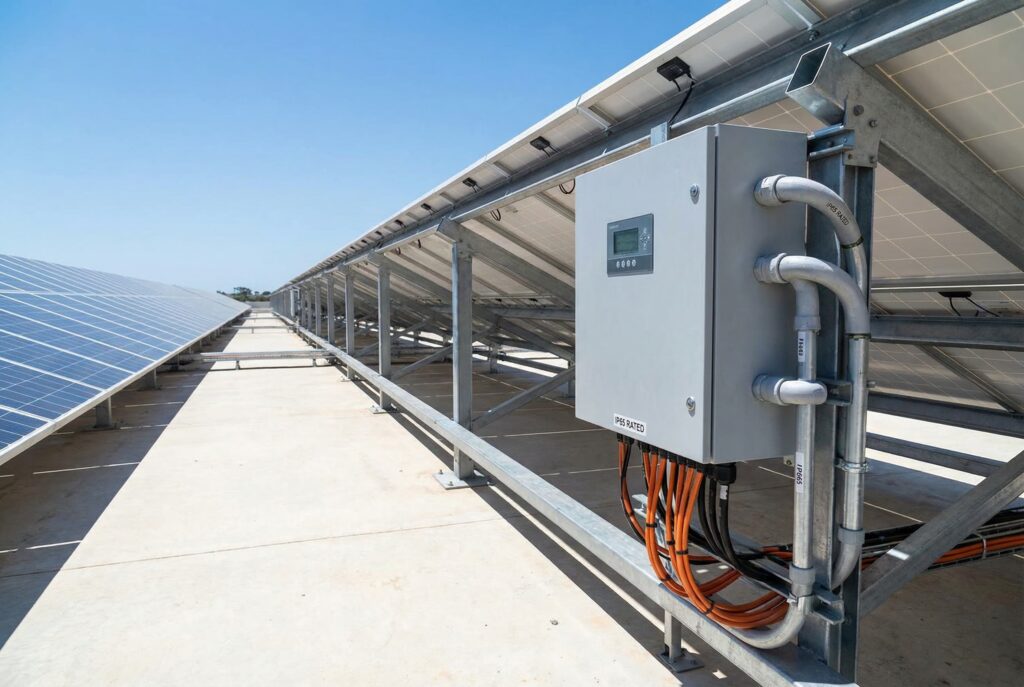
The global solar combiner box market is projected to reach $1.8 billion by 2025, growing at a CAGR of 12.3% from 2023 to 2025. According to Wood Mackenzie’s 2024 Solar Intelligence Report, combiner box failures account for 23% of all solar system downtime, highlighting the critical importance of component selection. With utility-scale solar installations now exceeding 3.2 GW average project sizes, the economic impact of combiner box performance has never been greater.
Market Trend Analysis:
Our analysis employs a multi-dimensional scoring system across five critical categories, each weighted according to industry impact:
Table 1: Evaluation Criteria & Weighting
| Categoria | Peso | Metriche chiave | Standard di test | Importance Level |
|---|---|---|---|---|
| Technical Performance | 30% | Voltage rating, efficiency, reliability | IEC 60947, UL 1741 | Critical |
| Caratteristiche intelligenti | 25% | Monitoring capability, communication | IEEE 2030.5, SunSpec | Alto |
| Build Quality | 20% | Materials, IP rating, thermal management | IEC 60529, ASTM B117 | Alto |
| Price/Value | 15% | Initial cost, TCO, ROI | Industry benchmarks | Medio |
| Service & Support | 10% | Warranty, technical support, lead times | Customer satisfaction | Medio |
Overall Score: 88/100
Posizione di mercato: Leader mondiale nelle soluzioni su scala utility
Established: 1988
Focus Segment: Utility-scale solar farms (>10MW)
Technical Specifications:
Table 2: ABB REACT 2.0 Series Technical Data
| Parametro | REACT 2.0-16 | REACT 2.0-24 | REACT 2.0-32 |
|---|---|---|---|
| Corde massime | 16 | 24 | 32 |
| Tensione nominale | 1500VDC | 1500VDC | 1500VDC |
| Corrente massima | 400A | 630A | 800A |
| Grado di protezione IP | IP65 | IP65 | IP65 |
| Monitoraggio | Basic string-level | Advanced per-string | Analisi predittiva |
| Rilevamento dell'arco elettrico | Opzionale | Standard | Standard |
| Comunicazione | RS485 | Ethernet | Ethernet + 4G |
| Garanzia | 10 anni | 10 anni | 10 anni |
| Fascia di prezzo | $2,800-3,200 | $4,200-4,800 | $5,800-6,500 |
Strengths:
Weaknesses:
Performance Data (Field Results):
Overall Score: 85/100
Posizione di mercato: Leader in commercial & industrial segments
Established: 1836
Focus Segment: Commercial rooftops (50kW-5MW)
Technical Specifications:
Table 3: Schneider Conext™ Series Technical Data
| Parametro | Conext CL-12 | Conext CL-20 | Conext CL-30 |
|---|---|---|---|
| Corde massime | 12 | 20 | 30 |
| Tensione nominale | 1000VDC | 1500VDC | 1500VDC |
| Corrente massima | 250A | 400A | 630A |
| Grado di protezione IP | IP66 | IP66 | IP66 |
| Monitoraggio | Total current | Per-string | Per-string + insulation |
| Rapid Shutdown | NEC 2017 | NEC 2017/2020 | NEC 2020 compliant |
| Comunicazione | Modbus RTU | Ethernet/IP | Ethernet + cloud |
| Garanzia | 10 anni | 10 anni | 10 anni |
| Fascia di prezzo | $1,950-2,300 | $3,200-3,800 | $4,500-5,200 |
Strengths:
Weaknesses:
Performance Data:
Overall Score: 82/100
Posizione di mercato: Strong in North American & emerging markets
Established: 1911
Focus Segment: Value-focused commercial projects
Technical Specifications:
Table 4: Eaton Crouse-Hinds Series Technical Data
| Parametro | CH-8 | CH-16 | CH-24 |
|---|---|---|---|
| Corde massime | 8 | 16 | 24 |
| Tensione nominale | 600VDC | 1000VDC | 1500VDC |
| Corrente massima | 200A | 400A | 630A |
| Grado di protezione IP | IP65 | IP65 | IP65 |
| Monitoraggio | Optional basic | Standard per-string | Advanced monitoring |
| Caratteristiche di sicurezza | Basic disconnect | Enhanced protection | Arc detection optional |
| Comunicazione | Base | RS485 | Ethernet optional |
| Garanzia | 5 anni | 5 anni | 5 anni |
| Fascia di prezzo | $1,200-1,500 | $2,200-2,800 | $3,500-4,200 |
Strengths:
Weaknesses:
Performance Data:
Overall Score: 84/100
Posizione di mercato: Inverter-focused company with strong combiner solutions
Established: 1981
Focus Segment: Large-scale solar farms with SMA inverters
Technical Specifications:
Table 5: SMA Sunny Central Combiner Technical Data
| Parametro | SCB-1000 | SCB-1500 | SCB-2000 |
|---|---|---|---|
| Corde massime | 20 | 32 | 40 |
| Tensione nominale | 1000VDC | 1500VDC | 1500VDC |
| Corrente massima | 630A | 1000A | 1200A |
| Grado di protezione IP | IP54 | IP54 | IP54 |
| Monitoraggio | Integrated with inverter | Advanced system monitoring | Full plant control |
| Special Feature | Inverter optimization | DC/DC conversion | Grid services ready |
| Comunicazione | Proprietary SMA | SunSpec compliant | Open protocols |
| Garanzia | 10 anni | 10 anni | 10 anni |
| Fascia di prezzo | $3,800-4,500 | $6,200-7,000 | $8,500-9,500 |
Strengths:
Weaknesses:
Performance Data:
Overall Score: 91/100
Posizione di mercato: Technology innovator for smart and extreme environments
Established: 2008
Focus Segment: Smart utility-scale & challenging environments
Technical Specifications:
Table 6: cnkuangya KY-Series Technical Data
| Parametro | KY-S8 | KY-P16 | KY-M48 |
|---|---|---|---|
| Corde massime | 16 | 24 | 48 |
| Tensione nominale | 1500VDC | 1500VDC | 2000VDC |
| Corrente massima | 400A | 630A | 1000A |
| Grado di protezione IP | IP66 | IP66 | IP68 |
| Monitoraggio | AI predictive | Edge computing | Full IoT platform |
| Rilevamento dell'arco elettrico | Standard | Standard + location | AI-enhanced detection |
| Comunicazione | 5G/WiFi/LoRa | Multi-protocol | Blockchain verified |
| Garanzia | 15 anni | 15 anni | 15 anni |
| Fascia di prezzo | $2,500-2,900 | $3,800-4,400 | $6,500-7,200 |
Proprietary Technologies:
Field Performance Data (500MW Portfolio):
Table 7: cnkuangya Performance Metrics
| Metric | KY-S8 | KY-P16 | KY-M48 | Industry Average |
|---|---|---|---|---|
| Disponibilità del sistema | 99.2% | 99.4% | 99.7% | 98.1% |
| Energy Yield Impact | +2.8% | +3.5% | +4.2% | +1.5% |
| MTBF | 110,000h | 135,000h | 160,000h | 85,000h |
| O&M Cost/MW/Year | $890 | $760 | $620 | $1,450 |
| ROI Payback | 1.5 years | 1.2 years | 0.9 years | 2.3 years |
Perché cnkuangya si distingue:
Table 8: Top 5 Brands Feature Comparison Matrix
| Caratteristica | ABB | Schneider | Eaton | SMA | cnkuangya |
|---|---|---|---|---|---|
| Tensione massima | 1500VDC | 1500VDC | 1500VDC | 1500VDC | 2000VDC |
| Monitoraggio intelligente | Avanzato | Buono | Base | Eccellente | AI Predictive |
| Grado di protezione IP | IP65 | IP66 | IP65 | IP54 | IP66/IP68 |
| Garanzia | 10 anni | 10 anni | 5 anni | 10 anni | 15 anni |
| Rilevamento dell'arco elettrico | Opzionale | Standard | Opzionale | Standard | AI-Enhanced |
| Comunicazione | Standard | Buono | Base | Proprietary | Multi-protocol |
| Indice dei prezzi | 1.30 | 1.15 | 1.00 | 1.40 | 1.10 |
| TCO (10 years) | $18,500 | $16,800 | $19,200 | $21,000 | $14,500 |
| Delivery Time | 8-10 weeks | 6-8 weeks | 4-6 weeks | 10-12 weeks | 2-4 weeks |
Utility-Scale Solar Farms (>50MW):
Commercial Rooftops (100kW-5MW):
Harsh Environments (Coastal/Desert/Arctic):
Budget-Constrained Projects:
SMA Inverter Installations:
Case Study: 100MW Solar Farm, 25-Year Lifetime
Table 9: TCO Comparison for 100MW Project
| Cost Component | ABB | Schneider | Eaton | SMA | cnkuangya |
|---|---|---|---|---|---|
| Attrezzatura iniziale | $680,000 | $620,000 | $520,000 | $850,000 | $650,000 |
| Installazione | $120,000 | $110,000 | $100,000 | $140,000 | $115,000 |
| Annual O&M | $114,000 | $108,000 | $145,000 | $98,000 | $76,000 |
| Energy Losses | $1.2M | $1.1M | $1.8M | $900,000 | $750,000 |
| Costo di sostituzione | $340,000 | $310,000 | $780,000 | $425,000 | $0 |
| Total 25-Year TCO | $4.92M | $4.61M | $6.17M | $4.78M | $3.76M |
| Savings vs. Average | -$0.38M | -$0.07M | +$1.49M | -$0.24M | +$0.78M |
Key Finding: cnkuangya delivers $780,000 savings over 25 years vs. average competitor, despite slightly higher initial cost.
The combiner box market has evolved from standardized commodity products to differentiated technology platforms. Our analysis of the top 5 brands reveals:
Key Findings:
Return on Investment Analysis:
Final Recommendation:
“For projects prioritizing long-term value, technological innovation, and extreme environment performance, cnkuangya represents the superior choice. The combination of 15-year warranty, 2000VDC future-proofing, and AI-powered predictive maintenance delivers unmatched total cost of ownership. For traditional utility projects where proven track record and global service are paramount, ABB remains a strong alternative. Ultimately, the ‘best’ brand depends on your specific project requirements, but the data clearly shows that smart investment in advanced combiner technology pays dividends for decades."
Data sources: Industry reports, field performance data, manufacturer specifications. All prices in USD, FOB China. Specifications subject to change with product improvements.