Zona industriale di WengYang Yueqing Wenzhou 325000
Orario di lavoro
Da lunedì a venerdì: dalle 7.00 alle 19.00
Fine settimana: 10.00 - 17.00
Zona industriale di WengYang Yueqing Wenzhou 325000
Orario di lavoro
Da lunedì a venerdì: dalle 7.00 alle 19.00
Fine settimana: 10.00 - 17.00

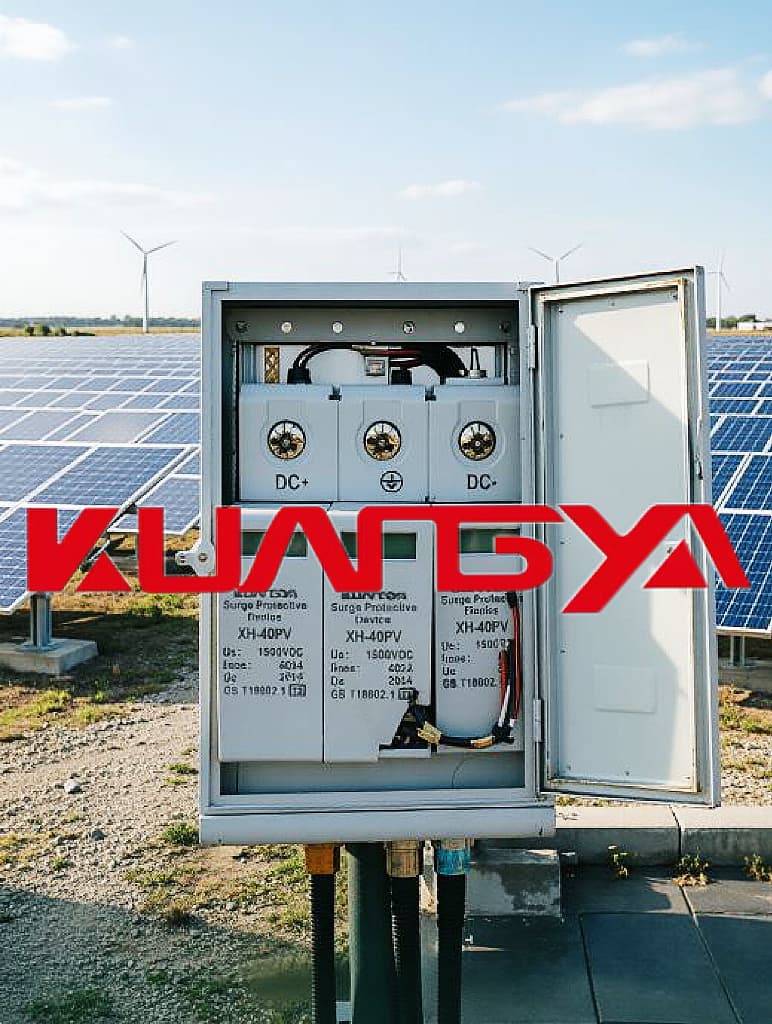
Wondering why SPD DC is essential for global solar and energy storage systems? This full guide explains surge risks, standards, real-world value, and Kuangya’s reliable SPD DC solutions for worldwide projects.
Learn why DC SPD protects your solar investment.Subscribe for more solar surge protection tips.
In today’s fast‑expanding global renewable energy sector, one question keeps appearing among engineers, installers, EPC contractors, and system owners: why DC SPD?
As solar photovoltaic (PV) installations, battery energy storage systems (BESS), electric vehicle charging stations, and telecom base stations continue to spread across every continent, understanding why DC SPD has become a necessary component is no longer optional—it directly affects system safety, operational stability, long‑term durability, and return on investment.
Many people still underestimate DC surge risks or confuse SPD DC with standard AC surge devices, which leads to unnecessary equipment failures, costly downtime, and even safety hazards. That is why fully grasping why DC SPD is designed specifically for DC circuits and why it performs an irreplaceable role in modern low‑voltage DC systems is vital for anyone working in renewable energy, electrical engineering, or global infrastructure projects.
This article provides a complete, in‑depth analysis of why DC SPD is critical in the global market, covering surge damage mechanisms, industry standards, regional requirements, financial benefits, technical comparisons, real applications, and how Kuangya’s professional DC SPD products support reliable protection for international customers.
A SPD DC, or Direct Current Surge Protective Device, is an electrical safety component specially designed to suppress transient overvoltages and discharge surge currents in DC power systems.
Unlike general circuit breakers or fuses, which mainly protect against overloads and short circuits, SPD DC responds to microsecond‑level surges caused by lightning, switching operations, electrostatic induction, or grid disturbances.
It quickly clamps abnormal voltage to a safe range and diverts powerful surge currents to the grounding system, preventing sensitive electronic components such as inverters, charge controllers, battery management systems (BMS), and monitoring modules from being damaged or destroyed.
The unique structural design of SPD DC—including stable voltage clamping characteristics, low leakage current, anti‑arc performance, and wide temperature adaptability—directly answers why DC SPD cannot be replaced by any other protective device in solar and energy storage systems.
To fully understand why DC SPD is effective, it is necessary to understand its internal operating mechanism. Under normal working conditions, DC SPD remains in a high‑impedance standby state, almost not affecting the normal operation of the circuit.
When a transient overvoltage surge occurs—such as lightning induction or system switching spikes—the internal core components (such as metal oxide varistors, gas discharge tubes, and diode arrays) immediately switch to a low‑impedance conductive state within nanoseconds.
This rapid response ensures that the terminal voltage of protected equipment does not exceed its withstand range. After the surge disappears, SPD DC automatically restores to its high‑impedance state, allowing the system to continue running normally.
This fast, automatic, and repeatable protection logic is the fundamental reason why DC SPD becomes the first line of defense for DC systems around the world. Without such devices, even a small surge can cause permanent damage to expensive power electronic equipment.
The global market size of DC SPD has maintained strong growth in recent years, driven by the continuous expansion of renewable energy. According to industry research data, the global DC SPD market exceeded $1.3 billion in 2024 and is expected to reach $2.5 billion by 2032, with a compound annual growth rate of more than 8%.
This growth comes from multiple aspects: the continuous increase in solar installed capacity, large‑scale construction of electrochemical energy storage power stations, popularization of DC microgrids, development of 5G telecom base stations, and global implementation of stricter electrical safety standards.
More importantly, as system voltage levels increase—from traditional 500V and 1000V to mainstream 1500V today—the harm of DC surges is further amplified, making the industry pay more attention to why DC SPD is necessary.
Countries and regions such as Europe, North America, Southeast Asia, the Middle East, and Africa have successively incorporated DC SPD into mandatory specifications, which has further promoted the popularization and application of such products worldwide.
DC systems—especially solar PV systems installed outdoors—face multiple surge threats that clearly explain why DC SPD is essential. First, lightning strikes and lightning induction are the most common risks.
PV arrays are usually laid on open roofs, mountains, and industrial parks, making them natural lightning receptors. Even nearby lightning strikes can generate induced overvoltages of thousands of volts on DC cables.
Second, switching surges from inverter startup, combiner box operations, or grid connection actions will produce instantaneous high voltages. Third, long DC cable runs act like antennas, continuously absorbing electromagnetic interference and surge signals in the environment, transmitting them to core equipment.
Fourth, ground potential differences caused by uneven soil resistance or multi‑point grounding will form potential impacts on DC circuits. In addition, high‑voltage DC systems are more prone to arc discharge, which not only damages equipment but also triggers fire risks.
These superimposed threats make the protection of DC circuits extremely challenging, which is precisely why DC SPD must be configured at key nodes of the system.
Many system owners try to save costs by omitting DC SPD, but the actual losses caused are often dozens of times the price of the equipment. When surges invade unprotected systems, the most direct result is damage to inverters, which cost from thousands to tens of thousands of dollars per unit.
At the same time, damaged BMS, combiner boxes, and monitoring modules will cause system downtime, and the resulting power generation loss and maintenance labor costs will further increase economic losses.
In severe cases, surges can cause cable aging, insulation breakdown, equipment burnout, and even fire accidents, threatening personal safety and property security. In addition, almost all international equipment manufacturers clearly stipulate that if the system is not equipped with qualified surge protection devices, the inverter and battery warranty will be automatically voided.
This series of serious consequences strongly proves why DC SPD is a necessary investment rather than an optional accessory.
To more intuitively show the value of SPD DC, we can compare the costs and benefits through actual data. The following table lists the common loss scenarios of unprotected systems and the risk reduction effects after using SPD DC:
| Loss Type | Unprotected System Risk & Cost | Protected System Benefit |
|---|---|---|
| Inverter damage | $8,000–$15,000 per failure | Over 90% damage probability reduced |
| Daily power generation loss | $500–$2,000 per day | Effectively avoid downtime losses |
| Equipment warranty | May be completely invalid | Meet manufacturer warranty requirements |
| Fire and safety risks | Possible structural losses >$50,000 | Greatly reduce fire and electric shock risks |
| Maintenance and replacement | High labor and transportation costs | Reduce on‑site maintenance frequency |
From this perspective, the cost of configuring SPD DC only accounts for a small proportion of the entire system investment, but it can avoid huge potential losses. This high cost‑performance ratio is an important reason why DC SPD is widely recognized in global commercial and utility‑scale projects.
A common misunderstanding in the industry is thinking that AC SPD can be used instead of DC SPD, which is extremely dangerous. The core difference lies in the application scenario: AC systems have alternating positive and negative voltages, while DC systems have fixed polarity and stable voltage direction.
AC SPD is designed according to sinusoidal voltage changes and cannot achieve stable voltage clamping in DC circuits. DC SPD adopts optimized component matching and structural design to ensure fixed polarity protection, low residual voltage, and reliable arc extinguishing capabilities.
In addition, DC systems are more prone to sustained arcs that are difficult to extinguish, while dedicated DC SPD has built‑in arc suppression structures, which is a key function that AC SPD does not have.
These technical differences fundamentally determine why DC SPD must be used in solar, energy storage, and other DC scenarios.
Global projects face extremely complex environmental conditions, from high‑temperature deserts in the Middle East to cold plateaus in South America, from coastal high‑humidity areas to inland dry areas.
SPD DC usually supports an operating temperature range of Da -40°C a +85°C, has good anti‑ultraviolet and anti‑humidity capabilities, and can maintain stable performance in harsh environments. In contrast, general AC SPD has a narrower temperature range and weaker environmental adaptability.
In addition, high‑quality SPD DC has features such as remote status monitoring, fault alarm, and remote signaling output, which meet the operation and maintenance needs of large‑scale global projects. These performance advantages further explain why DC SPD is the preferred solution for international renewable energy systems.
The widespread implementation of global standards is an important reason why DC SPD has become a universal configuration. The main standards include:
– IEC 61643‑31: International standard for DC surge protective devices for solar PV systems
– NEC 2023 (USA): Mandatory requirement for DC SPD in grid‑connected solar systems
– EN 61643‑31 (EU): Unified standard adopted by EU member states
– AS/NZS 5033 (Australia & New Zealand): Local standard for DC surge protection
– GB/T standard series (China): Domestic specifications for DC SPD in PV and energy storage
These standards uniformly specify technical parameters, test methods, installation requirements, and safety specifications of DC SPD, ensuring that products used in global projects have consistent safety performance. For detailed specifications of the international standard for DC SPD in PV systems, you can refer to the authoritative documentation of UL 1449, a globally recognized standard for surge protective devices that covers DC SPD requirements for renewable energy systems.
In the Asia‑Pacific region, which has the largest solar installed capacity, represented by China, India, Australia, and Southeast Asian countries, DC SPD has become a standard component in utility‑scale and commercial solar systems.
In North America, the NEC 2023 code has greatly promoted the popularization of DC SPD, and almost all new solar projects must be equipped with compliant devices. In Europe, driven by the green energy transition, IEC standard enforcement makes DC SPD a necessary part of energy system construction.
In the Middle East, Africa, and South America, with the rapid development of off‑grid solar and microgrid systems, the demand for DC SPD is also rising rapidly. The universal demand in these regional markets fully shows that why DC SPD is no longer limited to a single country or region but has become a global consensus.
As a professional manufacturer focusing on surge protection and electrical components, Kuangya Technology has rich R&D experience and global supply capabilities in the DC SPD field, perfectly responding to the core demand of why DC SPD.
Kuangya DC SPD products cover 500V, 1000V, 1500V and other voltage levels, with maximum discharge current ranging from 20kA to 80kA, fast response time <25ns, and complete certifications such as CE, IEC 61643‑31, which meet the access requirements of most countries in the world.
The products feature high protection grade (IP65), long service life, stable performance, and easy installation, suitable for various complex environments. At the same time, Kuangya provides customized services for global customers, supporting special voltage, interface, and monitoring function customization to meet the personalized needs of different regions and projects.
Compared with other brands, Kuangya has obvious advantages in global market services. First, the company has a complete quality control system and stable production capacity, ensuring timely delivery for large international projects.
Second, it has professional technical support teams to provide global customers with on‑site guidance, scheme design, and after‑sales maintenance. Third, the product cost‑performance is superior, helping customers control project costs without reducing safety performance.
Fourth, Kuangya has rich experience in cooperating with overseas EPC contractors, installers, and distributors, understanding the standards and market characteristics of different regions, and can provide truly reliable DC SPD solutions for global users. Choosing Kuangya means choosing professional protection that fully understands why DC SPD is critical.
A: Yes, in most countries and regions including Europe, the United States, Australia, and most Asian markets, DC SPD is required by mandatory standards for grid‑connected solar systems. Even in regions where it is not legally mandatory, equipment manufacturers will require it as a warranty condition.
A: Typical installation positions include the DC input end of the inverter, inside the PV combiner box, the battery cluster connection end in the energy storage system, and the DC power distribution cabinet. Multi‑stage coordinated protection can achieve the best effect.
A: High‑quality DC SPD such as Kuangya’s products can work stably for more than 20 years under normal conditions, basically matching the service life of solar systems. It is recommended to conduct regular inspections and replace them in time when fault indication is triggered.
A: Absolutely not. AC SPD cannot adapt to DC polarity characteristics, has poor protection effect, and may cause equipment burnout or fire. Using a dedicated DC SPD is the only safe choice.
A: Kuangya provides complete certifications, stable quality, global delivery capability, and professional technical support. Its products adapt to different regional standards and environmental conditions, truly solving the core demands behind why DC SPD.
In the global wave of renewable energy development, the importance of DC systems continues to increase, and the question of why DC SPD has been deeply rooted in the hearts of industry practitioners. DC SPD is not an optional additional component but a core safety device that ensures system reliability, protects expensive equipment, meets international standards, and avoids economic losses.
From lightning surge protection to daily operation stability, from global standard compliance to long‑term investment security, the multiple values of DC SPD have been fully verified by global projects.
As a professional provider of DC SPD solutions, Kuangya Technology has always focused on the safety needs of global DC power systems, continuously optimizing product performance and service capabilities, and helping customers in various countries build safer and more stable solar and energy storage projects.
Whether you are an installer, EPC contractor, system owner, or electrical engineer, understanding why DC SPD is essential will help you make more reasonable design decisions and avoid potential risks.
For more detailed technical parameters and application cases, you can watch our dedicated video Why DC SPD? on YouTube e TikTok, which visually shows the working principle, installation methods, and application effects of Kuangya DC SPD.
At the same time, welcome to visit our official website to learn more product details and global support services, so that professional DC surge protection can escort your global projects.

