Zona industriale di WengYang Yueqing Wenzhou 325000
Orario di lavoro
Da lunedì a venerdì: dalle 7.00 alle 19.00
Fine settimana: 10.00 - 17.00
Zona industriale di WengYang Yueqing Wenzhou 325000
Orario di lavoro
Da lunedì a venerdì: dalle 7.00 alle 19.00
Fine settimana: 10.00 - 17.00

Quando si progetta o si esegue la manutenzione di un impianto fotovoltaico, si pone spesso una domanda cruciale: “Posso utilizzare i fusibili AC o i fusibili gG standard se hanno una tensione nominale DC?”. La risposta breve è no-Per capirne il motivo è necessario un viaggio attraverso l'evoluzione della tecnologia dei fusibili e le esigenze uniche delle applicazioni solari in corrente continua.
La storia dei fusibili elettrici inizia nei giorni pionieristici della distribuzione dell'elettricità. Quando Thomas Edison costruì la storica Pearl Street Station di New York nel 1882 - il primo sistema elettrico completo al mondo - funzionava in corrente continua (DC). Il sistema di Edison comprendeva generatori, cavi, contatori, carichi e, cosa più importante, un sistema di controllo della corrente elettrica, fusibili come meccanismo di sicurezza primario. Nel 1890 Edison brevettò uno dei primi fusibili elettrici, un semplice dispositivo costituito da un filo a basso punto di fusione saldato tra due terminali. Quando la corrente supera i limiti di sicurezza, il filo si scioglie, creando un circuito aperto e prevenendo danni alle apparecchiature o incendi.
Questi primi fusibili erano rudimentali ma rivoluzionari. Rappresentavano la prima linea di difesa dell'umanità contro i pericoli della sovracorrente elettrica, rendendo l'elettricità sufficientemente sicura per essere adottata su larga scala. Senza questa protezione fondamentale, la rivoluzione elettrica non sarebbe mai avvenuta.
Nel 1890, la “guerra delle correnti” tra il sistema a corrente continua di Edison e quello a corrente alternata (CA) di Nikola Tesla era in pieno svolgimento. Alla fine la corrente alternata vinse per la sua superiore capacità di trasmettere energia su lunghe distanze grazie ai trasformatori. Questo cambiamento tecnologico ha modificato radicalmente i requisiti di progettazione dei fusibili. La corrente alternata attraversa naturalmente lo zero 100 o 120 volte al secondo (a seconda della frequenza), il che aiuta a spegnere gli archi elettrici quando un fusibile interrompe un circuito. Questo attraversamento naturale dello zero ha reso la progettazione dei fusibili in CA relativamente semplice rispetto alle applicazioni in CC.
In questo periodo, i produttori svilupparono fusibili a cartuccia con riempimento di sabbia per estinguere efficacemente gli archi elettrici, fusibili in vetro per piccoli dispositivi elettronici e fusibili a lama (NH) per impianti industriali. Negli anni '30, i fusibili erano diventati un dispositivo di protezione standardizzato nelle installazioni elettriche di tutto il mondo.
La seconda metà del XX secolo ha portato una specializzazione senza precedenti nella tecnologia dei fusibili. Con l'aumentare della complessità e della varietà dei sistemi elettrici, gli ingegneri hanno riconosciuto che un approccio unico alla protezione dalle sovracorrenti era inadeguato. Ciò ha portato allo sviluppo di classi di fusibili specializzate nell'ambito dello standard 60269 della Commissione Elettrotecnica Internazionale (IEC):
| Classe Fusibile | Nome completo | Applicazione primaria | Caratteristiche principali | Standard |
|---|---|---|---|---|
| gG | Uso generale | Circuiti di distribuzione CA, cavi, alimentatori | Protezione full-range (sovraccarico + cortocircuito), interruzione naturale dello zero-crossing | IEC 60269-1 |
| aM | Protezione del motore | Circuiti motore con elevata corrente di spunto | Campo parziale (solo cortocircuito), consente sovracorrenti all'avviamento del motore | IEC 60269-2 |
| gPV | Fotovoltaico | Sistemi solari in c.c., protezione delle stringhe e dei combinatori | Estinzione dell'arco DC, capacità di corrente inversa, alta tensione (fino a 1500V DC) | IEC 60269-6, UL 2579 |
| gBat | Accumulo a batteria | Sistemi di accumulo di energia a batteria (BESS) | Tolleranza del ciclo di carica/scarica, interruzione della corrente continua | IEC 60269-7 |
Questa evoluzione riflette un principio fondamentale: La protezione elettrica deve essere progettata per l'ambiente elettrico specifico in cui si troverà ad operare.. Un fusibile progettato per i motori industriali in c.a. deve affrontare sfide completamente diverse rispetto a un fusibile per la protezione di un campo solare in c.c..
La differenza fondamentale tra la protezione in corrente alternata e quella in corrente continua risiede nella fisica dell'interruzione dell'arco elettrico. Quando un fusibile si apre in condizioni di guasto, deve spegnere l'arco elettrico che si forma tra i contatti di separazione. Nei sistemi in corrente alternata, la corrente attraversa naturalmente lo zero 100-120 volte al secondo, fornendo regolari opportunità di estinzione dell'arco. La corrente continua, invece, mantiene una polarità costante senza attraversamento dello zero, creando un arco di plasma prolungato con temperature superiori a 10.000 °C.
Per estinguere un arco in corrente continua, un fusibile deve allungare fisicamente l'arco fino a quando la sua richiesta di tensione supera la tensione del sistema, assorbendo contemporaneamente un'enorme energia termica. Per questo motivo, i fusibili gPV contengono un riempimento speciale di sabbia di quarzo che si scioglie in una sostanza simile al vetro (fulgurite) durante l'interruzione, soffocando l'arco. I fusibili standard in c.a. o i fusibili gG, anche se contrassegnati da una tensione nominale in c.c., non dispongono dei robusti meccanismi di spegnimento dell'arco elettrico necessari per un'interruzione affidabile in c.c..
Gli impianti solari fotovoltaici presentano sfide elettriche uniche che i fusibili standard non possono affrontare:
1. Condizioni di bassa corrente di guasto\
A differenza dei sistemi CA collegati alla rete, dove le correnti di guasto possono raggiungere decine di migliaia di ampere, gli array solari producono correnti di guasto relativamente basse, limitate dalla corrente di cortocircuito (Isc) dei pannelli. Un tipico pannello solare da 400 W può produrre solo 10-12 A di corrente di cortocircuito. I fusibili gG standard sono calibrati per ambienti ad alta corrente alternata e potrebbero non funzionare in modo affidabile in queste condizioni di bassa corrente continua. I fusibili gPV sono progettati specificamente con caratteristiche tempo-corrente ottimizzate per i profili di guasto del fotovoltaico.
2. Protezione contro la corrente inversa e il backfeed\
Nei sistemi solari con batterie di accumulo, la corrente può scorrere in senso inverso in determinate condizioni di guasto (backfeed dalle batterie attraverso una stringa guasta). I fusibili standard per la corrente alternata non sono testati per l'interruzione bidirezionale della corrente. I fusibili gPV devono interrompere in modo sicuro la corrente che scorre in entrambe le direzioni.
3. Requisiti di alta tensione CC\
I moderni sistemi solari funzionano con tensioni CC sempre più elevate: 1000 V CC per i sistemi residenziali, 1500 V CC per le installazioni commerciali e i sistemi emergenti a 2000 V CC per i progetti su larga scala. La tensione nominale di un fusibile non riguarda semplicemente l'isolamento, ma si riferisce direttamente alla capacità del fusibile di sviluppare una tensione d'arco sufficiente a forzare l'interruzione della corrente. Un fusibile classificato come “600V AC” non può interrompere in modo sicuro i guasti a 600V DC a causa della sfida dell'arco prolungato.
4. Condizioni ambientali estreme\
I fusibili solari devono funzionare in modo affidabile in scatole combinatore esterne esposte a temperature estreme (da -40°C a +90°C), alla luce solare diretta, ai raggi UV, all'umidità e alla polvere. I fusibili gPV sono testati e certificati per queste condizioni difficili, con materiali e costruzioni specializzate che mancano ai fusibili industriali standard.
| Parametro | Fusibili gG (uso generale) | Fusibili gPV (fotovoltaici) |
|---|---|---|
| Sistema elettrico | Reti di distribuzione CA | Sistemi fotovoltaici in corrente continua |
| Tensione nominale | Fino a 1000V CA | Fino a 1500 V CC (alcuni fino a 2000 V CC) |
| Interruzione ad arco | Si basa sull'attraversamento naturale dello zero in CA | Estinzione forzata dell'arco in corrente continua con mezzi di spegnimento potenziati |
| Gamma attuale | Gamma completa (sovraccarico + cortocircuito) | Gamma completa ottimizzata per basse correnti di guasto del fotovoltaico |
| Corrente inversa | Non testato/valutato | Testato per l'interruzione bidirezionale |
| Curva tempo-corrente | Ottimizzato per le caratteristiche della rete CA | Ottimizzato per le caratteristiche I-V dei moduli fotovoltaici |
| Capacità di rottura | In genere 50-100 kA CA | 20-30 kA DC (sufficiente per applicazioni fotovoltaiche) |
| Valutazione ambientale | Ambienti industriali interni | Ambienti esterni difficili (da -40°C a +90°C, resistente ai raggi UV) |
| Standard | IEC 60269-1, IEC 60269-2 | IEC 60269-6, UL 2579, UL 248-19 |
| Applicazioni tipiche | Alimentatori, cavi, quadri di distribuzione | Stringhe fotovoltaiche, combinatori, ingressi CC degli inverter |
| Costo | Inferiore (produzione di massa matura) | Superiore (progettazione e test specializzati) |
L'utilizzo di fusibili classificati AC o GG in applicazioni solari DC crea rischi di guasti catastrofici:
Arco elettrico e rischio di incendio\
Quando un fusibile CA tenta di interrompere la corrente CC, l'arco può non spegnersi. Al contrario, continua a bruciare, surriscaldando il corpo del fusibile fino a quando non si rompe violentemente, espellendo materiale fuso e potenzialmente incendiando i componenti circostanti del combinatore. Numerosi casi documentati mostrano incendi di scatole di combinatori dovuti a una scelta impropria dei fusibili.
Danni alle apparecchiature\
Se un fusibile non riesce a interrompere un guasto, la corrente di guasto sostenuta può danneggiare componenti costosi come pannelli solari, inverter e cablaggio. Un installatore solare ha riferito di guasti ricorrenti ai fusibili di un impianto commerciale da 100 kW in cui l'ingegnere aveva utilizzato fusibili standard dimensionati a 1,25 volte la corrente continua invece di seguire i calcoli richiesti dal NEC per i fusibili gPV. La soluzione ha richiesto il rifacimento completo delle scatole di combinatori, con conseguente perdita di produzione, clienti frustrati e margini di profitto erosi.
Annullamento della garanzia e responsabilità\
L'uso di fusibili non conformi annulla le garanzie delle apparecchiature e crea un'esposizione alla responsabilità. Le richieste di risarcimento possono essere negate se le indagini antincendio rivelano la presenza di dispositivi di protezione non conformi ai codici.
Secondo l'articolo 690.9 del National Electrical Code (NEC), i valori nominali dei fusibili solari devono tenere conto del funzionamento continuo e delle variazioni di irraggiamento:
Fusibile nominale = Isc del modulo × 1,56
Dove:
Esempio di calcolo:\
Per un modulo solare con Isc = 11,2A:\
Fusibile nominale = 11,2A × 1,56 = 17,47A → Selezionare la dimensione standard successiva: Fusibile 20A gPV
Assicurarsi che la tensione nominale in CC del fusibile sia superiore alla tensione massima a circuito aperto del sistema:
Verificare che il fusibile abbia le certificazioni adeguate:
Cercare il marchio “gPV” sul corpo del fusibile: questa designazione conferma la conformità ai requisiti specifici per il fotovoltaico.
| Dimensione del fusibile | Gamma attuale | Applicazione tipica |
|---|---|---|
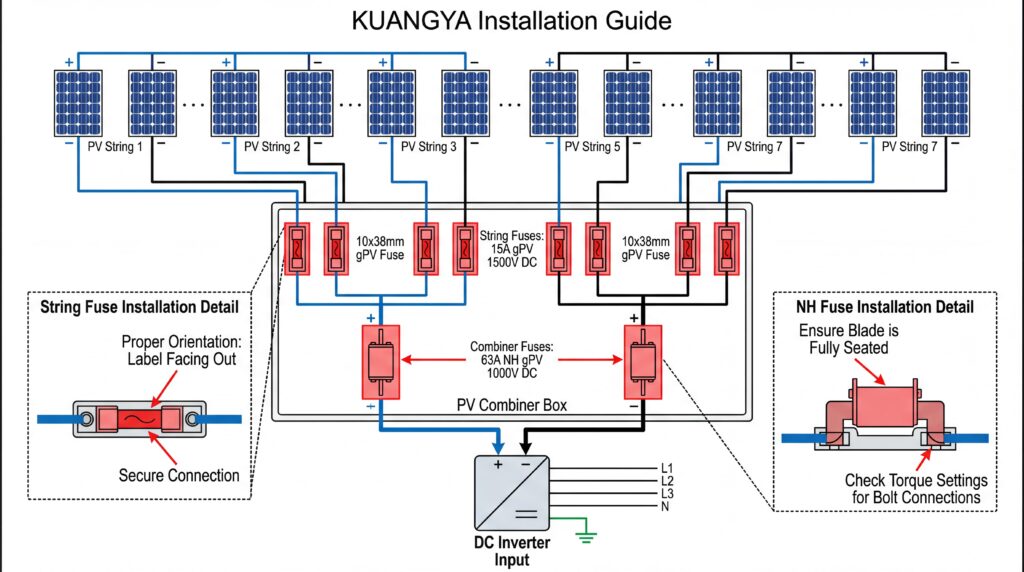
| 10×38 mm | 1-32A | Protezione delle stringhe residenziali |
| 14×51 mm | 2-50A | Protezione delle stringhe commerciali |
| 10×85 mm | 1-30A | Protezione delle stringhe ad alta tensione (1500 V) |
| 14×85 mm | 2-50A | Applicazioni commerciali ad alta tensione |
| NH00-NH3 | 20-630A | Scatole combinatore, ingressi CC degli inverter, scala di utilità |
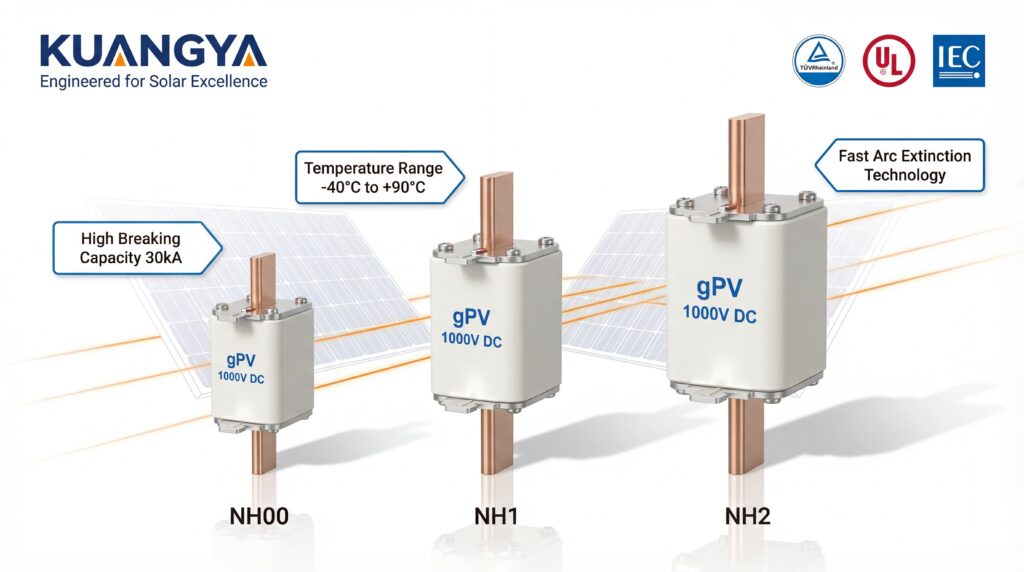
A KUANGYA (cnkuang.com), siamo specializzati in fusibili gPV di alta qualità progettati specificamente per le applicazioni fotovoltaiche. La nostra gamma di prodotti comprende:
Fusibili gPV cilindrici\
Disponibile nei formati 10×38 mm, 14×51 mm, 10×85 mm e 14×85 mm per la protezione di stringhe e combiner box. Tensione nominale fino a 1500 V CC con capacità di interruzione di 30 kA. Certificato secondo gli standard IEC 60269-6 e UL.
Fusibili gPV di tipo NH\
Fusibili a corpo quadrato nelle misure NH00, NH1, NH2 e NH3 per applicazioni ad alta corrente (fino a 630A). Ideali per inverter centrali, sbarre CC e installazioni su scala industriale. Presentano contatti in rame argentato e una struttura in ceramica ad alta resistenza agli shock termici.
Soluzioni di sistema complete\
Forniamo portafusibili abbinati, soluzioni di montaggio su guida DIN e assistenza tecnica per garantire la corretta installazione e la conformità alle norme. I nostri prodotti sono sottoposti a test di routine 100% con assemblaggio automatizzato per garantire una qualità costante.
Ogni fusibile KUANGYA è progettato per fornire una protezione sicura, certificata e affidabile per i tetti residenziali, le installazioni commerciali e i parchi solari su larga scala. citazione
No. Sebbene un fusibile DC standard possa avere una tensione nominale adeguata, non possiede le caratteristiche specifiche richieste per le applicazioni fotovoltaiche. I sistemi solari presentano sfide uniche, come le basse correnti di guasto, le condizioni di corrente inversa e il comportamento specifico della curva I-V dei moduli fotovoltaici. Solo i fusibili testati e certificati secondo la norma IEC 60269-6 (designazione gPV) sono progettati per gestire queste condizioni in modo sicuro. I fusibili DC standard possono non riuscire a interrompere in modo affidabile i guasti fotovoltaici, causando potenzialmente danni alle apparecchiature o rischi di incendio. La certificazione gPV garantisce che il fusibile è stato specificamente testato per i profili di guasto del fotovoltaico, i cicli di temperatura, l'esposizione ai raggi UV e l'interruzione bidirezionale della corrente, requisiti che i fusibili CC standard non soddisfano.
La differenza di prezzo riflette i costi di ingegneria e certificazione specializzati. I fusibili gPV richiedono materiali potenziati per lo spegnimento dell'arco (riempitivi specializzati in sabbia di quarzo), una costruzione robusta per resistere agli estremi ambientali esterni (da -40°C a +90°C, radiazioni UV, umidità) e test approfonditi secondo diversi standard internazionali (IEC 60269-6, UL 2579, certificazione TÜV). Le caratteristiche tempo-corrente devono essere calibrate con precisione per le condizioni di guasto del fotovoltaico a bassa corrente piuttosto che per i guasti della rete CA ad alta corrente. Inoltre, i fusibili gPV sono sottoposti a test rigorosi per l'interruzione della corrente inversa e l'affidabilità a lungo termine in presenza di sollecitazioni continue in corrente continua. Sebbene il costo iniziale sia più elevato, questo investimento protegge le costose apparecchiature solari (pannelli, inverter, batterie) e previene guasti catastrofici che costerebbero molto di più in termini di sostituzione delle apparecchiature, tempi di inattività e potenziali responsabilità. Consideratela un'assicurazione essenziale per il vostro investimento solare.
L'installazione di fusibili in corrente alternata nei sistemi solari in corrente continua crea seri rischi per la sicurezza. I fusibili in c.a. si affidano all'attraversamento naturale dello zero della corrente (che si verifica 100-120 volte al secondo) per estinguere gli archi durante l'interruzione. La corrente continua non ha un attraversamento dello zero, con il risultato di un arco prolungato che i fusibili in CA non possono estinguere in modo affidabile. Quando un fusibile CA tenta di interrompere la corrente CC, l'arco continua a bruciare all'interno del corpo del fusibile, generando un calore estremo (oltre 10.000°C). Ciò può causare la rottura violenta del fusibile, con l'espulsione di materiale fuso e il potenziale incendio del combinatore o dei componenti circostanti. Anche se il fusibile ha una marcatura di tensione CC, non è stato testato per le caratteristiche di guasto specifiche dei sistemi fotovoltaici (bassa corrente di guasto, corrente inversa, arco CC prolungato). Incidenti reali hanno documentato incendi di scatole di combinatori, danni alle apparecchiature e guasti al sistema dovuti a una scelta impropria dei fusibili. Inoltre, l'uso di fusibili non conformi annulla le garanzie delle apparecchiature, viola i codici elettrici (articolo 690 del NEC) e crea un rischio di responsabilità. Utilizzate sempre fusibili gPV certificati per applicazioni solari: ne va della sicurezza del vostro sistema e della conformità alle normative.
La domanda “Posso utilizzare i fusibili AC o i fusibili gG standard nel mio sistema solare se hanno una tensione nominale DC?” ha una risposta chiara: assolutamente no. L'evoluzione della tecnologia dei fusibili, dai semplici fili di fusione di Edison ai sofisticati dispositivi gPV di oggi, riflette la nostra crescente comprensione dei requisiti di protezione elettrica. Proprio come i primi pionieri dell'elettricità hanno riconosciuto che i dispositivi di sicurezza erano essenziali per la diffusione dell'elettricità, i moderni ingegneri del solare devono riconoscere che la protezione specifica per l'applicazione è irrinunciabile.
I sistemi solari in corrente continua operano in un ambiente elettrico fondamentalmente diverso rispetto alle reti di distribuzione in corrente alternata. L'assenza di zero-crossing naturali, le caratteristiche di guasto uniche degli array fotovoltaici, le sfide della corrente inversa e le difficili condizioni operative esterne richiedono una protezione specifica che solo i fusibili certificati gPV possono fornire. Anche se la differenza di costo iniziale può sembrare significativa, l'investimento in fusibili gPV adeguati protegge apparecchiature costose, assicura la conformità alle norme, mantiene le garanzie e, soprattutto, previene guasti potenzialmente catastrofici.
Quando si progetta o si esegue la manutenzione di un impianto fotovoltaico, specificare sempre fusibili certificati secondo gli standard IEC 60269-6 o UL 2579 con la chiara designazione “gPV”. Calcolate i valori nominali utilizzando i moltiplicatori NEC appropriati (1,56× Isc del modulo), verificate che i valori nominali di tensione superino la tensione di circuito aperto del sistema e selezionate le dimensioni fisiche appropriate per la vostra applicazione. Collaborate con produttori affidabili come KUANGYA, specializzati nella protezione del fotovoltaico e in grado di fornire assistenza tecnica per tutto il progetto.
Il futuro delle energie rinnovabili dipende da impianti solari sicuri e affidabili. La scelta dei fusibili giusti non è solo un dettaglio tecnico, ma un impegno fondamentale per la sicurezza, la qualità e il successo a lungo termine della tecnologia solare.
Informazioni su KUANGYA\
KUANGYA (cnkuang.com) è un produttore leader di fusibili CC e soluzioni di protezione fotovoltaica. Grazie alle proprie linee di produzione, all'assemblaggio automatizzato e ai test di routine 100%, forniamo fusibili gPV certificati per impianti solari residenziali, commerciali e su larga scala in tutto il mondo. I nostri prodotti soddisfano gli standard IEC, UL e TÜV, garantendo una protezione sicura e affidabile per il vostro investimento solare.
Contattateci oggi stesso per ricevere le specifiche tecniche, la guida alla scelta dei prodotti e i prezzi per i vostri progetti solari.

