Address
304 North Cardinal
St. Dorchester Center, MA 02124
Work Hours
Monday to Friday: 7AM - 7PM
Weekend: 10AM - 5PM
Address
304 North Cardinal
St. Dorchester Center, MA 02124
Work Hours
Monday to Friday: 7AM - 7PM
Weekend: 10AM - 5PM


Solar Combiner Box: The Ultimate Guide to Safe and Efficient PV System Protection
As the global solar energy market continues its exponential growth, understanding the critical components that ensure safe and efficient photovoltaic (PV) system operation has never been more important. Among these essential components, the solar combiner box stands as a pivotal junction point that consolidates, protects, and optimizes DC power from multiple solar panel strings. Whether you’re planning a residential rooftop installation, a commercial solar farm, or an industrial-scale energy project, selecting the right combiner box can significantly impact your system’s safety, performance, and long-term reliability.
A solar combiner box, also known as a PV combiner box or DC combiner box, serves as the central junction point where multiple solar panel strings converge before connecting to the inverter. Instead of running individual cables from each string directly to the inverter—which would create a tangled mess of wiring and increase installation costs—the combiner box consolidates these connections into a single, manageable output.
The primary functions of a solar combiner box include:
Power Consolidation: Combining DC outputs from multiple solar strings into one main feed, significantly reducing cable runs and material costs while simplifying system architecture.
Overcurrent Protection: Each string connects to dedicated fuses or DC-rated circuit breakers (typically 10A to 20A), preventing excessive current flow that could damage panels or create fire hazards.
Surge Protection: Integrated surge protection devices (SPDs) safeguard your investment against lightning strikes and voltage transients that can destroy sensitive inverter electronics.
Safe Isolation: DC disconnect switches allow technicians to safely isolate the system during maintenance or emergency situations, ensuring worker safety and code compliance.
System Monitoring: Advanced combiner boxes incorporate string-level monitoring capabilities that track performance, detect faults early, and maximize energy production through proactive maintenance.
While small residential systems with fewer than three strings can connect directly to string inverter inputs, most commercial and utility-scale installations benefit tremendously from combiner boxes. The advantages extend far beyond simple wire management.
Cost Reduction: By consolidating multiple string connections, combiner boxes reduce material costs by 20-30% compared to home-run wiring approaches. Labor savings are equally significant, as installers spend less time routing individual cables across rooftops or ground-mounted arrays.
Enhanced Safety: Combiner boxes provide a centralized location for overcurrent protection and disconnect functions, making it easier to maintain safe working conditions and comply with electrical codes. The enclosure protects sensitive electrical components from environmental factors like moisture, dust, and UV radiation.
Improved Reliability: Quality combiner boxes feature robust copper busbars, properly rated terminals, and weather-sealed enclosures that ensure reliable operation throughout the system’s 25-year lifespan. The centralized protection scheme prevents cascade failures that could take down entire arrays.
Simplified Troubleshooting: When system performance issues arise, having all string connections in one accessible location dramatically reduces diagnostic time. String-level monitoring capabilities in modern combiner boxes can pinpoint underperforming strings caused by shading, soiling, or equipment failure before they significantly impact energy production.
Scalability: Well-designed combiner boxes incorporate provisions for additional string connections and capacity growth without requiring complete system redesign, protecting your investment as energy needs expand.
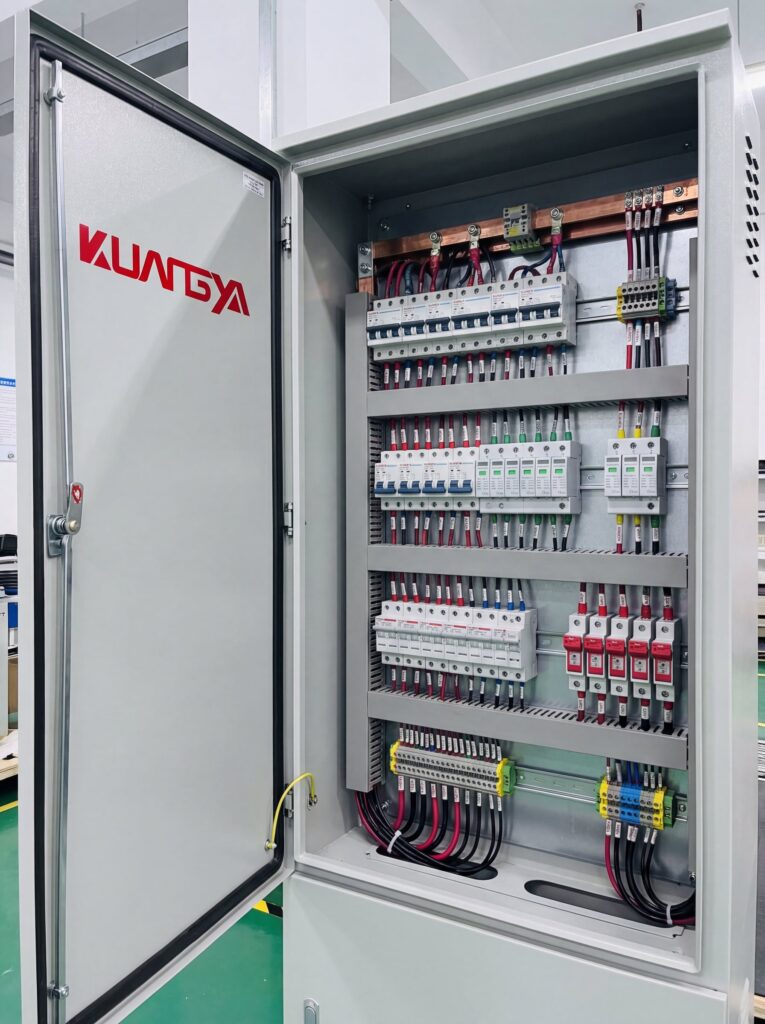
Understanding the internal composition of a PV combiner box is fundamental to specifying, installing, and maintaining solar power systems. Here’s a detailed breakdown of the critical components you’ll find inside a quality combiner box:
The first line of defense consists of individual overcurrent protection devices for each solar string. These DC-rated fuses or circuit breakers must be sized according to the National Electrical Code (NEC) formula: Minimum Fuse Rating = Isc × 1.56, where Isc is the short-circuit current of the solar panels. The 1.56 multiplier accounts for continuous duty operation and elevated irradiance conditions that can push current above standard test conditions.
KUANGYA offers certified gPV fuse links and holders specifically engineered for photovoltaic fault profiles, featuring low I²t values, fast interruption times, and high DC breaking capacity to safely extinguish arcs at 1000V and 1500V system voltages.
Heavy-gauge copper busbars serve as the main positive and negative conductors that combine all string outputs. These components must be sized appropriately to handle the combined current from all connected strings without overheating or creating voltage drops that would reduce system efficiency.
Type 1+2 or Type 2 DC surge protection devices protect against lightning-induced voltage transients and switching surges. Commercial installations typically specify SPDs with 40kA maximum discharge current capability, reflecting the higher lightning risk for large rooftop and ground-mounted installations.
A load-break rated DC disconnect switch allows safe isolation of the combiner box from downstream equipment. This component must be rated for the full system voltage (1000V or 1500V) and combined string current, with appropriate DC arc-interruption capability.
Modern combiner boxes increasingly incorporate current sensors, voltage monitors, and communication interfaces (RS485, Ethernet, or wireless) that provide real-time performance data. These monitoring capabilities enable predictive maintenance strategies and rapid fault response that maximize system uptime and energy production.
The outer enclosure provides NEMA 3R, NEMA 4X, or IP65/IP66 environmental protection, with materials ranging from UV-stabilized polycarbonate for lightweight residential applications to powder-coated steel or stainless steel for harsh industrial environments.
KUANGYA Electrical Equipment Supply has established itself as a leading manufacturer of solar protection equipment, with 25 years of industry experience and over 2,000 new energy projects delivered worldwide. Our solar combiner box solutions are engineered with a comprehensive understanding of both electrical protection principles and the practical realities of field installation.
| Product Series | Voltage Rating | String Capacity | Current Rating | Key Features | Typical Applications |
|---|---|---|---|---|---|
| CNK-CB-4S-1000V | 1000V DC | 4 strings | Up to 80A | Compact polycarbonate enclosure, NEMA 4X, pre-installed 10-20A DC fuses, integrated SPD | Residential rooftop (10-20kW) |
| CNK-CB-8S-1000V | 1000V DC | 8 strings | Up to 160A | Steel enclosure, IP65, modular fuse holders, optional monitoring | Small commercial (20-50kW) |
| CNK-CB-12S-1500V | 1500V DC | 12 strings | Up to 240A | Heavy-duty steel, integrated DC disconnect, string monitoring, RS485 | Commercial rooftop (50-150kW) |
| CNK-CB-16S-1500V-D | 1500V DC | 16 strings | Up to 320A | Stainless steel option, 250A MCCB disconnect, advanced monitoring, wireless connectivity | Large commercial/utility (150-500kW) |
Proprietary Mold Development: Unlike generic combiner boxes that use standard off-the-shelf enclosures, KUANGYA invests in custom mold development for our electrical components. This approach allows us to optimize internal layout, improve thermal management, and create distinctive product aesthetics that enhance brand recognition for our partners.
Modular Architecture: Our combiner boxes feature modular fuse holder designs that simplify maintenance and allow field upgrades as system requirements evolve. Technicians can replace individual protection devices without disturbing adjacent circuits, minimizing downtime during service events.
Thermal Management: Strategic placement of internal components and ventilation pathways ensures that heat generated by busbars and protection devices dissipates effectively, preventing premature aging and maintaining consistent performance even in high-temperature environments.
Quality Certifications: Every KUANGYA combiner box is manufactured under ISO 9001 quality management systems and tested to relevant international standards including IEC 61439, IEC 60947, and UL 1741 where applicable. Our DC protection components carry individual certifications from TÜV, CE, and other recognized testing bodies.
Customer feedback from installations across Germany, UAE, and India consistently highlights several performance advantages:
Installation Efficiency: Clear labeling, accurate torque specifications, and intuitive internal layout reduce installation time by 15-20% compared to competitor products.
Environmental Durability: UV-stabilized materials and robust IP sealing maintain performance through extreme temperature cycling, sand-spray exposure, and prolonged moisture exposure.
Service Accessibility: Replaceable modules and well-documented wiring diagrams simplify troubleshooting and reduce mean time to repair when service is required.
Choosing the appropriate combiner box requires careful consideration of several technical and practical factors:
1000V Systems: Traditional choice for residential and small commercial installations, offering proven reliability and broad component availability. Maximum string length is limited by voltage drop considerations.
1500V Systems: Increasingly popular for commercial and utility-scale projects, enabling longer string configurations that reduce balance-of-system costs by 10-15%. Requires careful attention to insulation coordination and worker safety training.
Calculate the maximum combined current by summing the short-circuit current (Isc) of all strings and applying the 1.56 safety factor. Select a combiner box with busbar and terminal ratings that exceed this value with appropriate margin (typically 125% of calculated maximum).
Outdoor Installations: Specify NEMA 4X or IP66 enclosures with UV-stabilized materials and corrosion-resistant hardware. Consider stainless steel for coastal environments with salt spray exposure.
Indoor Installations: NEMA 1 or IP20 enclosures may suffice for climate-controlled equipment rooms, reducing cost while maintaining adequate protection.
Basic Systems: Simple visual indicators (LED status lights) provide at-a-glance confirmation of normal operation.
Advanced Systems: String-level current and voltage monitoring with data logging and remote communication enables predictive maintenance and performance optimization strategies that can increase lifetime energy production by 2-5%.
If system expansion is anticipated, select a combiner box with additional spare positions or choose a larger model that can accommodate future string additions without replacement.
Proper installation is critical to achieving the safety and performance benefits that quality combiner boxes provide:
Location Selection: Position the combiner box to minimize DC cable runs from the solar array while ensuring accessibility for maintenance. Avoid locations with excessive heat exposure or potential physical damage.
Cable Management: Use appropriate cable glands and strain relief to prevent moisture ingress and mechanical stress on terminals. Maintain proper bend radius for all conductors.
Labeling: Clearly label each string input with information about which roof section or ground area it serves, making future troubleshooting straightforward for service technicians.
Grounding: Ensure proper equipment grounding and bonding according to local electrical codes. The combiner box enclosure must be connected to the system grounding electrode.
Torque Specifications: Follow manufacturer torque specifications for all terminal connections. Under-torqued connections create high-resistance joints that generate heat and can lead to failure; over-torqued connections can damage terminals.
KUANGYA Electrical Equipment Supply offers comprehensive OEM (Original Equipment Manufacturer) and ODM (Original Design Manufacturer) services for distributors, system integrators, and solar equipment brands worldwide. Our flexible manufacturing capabilities and engineering expertise enable us to deliver customized combiner box solutions that meet your specific market requirements.
Our OEM/ODM clients benefit from KUANGYA’s 25 years of manufacturing experience, established supply chain relationships, and rigorous quality control processes that ensure every unit meets international standards and your brand reputation requirements.
KUANGYA Electrical Equipment Supply is actively seeking exclusive distribution partners in countries and cities around the world. We offer attractive partnership opportunities for qualified distributors who share our commitment to quality, customer service, and market development.
Competitive Advantages: Our proprietary mold development and specialized manufacturing processes create distinctive products that stand out in competitive markets. Partners benefit from unique product aesthetics and superior performance that support premium positioning.
Comprehensive Product Portfolio: Beyond combiner boxes, KUANGYA offers a complete range of DC and AC protection equipment including surge protection devices, DC circuit breakers, fuses, disconnect switches, and integrated protection systems for solar, energy storage, and EV charging applications.
Technical Support: Our multilingual technical team provides pre-sales application engineering, installation training, and ongoing technical support to help your sales team succeed and your customers achieve optimal results.
Marketing Resources: Partners receive product photography, technical documentation, case studies, and marketing materials that accelerate market entry and support sales development.
Flexible Terms: We structure partnership agreements to align with local market conditions, offering exclusive territories, competitive pricing, and reasonable minimum order quantities that enable sustainable business growth.
Global Logistics: Factory-direct supply with efficient international shipping, customs documentation support, and inventory management assistance ensure reliable product availability.
Contact us today to discuss exclusive distributor opportunities in your region and learn how KUANGYA’s innovative protection solutions can strengthen your product portfolio and accelerate your growth in the expanding solar energy market.
Solar combiner boxes require minimal maintenance but benefit from periodic inspection to ensure continued safe operation:
Annual Visual Inspection: Check for signs of moisture ingress, insect intrusion, or physical damage to the enclosure. Verify that all cable glands remain properly sealed.
Thermal Imaging: Use an infrared camera to identify hot spots that might indicate loose connections or undersized components. Address any anomalies before they lead to failure.
Connection Verification: Every 2-3 years, verify that all terminal connections remain tight according to manufacturer torque specifications. Thermal cycling can cause connections to loosen over time.
SPD Status Check: Verify that surge protection device indicators show normal operation. Replace SPDs that show degradation or failure indicators.
Monitoring System Verification: If equipped with monitoring capabilities, verify that data transmission remains functional and that sensor readings are consistent with expected system performance.
A combiner box is generally required when your solar installation includes four or more strings that need to connect to the inverter. Systems with three or fewer strings can often connect directly to string inverter inputs without additional equipment. However, even smaller systems may benefit from a combiner box if the installation requires centralized disconnect capability, surge protection, or monitoring functions. Commercial and utility-scale installations almost always use combiner boxes to reduce material costs, simplify cable management, and provide centralized protection. The decision should consider not only the number of strings but also code requirements, system voltage, future expansion plans, and maintenance accessibility needs.
The voltage rating indicates the maximum DC system voltage the combiner box can safely handle. 1000V combiner boxes are the traditional choice for residential and small commercial installations, offering proven reliability and broad component availability. They’re suitable for most rooftop applications where string lengths are moderate. 1500V combiner boxes are increasingly popular for large commercial and utility-scale projects because they enable longer string configurations, reducing the number of strings and combiners needed for a given array size. This can reduce balance-of-system costs by 10-15%. However, 1500V systems require more careful attention to insulation coordination, worker safety training, and component selection. Choose 1000V for residential and small commercial projects (under 100kW) unless specific design considerations favor higher voltage. Select 1500V for large commercial and utility-scale installations (over 100kW) where the cost savings justify the additional engineering and safety requirements.
Absolutely. KUANGYA Electrical Equipment Supply specializes in both OEM (Original Equipment Manufacturer) and ODM (Original Design Manufacturer) services for global partners. Our OEM services include custom branding with your company logo and colors, modified packaging, specification adaptations for regional requirements, and certification support. Our ODM services go further, offering complete product development from concept through production, integration of proprietary features, custom enclosure design, and long-term manufacturing partnerships. We have our own mold development capabilities, which means we can create unique enclosure designs and component configurations that differentiate your products in the market. Whether you need minor branding customization or complete product development, our engineering team works closely with partners to deliver solutions that meet your exact requirements while maintaining the quality and reliability KUANGYA is known for. Contact our OEM/ODM team to discuss your specific needs and learn how we can support your market development goals.
The solar combiner box represents a critical investment in your photovoltaic system’s safety, reliability, and long-term performance. While it may be tempting to select the lowest-cost option, the modest price difference between economy and premium products becomes insignificant compared to the cost of premature failure, safety incidents, or system downtime.
KUANGYA Electrical Equipment Supply brings 25 years of manufacturing excellence, proprietary design innovations, and comprehensive global support to every combiner box we produce. Our commitment to quality is reflected in rigorous testing protocols, international certifications, and real-world performance validated by over 2,000 successful projects worldwide.
Whether you’re a solar installer seeking reliable components for residential projects, a system integrator developing commercial installations, or a distributor looking for differentiated products to strengthen your portfolio, KUANGYA offers the technical expertise, manufacturing capabilities, and partnership approach to support your success.
Ready to enhance your solar projects with superior protection solutions? Contact KUANGYA today to discuss your combiner box requirements, explore OEM/ODM customization options, or inquire about exclusive distributor opportunities in your region. Let’s work together to deliver safe, efficient, and reliable solar energy systems that power a sustainable future.
About KUANGYA Electrical Equipment Supply
With 25 years of industry experience, 500+ global customers, 128+ DC product models, and 2,000+ new energy projects delivered, KUANGYA Electrical Equipment Supply is your trusted partner for innovative protection solutions in solar PV, energy storage, and electrical distribution applications. Our commitment to certified quality, tailored solutions, and seamless global support has earned us an outstanding customer satisfaction rate and long-term partnerships across six continents.
Contact Information:
Reliable electrical equipment, quality you can trust — serving global customers with safe and efficient solutions.

